Executive Summary
AI-powered product demos are replacing static, one-size-fits-all sales presentations with adaptive, data-driven buyer experiences. The shift is driven by remote selling norms, longer buying committees, and buyers who self-educate before ever booking a call. The biggest opportunity: SaaS teams that connect demo engagement data directly to CRM pipeline intelligence will close faster with smaller teams. The biggest risk: AI demo agents that hallucinate product capabilities will destroy trust faster than a bad rep ever could. This report covers the 12 trends defining the next era of SaaS demos—and the operational shifts required to capitalize on them.
Why Product Demos Are Changing Right Now
AI-powered product demos are changing because B2B buyers now complete most of their evaluation independently, buying committees have expanded, and economic pressure demands higher conversion from fewer sales touches.
Three forces collided simultaneously. First, remote selling became permanent—not a pandemic workaround. Second, buyers started using ChatGPT, Perplexity, and Gemini to pre-research vendors before ever filling out a demo request form. Third, SaaS companies cut headcount while raising quotas, forcing revenue teams to do more with less engineering support.
The old model—SDR qualifies, AE schedules, SE builds a custom demo, everyone hopes for a follow-up—doesn’t survive contact with a five-person buying committee where three stakeholders never attend the live call.
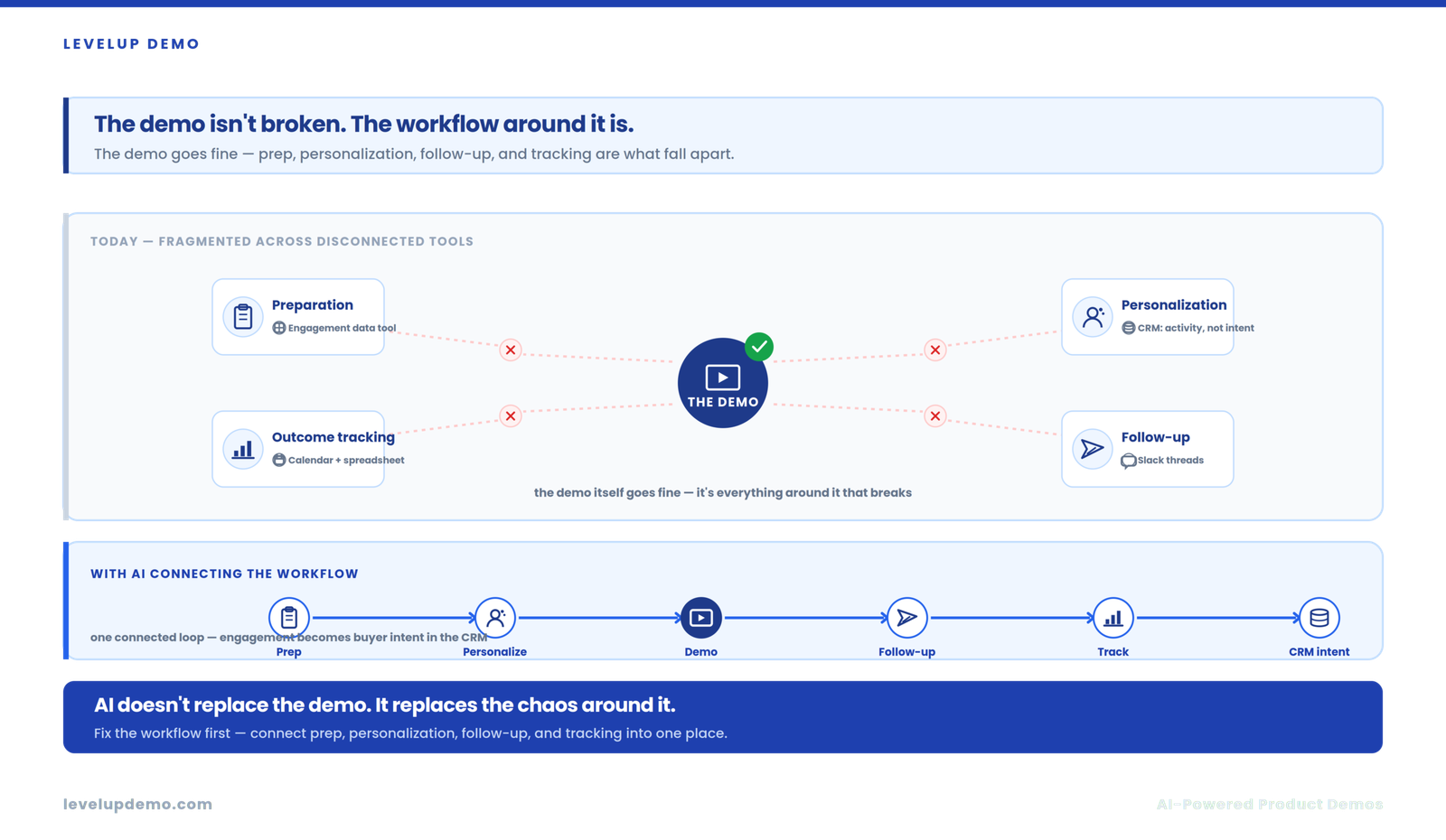
One pattern we keep seeing across early-stage SaaS teams: the demo itself goes fine, but everything surrounding the demo—preparation, personalization, follow-up, outcome tracking—falls apart. Demo engagement data sits in one tool. Follow-up tasks live in Slack threads. CRM records show activity but not buyer intent.
That operational gap is where AI changes the game. Not by replacing the demo. By replacing the chaos around the demo.
Key Takeaway: The demo isn’t broken. The demo workflow is broken. AI fixes the workflow first.
The Evolution of Product Demos: A Timeline
| Era | Model | Key Limitation |
|---|---|---|
| Pre-2015 | On-site, in-person demos | Geographic constraints, high cost per demo |
| 2015–2019 | Remote screen-share demos | One-directional, no async option |
| 2020–2022 | Interactive product demos (Storylane, Navattic, Walnut) | Static paths, no buyer intelligence |
| 2023–2024 | AI-assisted demos (Demostack, Reprise, Supademo) | AI helps create, but doesn’t adapt in real time |
| 2025–2026 | AI-powered demos with agentic workflows (e.g. LevelUp Demo) | Autonomous preparation, real-time personalization, CRM writeback — LLM-assisted, with a built-in chatbot and a human in the loop |
| 2027+ | Intelligent demo ecosystems | Demo Operating Systems connecting buyer intent, CRM, and revenue intelligence |
The 12 Trends
Trend 1: AI Demo Copilots Become Standard
AI demo copilots are software assistants that provide real-time guidance to sales reps during live product demonstrations, surfacing relevant talk tracks, objection responses, and buyer context without interrupting the conversation flow.
Gong and Chorus pioneered conversational intelligence by analyzing calls after the fact. The next wave—driven by large language models from OpenAI, Anthropic, and Google—moves intelligence into the live demo. Think of the copilot as a sales engineer whispering in your ear, except the whisper is grounded in CRM data, prior engagement signals, and product documentation.
The critical distinction: AI demo copilots assist human reps. AI demo agents (Trend 11) replace parts of the human workflow entirely.
Common mistake: Teams deploy copilots without constraining the model to approved product facts. One hallucinated feature claim during a live demo erodes trust instantly.
Checklist:
Trend 2: Hyper-Personalized Demos at Scale
Hyper-personalized AI-powered product demos dynamically adjust narrative, workflow sequences, and proof points based on the buyer’s role, industry, company size, and funnel stage—going far beyond swapping logos and names.
Most “personalized” demos today are shallow. Swap the prospect’s logo into the header, change “Acme Corp” to their company name, done. That’s not personalization. That’s a mail merge.
Real personalization means a CFO sees ROI dashboards and compliance workflows while a VP of Engineering sees API documentation and integration architecture—within the same demo, for the same account. Tools like Clay and Apollo surface the buyer intelligence needed to fuel this, but the demo platform must act on that data automatically.
| Personalization Level | What Changes | Impact |
|---|---|---|
| Surface-level | Logo, company name | Minimal—buyers see through it |
| Segment-level | Industry use case, role-specific flow | Moderate—feels relevant |
| Deep personalization | Narrative, proof points, data, workflow order | High—mirrors the buyer’s actual problem |
Key Takeaway: If two different buyer personas see nearly identical demos, the personalization is too shallow to move pipeline.
Trend 3: Autonomous Demo Preparation
Autonomous demo preparation uses AI to research the prospect, pull CRM and buyer intent data, build a tailored demo script, and pre-configure the demo environment—reducing preparation time from hours to minutes.
I spent three hours prepping a single enterprise demo last year before realizing the prospect had already watched our self-serve demo twice and clicked on the integrations page four times. The prep was wasted because the buyer intent data existed—it just wasn’t connected to my workflow.
AI-powered demo preparation tools pull data from Salesforce, HubSpot, Gong call transcripts, and buyer engagement analytics to auto-generate a preparation brief. The rep reviews and adjusts rather than starting from scratch.
Stop/Go Verification: Can you describe in one sentence what your prospect cares about most? If you can’t, your demo preparation process—AI-assisted or not—is broken.
Trend 4: AI-Powered Buyer Intelligence
AI-powered buyer intelligence aggregates signals from demo engagement, CRM activity, website behavior, and conversational data to predict which stakeholders are actively evaluating and what they care about.
Revenue intelligence platforms like Clari and Gong Labs already track deal health. The 2026 shift connects demo-specific engagement—which features were clicked, which sections were replayed, which stakeholders revisited the async demo—directly into opportunity scoring.
For small SaaS teams, the practical value is enormous: instead of guessing which follow-up to send, buyer intelligence tells you that the technical evaluator spent 12 minutes on the API section but the economic buyer never opened the pricing page.
Trend 5: Real-Time Objection Intelligence
Real-time objection intelligence uses conversational AI to detect buyer hesitation, pricing concerns, or competitive comparisons during live demos and surfaces relevant responses to the rep instantly.
The models powering ChatGPT and Claude can now process conversational context fast enough to identify objection patterns mid-sentence. Combined with Fireflies or Otter transcription, the system maps objections to a response library maintained by Product Marketing.
When AI should NOT replace humans: Complex, emotionally charged objections—”We got burned by your competitor last year”—require human empathy, not a suggested talk track.
Trend 6: Conversational Demo Analytics
Conversational demo analytics applies natural language processing to demo recordings and interactive demo sessions to extract engagement patterns, sentiment shifts, and topic-level interest data.
Traditional demo analytics tell you that someone watched. Conversational analytics tell you what resonated. The difference matters because stakeholder-level engagement data—tracked at the feature and topic level—transforms follow-up from generic to surgical.
Trend 7: AI Demo Quality Scoring
AI demo quality scoring evaluates every product demonstration against defined criteria—personalization depth, talk-to-listen ratio, feature coverage, objection handling—and generates a composite score that predicts deal progression.
The Demo Quality Score Framework
| Dimension | Weight | Measurement |
|---|---|---|
| Personalization depth | 25% | Segment-level or deeper? |
| Buyer engagement signals | 25% | Questions asked, features explored |
| Objection handling | 20% | Addressed vs. deflected |
| Follow-up speed | 15% | Hours to first meaningful follow-up |
| CRM data completeness | 15% | Outcome, next steps, stakeholder notes logged |
This scoring model works whether you run demos for 10 prospects a month or 200.
Trend 8: Predictive Demo Success Models
Predictive demo success models use historical demo data, CRM outcomes, and engagement signals to forecast which demos are most likely to convert—before the follow-up even begins.
Trend 9: AI-Generated Follow-Ups
AI-generated follow-ups automatically create personalized post-demo communications—emails, interactive deal rooms, and async demo paths—based on what happened during the live demonstration.
The ugly truth: most follow-ups are a generic PDF deck sent 48 hours too late. Buyers who experienced a dynamic, personalized demo then receive a static attachment. The experience gap kills momentum.
AI-generated follow-ups replace the static deck with an interactive deal room containing the specific features discussed, relevant case studies, and a personalized async evaluation path. CRM writeback ensures the follow-up is logged automatically.
Stop losing deals in the follow-up gap
LevelUp Demo centralizes demo outcomes, automates follow-up routing, and ensures no lead slips through—without replacing your existing CRM.
Trend 10: Demo Workflow Automation
Demo workflow automation connects every stage of the demo lifecycle—request capture, qualification, scheduling, preparation, delivery, follow-up, and outcome tracking—into a single automated pipeline.
For teams of 1–5 people, demo workflow automation isn’t a luxury. When demo requests live in a form, scheduling lives in Google Calendar, outcomes live in a spreadsheet, and follow-ups live in someone’s memory—deals die in the gaps.
The Demo Automation Pyramid
Most SaaS teams are stuck at Layer 1 or 2. The competitive advantage goes to teams that reach Layer 4 before worrying about Layer 6.
Trend 11: AI Demo Agents
AI demo agents are autonomous software systems that can conduct product demonstrations independently—answering buyer questions, navigating product workflows, and qualifying prospects—without a human rep present.
This is the most hyped and most dangerous trend on the list. Industry sources suggest over 60% of mid-market B2B buyers may run their first product demo without speaking to a salesperson by mid-2026 (emerging trend—treat as directional, not definitive).
| Capability | AI Copilot | AI Demo Agent |
|---|---|---|
| Operates independently | No—assists human rep | Yes—runs autonomously |
| Handles objections | Suggests responses | Responds directly |
| Qualifies prospects | Surfaces data | Makes routing decisions |
| Risk of hallucination | Lower (human filter) | Higher (no human check) |
| Best for | Complex, high-ACV deals | Self-serve, PLG evaluation |
The AI Trust Framework: Before deploying AI demo agents, validate three conditions: (1) the agent is grounded to product-approved content only, (2) escalation paths to human reps are clearly defined, (3) every agent interaction is logged and auditable in CRM.
Trend 12: The Rise of the Demo Operating System
A Demo Operating System is a centralized platform that manages the entire demo lifecycle—from lead capture and qualification through scheduling, delivery, analytics, follow-up, and CRM synchronization—replacing fragmented point solutions with a unified workflow.
This is where the industry is heading. Not another demo creation tool. Not another scheduling widget. A single operational layer that treats the demo as a revenue event, not a marketing asset.
This is exactly what we built LevelUp Demo to be. It manages the entire demo lifecycle in one place—centralized request capture, qualification and routing, scheduling, outcome tracking, follow-up management, and CRM synchronization—so demo engagement becomes connected pipeline intelligence instead of data stranded across a form, a calendar, and a spreadsheet. LLM-assisted preparation and a built-in chatbot handle the routine, while your reps stay in control of every conversation that matters.
The Future Demo Maturity Model
| Level | Description | Characteristics |
|---|---|---|
| 1 – Ad Hoc | No formal demo process | Spreadsheets, memory-based follow-up |
| 2 – Structured | Basic scheduling and tracking | Calendar links, manual CRM updates |
| 3 – Integrated | Demo data flows to CRM | Automated capture, outcome logging |
| 4 – Intelligent | AI assists preparation and follow-up | Buyer intelligence, quality scoring |
| 5 – Autonomous | AI agents handle first-touch demos | Human reps focus on complex deals only |
Most early-stage SaaS teams operate at Level 1 or 2. LevelUp Demo was built to move small teams from Level 1 to Level 3 without the overhead of enterprise tooling—explore pricing to see how lightweight demo operations can work for lean teams.
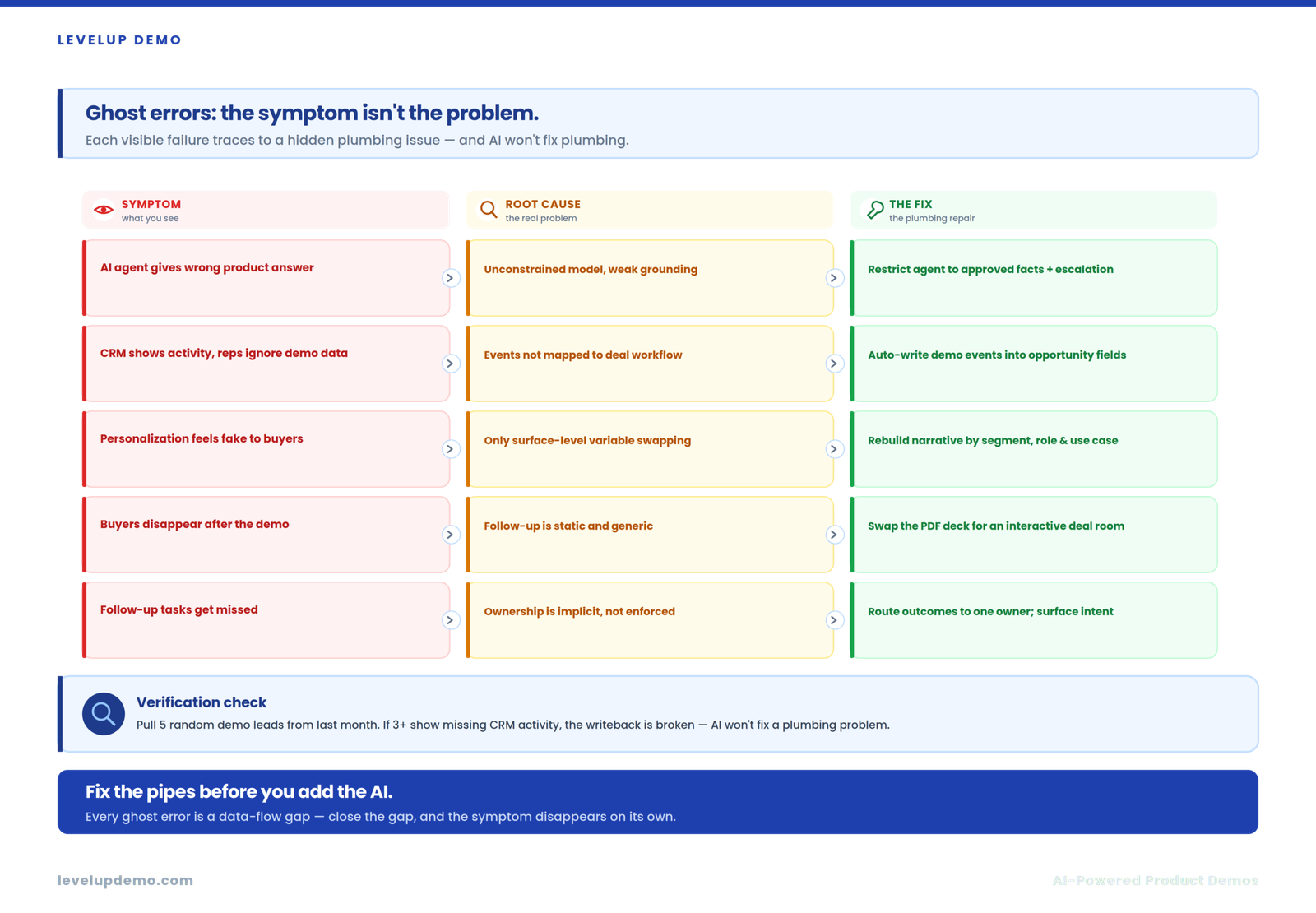
The Ghost Error Table
| Symptom | Root Cause | The Fix |
|---|---|---|
| AI demo agent gives wrong product answer | Unconstrained model, weak grounding | Restrict agent to approved product facts with canned escalation |
| CRM shows activity but reps ignore demo data | Engagement events not mapped to deal workflow | Auto-write key demo events into opportunity fields, not activity notes |
| Personalization feels fake to buyers | Only surface-level variable swapping | Rebuild demo narrative by segment, role, and use case |
| Buyers disappear after the demo | Follow-up is static and generic | Replace the PDF deck with an interactive deal room or async path |
| Follow-up tasks get missed | Ownership is implicit, not enforced | Route demo outcomes to a single owner and surface buyer intent in CRM |
Verification check: Pull 5 random demo leads from the last month. If 3 or more show missing activity in CRM, the writeback is broken—and AI won’t fix a plumbing problem.
FAQ
What are AI-powered product demos?
AI-powered product demos are product demonstrations that use artificial intelligence to personalize content, automate preparation, provide real-time guidance to reps, analyze buyer engagement, and generate follow-up communications—creating adaptive buyer experiences instead of static presentations.
Will AI replace sales engineers?
AI will not replace skilled sales engineers. AI handles repetitive preparation, qualification, and first-touch demos. Sales engineers remain essential for complex technical evaluations, custom integrations, and high-ACV deals where nuanced human judgment builds trust.
What is an AI demo agent?
An AI demo agent is an autonomous system that conducts product demonstrations without a human rep—answering questions, navigating workflows, and qualifying prospects. AI demo agents work best for self-serve PLG evaluation and should always include escalation paths to human reps.
How do AI copilots help during product demos?
AI copilots assist human reps during live demos by surfacing relevant talk tracks, buyer context from CRM, objection responses, and competitive intelligence in real time—without the buyer seeing the assistance. Copilots augment reps rather than replacing them.
What is demo workflow automation?
Demo workflow automation connects every stage of the demo lifecycle—request capture, qualification, scheduling, preparation, delivery, follow-up, and outcome tracking—into a single automated pipeline, eliminating manual handoffs and ensuring no lead falls through operational gaps.
Can AI personalize product demos?
AI can personalize product demos by adapting narrative, workflow sequences, data, and proof points based on buyer role, industry, company size, and engagement history. Effective AI personalization goes beyond swapping logos—it restructures the demo story for each audience segment.
What is a Demo Operating System?
A Demo Operating System is a centralized platform managing the complete demo lifecycle—from lead capture through follow-up and CRM synchronization. Unlike point solutions for scheduling or recording, a Demo Operating System treats every demo as a connected revenue event.
How is AI changing SaaS sales demos in 2026?
AI is changing SaaS sales demos by automating preparation, enabling real-time personalization, powering autonomous demo agents for self-serve evaluation, generating intelligent follow-ups, and connecting demo engagement data directly to CRM pipeline intelligence for better forecasting.
What skills will SaaS sales teams need for AI-powered demos?
SaaS sales teams will need prompt engineering skills, the ability to interpret AI-generated buyer intelligence, comfort working alongside AI copilots, and stronger consultative selling capabilities—because AI handles the routine, leaving humans to manage complex, high-stakes conversations.
What is the difference between interactive demos and AI-powered demos?
Interactive demos let buyers click through pre-built product paths. AI-powered demos adapt in real time based on buyer behavior, personalize content dynamically, answer questions conversationally, and write engagement data back to CRM—creating an intelligent, responsive evaluation experience rather than a static walkthrough.
Ready to fix your demo workflow before adding AI on top?
LevelUp Demo helps SaaS teams centralize demo requests, automate scheduling, track outcomes, and manage follow-ups—the operational foundation that makes AI-powered selling actually work.