
Your rep just ran their fourteenth demo this week. Pipeline’s stacked. Activity metrics look great on the dashboard. And yet—close rate is sitting at 19%, follow-up latency is bleeding warm leads, and nobody can explain why Q2 numbers are sliding.
I’ve reviewed hundreds of SaaS demos across early-stage and mid-market teams. The pattern is almost always the same: the problem isn’t demo volume. It’s that nobody is actually measuring demo quality. Reps run calls, managers glance at outcomes, and the whole cycle repeats without any structured feedback loop.
By the end of this guide, you’ll have a complete, score-able system to evaluate every product demo your team delivers—plus the coaching frameworks and checklists to actually improve performance week over week.
What Is a Demo Quality Score?
A demo quality score is a structured framework used to evaluate how effectively a SaaS product demo is delivered. It measures factors like discovery, personalization, buyer engagement, product storytelling, objection handling, and next steps to help teams coach reps and improve demo performance consistently.
Most sales orgs track demo-to-close rate as a lagging indicator. But that number only tells you what happened—not why. A demo quality score gives you the diagnostic layer underneath conversion data. It turns subjective opinions (“that demo felt off”) into repeatable, coachable criteria.
Think of it as a pre-mortem for every deal, not a post-mortem after you’ve already lost.
Why Demo Quality Matters More Than Demo Volume
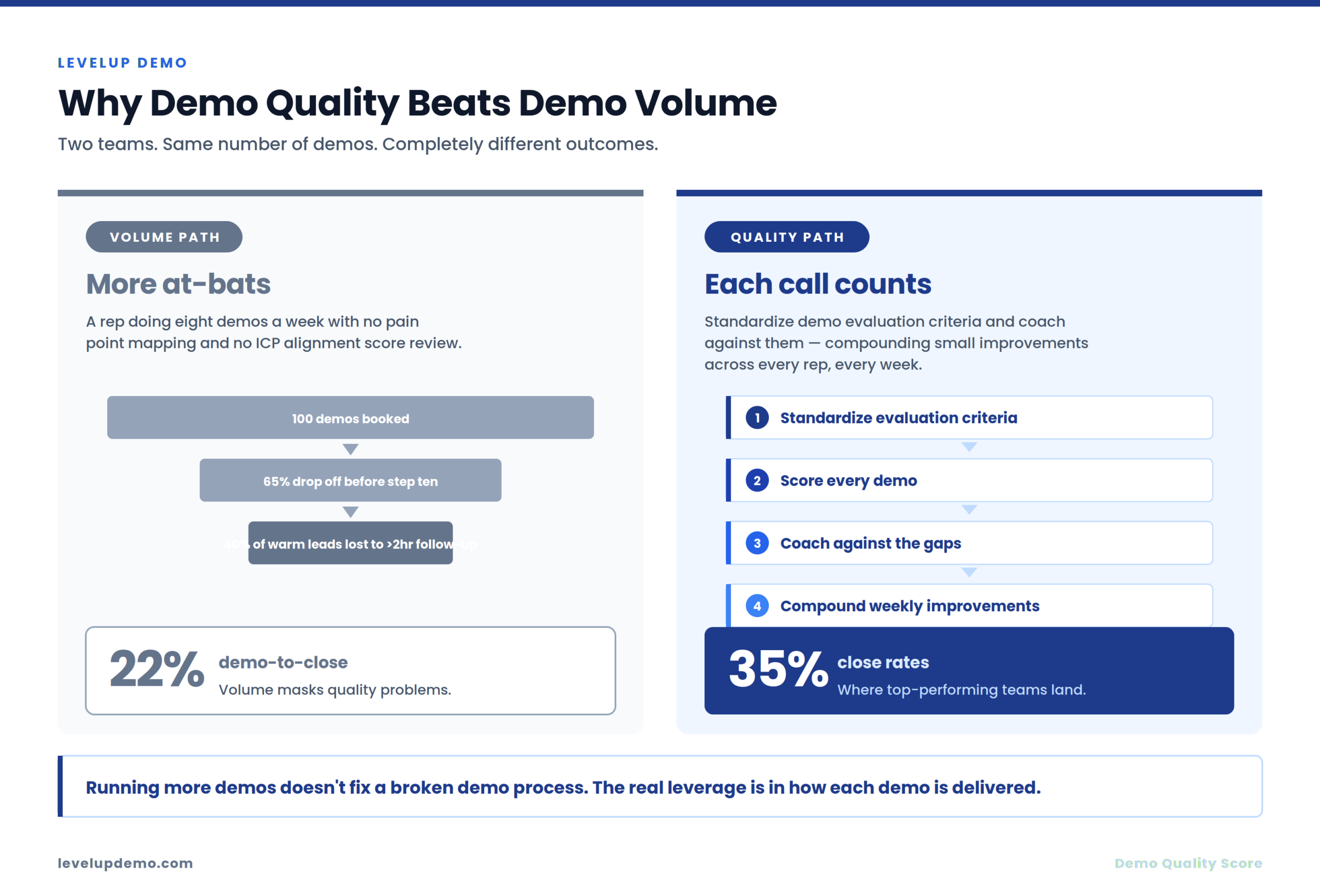
Running more demos doesn’t fix a broken demo process. Teams averaging a 22% demo-to-close rate aren’t underperforming because they need more at-bats—they’re underperforming because 65% of prospects drop off before step ten, and follow-up latency over two hours kills 40% of warm leads.
Volume masks quality problems. A rep doing eight demos a week with no pain point mapping and no ICP alignment score review is just burning pipeline faster.
The real leverage is in how each demo is delivered. When you standardize demo evaluation criteria and coach against them, you compound small improvements across every rep, every week. That’s how top-performing teams push toward 35% close rates—not by booking more calls, but by making each call count.
The LevelUp Demo Quality Score
Score every demo out of 100 points across eight weighted categories:
| Category | Weight | Why It Matters |
|---|---|---|
| Discovery & Qualification | 20 | Without validated pain, everything that follows is guesswork |
| Personalization | 15 | Generic demos signal laziness; buyers notice immediately |
| Business Value Alignment | 15 | Features don’t close deals—quantified outcomes do |
| Product Storytelling | 15 | Narrative flow determines whether buyers retain your message |
| Buyer Engagement | 10 | One-sided demos correlate directly with stalled deals |
| Objection Handling | 10 | Unaddressed concerns become silent deal-killers |
| Next Steps & Mutual Action Plan | 10 | Vague endings create funnel leakage |
| Overall Delivery | 5 | Pacing, confidence, and professionalism round out the experience |
Common scoring mistake: Managers over-weight “Overall Delivery” because it feels important. But a polished presenter who skips discovery and shows irrelevant features will still lose. Weight the categories that drive conversion, not the ones that look good on a recording.
How to Score Every Product Demo
Here’s how to evaluate each category. For each, I’ll describe what exceptional looks like and where reps typically fall short.
Discovery & Qualification (20 pts): The rep confirmed the prospect’s role, timeline, budget authority, and specific pain before showing product. They referenced discovery call questions that surfaced real business problems—not just feature requests. Exceptional reps validate pain points aloud: “So the core issue is X, and it’s costing you Y per quarter. Is that right?”
Personalization (15 pts): The demo was tailored to the prospect’s industry, workflow, or use case. Not a renamed template—an actually personalized demo with relevant data, scenarios, or integrations visible. If the prospect is in fintech and you’re showing a generic marketing dashboard, that’s a zero.
Business Value Alignment (15 pts): Every feature shown was tied to a business outcome. Value quantification happened explicitly—”This saves your team roughly four hours per week on manual reporting” versus “Here’s our reporting module.”
Product Storytelling (15 pts): The demo followed a logical narrative arc. Chapterization was clean. The rep didn’t jump between disconnected screens or features. Storyboard fidelity was high—meaning the flow matched a realistic user journey, not a random product tour.
Buyer Engagement (10 pts): The prospect spoke at least 30% of the time. The rep asked engagement questions, paused for reactions, and adapted based on buying signals. A monologue demo scores poorly here regardless of content quality.
Objection Handling (10 pts): Objections were explored, not deflected. The rep leaned into concerns rather than rushing past them. Strong objection handling sounds like “Tell me more about that concern” not “Oh, we actually do handle that.”
Next Steps & Mutual Action Plan (10 pts): The demo ended with a specific, agreed-upon next step—not “I’ll send over some materials.” A mutual action plan includes who does what, by when, and what success criteria look like.
Overall Delivery (5 pts): Pacing was appropriate. No filler words dominating the call. Screen transitions were smooth. The rep didn’t read from a script or sound robotic.
Verification checkpoint: After scoring, manually compare your assessment against the deal outcome. If demos scoring 80+ are still losing, your rubric needs recalibration.
The Demo Review Rubric
To keep scoring consistent across managers, use four performance levels for each category:
| Level | Score Range | Description |
|---|---|---|
| Needs Improvement | 0–40% of category weight | Critical elements missing; no evidence of the skill |
| Developing | 41–60% | Some elements present but inconsistent or surface-level |
| Proficient | 61–80% | Solid execution with minor gaps; meets expectations |
| Exceptional | 81–100% | Best-practice execution; could be used as a coaching example |
A rep scoring “Developing” on Discovery but “Exceptional” on Storytelling has a clear coaching priority. That’s the point—the rubric removes ambiguity and shows managers exactly where to focus.
Demo Quality Maturity Model
Teams don’t jump from bad demos to great ones overnight. There’s a progression:
Level 1 — Feature Dump
Reps show everything. No structure, no discovery. Prospects leave confused. Risk: high drop-off, long sales cycles, low close rates.
Level 2 — Scripted Demo
A standard deck and flow exists, but it’s the same for every prospect. Better than chaos, but engagement depth stays low because nothing feels relevant.
Level 3 — Personalized Demo
Reps adapt based on prospect data. ICP alignment score matters here. Demos feel tailored. Conversion starts improving.
Level 4 — Consultative Demo
The rep acts as an advisor, not a presenter. Discovery drives the entire demo structure. Prospects feel heard. Cycle time compression becomes measurable.
Level 5 — Revenue-Optimized Demo
Every demo is scored, reviewed, and coached. Analytics inform storyboard changes. Decision-maker forwardability is built into the process. Demo repeatability is systematized through SOPs. This is where teams consistently hit 30%+ close rates.
Most teams I’ve worked with sit at Level 2 or 3. Getting to Level 4 requires a coaching system. Getting to Level 5 requires operational infrastructure.
Common Demo Quality Mistakes
Seven patterns that show up repeatedly in demo reviews:
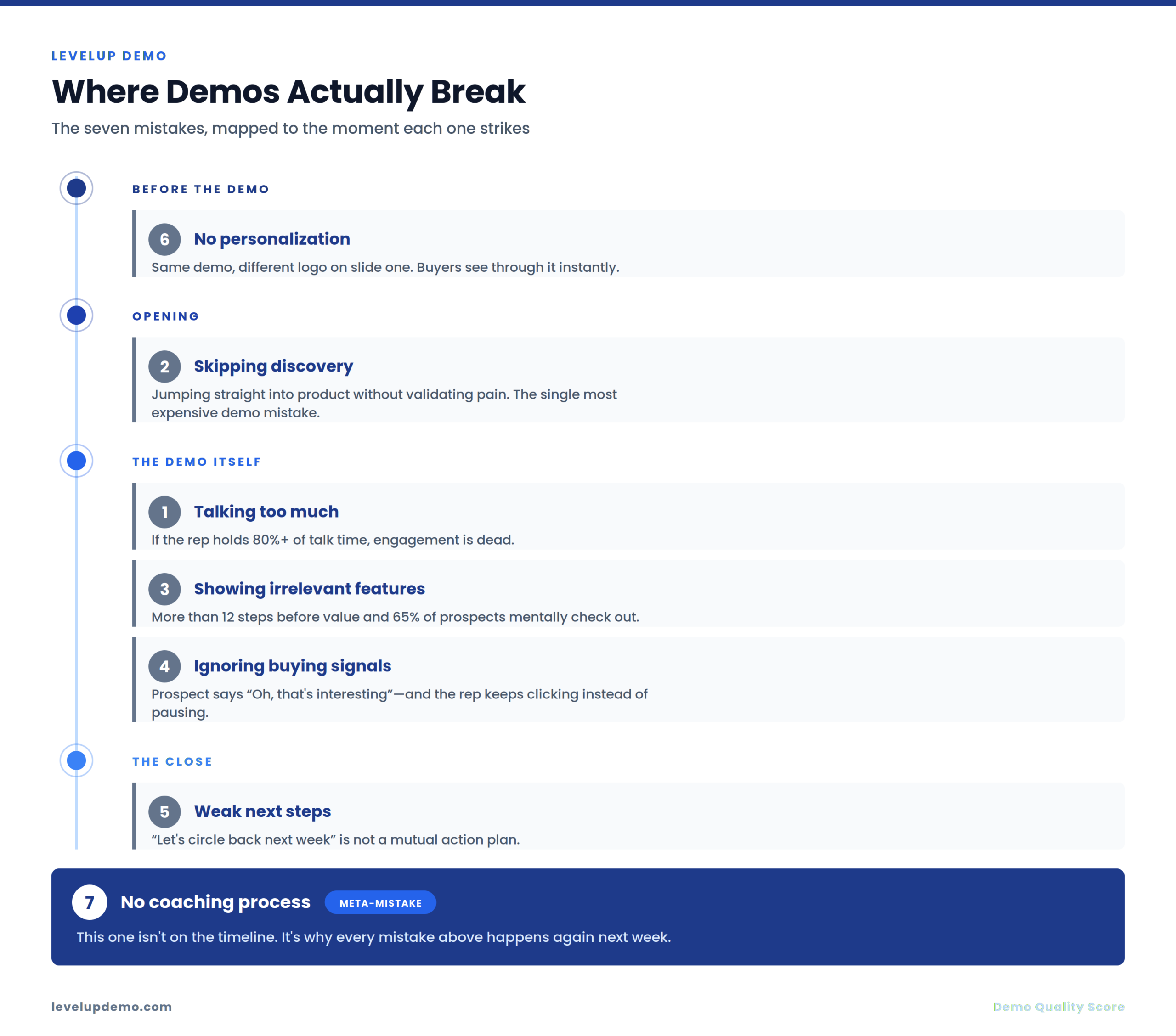
- 1Talking too much. If the rep holds 80%+ of talk time, engagement is dead.
- 2Skipping discovery. Jumping straight into product without validating pain. This is the single most expensive demo mistake.
- 3Showing irrelevant features. Feature fatigue is real. More than 12 steps before value and 65% of prospects mentally check out.
- 4Ignoring buying signals. Prospect says “Oh, that’s interesting”—and the rep keeps clicking instead of pausing.
- 5Weak next steps. “Let’s circle back next week” is not a mutual action plan.
- 6No personalization. Same demo, different logo on slide one. Buyers see through it instantly.
- 7No coaching process. This is the meta-mistake. Without structured review, every other mistake repeats indefinitely.
Stop running demos blind.
LevelUp Demo gives your team a centralized view of every demo request, outcome, and follow-up—so you can actually spot patterns and coach against them.
How Sales Managers Should Coach Demo Quality
The Demo Coaching Framework
Isolated feedback doesn’t stick. You need a cadence:
| Cadence | Activity | Purpose |
|---|---|---|
| Weekly | Review one recorded demo | Identify immediate coaching moments |
| Bi-weekly | 1:1 coaching session | Deep-dive on one or two scoring categories |
| Monthly | Team calibration | Align all managers on scoring standards |
| Quarterly | Process optimization | Update rubric, adjust weights, review trends |
Coaching questions managers should ask:
- “What did you learn about their pain in discovery that changed how you ran the demo?”
- “Which feature did you choose not to show, and why?”
- “Where did you feel the prospect disengage? What would you do differently?”
- “What was your mutual action plan, and did the prospect verbally commit to it?”
The goal isn’t critique—it’s building self-awareness. The best reps I’ve seen are the ones who can score their own demos accurately before a manager even watches.
The Demo Improvement Loop
This is the operational engine underneath everything:
→
Discover
→
Deliver
→
Review
→
Score
→
Coach
→
Improve
→
Repeat
Each cycle makes the next one better. A rep who goes through this loop 12 times in a quarter will outperform a rep who runs 50 unreviewed demos in the same period. Continuous improvement compounds—small scoring gains across eight categories create massive conversion differences over a full quarter.
Demo Review Checklist
Use this for every demo review. Print it. Share it. Make it part of your team’s operating rhythm.
Pre-Demo:
- ☐ Discovery completed and documented
- ☐ ICP alignment confirmed
- ☐ Prospect’s pain points identified
- ☐ Relevant stakeholders invited
- ☐ Demo agenda shared in advance
- ☐ Personalized workflow or use case prepared
- ☐ Value quantification prepared
- ☐ Competitive context reviewed
During Demo:
- ☐ Agenda confirmed at the start
- ☐ Pain points validated verbally
- ☐ Personalized content shown (not generic)
- ☐ Features tied to business outcomes
- ☐ Prospect engaged (questions asked, pauses used)
- ☐ Buying signals acknowledged
- ☐ Objections explored (not deflected)
- ☐ Demo stayed under time limit
- ☐ Story flow was logical and chaptered
- ☐ No UI drift or broken screens
Post-Demo:
- ☐ Success criteria confirmed with prospect
- ☐ Clear next step agreed (who, what, when)
- ☐ Mutual action plan documented
- ☐ Follow-up sent within one hour
- ☐ CRM updated with demo outcome
- ☐ Demo scored using quality scorecard
- ☐ Recording tagged for coaching review
- ☐ Decision-maker forwardable summary created
Verification: If you can’t check at least 20 of these 28 items, the demo has structural gaps worth coaching.
How LevelUp Helps Improve Demo Quality
Structured demo evaluation requires visibility. You can’t score what you can’t see, and you can’t coach what you can’t track.
LevelUp Demo provides the operational layer that makes quality scoring practical for small teams: centralized demo request capture, lead qualification before scheduling, outcome tracking across every demo, and follow-up management that closes the loop. The analytics dashboard surfaces patterns—like which reps have high volume but low demo-to-close rates—so managers know exactly where to focus coaching time.
It’s not about replacing your sales instincts. It’s about giving those instincts data to work with.
FAQ
How do you evaluate a SaaS product demo?
Use a structured scorecard covering discovery, personalization, value alignment, storytelling, engagement, objection handling, and next steps. Score each category against defined rubric levels and review recordings regularly with a consistent coaching cadence.
What should sales managers look for during demo reviews?
Focus on whether the rep validated pain before showing product, personalized the demo to the prospect’s context, engaged the buyer in two-way conversation, and closed with a specific mutual action plan—not just a polished presentation.
How often should demos be reviewed?
Review at least one demo per rep weekly. Pair this with bi-weekly individual coaching, monthly team calibration sessions, and quarterly process reviews to maintain scoring consistency and drive improvement.
What is a good demo quality score?
Teams should target 70+ out of 100 as a baseline for proficiency. Scores below 50 indicate structural problems in discovery or personalization. Consistently scoring above 85 suggests the rep is operating at a consultative or revenue-optimized level.
Who should own demo quality?
Sales managers own the coaching cadence. RevOps or sales enablement owns the scoring framework and calibration process. Reps own self-assessment. It’s a shared operational discipline, not a single person’s responsibility.
How can demo quality improve win rates?
Better discovery reduces wasted demos on unqualified prospects. Stronger personalization and value alignment increase buyer confidence. Consistent coaching compounds small improvements across every rep, driving measurable gains in conversion rates over time.
LevelUp Demo
Ready to build a demo quality system for your team?
Start with LevelUp Demo and get the visibility you need to score, coach, and convert.