
Quick Answer: SaaS discovery call questions are qualifying open-ended questions used by sales teams to identify a prospect’s operational pain points, budget, timeline, and stakeholder hierarchy. By asking a structured sequence of 11 to 14 targeted questions, reps can determine buying readiness and effectively customize subsequent product demos to close deals.
The best product demos rarely begin with a product. They begin with the right questions.
We’ve seen many demos fail because the sales rep jumped into features before understanding the prospect’s real priorities. The rep clicks through a polished slide deck, hits every talking point, and the prospect nods politely — then goes silent forever. Sound familiar?
Here’s what actually happened: the discovery call was either skipped entirely or filled with surface-level questions that produced surface-level answers. The rep walked into the demo armed with a name, a company, and maybe a job title. That’s not enough.
If you’re a SaaS founder running sales yourself or leading a small team of one to five, this guide gives you the exact questions, frameworks, and conversation structures to run discovery calls that actually convert into closed deals. No fluff. Just what works.
What Are Discovery Call Questions?
A discovery call is the first real sales conversation with a prospect.
Discovery call questions are the specific, open-ended prompts you use during that conversation to understand what’s broken, what matters, who decides, and whether this deal is real. The purpose of discovery is to understand before you present. That’s the whole job.
Good discovery questions do four things simultaneously: they qualify the opportunity, they surface pain, they map the buying committee, and they give you enough detail to personalize the demo. Bad discovery questions — “Tell me about your business” — produce vague answers that help nobody.
Why Discovery Questions Matter More Than Most Sales Teams Realize
Most teams treat discovery as a formality. A quick chat before the “real” meeting. That’s a mistake.
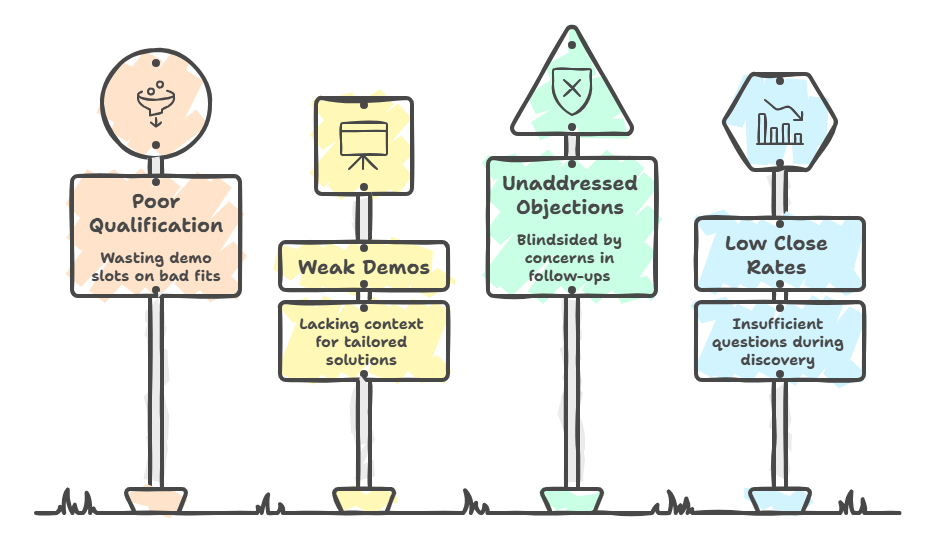
- Better qualification. When you ask the right questions, you stop wasting demo slots on prospects who don’t have budget, authority, or urgency. You can qualify demo requests before investing 45 minutes in a tailored walkthrough.
- Stronger demos. Discovery questions reveal the business problem behind the feature request. When a prospect says “we need better reporting,” discovery tells you why — maybe their VP can’t see pipeline metrics, or their team is manually pulling data into spreadsheets every Friday. That context changes your entire demo narrative.
- Fewer objections. Pricing concerns, timing hesitations, competitor comparisons — these all surface during discovery if you ask. You’d rather handle them early than get blindsided in a follow-up.
- Higher close rates. Research from Gong suggests reps should aim for 11–14 questions during a discovery call to improve closing chances. Not 3. Not 25. A focused range that balances depth with conversation flow.
Better questions lead to better demos and better close rates. It really is that direct.
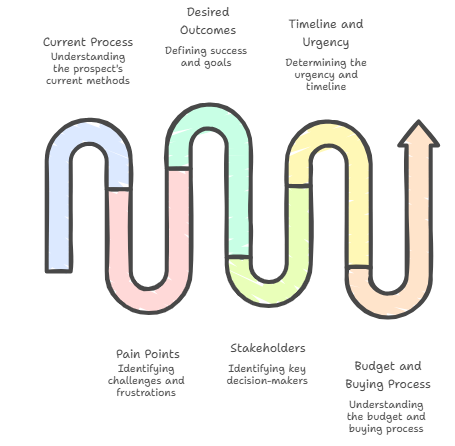
Discovery Call Framework: 6 Core Areas
This is the core execution path. Six phases, each with a clear purpose.
- Current Process — How they handle things today
- Pain Points — What’s broken or frustrating
- Desired Outcomes — What success looks like for them
- Stakeholders — Who influences and approves the decision
- Timeline and Urgency — Why now, and how fast
- Budget and Buying Process — How they evaluate and purchase
You don’t need to hit every area in a rigid sequence. But if you end a call and one of these boxes is empty in your CRM, you’ve got a gap.
25 Best Discovery Call Questions (Organized by Category)
Current Process
- How are you handling [this workflow] today?
- What tools or systems are you currently using for this?
- How long has your team been using this approach?
- What does a typical day look like for the person managing this?
Pain Points
- What’s the biggest challenge with your current approach?
- What happens when [the process] breaks down?
- How much time does your team spend on this each week?
- What have you already tried that didn’t work?
- If nothing changes in the next six months, what’s the impact?
Desired Outcomes
- What would success look like for you in six months?
- If you could fix one thing about this process, what would it be?
- How would you measure whether a new solution is working?
- What does your team need that they’re not getting today?
Stakeholders
- Who else will be involved in evaluating this?
- Is there someone on your team who would need to approve the budget?
- Who would be the day-to-day user of a tool like this?
- Has anyone else on your team explored solutions for this?
Timeline and Urgency
- What’s driving this initiative right now?
- Is there a deadline or event that’s creating urgency?
- When would you ideally want a solution in place?
- What happens if this decision gets delayed?
Budget and Buying Process
- Do you have a budget allocated for this?
- How does your team typically evaluate new tools?
- What’s your approval process look like?
- Are you comparing other solutions right now?
The Ugly Truth: Where Discovery Breaks Down
- Problem: Prospect ghosts after the call
The Weird Fix: Force a “commitment mirror” — recap + “On a scale of 1-10, how likely are you to move forward?” - Problem: Demos booked with zero pain uncovered
The Weird Fix: Pre-call ICP scorecard; auto-disqualify if match is below 70% - Problem: One stakeholder dominates, others stay silent
The Weird Fix: Run a stakeholder intro round: name, role, top priority per person - Problem: No urgency surfaces
The Weird Fix: Loss amplification: “How much revenue slips monthly because of this?” - Problem: Insights forgotten within hours
The Weird Fix: Voice-to-CRM transcription + shared summary with prospect’s quoted words
The disqual rate is a telling metric. If you’re qualifying 100% of discovery calls into demos, your pipeline is inflated. A healthy disqual rate sits around 20–30%. Zero disqualifications means you’re chasing quota, not knowledge.
Final Thoughts
Great demos begin with great discovery questions. The best discovery calls don’t feel like interrogations. They feel like focused conversations that uncover exactly what the prospect needs to solve.
Ready to streamline what happens after discovery?
LevelUp Demo helps SaaS teams manage scheduling, outcomes, and follow-ups in one place — so strong discovery calls turn into closed deals.
Frequently Asked Questions
What is a discovery call?
A discovery call is a pre-demo sales conversation designed to uncover a prospect’s pain points, goals, stakeholders, and timeline. It determines whether the opportunity is qualified and shapes how the product demo is delivered. The purpose of discovery is not to pitch — it is to understand.
How long should a discovery call be?
Most effective discovery calls run 20–30 minutes. That’s enough time to cover current process, pain, stakeholders, and next steps without losing momentum. Going longer usually means the rep is talking too much — aim for a 70/30 talk ratio favoring the prospect.
What questions should you ask on a discovery call?
Focus on process, pain, impact, and timeline. Key questions include: “What prompted you to look at this now?” “How are you handling this today?” “What’s the cost of not solving this?” and “Who else needs to be involved?” Avoid generic openers that don’t surface actionable insight.
What is the difference between a discovery call and a demo?
A discovery call uncovers the problem. A product demo shows how to solve it. Discovery happens first and determines whether a demo is warranted — and what it should focus on. Combining both into one meeting almost always weakens the demo’s relevance.
Why are discovery calls important in SaaS?
SaaS deals involve multiple decision-makers, longer evaluation cycles, and products that need to map to specific workflows. Discovery calls act as a demo gate — ensuring only qualified, well-understood opportunities move forward. Without them, teams waste time on demos that don’t convert and miss opportunities to increase demo bookings that actually close.