
A discovery call is an early sales conversation used to understand a prospect’s goals, challenges, current process, and buying readiness before presenting the product. In SaaS, discovery calls help sales teams qualify opportunities and tailor demos to the prospect’s specific needs. Think of it as the diagnostic conversation that determines whether a demo is even worth running — and if so, what it should focus on.
Why Most SaaS Demos Fail Before They Start
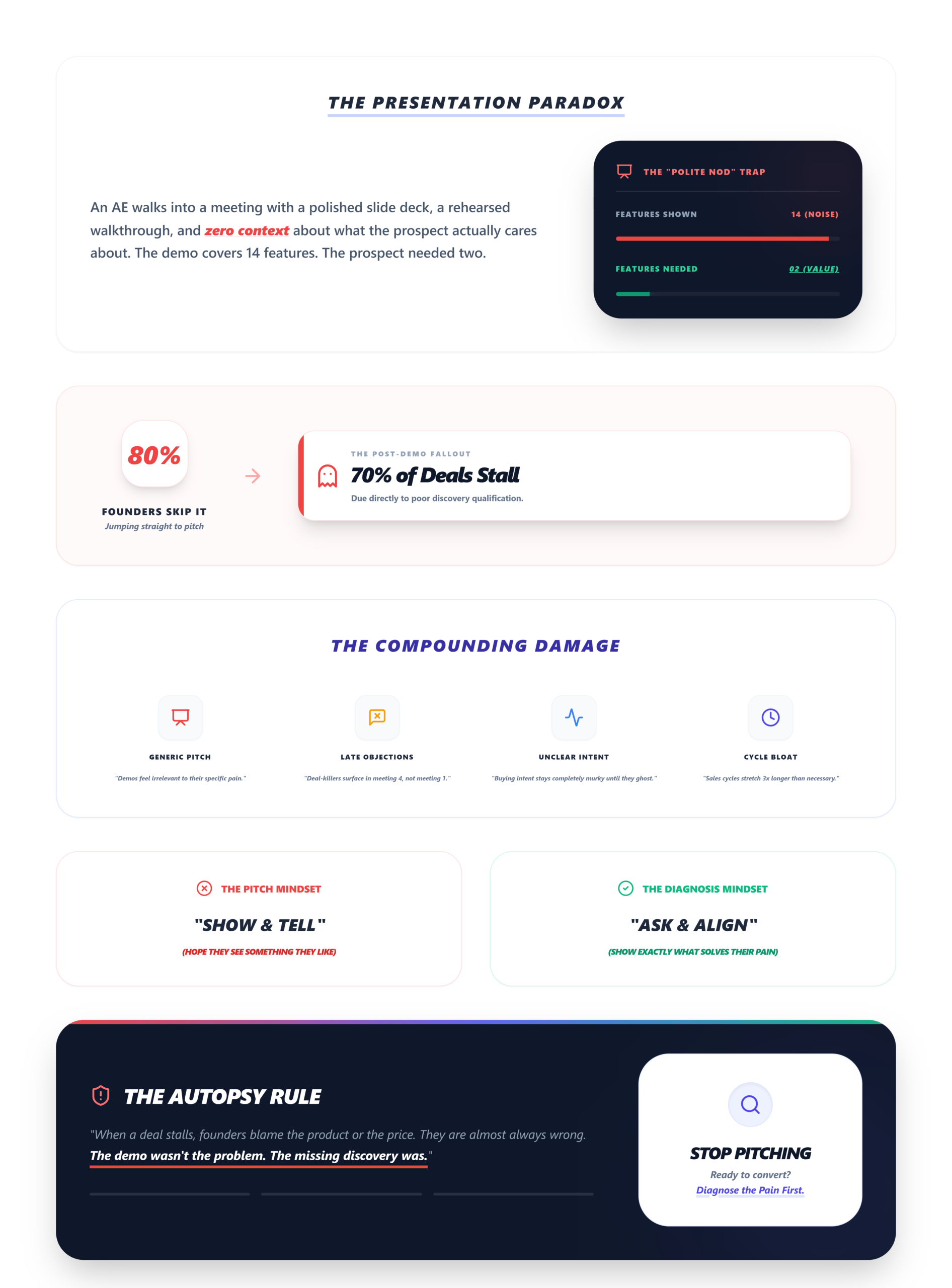
Here’s a scene we’ve watched play out dozens of times: an AE walks into a demo with a polished slide deck, a rehearsed product walkthrough, and zero context about what the prospect actually cares about.
The demo covers 14 features. The prospect needed two. They nod politely, say “we’ll circle back,” and ghost within 48 hours.
The demo wasn’t the problem. The missing discovery call was the problem.
When discovery is weak or skipped entirely — and 80% of founders skip it, jumping straight to demos — the downstream damage compounds fast:
- Demos feel generic and irrelevant
- Key objections surface in the final meeting, not the first
- Buying intent stays unclear until the deal stalls
- Sales cycles stretch 3x longer than they should
We’ve seen teams run polished demos that still fail because discovery never uncovered the real buying criteria. The data backs this up: 70% of SaaS deals stall post-demo due to poor discovery qualification.
By the end of this guide, you’ll have a repeatable discovery call framework that helps you disqualify bad fits early, uncover real pain, and run demos that actually convert.
The Pre-Flight Check: Are You Ready for Discovery?
Before building out your discovery process, a few things need to be locked down. You need:
- A defined ICP — even a rough one. Who are you actually built for?
- A CRM or tracking system where call notes, pain points, and next steps get logged (HubSpot, Salesforce, even a structured Notion board)
- A scheduling tool with a pre-call qualifier — Calendly with a short intake form works
- At least 2–3 case study “before-states” you can reference during calls
Stop/Go test: Can you describe your ideal customer and their top pain point in one sentence? If not, nail that down before running discovery. Otherwise, you’re qualifying against nothing.
If you’re still working on tightening your top-of-funnel process, start with how to qualify demo requests before layering in a full discovery framework.
Phase 1: Understand What a Discovery Call Actually Is
A discovery call is a structured conversation that helps SaaS teams gather context about a prospect before running a product demo. The goal is to understand pain points, stakeholders, timeline, and desired outcomes so the demo can focus on what matters most.
It’s not a pitch. It’s not a mini-demo. It’s not a “quick chat.”
A discovery call diagnoses the problem. A product demo demonstrates how to solve it. That distinction matters more than most teams realize. When you collapse both into one meeting, you end up answering questions the prospect never asked — and missing the ones they needed you to address.
Discovery calls turn generic demos into relevant buying conversations. That’s the entire value proposition of doing them well.
Phase 2: Why Discovery Calls Matter in SaaS
SaaS sales cycles involve multiple stakeholders, competing priorities, and prospects who’ve already done their own research before they talk to you. The discovery call is where you earn the right to run a relevant demo.
Here’s what the numbers say:
- Reps waste 40% of their time on unqualified leads without proper discovery
- 60% of discovery calls fail to uncover true pain, leading to a 25% demo no-show rate
- Effective discovery boosts close rates 2.5x by surfacing urgency early
Small teams feel this even harder. Without centralized notes and a clear qualification checkpoint, 50% of follow-ups drop off entirely. You’re not just losing deals — you’re losing the data that tells you why you’re losing them.
Visual checkpoint: After running discovery for two weeks, check your CRM. Do you have at least 3 verbatim prospect pain quotes logged per call? If the pain fields are empty, discovery isn’t happening — you’re just having conversations.
Phase 3: The Discovery Call Framework
This is the core execution path. Six phases, each with a clear purpose.
1. Understand the Current Process
Start here. Not with your product, not with your pitch — with their world. “Walk me through how you’re handling this today.” You’re listening for manual steps, workarounds, tools that don’t talk to each other. The root cause of their frustration usually lives in the process they’ve normalized.
2. Identify Pain Points
Go deeper than “what’s not working.” Ask implication questions. “How are you handling this today?” → then → “What happens when that breaks down?”
The SPIN framework is useful here — Situation, Problem, Implication, Need-payoff. You’re escalating from surface complaints to business impact. If you can’t quantify the loss (revenue, time, deals slipping), you haven’t gone deep enough.
Verification: Did the prospect articulate a specific cost or consequence? (“We’re losing about $50k/month in leaked leads” = Go. “It’s kind of annoying” = Stop — keep digging.)
3. Define Desired Outcomes
“What does success look like for you in 90 days?” This anchors the entire demo. If you don’t know what they’re solving toward, you’ll demo features instead of outcomes. Keep it buyer-led — let them talk 70% of the time here.
4. Confirm Stakeholders
“Who else will be involved in evaluating this?” Build the stakeholder map early. Who’s the economic buyer? Who’s the day-to-day user champion? If you’re only talking to one person and two others will weigh in later, your demo is going to miss critical perspectives.
A practical move: run a quick “stakeholder intro round” if multiple people join. Name, role, top priority. Takes 90 seconds. Saves you from multi-stakeholder misalignment that kills deals in week three.
5. Explore Timeline and Urgency
“What prompted you to explore solutions now?” The urgency driver matters. Tie it to something concrete — a fiscal quarter deadline, a board review, a churn spike.
No urgency usually means no decision. And if there’s genuinely no timeline, that’s a signal to disqualify early rather than chase a deal that won’t close.
6. Agree on Next Steps
This is where most calls fall apart. “Sounds good, we’ll be in touch” is not a next step. It’s a ghost invitation.
End with a next step commitment: “Based on what you’ve shared, I think a focused demo on X and Y makes sense. Does Thursday at 2pm work for your team?” Then send a recap — problem, impact, current fix — within 5 minutes. Use the prospect’s own words.
Visual checkpoint: Calendar invite sent and accepted. CRM stage moved to “Demo Scheduled” with stakeholder notes attached. If the next step is a vague email, your ghost risk just spiked.
Phase 4: Discovery Call Questions That Actually Work
Skip the generic “tell me about your business” opener. These are the questions that surface real information:
- What prompted you to explore solutions now?
- How are you handling this today, and what’s breaking?
- What challenges are slowing your team down the most?
- Who else will be involved in the decision?
- What does success look like — and by when?
- How much revenue or time is this costing you monthly?
- If you solve this, what changes for your team in Q3?
One move that works well when prospects dodge pain questions: the permission pivot. “Mind if I ask a deeper question about the impact?” It reframes the conversation without feeling aggressive.
And when someone says “just send me the demo” — don’t panic. Respond with: “Happy to. But first — what’s the top challenge you’re hoping it solves?” You’ve just turned a brush-off into discovery. For more on reading these moments, look at how to spot buying signals during the conversation.
A Real-World Discovery Scenario
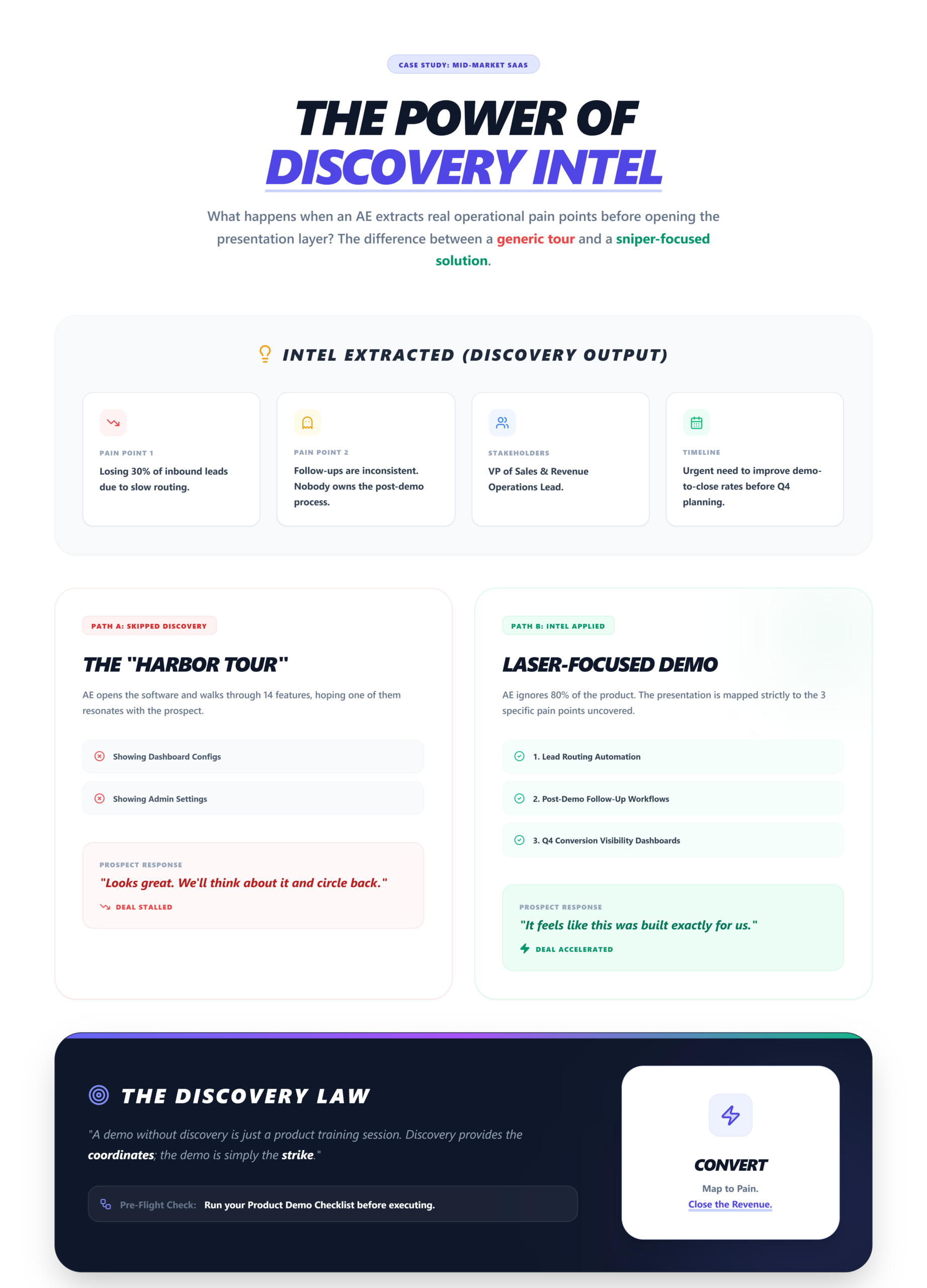
A mid-market SaaS company requests a demo through your site. During the discovery call, the AE learns:
- The team is losing 30% of inbound leads due to slow routing
- Follow-ups are inconsistent — no one owns the post-demo process
- Two stakeholders will evaluate the tool: VP Sales and the RevOps lead
- They want to improve demo-to-close rates before Q4 planning
Without discovery, the demo would’ve been a full product tour. With discovery, it’s now laser-focused on lead routing, follow-up automation, and conversion visibility — the three things that map directly to their pain.
The result? A demo that feels like it was built for them. Because, in a sense, it was.
That’s the difference between a demo that converts and one that gets a polite “we’ll think about it.” Before running that tailored demo, use a product demo checklist to make sure nothing falls through the cracks.
The Ugly Truth: Where Discovery Breaks Down
- Problem: Prospect ghosts after the call
The Weird Fix: Force a “commitment mirror” — recap + “On a scale of 1-10, how likely are you to move forward?” - Problem: Demos booked with zero pain uncovered
The Weird Fix: Pre-call ICP scorecard; auto-disqualify if match is below 70% - Problem: One stakeholder dominates, others stay silent
The Weird Fix: Run a stakeholder intro round: name, role, top priority per person - Problem: No urgency surfaces
The Weird Fix: Loss amplification: “How much revenue slips monthly because of this?” - Problem: Insights forgotten within hours
The Weird Fix: Voice-to-CRM transcription + shared summary with prospect’s quoted words
The disqual rate is a telling metric. If you’re qualifying 100% of discovery calls into demos, your pipeline is inflated. A healthy disqual rate sits around 20–30%. Zero disqualifications means you’re chasing quota, not knowledge.
How Discovery Improves Demo Conversion
The math is straightforward:
- Stage: Setup (1 week)
Action: Build ICP scorecard + call script
Result: 20% fewer unqualified demos - Stage: Run 10 calls (2 weeks)
Action: Log pain points, disqualify 2–3
Result: Pipeline clarity - Stage: Optimize (1 month)
Action: Analyze talk ratios, refine questions
Result: 30% conversion lift - Stage: Scale (3 months)
Action: Team playbook + shared framework
Result: 50% time saved on follow-ups
Great demos begin with great discovery. There’s no shortcut around that. For a broader view of how this fits into your entire sales motion, the ultimate guide to sales demos covers the full picture.
Ready to tighten the gap between discovery and demo?
Once discovery is complete, teams need a reliable system to schedule demos, capture outcomes, assign follow-ups, and analyze what converts. LevelUp Demo handles that workflow — from lead capture through conversion tracking — without the bloat of a traditional CRM.
FAQ
What is a discovery call?
A discovery call is a pre-demo sales conversation designed to uncover a prospect’s pain points, goals, stakeholders, and timeline. It determines whether the opportunity is qualified and shapes how the product demo is delivered. The purpose of discovery is not to pitch — it is to understand.
How long should a discovery call be?
Most effective discovery calls run 20–30 minutes. That’s enough time to cover current process, pain, stakeholders, and next steps without losing momentum. Going longer usually means the rep is talking too much — aim for a 70/30 talk ratio favoring the prospect.
What questions should you ask on a discovery call?
Focus on process, pain, impact, and timeline. Key questions include: “What prompted you to look at this now?” “How are you handling this today?” “What’s the cost of not solving this?” and “Who else needs to be involved?” Avoid generic openers that don’t surface actionable insight.
What is the difference between a discovery call and a demo?
A discovery call uncovers the problem. A product demo shows how to solve it. Discovery happens first and determines whether a demo is warranted — and what it should focus on. Combining both into one meeting almost always weakens the demo’s relevance.
Why are discovery calls important in SaaS?
SaaS deals involve multiple decision-makers, longer evaluation cycles, and products that need to map to specific workflows. Discovery calls act as a demo gate — ensuring only qualified, well-understood opportunities move forward. Without them, teams waste time on demos that don’t convert and miss opportunities to increase demo bookings that actually close.
The best demos don’t start with a feature presentation. They start with a discovery conversation that uncovers what the prospect actually needs to solve. Get that right, and the demo practically runs itself.