
This is where the Chili Piper vs Calendly conversation actually begins — not in a feature checklist, but in the moment revenue walks out the door.
The quick verdict: Calendly is the best simple scheduling tool for individuals, freelancers, and small teams. Chili Piper wins for mid-market and enterprise SaaS teams that need inbound lead routing and qualification.
But if your real problem is what happens after the demo gets booked — tracking outcomes, managing follow-ups, and closing visibility gaps — neither tool fully solves it.
Chili Piper vs Calendly — Quick Answer
- Calendly is a scheduling tool. It lets prospects pick a time on your calendar. It does this exceptionally well for individuals and small teams with straightforward booking needs.
- Chili Piper is a scheduling + routing platform. It qualifies inbound leads, routes them to the right rep based on territory, segment, or round-robin rules, and books meetings instantly from web forms.
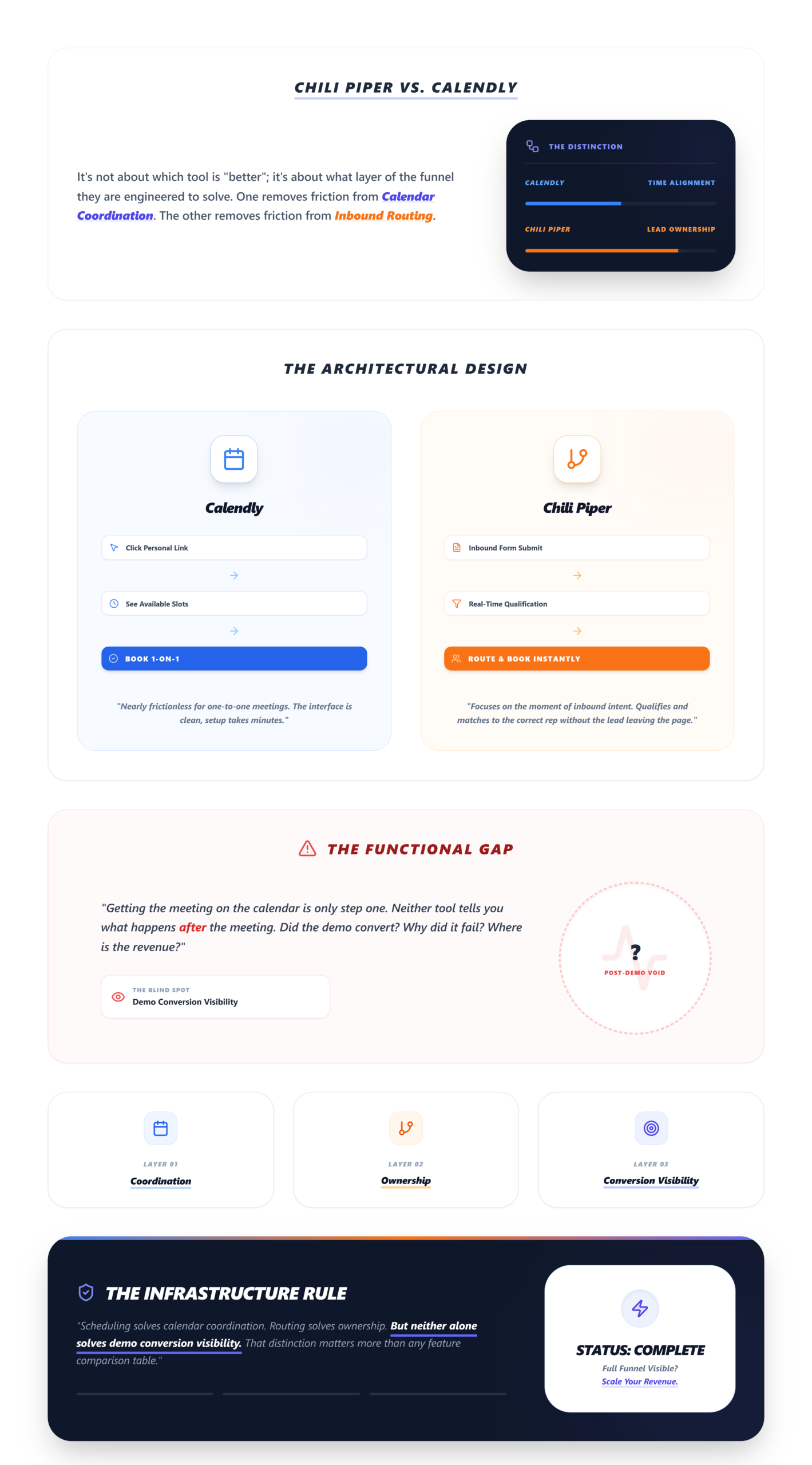
The key workflow difference: Calendly coordinates calendars. Chili Piper coordinates ownership.
But scheduling and routing are only two layers of the SaaS demo funnel. Qualification, follow-up consistency, outcome tracking, and conversion visibility are the layers where most SaaS teams bleed revenue.
What Is the Difference Between Chili Piper and Calendly?
Calendly focuses on removing friction from the scheduling interaction itself. A prospect clicks a link, sees available slots, and books. The interface is clean, the setup takes minutes, and for one-to-one meetings, it’s nearly frictionless.
Chili Piper focuses on what happens at the moment of inbound intent. When a lead submits a form, Chili Piper qualifies them in real time, matches them to the correct sales rep using routing logic, and presents booking options instantly — all without the lead leaving the page.
Scheduling solves calendar coordination. Routing solves ownership. But neither alone solves demo conversion visibility. That distinction matters more than any feature comparison table.
Why This Comparison Matters for SaaS Teams
Here’s a scenario most growing SaaS teams recognize:
A startup begins with five reps and 20 demo requests per week. Calendly handles scheduling. A shared spreadsheet tracks assignments. Follow-ups happen in Slack threads. It works.
Then inbound volume hits 50+ requests weekly. Suddenly, leads get assigned to the wrong reps. Follow-up timing becomes inconsistent. Demo outcomes live in scattered notes across CRM fields, spreadsheets, and Slack messages. Nobody knows which demos actually converted — or why.
Teams outgrow simple scheduling faster than they expect.
The operational complexity isn’t the booking itself. It’s everything surrounding it: routing logic, rep ownership, follow-up cadence, and conversion tracking. This is where funnel leakage silently erodes pipeline.
What Is Calendly?
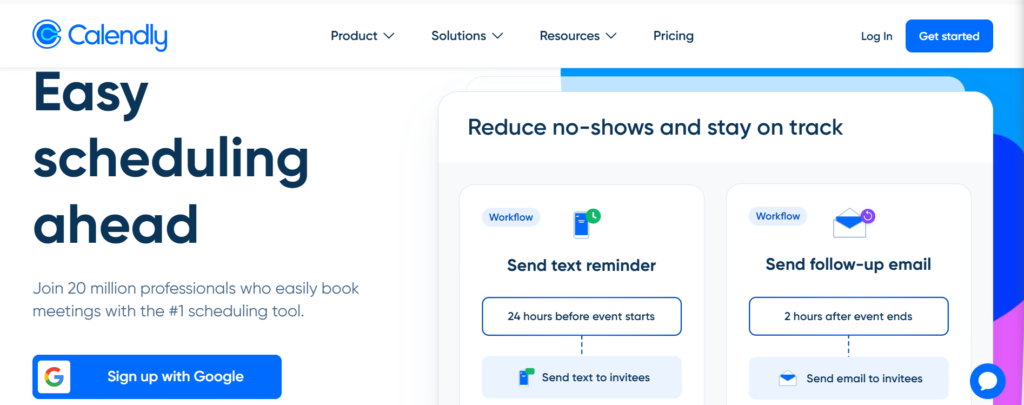
Calendly is the default scheduling tool for a reason. The onboarding flow takes under five minutes. You connect your calendar, set availability, share a link, and meetings get booked. The interface feels like it was designed for people who hate setting up software — and that’s a genuine strength.
Best for: Freelancers, consultants, customer success teams, SMBs, and anyone whose primary need is “let people book time with me without email ping-pong.”
Where it falls short for SaaS sales teams:
- No native lead routing by territory, segment, or account size
- No real-time form-based qualification
- Limited visibility into what happens after the meeting books
- Round-robin exists, but lacks the sophistication growing sales orgs need
- Follow-up workflows require stitching together separate tools
Calendly remains one of the simplest, most reliable scheduling tools available. For its intended use case, it’s excellent. But SaaS sales operations demand more than calendar coordination.
What Is Chili Piper?
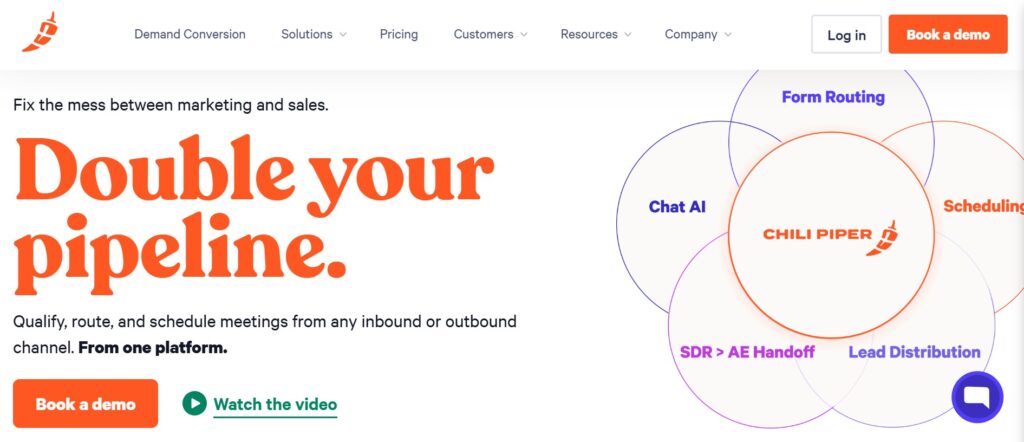
Chili Piper was built specifically for B2B inbound sales workflows. Its core product, Concierge, sits on your web forms and instantly qualifies, routes, and books meetings the moment a lead submits a request.
The routing logic is where Chili Piper earns its reputation. You can route by territory, company size, existing account ownership, round-robin with weighting, and custom rules. For teams with 10+ SDRs handling segmented inbound, this is a genuine operational advantage. Teams evaluating lead routing software often land on Chili Piper for exactly this reason.
Best for: Mid-market and enterprise SaaS teams with complex inbound routing needs and multiple rep segments.
Where it falls short:
- Pricing scales aggressively — enterprise tiers get expensive fast
- Setup complexity requires dedicated RevOps involvement
- The UI for configuring routing rules can feel dense; one wrong condition and leads misroute silently
- Post-demo visibility remains limited — you know the meeting was booked and routed, but tracking demo outcomes, follow-up quality, and conversion patterns still requires manual work or CRM customization
Most SaaS teams don’t lose revenue because of bad demos. They lose it because the workflow around the demo is fragmented.
Feature Comparison Breakdown
- Scheduling
Calendly: ✅ Excellent — clean, fast, intuitive | Chili Piper: ✅ Strong — form-based instant booking - Lead Routing
Calendly: ❌ Basic round-robin only | Chili Piper: ✅ Advanced — territory, segment, weighted - Real-Time Qualification
Calendly: ❌ Not available | Chili Piper: ✅ Form-based qualification logic - Follow-Up Automation
Calendly: ⚠️ Limited — reminders only | Chili Piper: ⚠️ Basic — relies on CRM triggers - Rep Ownership Clarity
Calendly: ❌ Manual assignment | Chili Piper: ✅ Automated assignment - Demo Outcome Tracking
Calendly: ❌ Not available | Chili Piper: ⚠️ Requires CRM customization - Workflow Visibility
Calendly: ❌ Scheduling-only view | Chili Piper: ⚠️ Routing view, limited post-demo - Best Use Case
Calendly: Individual scheduling, SMBs | Chili Piper: Inbound routing for sales teams
The Real Problem SaaS Teams Face
Here’s what actually happens in most SaaS sales workflows:
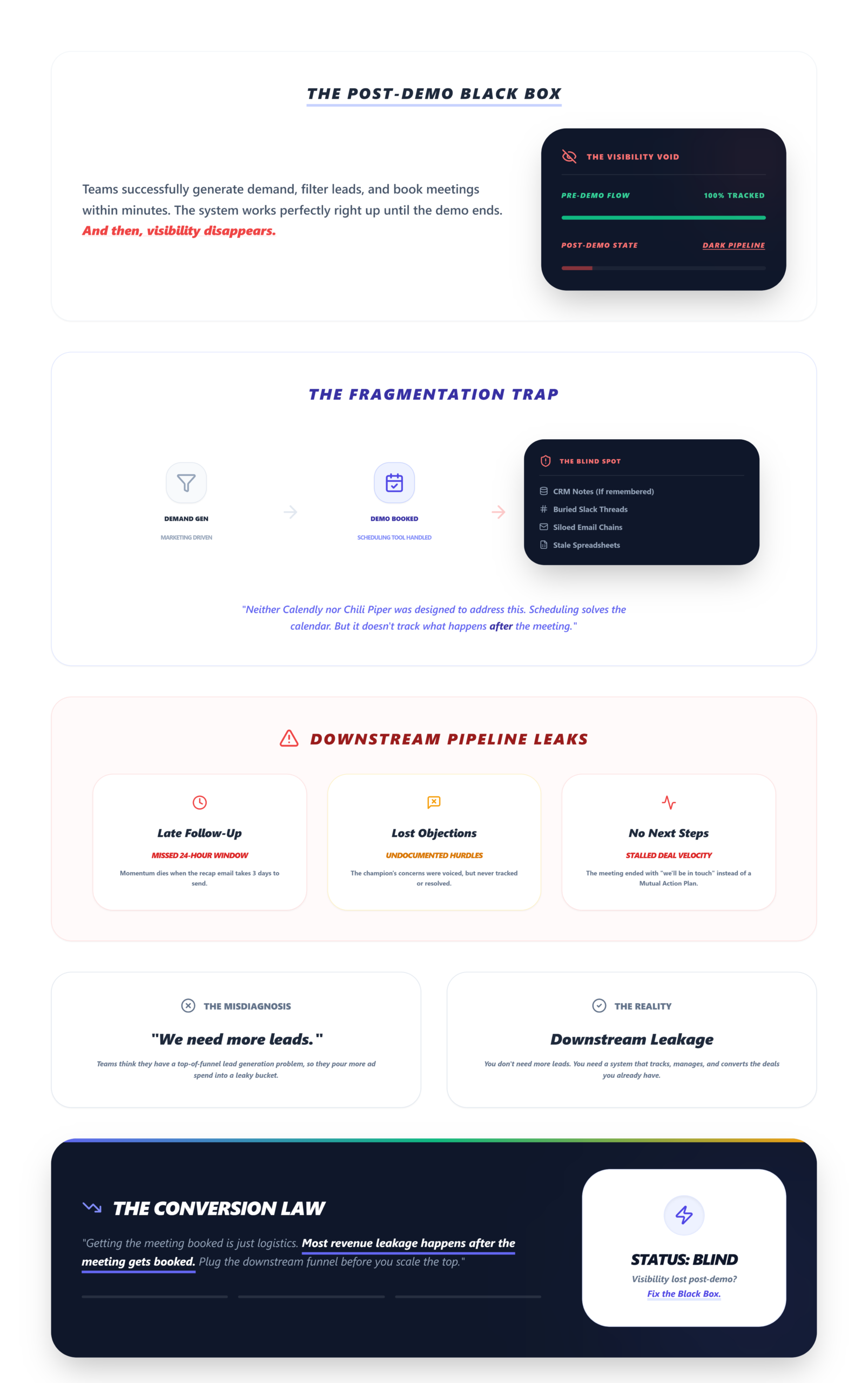
Marketing generates demand. A lead fills out a demo request form. The meeting gets booked (via Calendly, Chili Piper, or any scheduling tool). The demo happens.
And then… visibility disappears.
Did the prospect show up? What was discussed? What objections came up? Did the rep send a follow-up within 24 hours? Did the deal progress or stall? Why?
These answers live in fragmented systems: CRM notes (if the rep remembered to log them), Slack threads, email chains, and spreadsheets that go stale within days.
We’ve seen teams respond quickly to inbound requests — booking demos within minutes — but still lose deals because no one tracked what happened after the demo. The follow-up was late. The champion’s objections weren’t documented. The next steps were unclear.
Most revenue leakage happens after the meeting gets booked.
This is the blind spot that neither Calendly nor Chili Piper was designed to address. Many SaaS companies think they have a lead generation problem when the real issue is funnel leakage happening downstream.
Why Modern SaaS Teams Need More Than Scheduling
The category is evolving. Scheduling was the first layer. Routing was the second. Now the gap is demo workflow visibility — the ability to see the entire journey from inbound request to closed deal in one system.
This is where demo management software enters the conversation. Not as a replacement for scheduling or routing, but as the layer that sits on top and connects them.
LevelUp Demo was built for this exact problem. It doesn’t compete with Calendly on simple scheduling or with Chili Piper on routing logic. Instead, it addresses the operational blind spot both tools leave open:
- Demo outcome tracking — what actually happened in the meeting
- Follow-up automation — consistent post-demo sequences without manual effort
- AI-generated insights — patterns across demos that reveal why deals convert or stall
- Ownership visibility — clear accountability from booking through close
- Conversion analytics — not just “meetings booked” but “meetings that became revenue”
As SaaS teams scale, manual scheduling and follow-up quickly become operational bottlenecks. Teams increasingly adopt dedicated demo automation software to reduce delays, improve consistency, and close the visibility gap between “demo booked” and “deal closed.”
Demo workflows break when ownership, routing, and follow-up live in separate systems. LevelUp connects those layers into a single operational view.
36-Month Total Cost of Ownership
Pricing as of July 2025. Based on published pricing tiers.
- 1 User (36 months)
Calendly: $0 – $432 (Free/Standard) | Chili Piper: ~$2,700+ (no free tier) - 5 Users (36 months)
Calendly: $2,160 (Standard) | Chili Piper: ~$13,500+ - 15 Users (36 months)
Calendly: $6,480 – $12,960 (Teams/Enterprise) | Chili Piper: ~$40,500+ (Enterprise)
The scaling penalty with Chili Piper is steep. Per-seat pricing at the enterprise tier compounds quickly, and many advanced routing features are locked behind higher plans. Calendly’s free tier is genuinely useful for individuals, but Teams-tier pricing adds up once you need round-robin and admin features.
For teams evaluating price-to-value, Calendly wins for small teams with simple needs. Chili Piper’s cost is justified only when routing complexity genuinely demands it. LevelUp Demo’s pricing model focuses on workflow-level value rather than per-seat scaling — worth evaluating once your team outgrows basic scheduling.
Which Tool Should You Choose?
Choose Calendly if:
- You’re a solo operator, freelancer, or small team
- Your primary need is removing scheduling friction
- You don’t have complex routing or qualification requirements
- Budget matters and you need a free or low-cost option
Choose Chili Piper if:
- You have 10+ SDRs handling segmented inbound demand
- Territory-based or account-based routing is a hard requirement
- You have RevOps capacity to configure and maintain routing rules
- Speed-to-lead on inbound form submissions is a priority metric
Choose LevelUp Demo if:
- You’ve solved scheduling and routing but still lack post-demo visibility
- Demo outcomes, follow-ups, and conversion patterns are tracked manually
- Your team needs a centralized view of the entire inbound demo workflow
- You want AI-driven insights into why demos convert or stall
Final Takeaway
Scheduling is not conversion. Routing is not workflow visibility. And booking more demos doesn’t automatically mean closing more revenue.
Calendly solves scheduling beautifully. Chili Piper solves routing with precision. But the operational gap between “meeting booked” and “deal closed” is where most SaaS teams lose the revenue they worked so hard to generate.
SaaS teams eventually outgrow basic scheduling tools as inbound demand scales. The question isn’t whether you need scheduling or routing. It’s whether you have visibility into the entire demo workflow — from the moment a lead raises their hand to the moment the deal closes or dies.
The real challenge isn’t booking demos. It’s turning demos into revenue.
Stop Losing Revenue After the Demo.
If you’re still losing track of leads after the meeting is booked, see what your pipeline looks like when it’s automated end to end.
✅ Automated Post-Demo Follow-Ups
✅ Clear Rep Ownership & Tracking
FAQ
Is Chili Piper better than Calendly?
For SaaS sales teams with complex inbound routing needs, yes. Chili Piper’s real-time qualification and territory-based routing solve problems Calendly wasn’t designed to address. But for simple scheduling, Calendly is faster, cheaper, and easier to set up.
Is Calendly enough for SaaS sales?
For early-stage teams with low inbound volume, Calendly handles scheduling effectively. Once you have multiple reps, segmented territories, or 50+ weekly demo requests, you’ll likely need routing capabilities Calendly doesn’t offer natively.
What is Chili Piper used for?
Chili Piper is primarily used for inbound lead routing and instant meeting booking from web forms. It qualifies leads in real time, assigns them to the correct rep, and books the meeting without the prospect leaving the page.
What tools improve demo conversion rates?
Demo conversion improves when teams address the full workflow — not just scheduling. Lead routing software reduces response time. Demo automation software ensures consistent follow-up. Demo management platforms like LevelUp provide the outcome visibility needed to identify and fix conversion bottlenecks.
Where does revenue leakage happen in demo workflows?
Most SaaS funnel leakage occurs after the meeting is booked — inconsistent follow-ups, unclear ownership, untracked outcomes, and fragmented handoffs between systems. Scheduling and routing tools address the front end; the back end is where deals quietly die.