
Your reps are running demos. Leads are coming in. But somehow, 35% of prospects reschedule because no one locked down next steps during the call. Your follow-up emails are landing in spam at a rate approaching 30%. And 40% of your live demos hit some kind of tech issue that makes your product look broken instead of brilliant.
We’ve seen this pattern repeat across dozens of SaaS teams. The demo itself isn’t the problem. The operation around it is.
A demo operations playbook is the system that governs every stage from the moment a visitor clicks “Request a Demo” to the moment a deal closes — or doesn’t. By the end of this guide, you’ll have the frameworks, checklists, and KPIs to build one from scratch, plus a maturity model to benchmark where your team stands right now.
What Is Demo Operations?
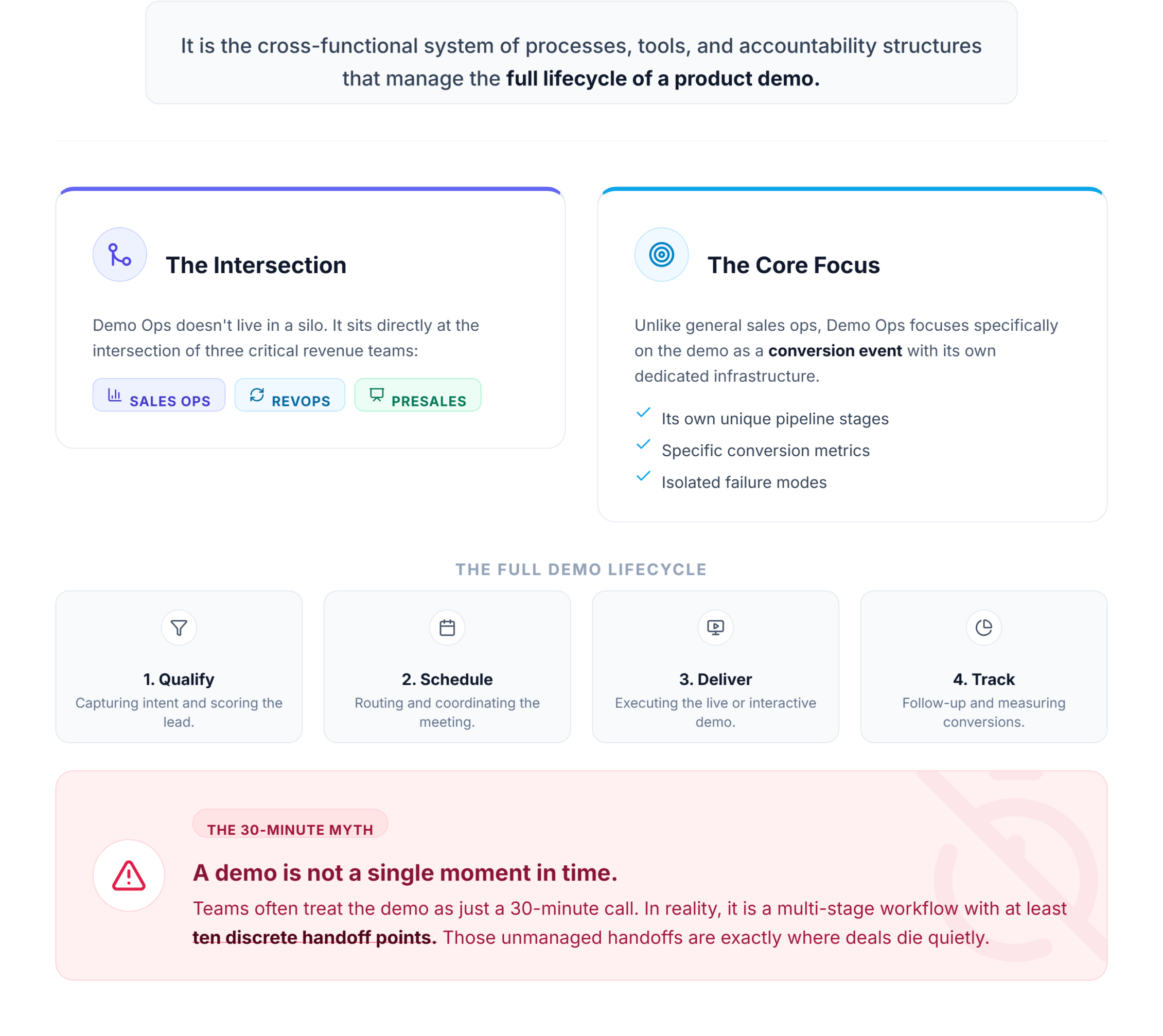
Demo operations is the cross-functional system of processes, tools, and accountability structures that manage the full lifecycle of a product demo — from lead capture and qualification through scheduling, delivery, follow-up, and conversion tracking.
It sits at the intersection of sales operations, RevOps, and presales. But unlike general sales ops, demo operations focuses specifically on the demo as a conversion event with its own pipeline, metrics, and failure modes.
One recurring challenge we see: teams treat the demo as a single moment — a 30-minute call — rather than a multi-stage workflow with at least ten discrete handoff points. That’s where deals die quietly.
Why Demo Operations Matter
Demo operations directly impact revenue predictability, buyer experience, and sales cycle length. Without a structured process, teams default to ad hoc scheduling, inconsistent discovery, and generic feature walkthroughs that fail to create A-ha moments.
Here’s what’s actually at stake:
- Revenue leakage.
When follow-up processes break down, deals stall between demo and proposal. We’ve observed that teams without standardized follow-up playbooks lose visibility on 20-40% of demoed opportunities. - Forecasting gaps.
If you can’t track demo-to-opportunity and demo-to-close rates, your pipeline forecast is guesswork. - Buyer experience erosion.
A prospect who waits 48 hours for scheduling, gets a generic walkthrough, and receives no Mutual Action Plan afterward is already comparing you to the competitor who nailed all three. - Rep inconsistency.
Without demo templates and objection libraries, your best rep closes at 3x the rate of your worst. That’s not a talent problem — it’s an operations problem.
High-performing teams typically treat the demo as a revenue process, not a calendar event. That mindset shift changes everything downstream.
The Complete Demo Operations Workflow
The demo operations workflow consists of ten sequential stages, each with distinct ownership, exit criteria, and failure risks. Here’s the full sequence:
Website Visitor → Demo Request → Qualification → Lead Routing → Scheduling → Discovery → Demo Delivery → Follow-up → Proposal → Closed Won / Closed Lost
Let’s break each stage down.
- 1. Website Visitor. Traffic arrives via organic, paid, or referral channels. The visitor encounters your demo request form — and this is where most teams already leak. If the form doesn’t capture ICP-qualifying data (company size, role, use case), you’re routing blind.
- 2. Demo Request. The form submission triggers the workflow. Smart forms auto-log the lead into your dashboard and tag it for qualification. No manual CSV exports. No Slack messages saying “hey, someone filled out the form.”
- 3. Qualification. This is the gate. Does this prospect match your ICP? Do they have buying signals that indicate real intent? Teams that skip this step waste 30-40% of their demo capacity on unqualified leads.
- 4. Lead Routing. Qualified leads get assigned to the right rep based on territory, segment, product line, or round-robin rules. Manual routing introduces delays. Automated routing via lead routing software cuts response time dramatically.
- 5. Scheduling. The rep (or the system) books the demo. Calendar automation via tools like Calendly or Chili Piper eliminates the back-and-forth email chains that kill momentum. The best demo scheduling tools integrate directly with your CRM.
- 6. Discovery. Before showing anything, spend at least 25% of the call on discovery questions. Confirm the end goal using the ACE Framework. If you skip discovery, you’re guessing what matters — and your demo becomes a feature tour.
- 7. Demo Delivery. This is where product demo best practices come in. Limit to 2-4 key differentiators. Create A-ha moments tied to the prospect’s specific pain. Keep it under 30 minutes. Have a canned demo backup ready in case of tech failure — because 40% of live demos hit issues.
- 8. Follow-up. Send within 24 hours. Use plain-text emails with a calendar link rather than heavy attachments (which trigger spam filters). Use BAMFAM during the demo itself to book the next meeting before anyone hangs up.
- 9. Proposal. Deliver a tailored proposal with a MAP that outlines milestones, decision dates, and stakeholder responsibilities.
- 10. Closed Won / Closed Lost. Log the outcome. Capture the reason. Feed it back into your analytics to refine the entire process.
The Demo Operations Maturity Model
Most SaaS teams operate at Level 1 or 2 of demo operations maturity. We’ve developed a five-level framework to help you benchmark your current state and identify what to build next.
Level 1 · Reactive
Characteristics: No formal process. Demos happen ad hoc. No qualification gate. No KPI tracking. Reps do their own thing.
Next Step: Document your current workflow. Identify who owns each stage.
Level 2 · Standardized
Characteristics: Basic demo templates exist. Scheduling is semi-automated. Follow-up happens, but inconsistently.
Next Step: Implement qualification criteria and SLAs for response time.
Level 3 · Optimized
Characteristics: Qualification is formalized. Routing is automated. Discovery is structured. KPIs are tracked monthly.
Next Step: Build branching paths for different personas. Add objection libraries.
Level 4 · Predictive
Characteristics: Demo analytics inform forecasting. AI-assisted personalization tailors content by industry. Win/loss analysis feeds back into demo design.
Next Step: Integrate demo data with revenue models. Automate follow-up sequences.
Level 5 · Autonomous
Characteristics: Self-serve demos run alongside live demos. Buyer committee members access tailored content asynchronously. Demo ops runs with minimal manual intervention.
Next Step: Continuously test and refine. Expand to new segments and markets.
In many SaaS sales teams, the jump from Level 2 to Level 3 produces the biggest impact. That’s where you stop losing deals to process gaps and start losing them only to product-market fit issues — which is a much better problem to have.
The Most Common Demo Operations Bottlenecks
The seven most frequent demo operations bottlenecks are slow lead response, weak qualification, scheduling friction, poor handoffs, generic demos, absent follow-up, and lack of analytics.
Slow lead response
What it looks like: Leads wait 24+ hours for first contact
The fix: Automate routing + set a 5-minute SLA
Weak qualification
What it looks like: Reps demo to anyone who asks
The fix: Define ICP criteria and enforce a qualification gate
Scheduling delays
What it looks like: 4-5 emails to find a time
The fix: Calendar automation with embedded booking links
Poor handoffs
What it looks like: SDR qualifies, AE has no context
The fix: Shared CRM notes + mandatory handoff template
Generic demos
What it looks like: Same walkthrough for every prospect
The fix: Persona-based demo flows with branching paths
No follow-up process
What it looks like: Prospects go dark after the demo
The fix: Standardized follow-up playbook + BAMFAM
Lack of analytics
What it looks like: No visibility into demo-to-close rate
The fix: Build a KPI dashboard and review weekly
One common pattern among SaaS teams: they invest heavily in top-of-funnel lead gen but treat the demo stage as a “just wing it” moment. The result? Funnel leakage at the exact point where deals should be accelerating.
How to Build a Demo Operations Playbook
Building a demo operations playbook requires seven phases, executed over 6-9 months for full compounding.
- Phase 1 (Week 1-2): Audit your current state. Map every step from demo request to close. Use the audit checklist below. Identify who owns what — and where ownership is ambiguous.
- Phase 2 (Week 2-3): Define qualification criteria. Document your ICP. Create a scoring rubric for high-intent demo requests. Set the gate.
- Phase 3 (Week 3-4): Automate routing and scheduling. Connect your demo form to your CRM. Set up routing rules. Integrate calendar tools. Target: zero manual scheduling for standard demos.
- Phase 4 (Week 4-6): Build demo templates. Create persona-based demo flows. Add 2-4 A-ha moments per flow. Build a demo checklist for pre-call prep. Record a canned demo backup.
- Phase 5 (Week 6-8): Standardize follow-up. Create follow-up email templates (plain text, with calendar links). Build a MAP template. Implement BAMFAM as a non-negotiable step.
- Phase 6 (Week 8-12): Launch analytics. Build your KPI dashboard. Set weekly review cadence. Start tracking demo completion rates — aim for 9-12 steps in self-serve flows, which show 84% higher completion than 5-step demos.
- Phase 7 (Month 3-9): Optimize and scale. Analyze win/loss patterns. Refine demo content based on data. Launch self-serve demos for the buyer committee. Expand to multiple stakeholder demos.
Quick win: If you do nothing else, implement BAMFAM and a 24-hour follow-up SLA. Those two changes alone reduce the 35% reschedule rate we see in teams without structured next-step processes.
Demo Operations KPIs Every SaaS Team Should Track
Demo request volume Weekly
Why it matters: Measures top-of-funnel demand
Qualified demo rate Weekly
Why it matters: Shows qualification gate effectiveness
Response time (lead to first contact) Daily
Why it matters: Speed-to-lead directly correlates with conversion
Scheduling rate Weekly
Why it matters: Percentage of qualified leads who book
Attendance rate Weekly
Why it matters: No-show rate reveals scheduling or qualification issues
Demo completion rate Weekly
Why it matters: For self-serve: are users finishing the flow?
Demo-to-opportunity rate Bi-weekly
Why it matters: Conversion from demo to qualified pipeline
Demo-to-close rate Monthly
Why it matters: The ultimate effectiveness metric
Sales cycle length Monthly
Why it matters: Time from first demo to closed-won
Revenue influenced Monthly
Why it matters: Total revenue touched by demo-sourced pipeline
Demo Operations Health Score
Score yourself 0-2 on each question (0 = No, 1 = Partially, 2 = Yes). Total possible: 20.
Score (0-2): ___
Score (0-2): ___
Score (0-2): ___
Score (0-2): ___
Score (0-2): ___
Score (0-2): ___
Score (0-2): ___
Score (0-2): ___
Score (0-2): ___
Score (0-2): ___
0-8: Reactive. Start with the audit checklist. 9-14: Standardized. Focus on automation and analytics. 15-20: Optimized or above. Move toward predictive and autonomous.
Demo Operations Audit Checklist
Use this to diagnose gaps in your current process:
- ☐ ICP and qualification criteria are documented
- ☐ SLA for lead response time is defined (target: under 5 minutes)
- ☐ Demo request form captures qualifying data
- ☐ Lead routing rules are automated
- ☐ Calendar automation is active
- ☐ Discovery call framework is standardized
- ☐ Demo templates exist for each persona
- ☐ A-ha moments are mapped per demo flow
- ☐ Objection library is maintained and accessible
- ☐ Canned demo backup is recorded and current
- ☐ Demo environment is clean and separate from production
- ☐ Follow-up email templates are approved and tested
- ☐ BAMFAM is a documented step in the process
- ☐ MAP template is available for post-demo use
- ☐ KPI dashboard is live and reviewed weekly
- ☐ Win/loss analysis is conducted monthly
- ☐ Demo flows are updated quarterly
- ☐ Handoff process between SDR and AE is documented
- ☐ Demo mistakes are cataloged and used for training
How LevelUp Supports Demo Operations
We’ve observed that most SaaS teams cobble together 4-6 disconnected tools to manage their demo workflow — a form builder here, a calendar tool there, a spreadsheet for tracking, and a CRM that nobody updates.
LevelUp Demo was built to consolidate the operational layer. The smart demo form replaces your existing request form and auto-logs leads into a centralized dashboard. From there, lead qualification, scheduling, outcome tracking, and follow-up management happen in one workspace — not across seven browser tabs.
The analytics dashboard tracks the KPIs outlined above without requiring a BI tool or custom Salesforce reports. And for teams that are still early-stage, it works alongside your existing CRM rather than replacing it.
LevelUp Demo
If your team is building or refining a demo operations process, explore how LevelUp Demo fits into your workflow — or check the pricing to see if it matches your stage.
Frequently Asked Questions
What is a demo operations playbook?
A demo operations playbook is a documented system covering every stage of the demo lifecycle — from lead capture and qualification through delivery, follow-up, and conversion tracking. It defines ownership, SLAs, templates, and KPIs so the process runs consistently regardless of which rep is involved.
Who owns demo operations in a SaaS company?
Ownership typically sits with RevOps or sales leadership. In smaller teams, the founder or head of sales owns it. The key is that someone owns the end-to-end workflow — not just individual stages. Shared ownership without clear accountability is where most processes break.
What KPIs should demo operations teams track?
At minimum: demo request volume, qualified demo rate, response time, attendance rate, demo-to-opportunity rate, demo-to-close rate, and sales cycle length. Review response time daily and conversion metrics weekly.
How is demo operations different from sales operations?
Sales operations covers the entire sales process — territory planning, compensation, CRM management, forecasting. Demo operations is a subset focused specifically on the demo as a conversion event, with its own workflow, metrics, and optimization levers.
What tools are used for demo operations?
Common categories include CRM (HubSpot, Salesforce), scheduling (Calendly, Chili Piper), interactive demo platforms (Navattic, Consensus, Demostack, Storylane, Walnut), analytics (Gong), and demo management software that consolidates multiple functions.
How often should a demo process be reviewed?
KPIs should be reviewed weekly. Demo templates and flows should be updated quarterly. A full process audit — using a checklist like the one above — should happen every six months or whenever conversion rates shift by more than 10%.
What to Do Next
Don’t try to build all of this at once. Start here:
- 1. This week: Run the health score assessment. Be honest.
- 2. Next week: Complete the audit checklist. Flag the three biggest gaps.
- 3. Within 30 days: Implement BAMFAM, a 24-hour follow-up SLA, and calendar automation.
- 4. Within 90 days: Build your KPI dashboard and start weekly reviews.
The demo is often the single highest-leverage moment in your sales cycle. Treating it like a process — not just a performance — is what separates teams that grow predictably from teams that just get lucky sometimes.