What is the difference between interactive product demos and live product demos? Interactive product demos are self-guided experiences that let prospects explore a product at their own pace without speaking to a sales representative. Live product demos are real-time presentations led by a salesperson, allowing personalized conversations, discovery, and objection handling. Most SaaS companies benefit from using both at different stages of the buying journey.
Two Buyers, One Website, Zero Patience for the Wrong Experience
Imagine two potential buyers visit your website within the same hour.
One wants to click around the product immediately, no meetings, no calendars, no small talk. The other needs to discuss integrations with their existing tech stack, negotiate pricing for 200 seats, and loop in a VP of Engineering before anything moves forward.
Should both receive the same type of demo?
Probably not.
Interactive Product Demos vs Live Product Demos is a decision every SaaS team eventually faces. While both help prospects evaluate your product, they serve very different purposes in the buyer journey. Choosing the wrong demo format at the wrong stage can create friction, waste your sales team’s time, and hurt conversions.
Yet many SaaS companies still funnel every prospect into the same demo experience and wonder why conversion rates stall.
We’ve seen SaaS teams assume interactive demos can replace live demos entirely. In reality, the highest-converting teams use both at different stages of the buyer journey.
Knowing when to use each demo format is the difference between a leaky funnel and a revenue engine.
The Quick Verdict: In the Interactive Product Demos vs Live Product Demos debate, interactive demos win for top-of-funnel engagement, scalability, and product-led growth motions. Live demos win for enterprise deals, complex discovery, and closing high-value accounts. The smartest SaaS companies don’t choose one. They build a demo journey that layers both.
The Quick Verdict: In the Interactive Product Demos vs Live Product Demos debate, Interactive demos win for top-of-funnel engagement, scalability, and product-led growth motions. Live demos win for enterprise deals, complex discovery, and closing high-value accounts. The smartest SaaS companies don’t choose one. They build a demo journey that layers both.
What Is a Live Product Demo?
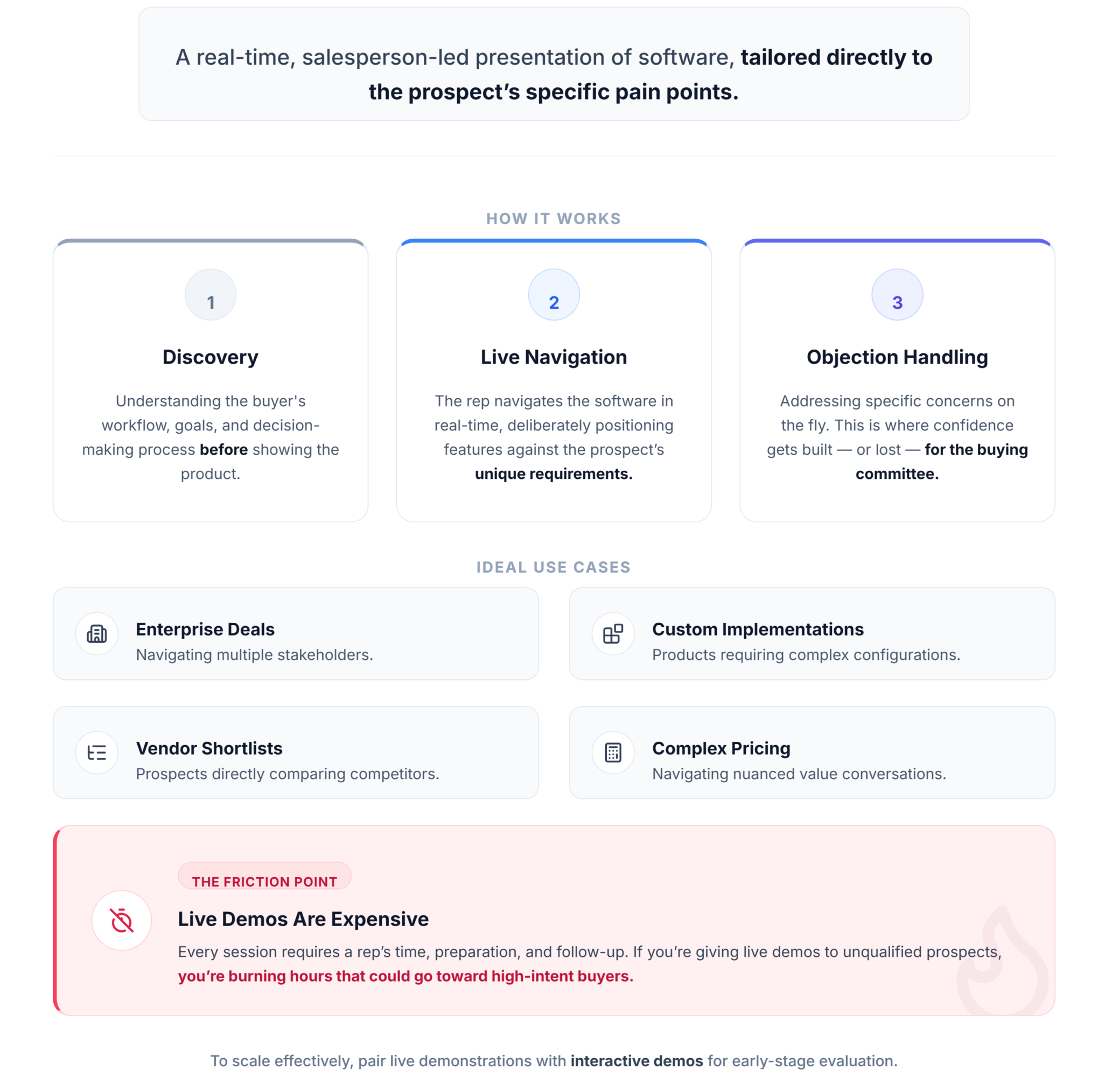
A live product demo is a real-time, salesperson-led presentation of a software product. It typically happens over a video call (sometimes in person) and involves a sales engineer or account executive walking a prospect through the product while tailoring the conversation to their specific pain points.
How it works: A prospect books a meeting. Before the call, a rep runs discovery — understanding the buyer’s workflow, goals, and decision-making process. During the demo, the rep navigates the product live, answers questions in real time, handles objections, and positions features against the prospect’s unique requirements.
Where it fits: Mid-to-bottom of the funnel. After initial interest has been established and the prospect has been qualified.
Ideal use cases:
- Enterprise deals with multiple stakeholders
- Products requiring custom implementation or configuration
- Complex pricing conversations
- Prospects comparing shortlisted vendors
- Situations where objection handling determines the outcome
Live demos are excellent for uncovering complex business needs, while interactive demos remove friction during early product evaluation. When a deal involves a buying committee, executive sign-off, or technical validation, a live demo is where confidence gets built — or lost.
The friction point? Live demos are expensive. Every session requires a rep’s time, preparation, and follow-up. Scale becomes a problem fast when your pipeline grows faster than your team. And if you’re giving live demos to unqualified prospects, you’re burning hours that could go toward high-intent demo requests.
For teams looking to sharpen their approach, understanding how to give a product demo that actually converts is foundational. Pairing that with solid product demo best practices separates average reps from closers.
What Is an Interactive Product Demo?
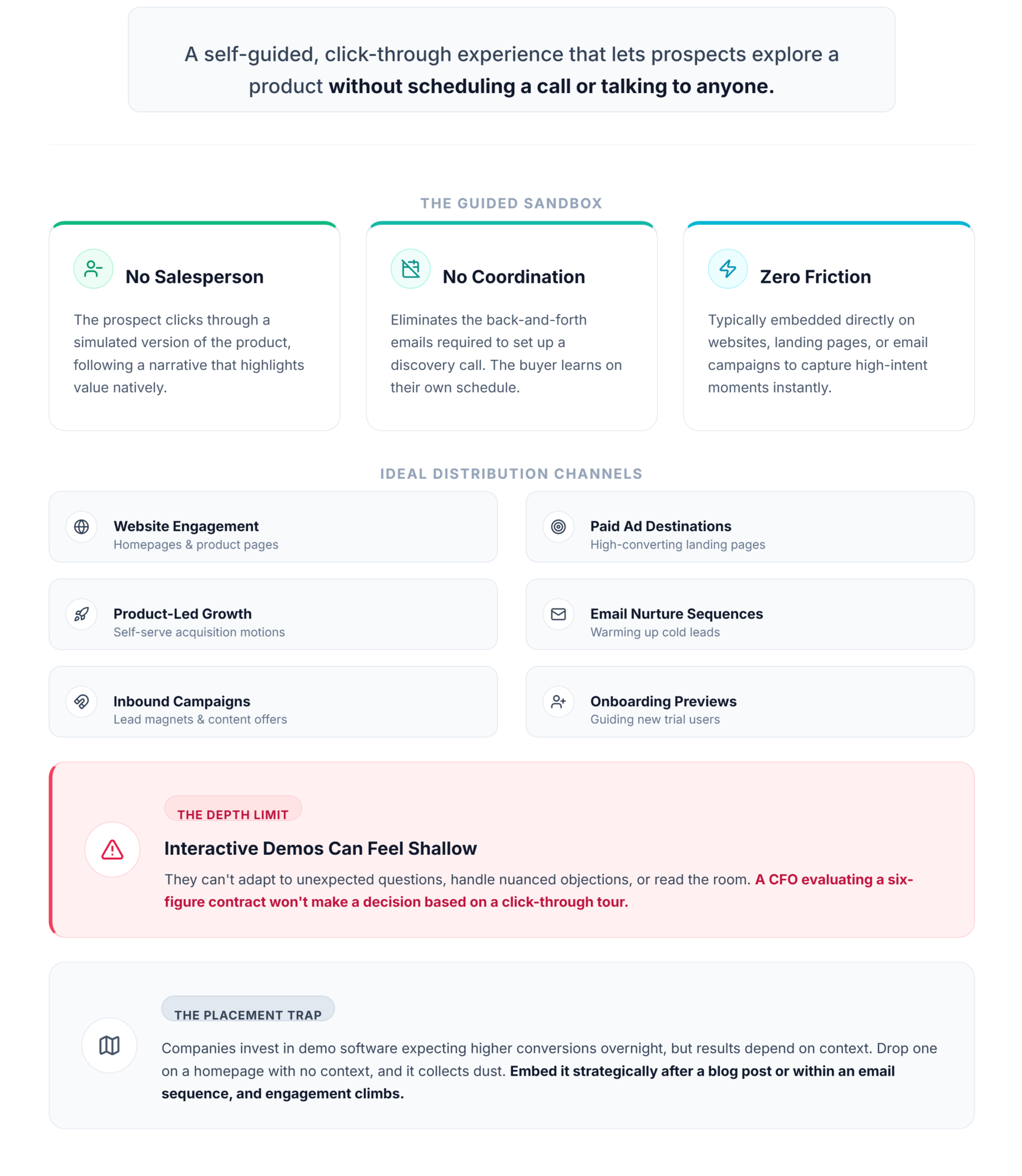
An interactive product demo is a self-guided, click-through experience that lets prospects explore a product without scheduling a call or talking to anyone. These demos are typically embedded on websites, landing pages, email campaigns, or ad destinations.
Think of it as a guided sandbox. The prospect clicks through a simulated or live version of the product, following a narrative that highlights key features and value propositions. No salesperson required. No calendar coordination. No friction.
Common tools for building interactive product demos include platforms like Navattic, Storylane, Walnut, and Tourial — each offering slightly different approaches to building these experiences.
Where it fits: Top-of-funnel. Awareness and early evaluation stages.
Ideal use cases:
- Website engagement and conversion
- Product-led growth motions
- Inbound marketing campaigns
- Paid ad landing pages
- Email nurture sequences
- Onboarding previews for trial users
The friction point? Interactive demos can feel shallow for sophisticated buyers. They can’t adapt to unexpected questions, handle nuanced objections, or read the room. A CFO evaluating a six-figure contract won’t make a decision based on a click-through tour.
Companies often invest in interactive demo software expecting higher conversions overnight, but results usually depend on where those demos are introduced in the sales process. Drop one on a homepage with no context, and it collects dust. Embed it strategically after a blog post or within an email sequence targeting warm leads, and engagement climbs.
For teams evaluating tools, comparing demo automation software or reviewing Walnut alternatives can help identify the right fit.
Interactive Product Demos vs Live Product Demos: Key Differences
| Factor | Live Product Demo | Interactive Product Demo |
|---|---|---|
| Human interaction | High — real-time conversation | None — fully self-guided |
| Personalization | Deep — tailored to buyer’s workflow | Limited — pre-built narrative paths |
| Scalability | Low — requires rep time per session | High — unlimited concurrent users |
| Buyer control | Moderate — rep guides the flow | Full — prospect drives the pace |
| Qualification | Strong — discovery happens in real time | Weak — relies on behavioral signals |
| Objection handling | Real-time — reps address concerns live | None — objections go unanswered |
| Cost per demo | High — salaries, prep, follow-up | Low — one-time build, ongoing use |
| Sales effort | Significant — scheduling, prep, delivery | Minimal — set it and forget it |
| Best funnel stage | Mid-to-bottom | Top-to-mid |
| Buying intent signal | High — prospect committed time | Variable — could be casual browsing |
The takeaway: Interactive demos create accessibility. Live demos create confidence. They solve different problems at different moments, and treating them as interchangeable is where most SaaS teams trip up.
When Should SaaS Companies Use Live Product Demos?
Live demos earn their keep when the deal is complex, the stakes are high, or the buyer needs to feel heard.
- Enterprise sales
Deals involving procurement teams, security reviews, and legal sign-off require human conversation. A click-through demo won’t survive a multiple stakeholder demo scenario. - Custom workflows
When the prospect’s use case doesn’t fit a standard narrative, a rep needs to show flexibility live. - Objection-heavy sales cycles
Pricing concerns, competitive comparisons, and implementation fears require handling objections during product demos with nuance. - High-ACV deals
When contract values justify the time investment, live demos deliver ROI that self-serve experiences can’t match.
When Should SaaS Companies Use Interactive Product Demos?
Interactive demos shine when the goal is volume, speed, and reducing friction for early-stage buyers.
- Top-of-funnel engagement
A prospect reading a blog post clicks an embedded demo and experiences the product in under three minutes. No form fill. No waiting. - Product-led growth
Companies with self-serve motions use interactive demos to accelerate the “aha moment” before a free trial even starts. - Paid ad campaigns
Sending ad traffic to an interactive demo instead of a static landing page gives prospects something to do, not just read. - Email nurture
Dropping an interactive demo link into a mid-funnel email sequence re-engages prospects who went cold.
Can Interactive Demos Replace Live Product Demos?
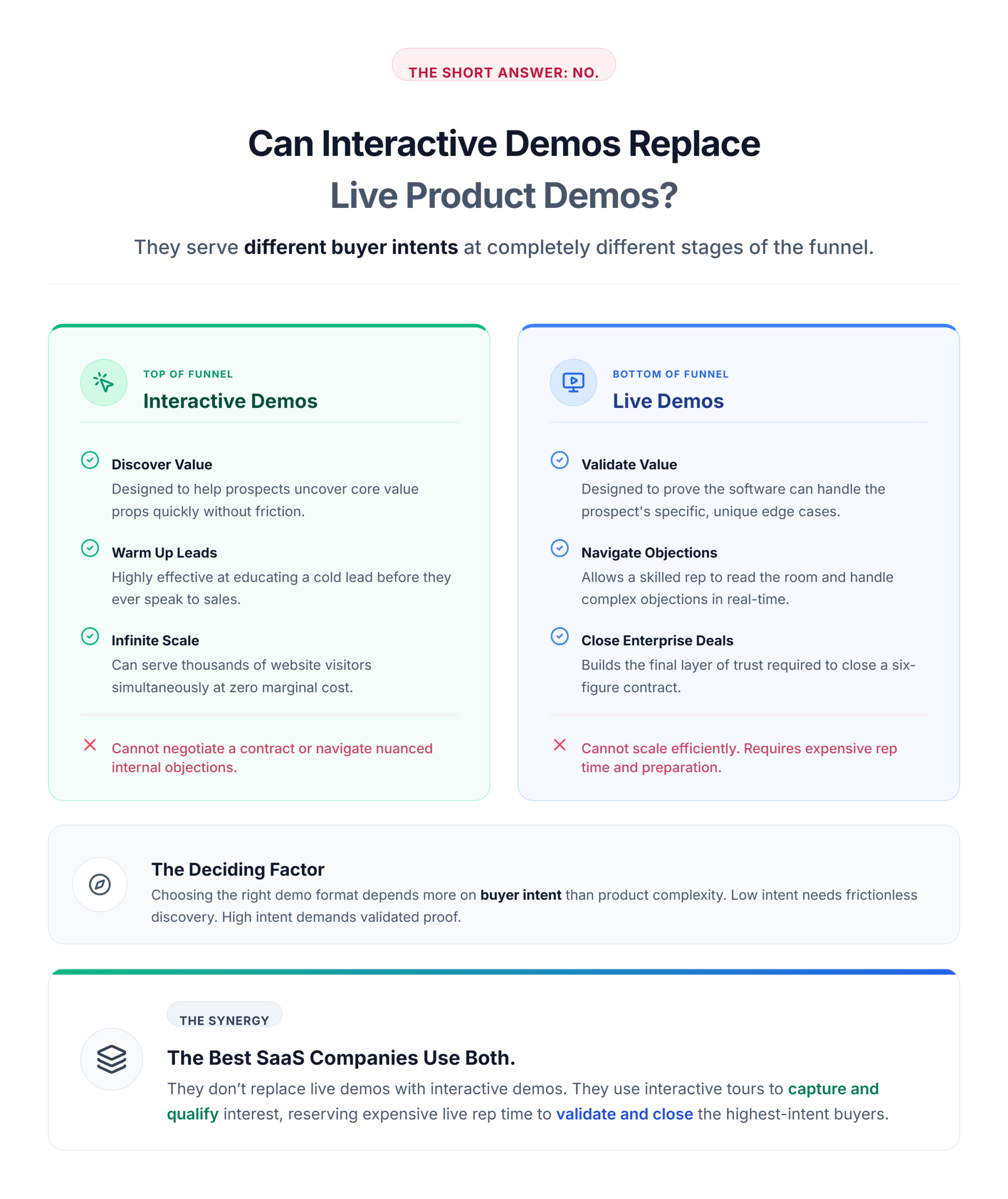
No.
Interactive demos help prospects discover value. Live demos help decision-makers validate it.
They serve different buyer intents at different stages. An interactive demo can warm up a cold lead, but it can’t negotiate a contract. A live demo can close an enterprise deal, but it can’t scale to thousands of website visitors simultaneously.
Choosing the right demo format depends more on buyer intent than product complexity.
The best SaaS companies don’t replace live demos with interactive demos. They use each where it delivers the most value.
A Hybrid Demo Strategy Delivers the Best Results
Modern SaaS sales teams build demo journeys, not isolated demo experiences. Here’s what a complete hybrid flow looks like:
Website Visitor → Interactive Demo (self-guided exploration) → Demo Request (prospect signals intent) → Discovery Call (rep qualifies and uncovers needs) → Live Product Demo (tailored presentation) → Stakeholder Demo (executive or technical validation) → Proposal → Customer
Each step builds on the previous one. The interactive demo generates interest and qualifies intent through engagement signals. The discovery call questions uncover what matters most. The live demo addresses those specific needs. The stakeholder demo gets buy-in from the broader committee.
This layered approach means reps only spend time on prospects who’ve already demonstrated interest — dramatically improving demo-to-close rates and reducing funnel leakage.
Teams focused on pipeline efficiency should also explore how to increase demo booking rate between the interactive demo and live demo stages.
Common Mistakes SaaS Teams Make
- Expecting interactive demos to close enterprise deals. They won’t. They’re designed to generate interest, not negotiate terms.
- Giving live demos too early. Demoing before discovery means presenting features without context. That’s a recipe for “looks great, we’ll get back to you.”
- Using only one demo format. A single-format strategy leaves gaps in the buyer journey.
- Not qualifying buyers first. Every live demo given to an unqualified prospect is time stolen from a deal that could close.
- Poor follow-up after interactive demos. If someone completes an interactive demo and nobody follows up within 24 hours, that buying signal evaporates.
- Measuring demo volume instead of demo quality. Fifty demos a week means nothing if none of them convert.
Which Demo Approach Is Right for Your SaaS Business?
| Your Goal | Recommended Approach |
|---|---|
| Generate demand | Interactive |
| Qualify buyers | Live |
| Enterprise sales | Live |
| Product-led growth | Interactive |
| Self-service evaluation | Interactive |
| Complex implementation | Live |
| Executive presentations | Live |
| Website engagement | Interactive |
| Customer education | Interactive |
How LevelUp Fits Into a Modern Demo Strategy
The reality is that modern SaaS companies don’t choose between live and interactive demos. They build a demo ecosystem — and they need infrastructure to manage it.
LevelUp helps teams qualify demo requests, route leads to the right reps, schedule demos without the back-and-forth, and manage the entire demo workflow from first touch to closed deal. When interactive demos generate a surge of high-intent demo requests, LevelUp ensures none of them slip through the cracks.
It’s not about replacing your demo strategy. It’s about making sure every demo — interactive or live — leads somewhere.
LevelUp Demo
Make every demo lead somewhere.
LevelUp qualifies demo requests, routes leads to the right reps, and manages the whole demo workflow from first touch to closed deal — so the surge from your interactive demos never slips through the cracks.
Frequently Asked Questions
What is an interactive product demo?
An interactive product demo is a self-guided, click-through experience that allows prospects to explore a software product without scheduling a meeting or speaking with a salesperson. These demos are typically embedded on websites, landing pages, or shared via email campaigns.
What is a live product demo?
A live product demo is a real-time presentation of a software product led by a salesperson or sales engineer. It involves personalized conversation, discovery, objection handling, and is typically conducted over video call.
Which is better: interactive or live product demos?
Neither is universally better. Interactive demos excel at top-of-funnel engagement and scalability. Live demos excel at enterprise sales, complex discovery, and closing high-value deals. The most effective SaaS companies use both within a structured demo journey.
Can interactive demos replace live demos?
No. Interactive demos generate interest and help prospects discover value independently. Live demos build confidence, handle objections, and close deals. They serve different buyer intents and different funnel stages.
When should SaaS companies use interactive demos?
SaaS companies should use interactive demos for website engagement, product-led growth, inbound marketing, paid ad campaigns, email nurture sequences, and early-stage product evaluation where scheduling a call creates unnecessary friction.
Are interactive demos suitable for enterprise sales?
Interactive demos can support enterprise sales as a top-of-funnel touchpoint, but they cannot replace the live demos, stakeholder presentations, and discovery conversations that enterprise deals require.
How do interactive demos improve conversions?
Interactive demos improve conversions by reducing friction in early-stage evaluation. Prospects can experience the product immediately without booking a meeting, which increases engagement and generates more qualified demo requests downstream.