
How can SaaS companies reduce sales cycle length? SaaS companies can reduce sales cycle length by improving lead qualification, responding faster to demo requests, personalizing product demos, involving stakeholders early, addressing objections proactively, and creating clear post-demo next steps. Sales cycle reduction is usually a byproduct of better buyer experiences, not more aggressive selling.
A 30-day sales cycle and a 90-day sales cycle can start with the exact same lead.
The difference usually isn’t product quality. It’s how efficiently the opportunity moves through the buying journey. Stalled deals, delayed decisions, stakeholder bottlenecks, pipeline friction — these are the things that turn a promising opportunity into a three-month slog. And most of the time, the prospect hasn’t lost interest. They’ve hit a wall your process didn’t clear for them.
We’ve seen companies spend heavily on lead generation while opportunities sit untouched for days after a demo. That’s the disconnect. You don’t need more leads. You need the ones you have to move faster.
This piece breaks down exactly how to make that happen — with frameworks, checklists, and the operational details that actually compress timelines. If you’re building or refining your sales pipeline, this is where the leverage sits.
What Is Sales Cycle Length?
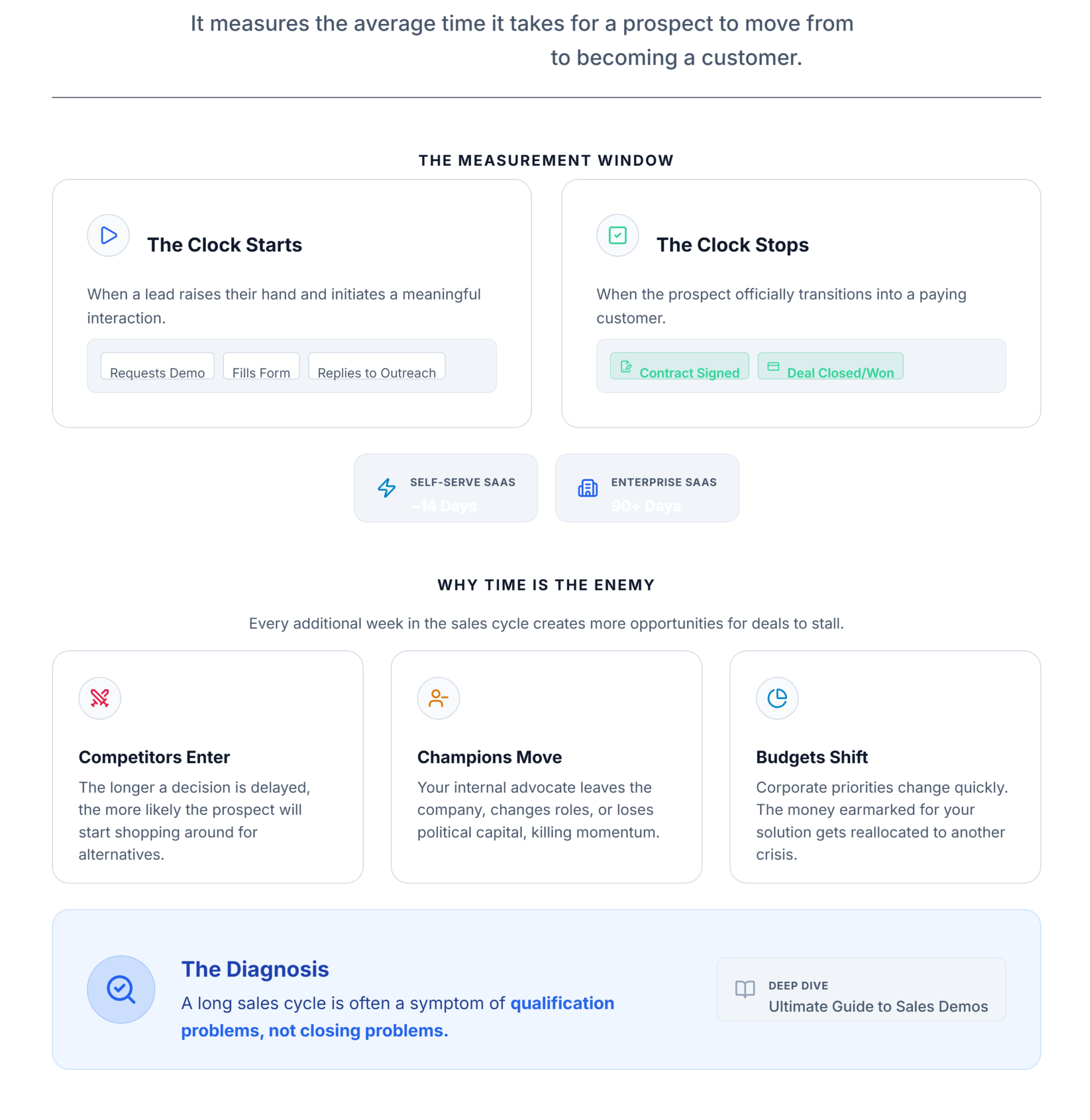
Sales cycle length measures the average time it takes for a prospect to move from first meaningful engagement to becoming a customer.
It’s the clock that starts when a lead raises their hand — requests a demo, responds to outreach, fills out a form — and stops when the deal closes. For most B2B SaaS companies, this ranges from 14 days for self-serve products to 90+ days for enterprise deals with procurement layers.
Why does it matter? Because every additional week in the sales cycle creates more opportunities for deals to stall. Competitors enter the picture. Champions change roles. Budgets get reallocated. A long sales cycle is often a symptom of qualification problems, not closing problems.
For a deeper look at the full demo-to-close process, the ultimate guide to sales demos covers the end-to-end flow.
Why Long Sales Cycles Hurt SaaS Growth
Delayed revenue is the obvious cost. But the cascading effects are worse:
- Forecast accuracy drops
When deals drag, pipeline projections become guesswork. - Sales efficiency tanks
Reps spend more time per deal, reducing total capacity. - Opportunities leak
Prospects go dark. Competitors move faster. Internal priorities shift. - CAC inflates
More touches, more meetings, more resources per closed deal.
Every unnecessary step in the buying journey increases the likelihood of deal stagnation. And the worst part? Most teams don’t realize the cycle is bloated until they compare their numbers against benchmarks.
The Biggest Causes of Long SaaS Sales Cycles
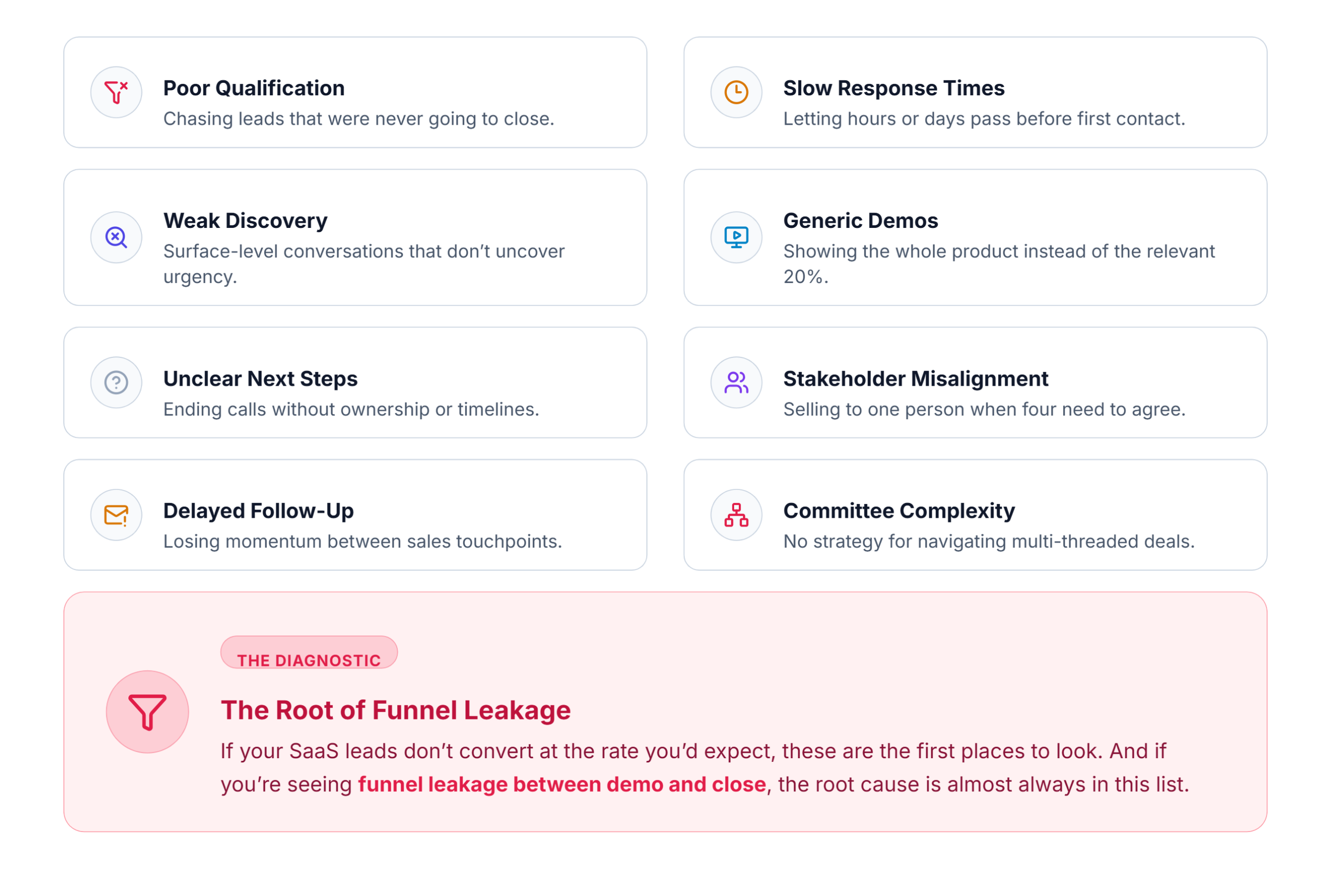
Here’s the list. Most teams have at least three of these running simultaneously:
- Poor qualification — chasing leads that were never going to close
- Slow response times — letting hours or days pass before first contact
- Weak discovery — surface-level conversations that don’t uncover urgency
- Generic demos — showing the whole product instead of the relevant 20%
- Unclear next steps — ending calls without ownership or timelines
- Stakeholder misalignment — selling to one person when four need to agree
- Delayed follow-up — losing momentum between touchpoints
- Buying committee complexity — no strategy for navigating multi-threaded deals
If your SaaS leads don’t convert at the rate you’d expect, these are the first places to look. And if you’re seeing funnel leakage between demo and close, the root cause is almost always in this list.
7 Proven Ways to Reduce Sales Cycle Length
This is the core. Each tactic targets a specific friction point in the buying journey.
1. Improve Lead Qualification Early
Faster sales cycles start with better qualification. If you’re spending demo time on leads that don’t fit your ICP, you’re burning capacity on deals that were never real.
Use automated lead scoring to tag leads based on intent signals — pricing page visits, ROI guide downloads, feature comparison views. Set a threshold (75 points works well for most mid-market SaaS) for auto-routing to demo booking. Score based on behavior, not just form data, because the “Industry” field gets left blank more often than you’d think.
The verification: your CRM shows a “High Intent” badge next to the lead, and the booking button is active — no manual steps required.
Learn how to qualify demo requests effectively, identify high-intent demo requests, and build a pipeline of qualified SaaS leads.
2. Respond Faster to Demo Requests
A successful demo booking flow takes about 4 minutes from click to confirmation email. If it exceeds 8 minutes, the lead cools by roughly 22%. That’s the speed-to-lead math.
The first-response advantage is real. The team that responds first usually wins — not because their product is better, but because they removed the friction of waiting.
One thing I see constantly: confirmation emails landing in Spam for leads using corporate Outlook gateways. The sensory signal of a lost lead is the absence of a reply within two hours. Send a backup text: “Did you get the email? It might be in Spam.”
Dig into lead response time benchmarks, evaluate lead routing software, and figure out how to assign leads without bottlenecks.
3. Run Better Discovery Calls
The “Front-Load Discovery” tactic works: ask “Who else needs to be involved?” and “What’s the risk of doing nothing?” in the first five minutes. Then schedule the stakeholder meeting within 10 days.
Generic questions like “What’s your budget?” get generic answers. When a lead says “I don’t know the budget,” ask instead: “Is this in the right ballpark for [Product Tier]?” It keeps the conversation moving without forcing commitment on a number they genuinely might not have.
Open a Mutual Action Plan during the call — shared timeline, milestones, owners, dates. This single artifact compresses cycles more than any other tool I’ve used.
4. Personalize Product Demos
Generic demos are cycle killers. When you show the whole product, you dilute relevance and give the prospect more to “think about” — which really means more reasons to delay.
Focus on buyer-specific workflows. If they’re in fintech, show the compliance reporting feature. If they’re a 5-person startup, skip the enterprise admin panel. Let the lead click through the product in real-time where possible — interactive demos outperform static slide decks by a wide margin.
Quick friction note: interactive demo tools often fail when browser cookies are blocked. Pre-call check: “Please ensure cookies are enabled for [your domain].”
Read up on how to personalize a SaaS demo, review product demo best practices, and get the full breakdown on how to give a product demo that moves deals forward.
5. Involve Stakeholders Earlier
The biggest hidden cycle-extender: selling to one champion and then waiting weeks for them to “socialize” internally. By the time the CFO or VP of Eng gets looped in, momentum is gone.
Ask for stakeholder access during discovery — not after the demo. If you can get the buying committee in the room (or on the call) by Stage 3, you compress what would’ve been two separate evaluation loops into one.
6. Handle Objections Before They Become Roadblocks
The best SaaS teams remove obstacles before prospects encounter them. That means sending your SOC 2 Type II report, standard DPA, and a pre-completed security questionnaire proactively at Stage 3 — before the lead’s legal team asks.
If you wait for the procurement request, you’ve added 2–3 weeks. If you send a pre-approved MSA template upfront, you cut that to days.
.
7. Define Clear Next Steps After Every Demo
Every demo should end with three things: an owner, a timeline, and an action item. Not “let’s circle back next week.” Specific: “Sarah will share the security questionnaire by Thursday, and we’ll reconvene Friday at 2pm to review with your VP.”
No clear next step = the deal enters limbo. And limbo is where sales cycles go to die.
A Sales Cycle Acceleration Framework
Stage 1 · Qualification
Stage 2 · Discovery
Stage 3 · Demo
Stage 4 · Stakeholder Alignment
Stage 5 · Decision
Stage 6 · Close
Long sales cycles are often caused by process friction rather than lack of interest. This framework targets friction at every stage.
Common Mistakes That Slow Down SaaS Sales Cycles
- Chasing every lead instead of prioritizing ICP-fit opportunities
- Running generic demos that don’t connect to the buyer’s specific pain
- Weak discovery that skips urgency and risk questions
- Missing stakeholders until Stage 5
- Poor follow-up cadence — waiting for the prospect to drive next steps
- No urgency creation — failing to quantify the cost of inaction
Faster sales cycles are usually built through better process design, not more aggressive selling.
How High-Performing SaaS Teams Reduce Time-to-Close
Qualification is automated. Leads are scored, routed, and booked within minutes. Champion data (LinkedIn profile, recent company news) is pre-loaded. The demo booking rate is tracked weekly.
The conversation is personalized. Stakeholders are present. Objections are addressed in real-time. The Mutual Action Plan is visible and updated live.
Follow-up goes out within the hour. Security docs are attached proactively. The demo-to-close rate is measured per rep, per segment.
High-performing SaaS teams remove friction before it becomes an objection.
How LevelUp Helps SaaS Teams Reduce Sales Cycle Length
This is where tools matter — but only if they solve the right problems.
LevelUp gives teams qualification visibility directly inside the demo workflow. Leads are captured, scored, and routed without manual CRM entry. Demo scheduling integrates with Google Calendar. Stakeholder coordination happens inside a single view. Follow-up workflows include reminders, status tracking, and outcome logging.
It’s not a replacement for your CRM. It’s the layer between “lead raised hand” and “deal closed” that most CRMs handle poorly. For teams that want to request a demo and see how it fits, the setup takes minutes.
LevelUp Demo
Move the deals you already have faster.
LevelUp captures, scores, and routes leads without manual CRM entry, then handles scheduling, stakeholder coordination, and follow-up — the layer between “lead raised hand” and “deal closed.”
FAQ
What is sales cycle length?
Sales cycle length is the average number of days between a prospect’s first meaningful engagement (demo request, sales call, form fill) and their conversion to a paying customer. It’s a core metric for forecasting revenue and measuring sales efficiency in SaaS.
How can SaaS companies reduce sales cycle length?
SaaS companies reduce sales cycle length by qualifying leads earlier, responding faster to demo requests, personalizing demos to buyer-specific pain points, involving stakeholders before Stage 4, handling objections proactively with pre-sent security and legal docs, and defining clear next steps after every interaction.
What causes long SaaS sales cycles?
The most common causes are poor lead qualification, slow response times, generic product demos, weak discovery calls, stakeholder misalignment, delayed follow-up, and buying committee complexity. Process friction — not prospect disinterest — is usually the root cause.
How do demos impact sales cycle length?
Demos are the highest-leverage moment in the sales cycle. A personalized, interactive demo that addresses the buyer’s specific workflow can compress evaluation time significantly. A generic demo creates more questions, more internal meetings, and more delays.
Why is lead qualification important for faster sales?
Without strong lead qualification, sales teams spend time on prospects who don’t fit the ICP, lack budget authority, or aren’t ready to buy. Better qualification means reps focus on deals with real momentum — which directly reduces average cycle length.
The Bottom Line
A long sales cycle doesn’t mean your product needs work. It usually means your process does. Start with qualification, fix the friction points in sequence, and measure the delta. The deals will tell you what’s working.