
Product demo best practices are strategies used by SaaS sales teams to deliver more relevant, engaging, and conversion-focused demos. These include strong discovery, personalization, problem-led walkthroughs, clear next steps, and focused storytelling instead of generic feature presentations.
Most SaaS demos fail for a simple reason: the rep shows the product before fully understanding the buyer’s problem.
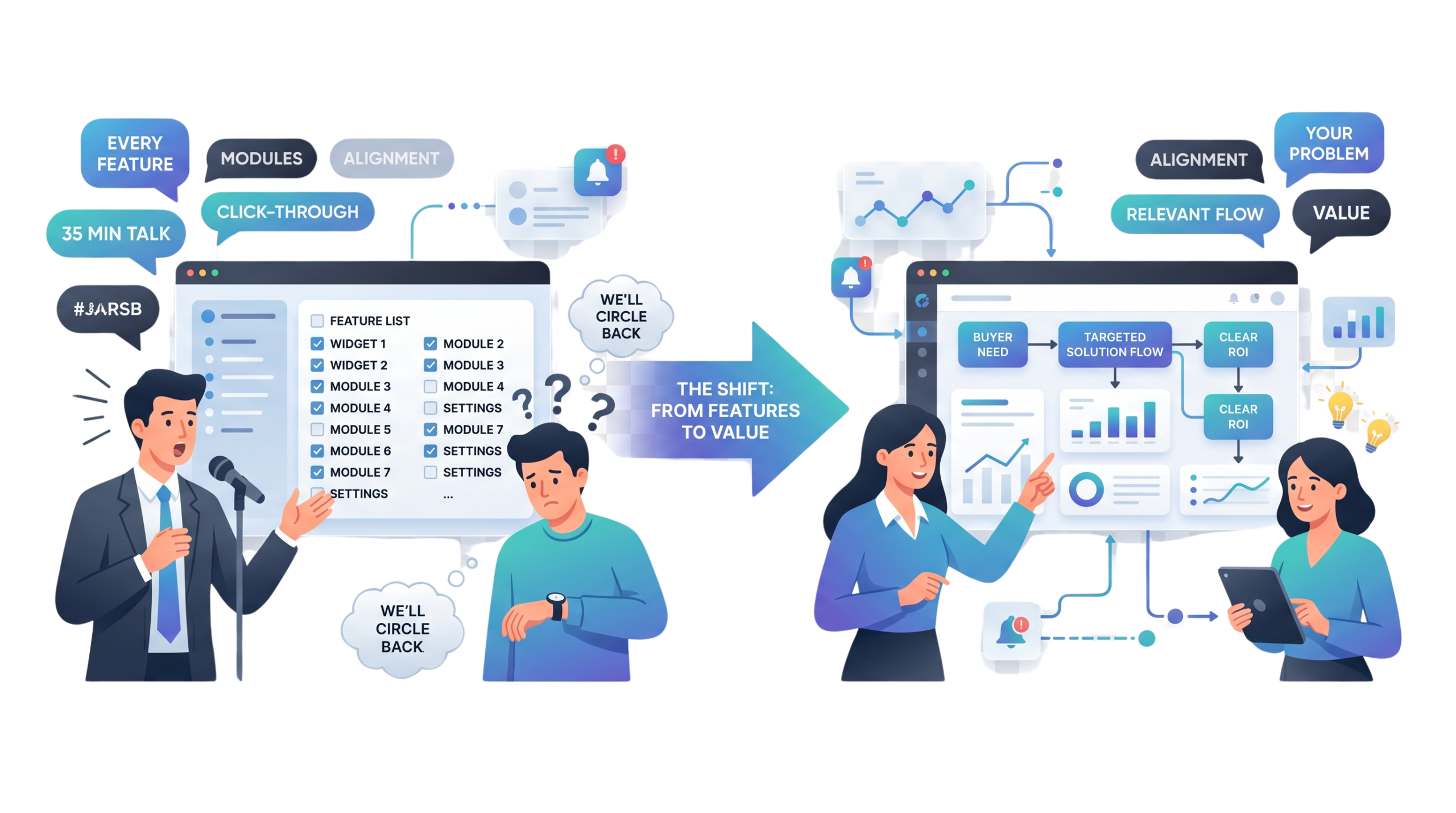
We’ve seen it play out dozens of times. A prospect books a demo. The rep fires up a polished walkthrough, clicks through every module, talks for 35 minutes straight—and then the prospect says, “This is great. We’ll circle back.” They never do.
The demo wasn’t bad. The product wasn’t bad. But the conversation never connected to what the buyer actually cared about. Features piled up. Context disappeared. Objections surfaced too late. And the next step? Something vague like “let us know.”
This is the pattern behind most lost demo opportunities. Demos become feature-heavy. Buyers lose the thread. Engagement drops. And the deal stalls.
The fix isn’t a better slide deck. It’s structure, buyer alignment, personalization, and clarity about what happens next.
By the end of this guide, you’ll have a repeatable framework for running SaaS product demos that actually move prospects toward a decision—whether your team is two people or twenty.
The Pre-Flight Check: Are You Actually Ready to Demo?
Before running through best practices, here’s a quick readiness gut-check.
You should also have:
- A CRM record with populated qualification fields
- A short agenda attached to the calendar invite
- A demo flow mapped to one or two pain points (not your entire feature set)
- A clear owner for post-demo follow-up
If those aren’t locked down, the best practices below won’t save you. Fix the workflow first. If you want a full breakdown of what to prepare before every call, our SaaS demo checklist covers the operational side.
Why Most SaaS Product Demos Fail
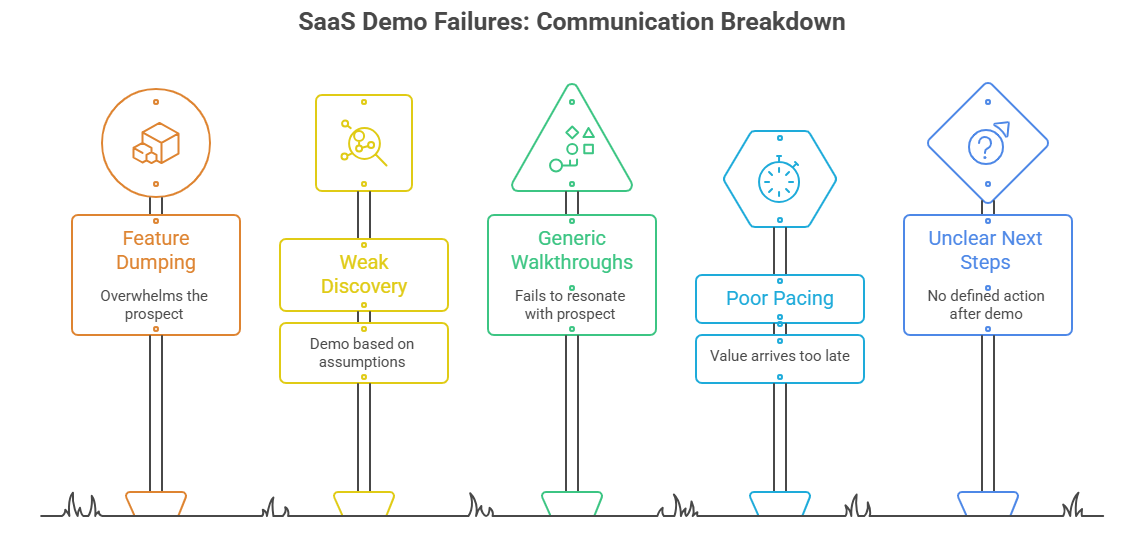
Most failed demos are not product problems. They are communication and workflow problems. The usual suspects:
- Feature dumping. Reps walk through every tab, every setting, every integration. The prospect’s eyes glaze over around minute twelve. Research suggests that too much feature coverage actively lowers comprehension—buyers remember relevant moments, not every feature shown during the demo.
- Weak discovery. The rep didn’t run a proper discovery call beforehand, so the demo is built on assumptions. Most demo objections appear because discovery was incomplete.
- Generic walkthroughs. Same demo for a 10-person startup and a 500-person enterprise team. Same flow, same data, same story. The prospect can tell.
- Poor pacing. Twenty minutes of setup before reaching any value. By the time the “good part” arrives, attention is gone.
- Unclear next steps. The demo ends with “any questions?” instead of a defined action. No owner, no timeline, no momentum.
What Makes a Great Product Demo?
Great demos focus on the prospect’s workflow, not your feature list. That’s the core shift. Instead of “let me show you what our product does,” the frame becomes “let me show you how this solves the specific thing you’re dealing with.”
The markers of a strong demo:
- Relevance. Every screen shown connects to the prospect’s stated problem.
- Buyer alignment. The walkthrough mirrors the prospect’s role, industry, and decision criteria.
- Clarity. The value proposition lands in the first 30 seconds—not buried at the end.
- Engagement. The prospect talks as much as (or more than) the rep.
- Outcome focus. The demo ends with a clear picture of what changes for the buyer.
The best SaaS demos feel personalized because they are built around the prospect’s actual workflow. That’s not magic. It’s preparation.
12 Product Demo Best Practices for SaaS Teams
This is the core playbook. Each practice includes the principle, why it matters, and how it looks in practice.
- Start With Discovery, Not Features. Never open a demo cold. Before showing anything, confirm what the prospect cares about. Even a quick two-minute recap—”Last time we talked, you mentioned X and Y. Is that still the priority?”—resets the frame. If you haven’t had a discovery conversation at all, pause the demo. Use strong discovery call questions to surface pain points first. Demoing without discovery is like prescribing medication without a diagnosis.
- Personalize the Demo Around the Prospect’s Workflow. A VP of Operations and a Head of Marketing need different walkthroughs of the same product. Role-specific demos convert better because they mirror the buyer’s daily reality. We’ve found that even small adjustments—using the prospect’s industry language, showing a relevant use case, referencing their team size—shift engagement dramatically. A pre-demo questionnaire asking for 2–3 exact pain points makes this easy to execute. For scripting ideas that adapt to different buyer profiles, check out these product demo script examples.
- Focus on Problems Before Features. Buyers care about outcomes. Start with the problem, then show how the product addresses it. “You mentioned your team spends four hours a week on manual reporting. Here’s how that workflow looks inside our platform—automated.” Product demos should clarify value, not overwhelm buyers with complexity. Lead with the pain, not the product.
- Reach the “Wow Moment” Early. Attention drops fast. Data from interactive demo platforms shows that the highest-completion flows are just 1 to 6 steps. If your “a-ha moment” is buried behind ten minutes of navigation and setup, most prospects won’t get there. Build your demo storyboard so the strongest value moment hits within the first few minutes. Front-load impact.
- Keep the Demo Conversational. A demo is not a presentation. It’s a dialogue. Ask questions throughout. “Does this match how your team handles it today?” or “Is this the part that’s causing friction?” These micro-checkpoints keep the prospect engaged and give you real-time signal on what matters. Monologues kill demos. If you’ve been talking for five minutes straight without the prospect responding, you’ve lost them.
- Watch for Buying Signals. When a prospect asks “How does implementation work?” or “Can we add more users later?”—that’s a buying signal. They’re mentally projecting themselves into using the product. Learn to recognize buying signals and respond accordingly. Shift from “showing” to “closing” mode. Discuss timelines, stakeholders, and next steps when you see these cues. Don’t just barrel through your remaining slides.
- Avoid Feature Overload. This is the single most common demo mistake. Showing everything signals that you don’t know what matters to this specific buyer. Pick three to four features that directly address the prospect’s pain points. That’s it. If the demo flow exceeds the minimum needed to reach value, cut it. A 20–30 minute demo that covers two relevant workflows beats a 60-minute product tour every time.
- Use Realistic Scenarios and Data. Generic placeholder data (“Acme Corp,” “John Doe”) makes demos feel fake. Use a sandbox environment with realistic scenarios that mirror the prospect’s actual situation. Real-world simulation helps the buyer imagine usage. “Here’s what it looks like when a team your size processes approvals through this workflow.” That’s concrete. That sticks.
- Handle Objections Naturally. Objections around pricing, implementation timelines, and integrations will come up. Don’t dodge them or defer everything to “a follow-up call.” Address concerns directly and honestly. If implementation takes three weeks, say so. If a specific integration isn’t available yet, acknowledge it and explain the workaround. Balanced, practical responses build trust faster than polished deflections.
- Define Clear Next Steps. This is where deals die quietly. The demo ends, everyone says “great call,” and then… nothing. End every demo with one defined next action and a clear owner. “I’ll send a recap with the three workflows we covered, and let’s schedule a call with your Head of Ops for Thursday. Does that work?” Stop if the demo ends with “let us know.” Go if it ends with a specific action, owner, and date.
- Follow Up Quickly After the Demo. Your follow-up SLA should be same-day. Send a recap email from the rep who ran the demo—not a generic template from marketing. Include: the specific pain points discussed, the workflows shown, any open questions, and the agreed next step. Momentum fades fast. A follow-up sent 48 hours later is already competing with everything else in the prospect’s inbox.
- Analyze What Actually Converts. Track your demo-to-close rate by segment, by rep, and by demo type. Which “a-ha moments” actually correlate with closed deals? Which demo flows lead to stalled pipelines? Without funnel attribution, you can’t tell which demo approach converts. Many teams don’t know which moments actually drive decisions—they just repeat whatever they showed last time.
If you’re struggling to get enough demos on the calendar in the first place, start with strategies to increase demo bookings before optimizing the demo itself.
Product Demo Best Practices by Team Size
- Startups (1–3 people)
The founder is usually running demos solo. Focus on a tight, repeatable 15-minute flow. Use a pre-demo questionnaire to save time on discovery. Track outcomes in a simple system—even a spreadsheet works initially, but it breaks fast. - SMB SaaS teams (4–10 people)
Assign demo ownership clearly. The biggest operational failure here is unclear follow-up responsibility. One person runs the demo, another is supposed to follow up, and the lead falls through the gap. Centralized visibility matters. - Scaling sales teams (10+)
Standardize demo flows by ICP segment but allow reps to personalize within the framework. Track conversion by rep and by flow variant. Invest in demo management software to keep the funnel visible across the team.
How Interactive Product Demos Fit Into the Process
Not every prospect needs a live, rep-led demo. Interactive product demos and self-guided demos let prospects explore the product on their own timeline—before or after a live conversation. The data here is interesting: 71.9% of top-performing interactive demos start with a modal, and the highest-completion flows stay under 6 steps. Short, focused, role-specific.
The strongest demo programs use a hybrid approach: interactive demos for early-stage exploration, live demos for qualified prospects, and recorded walkthroughs for stakeholders who missed the call. For a deeper look at how this fits into the full sales demo lifecycle, our ultimate guide to sales demos covers the complete picture.
Running demos without visibility?
LevelUp Demo helps SaaS teams manage qualification, scheduling, follow-ups, and conversion tracking in one place — so strong discovery calls turn into closed deals.
Frequently Asked Questions
What are product demo best practices?
Product demo best practices are structured strategies—including strong discovery, personalization, problem-led walkthroughs, and clear next steps—that help SaaS sales teams deliver more relevant, engaging demos that convert at higher rates.
How long should a SaaS product demo be?
Most effective SaaS demos run 20–30 minutes. Short enough to maintain attention, long enough to cover two or three relevant workflows. Interactive demo formats work best at 1–6 steps or under 5 minutes for self-guided experiences.
What makes a good software demo?
A good demo is relevant to the buyer’s specific problem, reaches value quickly, stays conversational, and ends with a clear next step. It focuses on outcomes and workflows rather than exhaustive feature coverage.
How do you personalize a demo?
Use pre-demo discovery to identify the prospect’s role, industry, and pain points. Tailor the demo flow to show only the workflows that matter to them, using realistic data and scenarios that mirror their actual environment.
What mistakes should sales reps avoid during demos?
The biggest mistakes: skipping discovery, showing too many features, talking without pausing for input, ignoring buying signals, and ending without a defined next step. These are workflow problems, not presentation problems.
How do demos improve conversion rates?
Demos that align with the buyer’s priorities reduce objections, build trust faster, and create clear momentum toward a decision. Tracking your demo-to-close rate by segment helps identify which approaches actually drive closed deals.