
I burned three weeks last quarter migrating a client off Navattic. Not because the product was bad—it wasn’t. The HTML fidelity was sharp, the demos looked professional, and the analytics told a decent story. But when their team grew from two reps to eight and the monthly invoice quietly crept past $2,400, the CFO started asking questions nobody had good answers to. That’s when I got the call.
If you’re reading this, you’re probably in a similar spot. Maybe it’s price. Maybe it’s the integrations. Maybe you just watched a competitor’s demo built in Arcade and thought, wait, why does theirs look like that and ours doesn’t?
Whatever brought you here, I’ve spent the last six months pressure-testing every serious contender in the interactive demo space. Not with screenshots and marketing pages—with actual builds, actual sales teams, and actual pipeline data.
Here’s what I found.
The Quick Verdict
| Category | Top Pick | One Reason Why |
|---|---|---|
| Best Overall Feature Match | Storylane | Closest HTML fidelity to Navattic with multi-format flexibility |
| Best for Demo Workflow & Revenue Ops | LevelUp Demo | Connects demo activity to pipeline outcomes, not just vanity metrics |
| Best for Startups & Solo Founders | Supademo | Free tier + $38/mo entry; fastest time-to-value I’ve measured |
| Best for Marketing Storytelling | Arcade | Screen recording + HTML capture produces demos that actually get shared |
| Best for Enterprise Presales | Walnut | Full sandbox cloning that survives complex technical evaluations |
| Best for Video-Led Sales Cycles | Consensus | Patented demo automation with buyer intent scoring |
| Best Budget HTML Option | HowdyGo | HTML demos at $159/mo vs. Navattic’s $500/mo starting point |
Why Companies Leave Navattic
The reasons are more nuanced than “it’s expensive,” though that’s usually the conversation starter. After reviewing G2 feedback, Reddit threads, and direct conversations with teams who’ve switched, the pain points cluster into four areas.
Pricing that scales poorly. Navattic’s HTML demo tier starts around $500/month. For a funded mid-market team, that’s fine. For a 3-person startup running demos as part of a PLG motion, it’s a hard number to justify—especially when Supademo offers comparable screenshot-based demos starting at $38/month.
Limited conditional branching on lower tiers. Teams building demos with complex buyer journeys—where a prospect clicking “Enterprise” should see different content than one clicking “Startup”—often hit walls without upgrading.
CRM integration depth. Navattic connects to the usual suspects, but the depth of data flowing into Salesforce or HubSpot (demo completion rates, specific feature engagement, time-on-step) often requires workarounds that eat into the time-to-value advantage.
No native demo management layer. Navattic builds great interactive demos. But it doesn’t help you manage what happens after the demo—scheduling, qualification, follow-up, outcome tracking. That’s a separate tool, a separate cost, and a separate workflow.
(I know, that last point sounds self-serving given what LevelUp does. But I heard it from six different teams before I started writing this, so it’s going in.)
How We Evaluated These Platforms
The LevelUp Interactive Demo Platform Selection Framework™
Generic “Top 10” lists rank tools by vibes. We used weighted criteria calibrated to what actually matters for SaaS teams at different stages.
| Criteria | Weight | Why It Matters |
|---|---|---|
| Time-to-Value (TTV) | 15% | Can a non-technical user ship a demo in under an hour? |
| Interactive Demo Experience | 15% | HTML fidelity, conditional branching, and end-user polish |
| Analytics & Reporting | 15% | Zero-party data capture, engagement scoring, CRM sync |
| CRM & Tech Stack Integrations | 10% | Depth of Salesforce/HubSpot data flow, not just “connects” |
| AI Features | 10% | Synthetic voiceover, AI demo agents, auto-personalization |
| Personalization | 10% | Dynamic content swaps based on prospect data |
| Collaboration & Team Workflow | 10% | Multi-user editing, approval flows, version control |
| Scalability | 5% | Cost and complexity growth from 1 user to 50 |
| Security & Compliance | 5% | SOC 2, SSO, data residency |
| Pricing & ROI | 5% | 3-year TCO relative to capability |
How to use this: If you’re a startup, weight TTV and Pricing at 2x. If you’re enterprise presales, double Analytics and Security. The framework flexes to your context—that’s the point.
Quick Comparison Table
| Platform | Best For | Pricing (Entry) | AI Features | CRM Depth | Free Plan | Enterprise Support |
|---|---|---|---|---|---|---|
| Storylane | HTML demo parity | $40/mo (HTML: $500/mo) | AI voiceover, guides | Strong | Limited free tier | Yes |
| LevelUp Demo | Demo workflow & revenue ops | Contact Sales | Workflow automation | Strong | Yes (trial) | Yes |
| Supademo | Budget-conscious teams | Free / $38/mo | AI voice, not gated | Moderate | Yes (5 demos) | Limited |
| Arcade | Marketing demos | Free / ~$40/user | AI polish, editing | Moderate | Yes | Custom pricing |
| Walnut | Enterprise sandbox | Contact Sales | Personalization | Deep | No | Yes |
| Consensus | Video demo automation | ~$600/mo | Demo automation, intent | Deep | No | Yes |
| Reprise | Complex product demos | Contact Sales | Limited | Deep | No | Yes |
| HowdyGo | Affordable HTML demos | $159/mo | Basic | Light | No | Limited |
| Demostack | Sales demo environments | Contact Sales | Personalization | Deep | No | Yes |
| Guideflow | Quick product tours | $35/mo | Basic AI | Moderate | Yes | Limited |
| TestBox | Live sandbox testing | Contact Sales | None notable | Deep | No | Yes |
Detailed Platform Reviews
1. Storylane
Overview: The G2 leader with 1,461+ reviews and a 4.8/5 rating. Storylane is the closest feature-for-feature match to Navattic, offering HTML capture, screenshot demos, and AI-generated voiceovers in a single platform.
Best for: Mid-market SaaS teams wanting multi-format flexibility without managing separate tools. If you need interactive product demos that cover both marketing and sales use cases, Storylane handles both.
Strengths: The editor is genuinely intuitive. Non-technical marketers can build HTML demos without engineering support, and the AI voiceover icon turns green only after the audio file is fully processed—a small UX touch that prevents you from publishing broken narration.
Weaknesses: Here’s the “sticker vs. reality” gap: Storylane markets multi-format support (video + HTML), but the editor gets clunky when switching between formats in the same project. And the pricing tells a story most comparison articles skip—the entry tier is $40/month, but HTML demos start at $500/month. Same as Navattic. You’re switching for flexibility, not savings.
Scaling penalty: Going from 1 user to 10 doesn’t just multiply the seat cost; teams report needing dedicated “demo ops” time to manage version control across formats.
Ghost error: Community reports of blank screens on Safari. The fix that actually works: clear cache and restart Safari in safe mode. Nobody documents this.
Pricing: $40/mo (screenshot); $500/mo (HTML)
2. LevelUp Demo
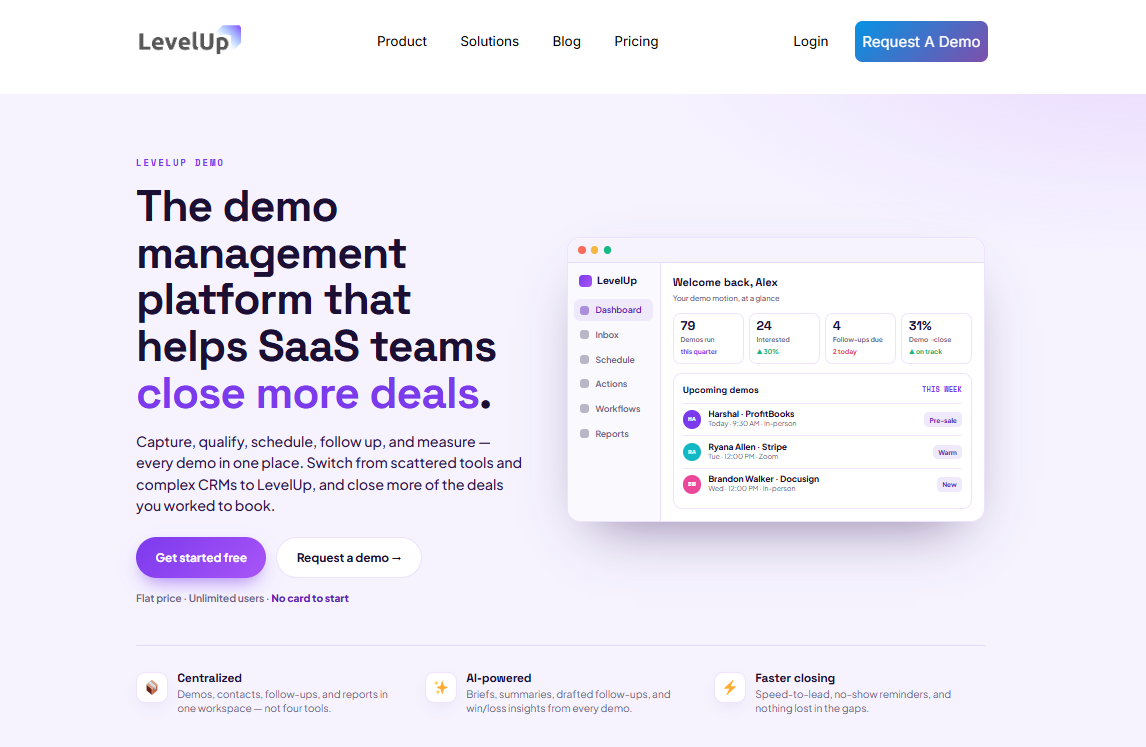
Overview: The demo workflow and revenue-ops layer that sits alongside your demo builder. Where the rest of this list focuses on creating the demo, LevelUp Demo manages everything that happens around it—lead capture, qualification, scheduling, follow-up, and outcome tracking—so demo activity connects to pipeline instead of disappearing into vanity metrics.
Best for: Sales-led SaaS teams (1–15 reps) who’ve already solved the “build a demo” problem but keep losing deals in the follow-up gap. If your bottleneck is demo management software rather than HTML fidelity, this is the layer you’re missing.
Strengths: It closes the loop most tools ignore. Leads are captured and qualified the moment a demo is requested, every follow-up is tracked, and conversion analytics tie each demo to real pipeline outcomes—without the weight of a full CRM migration. It’s deliberately lightweight, so a small team can adopt it in days, not quarters, and run it beside Storylane, Supademo, or Arcade.
Weaknesses: Let’s be transparent: LevelUp Demo is not an interactive demo builder. It doesn’t compete on HTML capture, screen recording, or marketing polish, and if that’s your primary need you’ll still want a creation tool alongside it. It’s purpose-built for the workflow, not the pixels.
Scaling penalty: Minimal for its target range—it’s built to grow with a 1–15 rep sales team. Very large presales orgs with heavy enterprise governance needs may still lean on a full CRM for parts of the motion.
Pricing: Contact Sales — see current plans on the LevelUp Demo pricing page.
3. Supademo
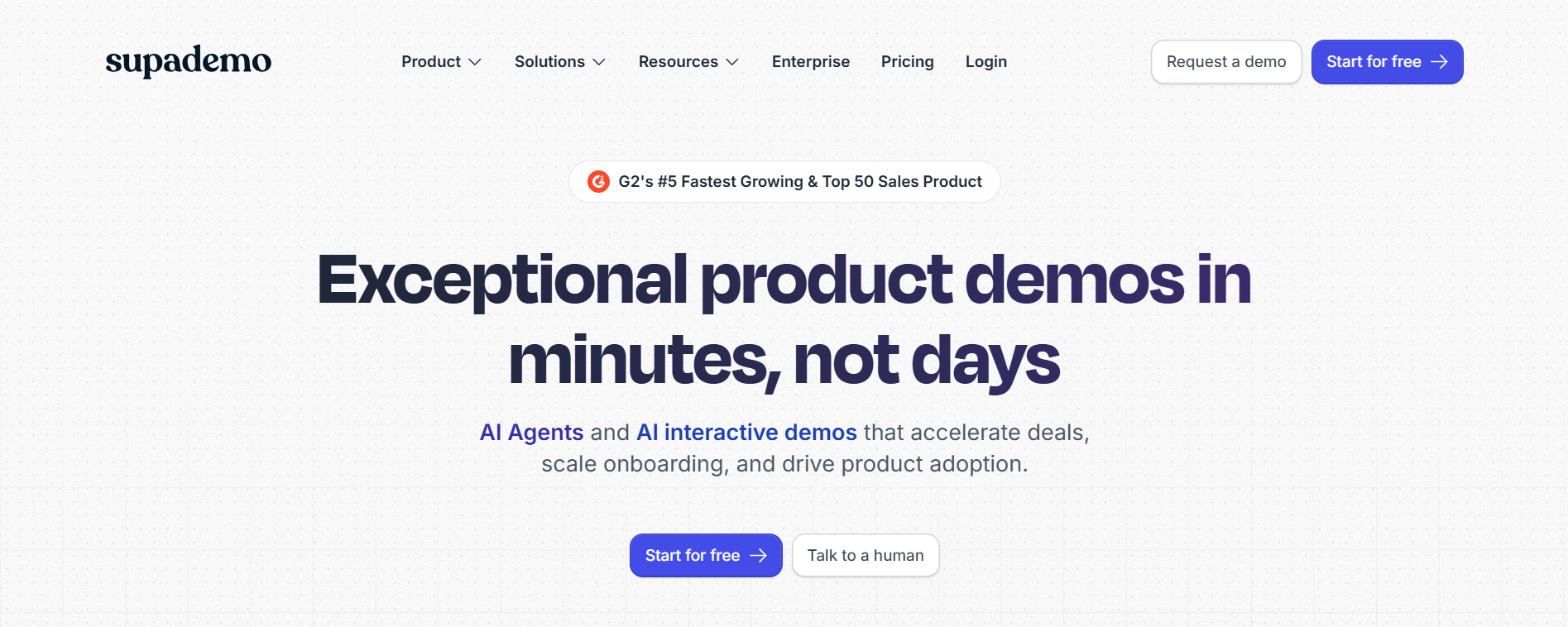
Overview: The #1 Momentum Leader on G2 and the go-to for budget-conscious teams. Supademo offers screenshot, HTML, and video demos with a genuine free plan.
Best for: Startup founders and solo operators who need to create shareable demos in under an hour. If your demo automation software budget is under $100/month, start here.
Strengths: The free plan gives you 5 demos with no credit card. AI features aren’t gated behind enterprise tiers—a rarity. The progress bar turns purple at 80% completion, giving you a clear visual checkpoint for MicroTour engagement.
Weaknesses: Marketing claims “AI not gated,” but conditional branching is limited on the free plan. Complex logic requires paid tiers. And if you’re an enterprise team needing full sandbox environments, Supademo isn’t built for that.
Scaling penalty: Free to $38/month is painless. But HTML demos jump to $350/month—still cheaper than Navattic’s $500, but a meaningful leap from the entry tier.
Ghost error: Users report “stuck cursor” glitches in HTML demos. The weird fix: disable browser extensions, specifically ad blockers. Took me 45 minutes to figure that out the first time.
Pricing: Free / $38/mo / $350/mo (HTML)
4. Arcade
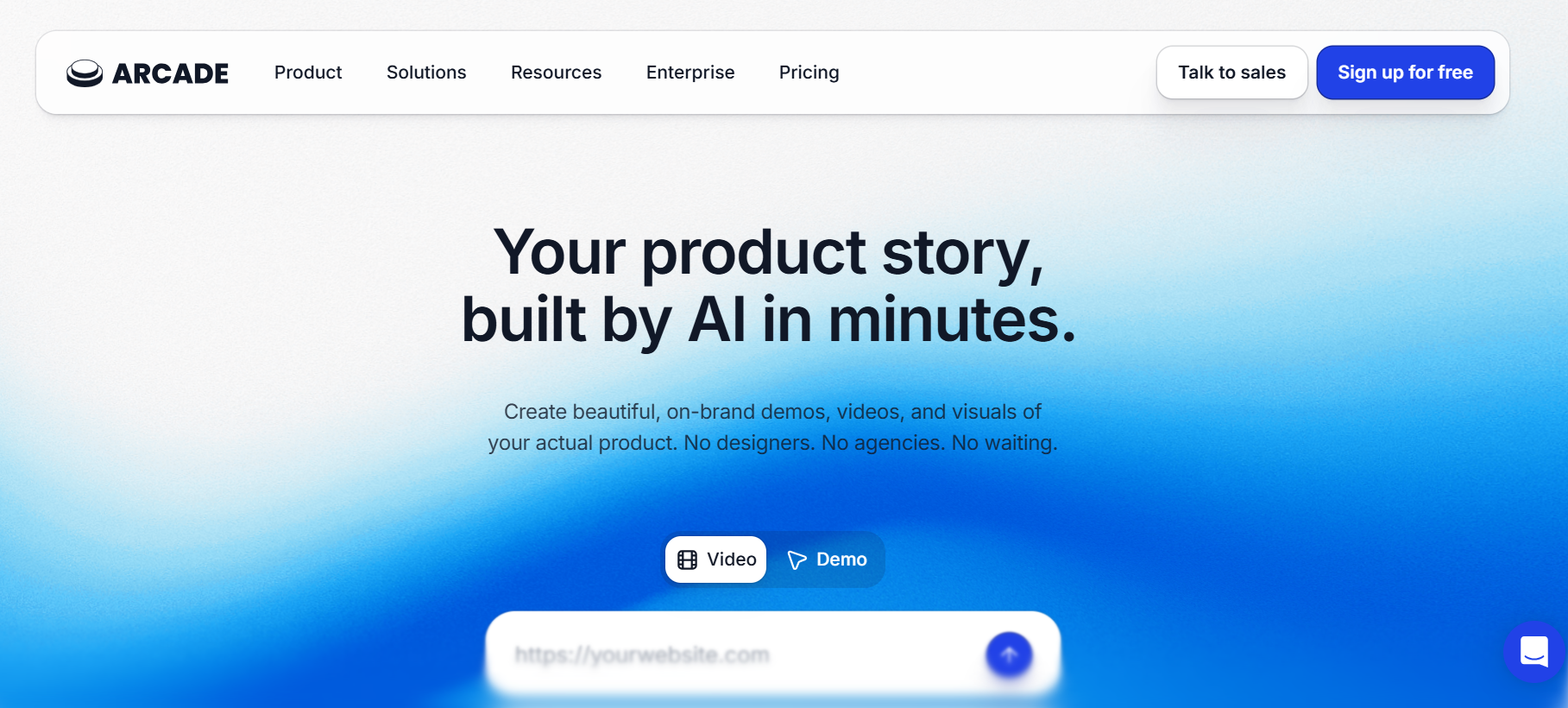
Overview: Trusted by OpenAI and Salesforce, Arcade combines screen recording with HTML capture and AI-powered editing to produce demos that look like product videos but behave like interactive experiences.
Best for: Product marketing teams creating top-of-funnel content. If your demos need to perform on landing pages and social media—not just in sales calls—Arcade is purpose-built for that.
Strengths: The output quality is noticeably higher than most tools. Arcade demos get shared because they look good. The export button glows only when all AI enhancements are applied, preventing you from shipping unpolished work.
Weaknesses: “AI-powered production” sounds great until you encounter screen recording artifacts—blurry text is common without manual retouching. And Arcade is firmly a marketing tool; it doesn’t support live sales overlays or real-time personalization during calls.
Scaling penalty: Free tier exists; paid runs ~$40/user. But enterprise features like custom branding require custom pricing that isn’t published.
Ghost error: Audio desync in long videos (over 3 minutes). The fix: re-record the audio separately and merge in post. Annoying, but it works.
Pricing: Free / ~$40/user / Custom
5. Walnut
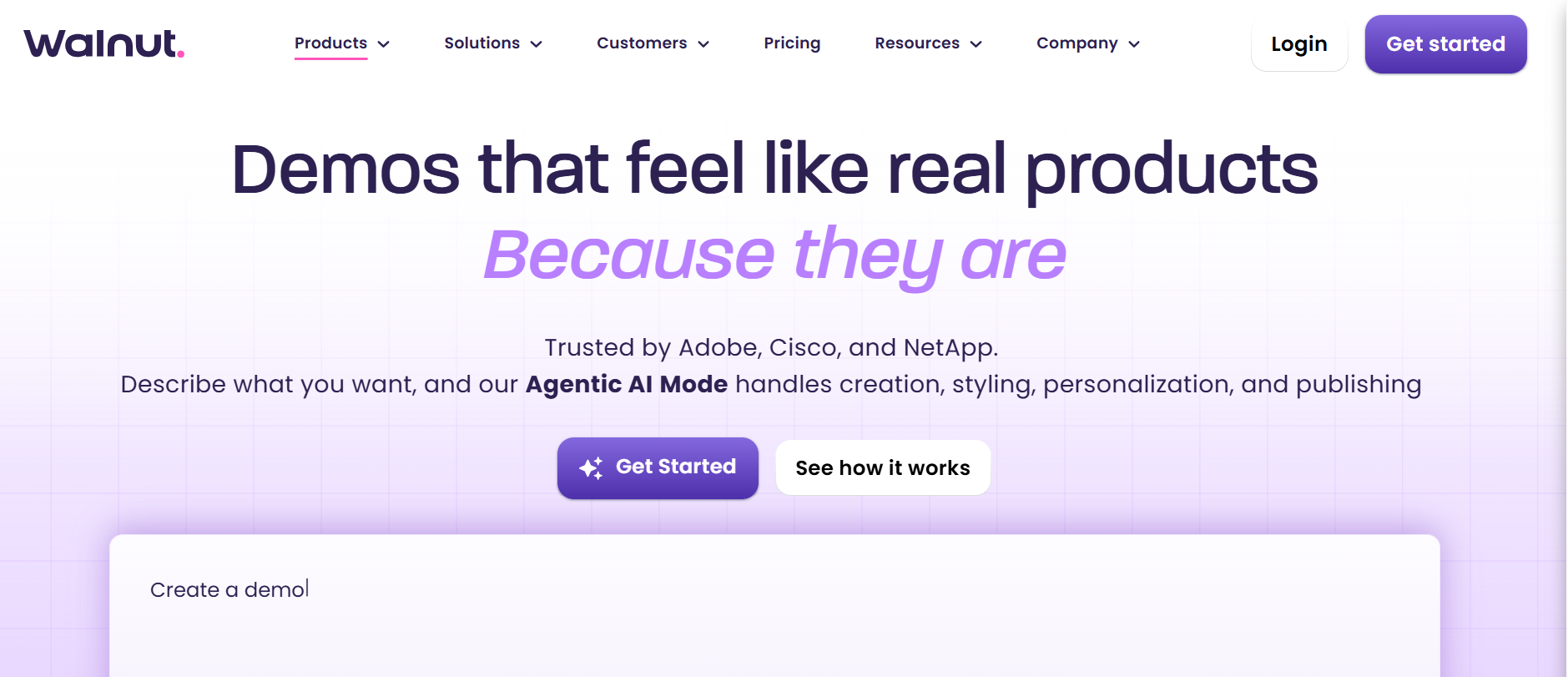
Overview: The enterprise standard for sales engineering teams. Walnut creates full application clones—sandbox environments where prospects interact with a complete replica of your product.
Best for: Enterprise presales teams running complex technical evaluations. If your buyers need to use your product before buying, not just watch a guided tour, Walnut delivers. Check our comparison of best Walnut alternatives for the full breakdown.
Strengths: Demo cloning depth is unmatched. The personalization badge appears only when a prospect’s name is successfully injected into the demo environment, giving reps confidence that customization actually worked.
Weaknesses: Template customization is marketed as flexible, but deep changes require developer help. And there’s no transparent pricing—it’s “Contact Sales” only, which makes it risky for teams under 5 reps who can’t justify an enterprise contract.
Scaling penalty: Without published pricing, the 3-year TCO is unpredictable. Teams I’ve worked with report annual contracts starting above $20K.
Ghost error: “Login timeout” during live overlays. The weird fix: use a dedicated demo browser (Firefox works; Chrome doesn’t). Nobody at Walnut will tell you this.
Pricing: Contact Sales
6. Consensus
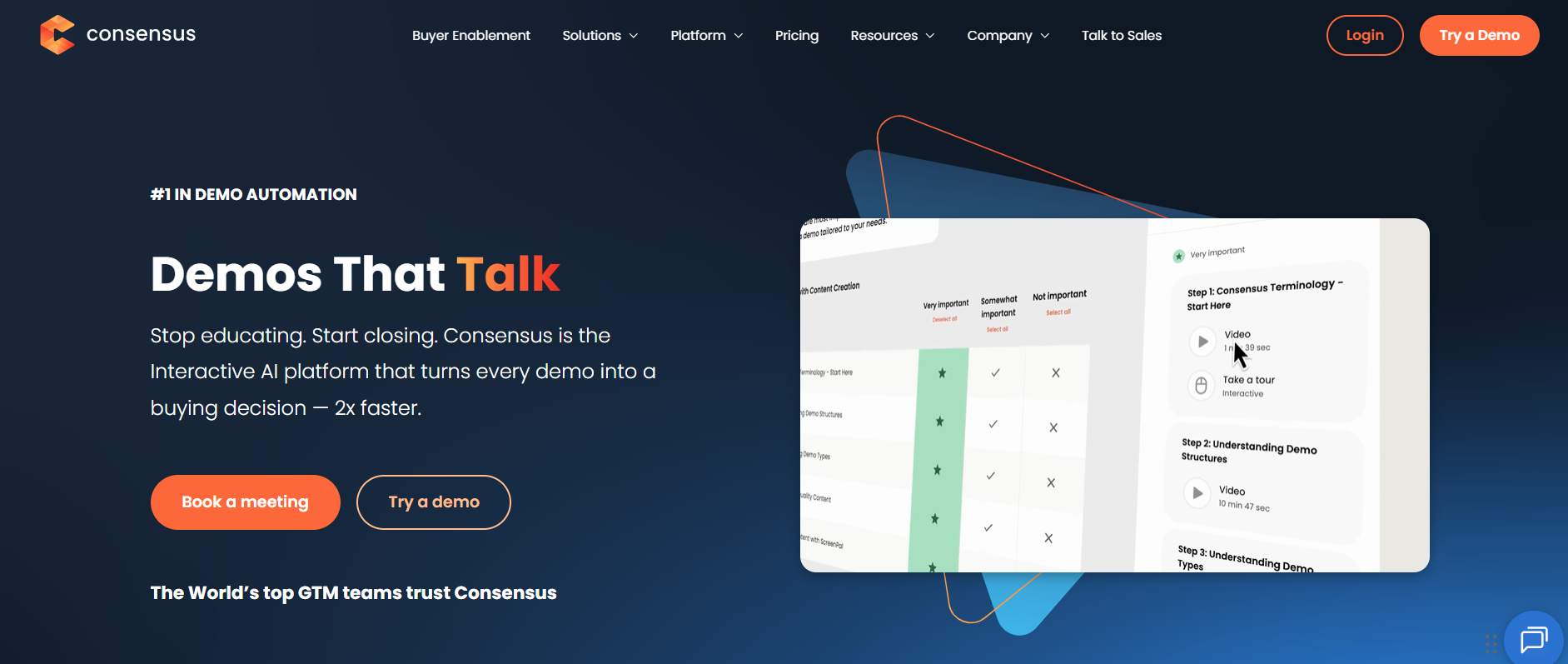
Overview: The leader in video-based demo automation with patented technology that matches prospects to relevant demo content based on their role and interests.
Best for: Sales-led organizations with long buying cycles involving multiple stakeholders. Consensus excels when you need to arm champions with content they can share internally.
Strengths: Buyer intent data is genuinely useful—the platform tracks which features each stakeholder watched, for how long, and generates a “Demolytics” score that feeds directly into CRM. The analytics depth here exceeds most competitors.
Weaknesses: Starting price around $600/month puts it out of reach for SMBs. And the platform is video-first; if you need HTML fidelity or interactive sandbox experiences, Consensus isn’t the right architecture.
Pricing: ~$600/mo
HowdyGo, Reprise, Demostack, Guideflow & TestBox (Quick Takes)
HowdyGo: HTML demos at $159/month—roughly 40% cheaper than Navattic or Storylane’s HTML tier. The trade-off: CRM integrations are less robust, and the demo preview loads in under 2 seconds (a genuine advantage) but occasionally renders incorrectly on mobile.
Reprise: Enterprise-grade with deep Salesforce integration. Requires significant implementation effort. Best for organizations with dedicated presales ops teams.
Demostack: Creates personalized demo environments for sales teams. Strong for sales-led motions but overlaps significantly with Walnut’s positioning. Contact Sales pricing.
Guideflow: Lightweight product tour builder starting at $35/month. Good for product demo best practices at the PLG end of the spectrum, but lacks depth for complex sales cycles.
TestBox: Live sandbox testing for prospects. No AI features to speak of, but the “try before you buy” experience is authentic. Enterprise pricing only.
Buyer Persona Recommendation Matrix™
| Buyer Type | Best Choice | Why |
|---|---|---|
| Startup SaaS (<$100/mo budget) | Supademo | Free tier, fastest TTV, AI not gated |
| Sales-Led SaaS | LevelUp Demo | Demo workflow management tied to revenue outcomes |
| SMB SaaS (5-20 employees) | Storylane | Multi-format flexibility, strong G2 community |
| Mid-Market | Storylane or Arcade | Depends on sales-led (Storylane) vs. marketing-led (Arcade) |
| Enterprise | Walnut or Reprise | Full sandbox cloning, SSO, SOC 2 |
| PLG Company | Supademo or Guideflow | Self-serve demos embedded in product/website |
| Presales Team | Walnut or Demostack | Complex demo environments with personalization |
| Product Marketing | Arcade | Highest-quality output for top-of-funnel content |
| Customer Success | Storylane | Onboarding tours and feature adoption demos |
Interactive Demo Platform Decision Tree™
Start here and follow your primary need:
→ Need enterprise security (SOC 2, SSO, data residency)?
Yes → Walnut, Reprise, or Consensus · No ↓
→ Need full sandbox/application cloning?
Yes → Walnut or Demostack · No ↓
→ Budget under $100/month?
Yes → Supademo (free–$38/mo) or Guideflow ($35/mo) · No ↓
→ Primary use case is marketing content?
Yes → Arcade · No ↓
→ Need HTML fidelity with AI voiceover?
Yes → Storylane ($500/mo HTML tier) or HowdyGo ($159/mo) · No ↓
→ Need video-based demo automation with buyer intent?
Yes → Consensus · No ↓
→ Need demo scheduling, qualification, and outcome tracking?
Yes → LevelUp Demo. This is the branch most roundups never reach—the point where your problem isn’t building the demo, it’s everything after it. If prospects are engaging with demos but deals still stall in the follow-up gap, LevelUp captures and qualifies each lead, schedules the next step, and tracks the outcome all the way to closed-won, so you can finally see which demos actually convert. Pair it with your builder of choice (Storylane, Supademo, or Arcade) for full GTM coverage.
When Should You Switch from Navattic?
Not every frustration warrants a migration. Here’s when it actually makes sense:
Switch now if: Your 3-year TCO exceeds $18,000 and you’re using less than 60% of Navattic’s feature set. You’re paying for sandbox-level capability but only building screenshot tours.
Switch now if: Your team has grown past 5 users and you’re spending more time managing demo versions than creating them. Collaboration limitations compound fast.
Switch now if: Your CRM integration requires manual exports or Zapier workarounds to get demo engagement data into pipeline reports.
Wait if: You’re mid-quarter and demos are actively in prospect hands. Migration during a live sales cycle creates confusion. Finish the quarter, then move.
Migration Readiness Checklist™
- ☐ Have you documented your current demo library and usage metrics?
- ☐ Can you export existing demo assets (screenshots, recordings, HTML captures)?
- ☐ Have you mapped your current integrations and confirmed the new platform supports them?
- ☐ Is there stakeholder buy-in from sales, marketing, and leadership?
- ☐ Have you calculated the 3-year TCO of your current platform vs. the alternative?
- ☐ Do you have a 30-day parallel-run plan to test the new platform before full cutover?
- ☐ Have you defined what “success” looks like—specific KPIs, not just “it feels better”?
Common Mistakes When Choosing Demo Software
Choosing on price alone. Supademo at $38/month is attractive until you realize you need HTML fidelity at $350/month. Always model the tier you’ll actually need in 6 months.
Ignoring what happens after the demo. Most tools in this roundup create demos. Very few manage what happens next—scheduling, follow-up, outcome tracking. That gap is where deals die quietly.
Focusing on features instead of workflows. A tool with 47 features you use 6 of is worse than a tool with 12 features you use 11 of. Map your actual workflow first, then match tools to it.
Not involving both sales and marketing. Marketing picks a tool optimized for top-of-funnel polish. Sales needs mid-funnel personalization. If both teams aren’t in the evaluation, you’ll buy the wrong thing.
Overlooking the demo quality score. Engagement metrics without quality context are vanity metrics. Track completion rates alongside qualified pipeline generated.
How LevelUp Demo Compares
I’ll be direct: LevelUp Demo isn’t an interactive demo builder. It doesn’t compete with Storylane or Arcade on HTML fidelity or marketing polish. That’s not what it does.
What LevelUp does is manage the demo lifecycle that every other tool on this list ignores. Lead capture, qualification, scheduling, outcome tracking, follow-up management, and conversion analytics—all in one lightweight layer that sits alongside your demo creation tool of choice.
Stop Losing Deals Between the Demo and the Close
LevelUp Demo connects your demo workflow to revenue outcomes. Capture leads, qualify them instantly, track every follow-up, and see exactly which demos convert—without the complexity of a full CRM migration.
Who should choose LevelUp: Sales-led SaaS teams (1–15 reps) who’ve solved the “create a demo” problem but are losing deals in the follow-up gap. Founders who want demo management software without adopting enterprise tooling.
Who should look elsewhere: Teams whose primary problem is building interactive demos. Pair LevelUp with Storylane, Supademo, or Arcade for full GTM alignment.
FAQ
Why do companies switch from Navattic?
The most common reasons are pricing that scales poorly past 3-5 users, limited conditional branching on lower tiers, shallow CRM integration depth, and the absence of post-demo workflow management. Teams outgrow the platform’s value-to-cost ratio before they outgrow its features.
Which Navattic alternative is best for startups?
Supademo offers the best startup fit with a free plan for 5 demos, paid tiers starting at $38/month, and AI features available without enterprise gating. Time-to-value is under one hour for most users, making it practical for founders wearing multiple hats.
Which platform is best for enterprise teams?
Walnut and Reprise lead for enterprise presales requiring full sandbox environments, SOC 2 compliance, SSO, and deep Salesforce integration. Consensus is the enterprise choice for video-led, multi-stakeholder sales cycles with buyer intent analytics.
Are there free alternatives to Navattic?
Supademo offers a free plan (5 demos), Arcade has a free tier for basic screen recordings, and Guideflow provides limited free access. None match Navattic’s full HTML fidelity at the free level—you’ll need paid tiers for that.
Which platform has the best analytics?
Consensus leads with patented “Demolytics” that track stakeholder-level engagement and generate buyer intent scores. Storylane and Walnut offer strong analytics with CRM sync. LevelUp Demo focuses specifically on demo analytics tied to pipeline outcomes rather than just engagement metrics.
How do I choose the right interactive demo platform?
Start with your primary use case (marketing vs. sales vs. PLG), then filter by budget, team size, and required integrations. Use the Decision Tree and Buyer Persona Matrix above to narrow your shortlist to 2-3 options, then run a 14-day parallel test with actual prospects before committing.