
Last quarter, I spent three weeks migrating a 40-person sales org off a demo platform they’d outgrown. The tool wasn’t broken — their needs had just outpaced it. They’d started with Storylane, built 60+ interactive demos, and then hit a wall when their enterprise buyers started requesting personalized sandbox environments and their CRM couldn’t reconcile demo engagement data with pipeline stages.
That experience crystallized something I keep seeing: choosing a demo platform is less about finding the “best” tool and more about finding the best fit for your GTM strategy. Storylane is genuinely excellent for teams getting started with interactive demos. But SaaS companies at different growth stages, with different sales motions, need different things.
This guide breaks down the leading alternatives objectively — where each one fits, where it doesn’t, and which trade-offs actually matter when you’re making a switch.
What are the best Storylane alternatives?
The best Storylane alternatives for SaaS teams include LevelUp Demo, Navattic, Walnut, Consensus, Demostack, Supademo, and Reprise. The right choice depends on whether your priority is interactive demos, enterprise personalization, product marketing, sales enablement, demo automation, or end-to-end demo operations.
The TL;DR Matrix
| Category | Top Pick | One Reason Why |
|---|---|---|
| End-to-End Demo Operations | LevelUp Demo | Manages qualification, scheduling, follow-ups, and demo funnel accountability in one workflow |
| Enterprise Personalization | Walnut | Per-prospect customization built for ABM-heavy sales teams |
| Budget-Friendly Quick Demos | Supademo | Free plan with 5 demos; Pro at $27/creator |
| Marketing-Led HTML Demos | Navattic | Highest HTML fidelity for GTM and PLG marketing teams |
| Demo Automation (Video-Led) | Consensus | Async video enablement purpose-built for enterprise sales cycles |
| Sandbox Environments | Reprise | API-level cloning for engineering-heavy product demos |
Why SaaS Teams Look for Storylane Alternatives
Teams outgrow tools — not because the tool failed, but because the business changed. Here’s what I consistently hear in conversations with SaaS revenue leaders:
- Pricing pressure at scale.
Storylane’s per-seat model works for small teams. When you’re adding 15 sales reps and 4 marketing managers, the 3-year TCO math shifts dramatically. - Enterprise security and compliance.
Larger buyers demand SOC 2 reports, SSO, and granular role-based access that may require higher-tier plans. - Advanced personalization.
Per-prospect customization for ABM campaigns goes beyond what a standard interactive demo builder offers. - AI capabilities.
Teams want AI narration, auto-generated tooltips, and intelligent demo routing — not just screenshot capture. - Integration depth.
If your CRM (Salesforce, HubSpot) can’t sync demo engagement signals to pipeline stages, you’re flying blind on batch reconciliation. - Demo format diversity.
Some teams need sandbox environments, async video demos, or live demo scheduling alongside interactive walkthroughs. Many SaaS companies use more than one demo format throughout the buyer journey instead of relying on a single platform.
None of these are “flaws” in Storylane. They’re evolving business requirements. And recognizing the difference matters when you’re evaluating alternatives with clear eyes.
How We Evaluated Storylane Alternatives
I used a weighted evaluation framework built from real implementation experience — not feature-list comparisons scraped from vendor websites.
| Evaluation Criteria | Weight | Why It Matters |
|---|---|---|
| Time-to-Value | 30% | Solo founders need <1 hour to publish a first demo |
| UX Friction | 25% | Fewer manual tooltip fields = faster iteration cycles |
| 3-Year TCO | 25% | Growth-tier pricing spikes can break small budgets |
| Integration Depth | 20% | CRM sync for demo tracking and demo funnel accountability |
| AI Features | Bonus | Faster demo creation and narration |
| Scalability | Bonus | Enterprise readiness (SSO, roles, audit logs) |
| Customer Support | Bonus | Faster implementation and migration |
The “Anti-Persona” filter was equally important. For every tool, I asked: who should NOT use this? That’s where the real clarity lives.
Feature Comparison Matrix
| Tool | Interactive Demos | AI Features | Personalization | CRM Integration | Analytics | Best For |
|---|---|---|---|---|---|---|
| LevelUp Demo | Via workflow | Lead routing AI | Qualification-based | HubSpot, Salesforce | Demo funnel metrics | End-to-end demo ops |
| Navattic | ✅ HTML capture | Limited | Template-based | HubSpot, Salesforce | Viewer analytics | Marketing/GTM teams |
| Walnut | ✅ Strong | Guided AI | Per-prospect | Salesforce, HubSpot | Sales analytics | Enterprise sales/ABM |
| Consensus | Video-led | Auto-edit | Buyer-driven | Salesforce | Stakeholder tracking | Demo automation |
| Demostack | ✅ Cloned env | Limited | Environment-based | Salesforce | Presales metrics | Demo environments |
| Supademo | ✅ Screenshot | AI tooltips | Limited | Zapier-based | Basic | Startups/solo creators |
| Reprise | ✅ Sandbox | Limited | API-driven | Salesforce | Enterprise | Complex products |
First, About Storylane Itself
Before the alternatives, it’s worth being clear-eyed about the incumbent — because pretending Storylane isn’t a strong product would undermine everything else in this guide.
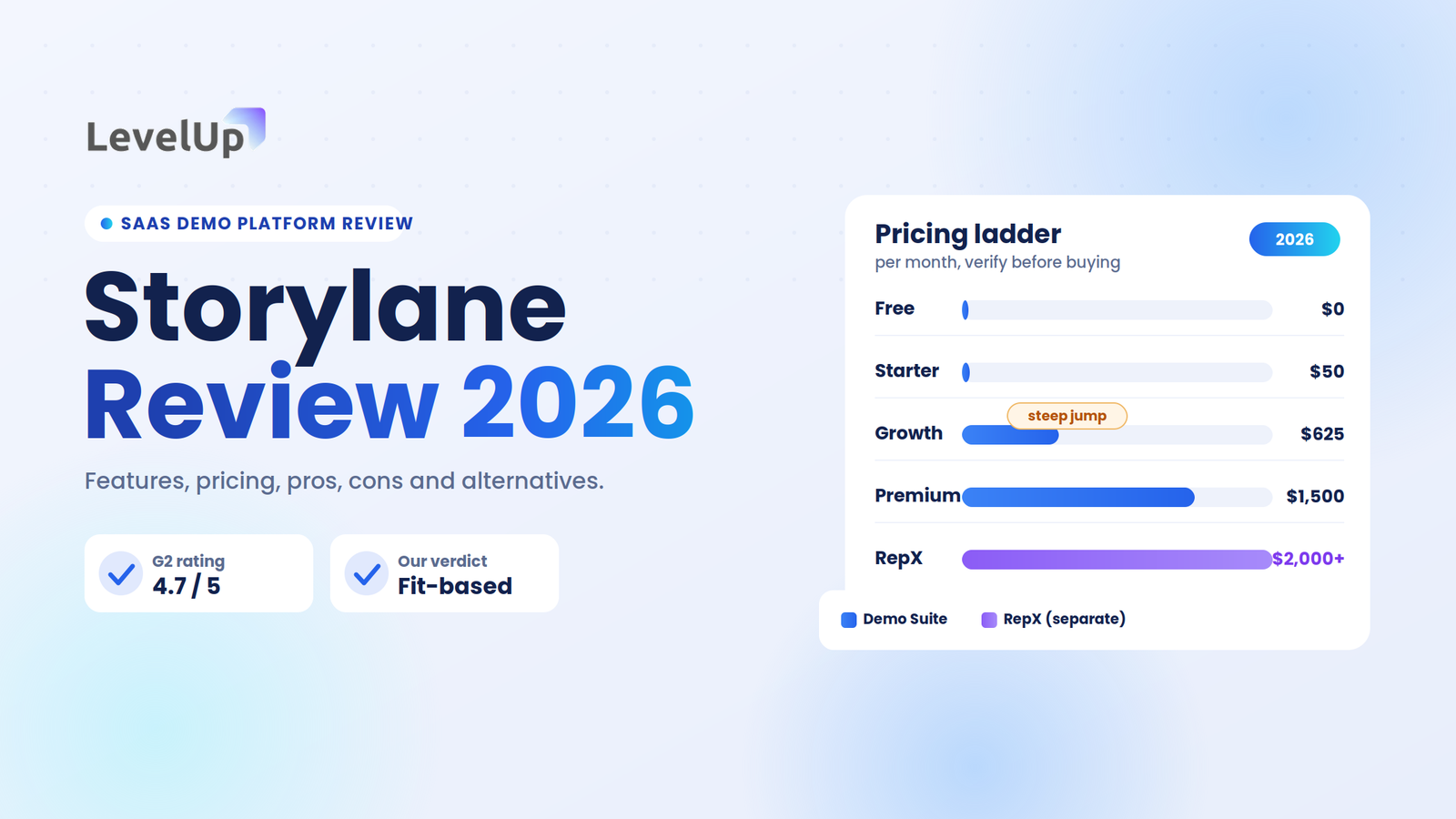
Storylane excels at: interactive product demos with HTML capture, ease of use for non-technical teams, and product marketing use cases. Their AI-assisted tooltip generation has gotten noticeably faster, and the template library is one of the most approachable in the category.
Best For: Product marketing teams building self-serve interactive demos for websites, email campaigns, and PLG marketing funnels.
Pros:
- Fastest time-to-first-demo for non-technical users
- Strong HTML capture quality
- Growing AI feature set
- Clean embed experience
Where Teams Outgrow It:
- Per-seat pricing compounds at scale
- Enterprise personalization requires workarounds
- CRM integration depth lags behind sales-focused tools
- Limited demo process management (scheduling, qualification, follow-ups)
Visual Checkpoint: The demo preview renders a green border when the HTML capture matches the source at 90%+ accuracy.
Storylane remains one of the easiest platforms for teams starting with interactive product demos. The question isn’t whether it’s good — it’s whether your needs have grown beyond what it was designed to do. If they have, here are the alternatives worth evaluating.
The 7 Best Storylane Alternatives
Each of these earns its place for a specific motion — end-to-end demo operations, enterprise personalization, marketing-led HTML demos, demo automation, cloned environments, budget-friendly quick demos, or API-level sandboxes. They’re ordered to start with the broadest operational fit and move toward the more specialized tools. Match the pick to your sales motion, not the other way around.
1. LevelUp Demo — Best for SaaS Teams That Want End-to-End Demo Operations
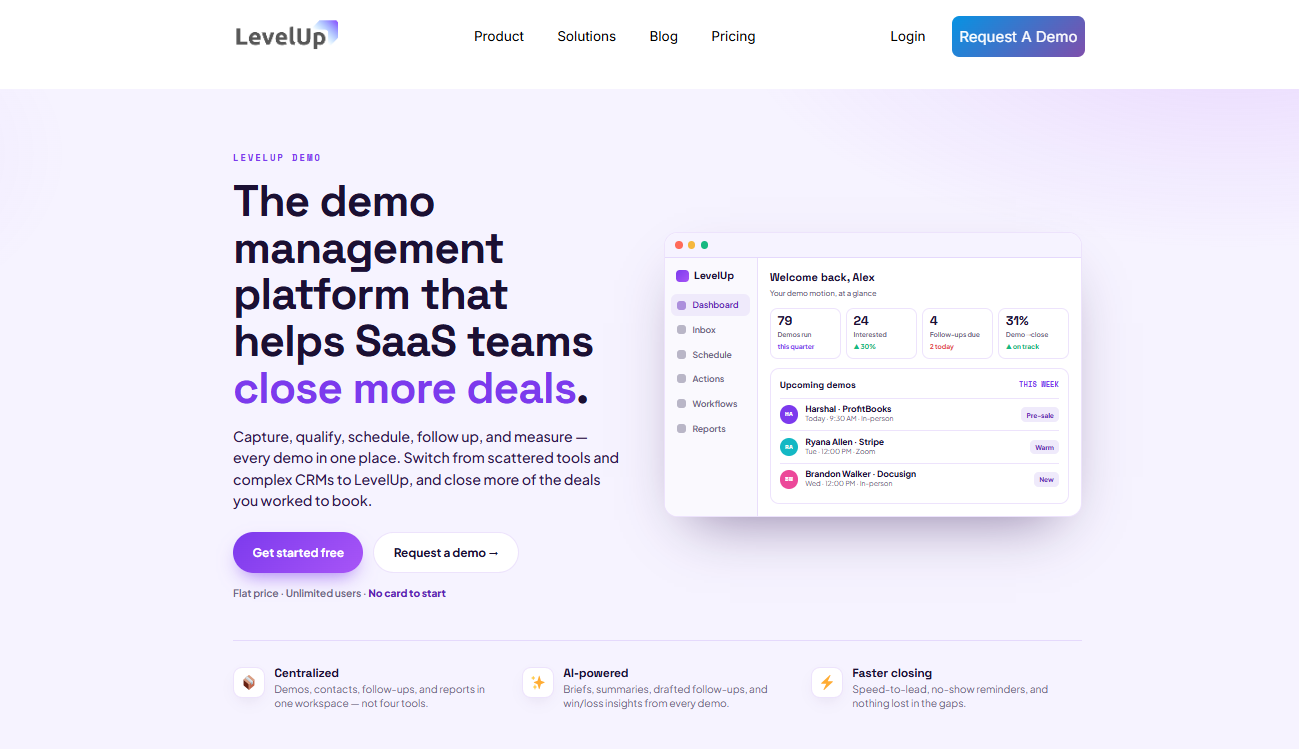
The demo itself is only half the problem. Most teams I work with lose deals not because their demo was bad, but because the process around the demo — qualification, scheduling, follow-up, stakeholder management — fell apart.
LevelUp Demo approaches this differently than pure interactive demo builders. Instead of focusing solely on the demo asset, it orchestrates the entire demo workflow: smart demo forms replace the standard “Request a Demo” page, leads get auto-qualified and routed, demos are scheduled within the platform, and outcomes are tracked with clear status updates (Won, Lost, In Follow-up, Pending).
Best For: SaaS founders and small sales teams (1–5 members) who need demo funnel accountability without the complexity of a full CRM migration.
Pros:
- Smart demo form replaces your website’s request form and auto-logs leads
- Lead qualification prevents wasted time on unqualified requests
- Follow-up management with filters and reminders — reduces funnel leakage significantly
- Analytics dashboard tracks demo-to-close conversion in one view
- Works alongside existing CRMs rather than replacing them
Potential Limitations:
- Not an interactive demo builder — it manages the demo process, not demo creation
- Best suited for teams relying on live demos rather than self-serve interactive walkthroughs
- Lighter feature set compared to enterprise CRMs (by design — it’s built for focus)
Scaling Penalty: Lightweight architecture means costs stay predictable as teams grow. No 10x pricing jumps.
Why Choose It: If your demo booking rate is healthy but your demo-to-close rate is suffering, the problem is usually process — not the demo itself. LevelUp solves that layer.
2. Navattic — Best for Marketing-Led HTML Demos at Enterprise Scale
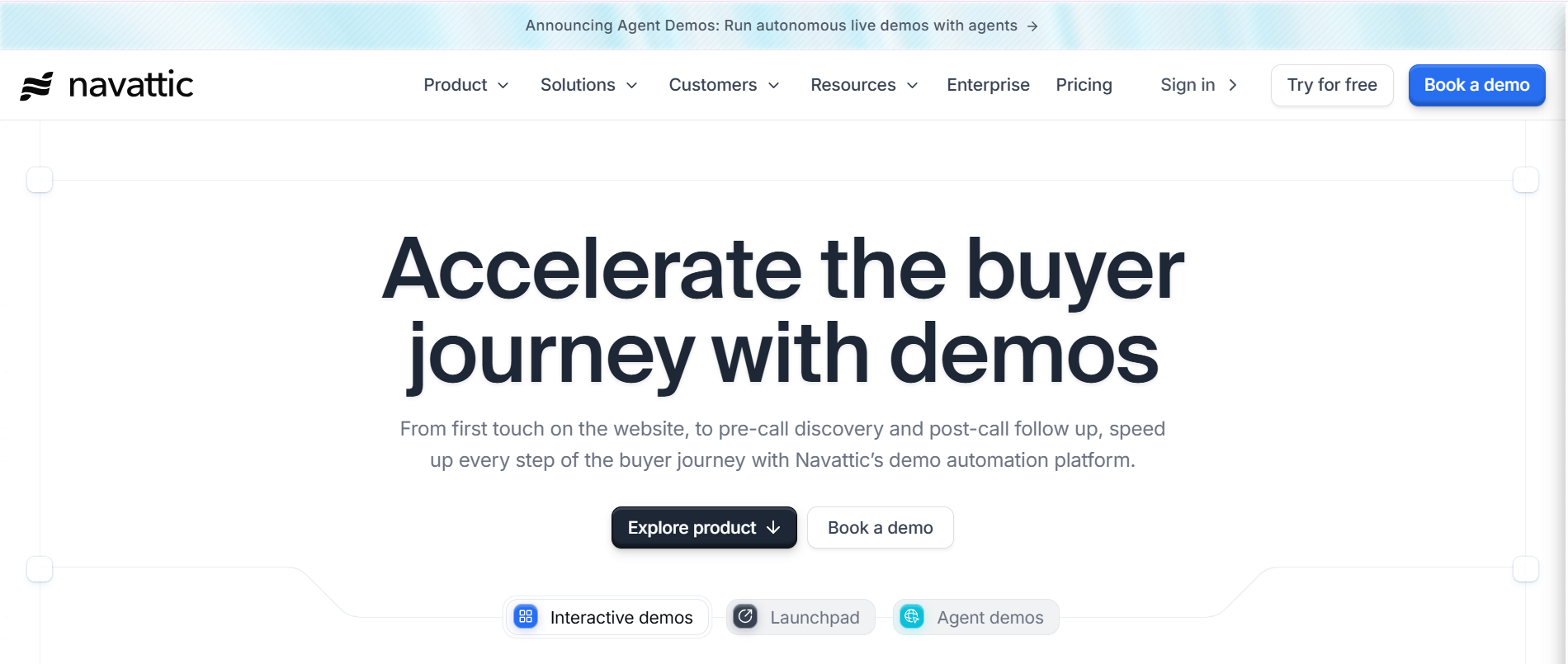
Navattic has carved out a clear position: highest HTML fidelity for marketing and GTM teams who need pixel-perfect interactive demos embedded across their web properties.
Best For: Enterprise marketing teams running PLG motions who need demos that look and feel identical to the live product.
Pros:
- HTML cloning accuracy consistently hits 95%+ on Enterprise tier
- Purpose-built for marketing workflows, not sales personalization
- Strong viewer analytics for campaign attribution
Potential Limitations:
- Full HTML fidelity requires Enterprise tier ($40/user) — an 8x cost jump from free
- Not built for sales-led per-prospect customization
- Safari compatibility issues persist (embed breaks on some WordPress configurations)
Ghost Error & Fix: “Embed breaks on WordPress” → Use a “Custom HTML” block instead of the WordPress plugin embed.
Anti-Persona: If you’re a sales-led team needing per-prospect demo variants, Navattic isn’t designed for that motion.
Visual Checkpoint: Cloning status displays a blue icon when HTML fidelity exceeds 95%.
3. Walnut — Best for Enterprise Sales Personalization and ABM
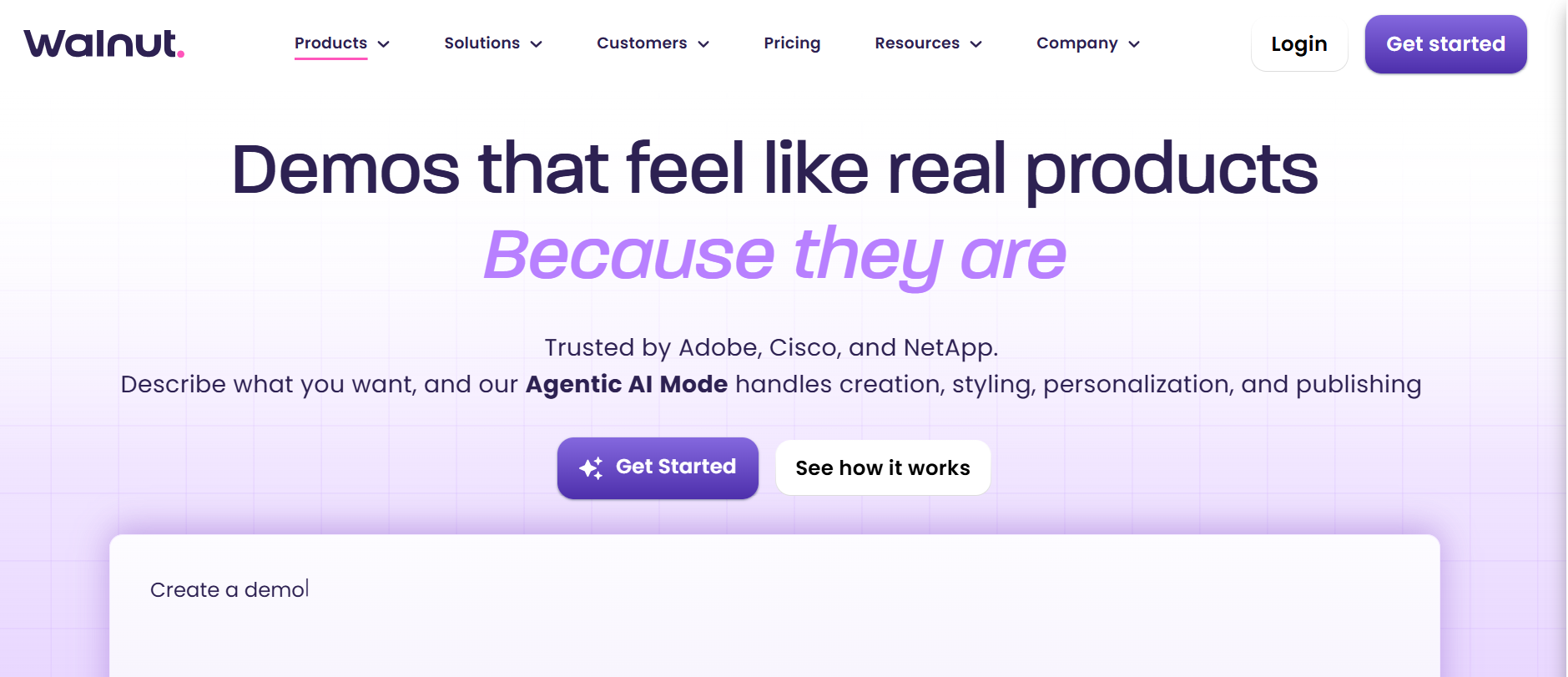
Walnut is the demo platform I recommend most often to enterprise sales teams running account-based strategies. Per-prospect customization is its core differentiator — you can create tailored demo variants for individual accounts with their data, branding, and use cases baked in.
Best For: Enterprise sales teams and presales engineers running ABM campaigns with high-value accounts.
Pros:
- Per-prospect customization is genuinely powerful for ABM
- Strong Salesforce integration for demo engagement tracking
- Built for sales workflows, not just marketing embeds
Potential Limitations:
- $500/month quarterly minimum — too expensive for 3-person teams
- Each demo variant requires manual setup (no bulk variant generation yet)
- Overkill for teams running product-led or self-serve motions
Scaling Penalty: $500/month (quarterly) → $1,000/month (Growth tier). 2x cost increase for team scaling.
Ghost Error & Fix: “Demo variant not saved” → Clear browser cache and re-login. Variants occasionally fail to persist in incognito mode.
Visual Checkpoint: Customization panel shows an orange highlight when a variant is active and synced.
4. Consensus — Best for Demo Automation and Async Video Enablement
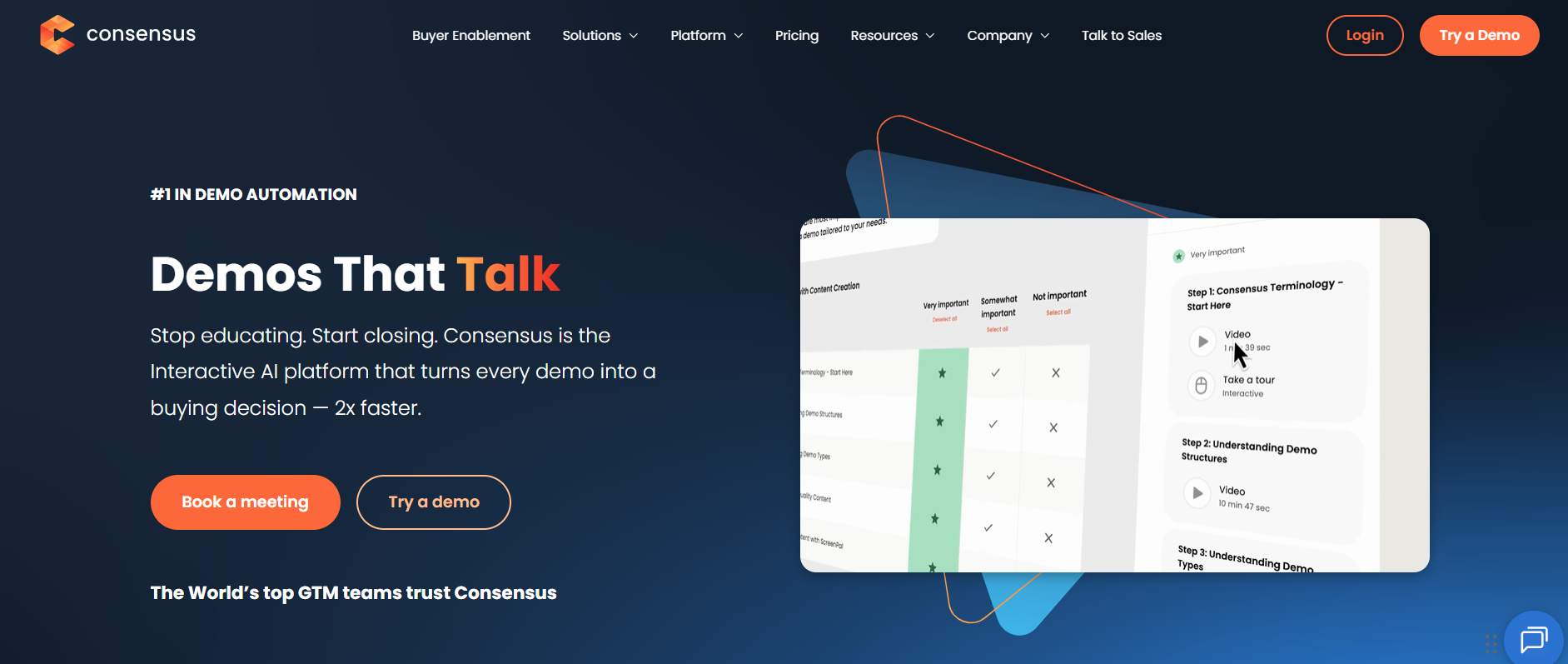
Consensus takes a fundamentally different approach. Instead of interactive click-through demos, it focuses on async video enablement — automated, personalized video demos that buyers can consume on their own schedule.
Best For: Enterprise sales organizations with long, multi-stakeholder sales cycles where getting everyone on a live call is impractical.
Pros:
- Async video demos reduce scheduling friction in complex enterprise deals
- Stakeholder tracking shows which decision-makers watched what
- Strong demo automation capabilities for scaling presales
- Video bubbles and overlay annotations add context without live narration
Potential Limitations:
- Video-led approach doesn’t suit teams needing interactive, hands-on product exploration
- Higher price point targets enterprise budgets
- Less effective for PLG or self-serve SaaS motions
Anti-Persona: If your buyers want to click through your product themselves, Consensus’s video-first model won’t satisfy that need.
5. Demostack — Best for Cloned Demo Environments in Presales
Demostack creates full demo environments — cloned versions of your product that presales teams can customize without touching production data.
Best For: Presales engineers and solutions consultants who need realistic product environments for live demos without risking production data.
Pros:
- Full product environment cloning (not just screenshots)
- Presales teams can customize data scenarios
- Realistic buyer experience during live demos
Potential Limitations:
- Requires technical setup for environment cloning
- Higher cost than screenshot-based tools
- Less useful for marketing embed use cases
Scaling Penalty: Environment cloning costs increase with product complexity. Teams with 50+ microservices report significantly longer setup times.
6. Supademo — Best Budget Option for Solo Creators and Startups
Supademo is the tool I point solo founders toward when they need a working interactive demo by end of day without spending anything.
Best For: Startups, solo creators, and early-stage teams with tight budgets who need quick, functional demos.
Pros:
- Free plan supports 5 demos with no time limit
- Pro tier at $27/creator is the lowest in the category
- AI-generated tooltips speed up creation
- Clean, minimal interface
Potential Limitations:
- Free plan lacks video export — Pro required
- No team pricing structure; solo-creator focus
- CRM integration limited to Zapier (no native Salesforce/HubSpot sync)
- Analytics are basic compared to enterprise tools
Scaling Penalty: Free (5 demos) → Pro ($27/creator). Adding 5 creators = 5x cost. There’s no team discount tier.
Ghost Error & Fix: “Tooltip text overlaps on mobile” → Reduce font size to 12px in the editor. The responsive preview doesn’t always catch this.
Visual Checkpoint: Demo preview shows a green checkmark when all tooltips are validated and positioned correctly.
7. Reprise — Best for API-Level Sandbox Demos in Complex Products
Reprise occupies the high end of the market. API-level cloning creates full sandbox environments that mirror your product’s actual behavior — not just its UI.
Best For: Engineering-heavy enterprises with complex products that require functional sandbox demos for technical buyers.
Pros:
- API-level cloning creates genuinely functional demo environments
- Sandbox demos handle complex, multi-step product workflows
- Enterprise-grade security and compliance
Potential Limitations:
- Requires dedicated demo engineers for setup and maintenance
- Highest cost in the category (Growth tier ~$1,000/month)
- Overkill for marketing teams needing simple interactive walkthroughs
Scaling Penalty: Free (limited) → Growth ($1,000/month). 10x cost jump for enterprise sandbox access.
Ghost Error & Fix: “Sandbox loads slowly” → Increase server timeout to 30 seconds in the configuration panel. Default timeout is 15s, which fails on data-heavy products.
Visual Checkpoint: Sandbox status displays a red icon if the API sync fails during environment refresh.
Anti-Persona: Small teams without engineering resources to maintain sandbox environments.
Your demo workflow is only as strong as its weakest handoff.
If you’re evaluating interactive demo tools but your real bottleneck is qualification, scheduling, or follow-up, explore how LevelUp Demo streamlines the entire demo process — from lead capture to conversion tracking — without replacing your existing stack.
Which Storylane Alternative Is Right for You?
The best Storylane alternative depends on your sales process, not just your feature checklist. Here’s the decision matrix:
| If You Need… | Choose | Why |
|---|---|---|
| End-to-end demo operations | LevelUp Demo | Manages qualification, scheduling, outcomes, and follow-ups |
| Enterprise HTML demos | Navattic | Highest HTML fidelity for marketing embeds |
| Enterprise sales personalization | Walnut | Per-prospect customization for ABM |
| Demo automation (video-led) | Consensus | Async video enablement for multi-stakeholder deals |
| Cloned demo environments | Demostack | Full product environment for presales |
| Budget-friendly quick demos | Supademo | Free plan + $27/creator Pro tier |
| Complex sandbox demos | Reprise | API-level cloning for technical buyers |
Interactive demo platforms solve different problems depending on whether your focus is marketing, sales, presales, or customer success. Match the tool to the motion, not the other way around.
Key Questions to Ask Before Switching from Storylane
Before you migrate, run through these:
- What stage of the buyer journey am I optimizing? Top-of-funnel marketing embeds need different tools than bottom-of-funnel presales demos.
- Do I need interactive demos, live demo workflows, or both? Most growing teams need both — and understanding the difference between interactive and live demos matters.
- How important are CRM integrations? If demo engagement data doesn’t flow into your pipeline, you can’t measure demo-to-close rate accurately.
- Do I need AI-assisted demo creation? AI narration and auto-tooltips save meaningful time — but only if your team produces demos at volume.
- How many teams will use the platform? A 3-person startup and a 40-person sales org have fundamentally different scaling requirements.
- How will migration affect existing demo assets? Migration costs, existing demo assets, and workflow integrations should be evaluated alongside pricing when switching platforms.
- What’s the 3-year TCO? That $27/month tool becomes $1,620/year per creator at scale. Model it out.
FAQ
What is the best alternative to Storylane?
The best alternative depends on your use case. LevelUp Demo is strongest for end-to-end demo operations and workflow management. Walnut leads for enterprise sales personalization. Supademo is the most budget-friendly option. Navattic excels at HTML demos for marketing teams. No single platform fits every GTM strategy.
Why do companies switch from Storylane?
Companies typically switch because of evolving needs — not because Storylane failed. Common triggers include enterprise security requirements, per-prospect customization for ABM, deeper CRM integration for demo funnel accountability, pricing pressure at scale, or the need for demo formats beyond interactive walkthroughs (like sandbox environments or async video).
Is Storylane suitable for enterprise SaaS?
Storylane works well for enterprise product marketing teams building interactive demos. However, enterprise sales teams often need deeper personalization (Walnut), sandbox environments (Reprise/Demostack), or demo process management (LevelUp Demo) that goes beyond what Storylane’s core product addresses.
Which Storylane alternative is best for startups?
Supademo is the strongest option for startups. Its free plan supports 5 demos with no time limit, and Pro pricing at $27/creator is the lowest in the category. For startups that also need demo scheduling and lead qualification, LevelUp Demo’s lightweight approach avoids the complexity of enterprise platforms.
Which platform is best for interactive product demos?
For pure interactive product demos, Supademo and Navattic are the strongest builders among these alternatives. Supademo offers the fastest, most budget-friendly path to a working demo for non-technical teams. Navattic leads on HTML fidelity for marketing embeds. The choice depends on whether you prioritize speed and cost (Supademo) or pixel-perfect capture for campaigns (Navattic).
What should I consider before switching demo software?
Evaluate five factors: 3-year total cost of ownership (not just monthly price), migration effort for existing demo assets, CRM integration depth for pipeline attribution, team adoption friction, and whether you need multiple demo formats across the buyer journey. How to qualify demo requests should also inform which platform features matter most.
LevelUp Demo
Fix the demo process, not just the demo asset.
Smart forms, lead qualification, scheduling, and conversion tracking in one lightweight workflow — built to plug the leaks between “lead raised hand” and “deal closed,” without replacing your existing stack.