Last reviewed: 30 October 2026. This article is general sales-enablement guidance, not legal, security, or compliance advice. Verify every certification, control, and contractual claim against your organization’s current approved documentation before stating it to a buyer.
A SaaS demo is going well. The champion is engaged, the product is landing, and then someone from the buyer’s security team asks whether you are SOC 2 certified, where their data would be hosted, and how access is controlled. The conversation has just changed shape: the buyer is no longer asking what the product does, but what your organization can prove.
The principle that holds across every deal size: a strong answer is not the most reassuring answer, it is the most accurate answer you can support with current evidence. This guide gives you a repeatable way to clarify what the buyer actually needs, give a verified answer, bring in the right specialist, and agree on the next step, so a security question moves the deal forward instead of stalling it.
It matters most when you sell to mid-market or enterprise buyers, where IT, security, legal, or procurement must approve the purchase, and it is written to be useful whether you have a dedicated security team or are a founder running demos yourself. If your product is self-serve with no customer-data ingestion and deals close in a single call, this framework is heavier than you need, and handling unverified feature questions is a closer fit.
On this page
Why Security and Compliance Questions Come Up During SaaS Demos
A product question asks what the software does. A security question asks what the organization can prove, and the people asking are often not the ones who requested the demo.
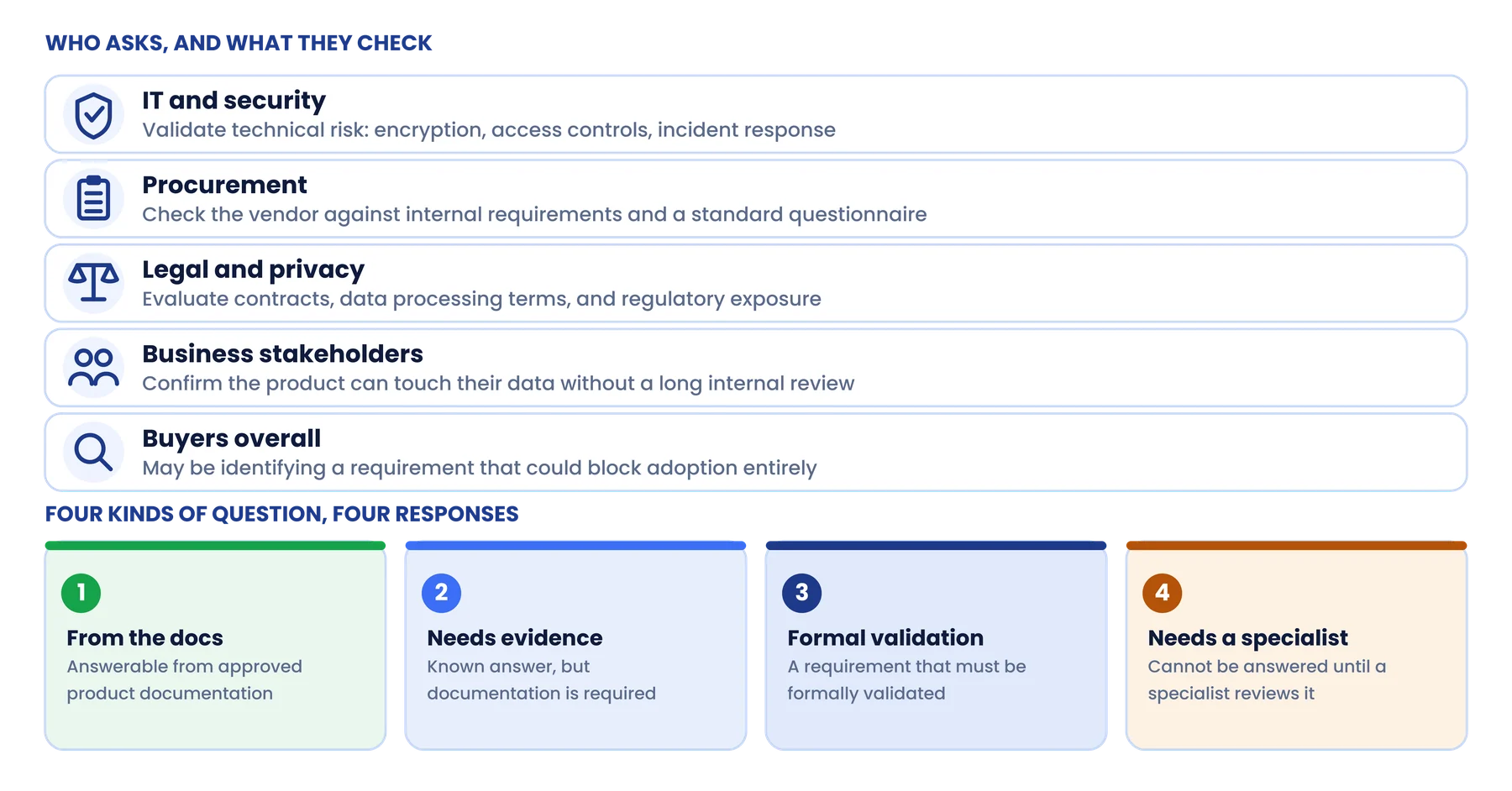
- IT and security validate technical risk, from encryption and access controls to incident response.
- Procurement checks the vendor against internal requirements and a standard questionnaire.
- Legal and privacy evaluate contractual obligations, data processing terms, and regulatory exposure.
- Business stakeholders confirm whether the product can be used with their data without triggering a long internal review.
- Buyers as a whole may be identifying a requirement that could prevent adoption entirely.
A security question is not automatically a buying signal or a rejection. Its significance depends on the buyer’s requirements and where they are in the evaluation. Treating a procurement gate as a sales objection to overcome with enthusiasm is how a seller ends up making a claim the company cannot substantiate. Security review is now a routine part of most B2B software evaluations, so the practical question is whether it happens inside your sales process, where you can track it, or after you have lost visibility into it.
One distinction is worth holding onto before any answer: a question that can be answered from approved product documentation is different from one that needs supporting evidence, which is different again from a requirement that needs formal validation, or a question that cannot be answered until a specialist reviews it. The framework below turns that distinction into a response.
The Most Common Security and Compliance Questions in SaaS Demos
Treat this as a preparation checklist rather than an exhaustive list. Not every buyer asks every question, and requirements vary by industry, geography, data sensitivity, and internal policy.
Certifications and independent audits
Typical questions: “Are you SOC 2 certified?” “Do you have ISO 27001?” “Can you provide an independent audit report?” Terminology matters more here than anywhere else. A SOC 2 Type II report is an attestation by an independent auditor covering a defined scope and observation period, not a certification. An ISO/IEC 27001 certificate confirms that an information-security management system has been certified against the standard. A general security policy is not equivalent to either. If you do not know whether your company holds a specific report or certificate, the only safe answer is to confirm and follow up, because “I believe so” during a live demo can become a documented representation the buyer relies on.
Data storage, hosting, and residency
Typical questions: “Where is our data hosted?” “Can it stay in a particular region?” “Which third parties process our information?” The answer may depend on the product, plan, service providers, configuration, or contract, and the figure you remember might cover only primary production storage. Backups, disaster-recovery copies, support access, and analytics pipelines can live elsewhere, so verify the actual facts, including subprocessors, before answering.
Encryption, identity, and access controls
Typical questions: “Is data encrypted in transit and at rest?” “Do you support single sign-on?” “Can administrators control user permissions?” When the answer is a supported capability, you can often demonstrate it live. The trap is conflating a supported feature with a buyer-specific requirement: single sign-on and automated provisioning may be procurement requirements rather than optional extras, and if they are gated behind a specific plan tier, say so plainly.
Privacy, retention, and deletion
Typical questions: “How long do you retain our data?” “Can we request deletion?” “Do you sign a data processing agreement?” These must be confirmed against actual policies and contractual terms. A data processing agreement, or DPA, defines processing roles, subprocessors, transfer mechanisms, and data-protection obligations, so it should be summarized live only by someone who has read the current version.
Incident response, backups, and business continuity
Typical questions: “What happens if there is a security incident?” “How are backups managed?” “What recovery commitments can you make?” Recovery Point Objective and Recovery Time Objective are tested targets with a specific scope, not marketing numbers. Direct the buyer to approved documentation and the team that owns those commitments rather than inventing a notification timeline or a recovery guarantee.
AI data handling
Typical questions: “Is our data used to train your AI models?” “Which AI providers process our data?” “Can we control what is sent to an AI service?” This is where blanket answers cause the most damage. The correct answer depends on the specific AI feature, the model provider’s terms, whether data is sent to an external service, retention at the provider level, and the opt-out controls that exist. Generalizing from one provider’s policy to your whole product is how a seller ends up contradicting their own documentation.
A Practical Framework for Answering Security Questions During a Demo
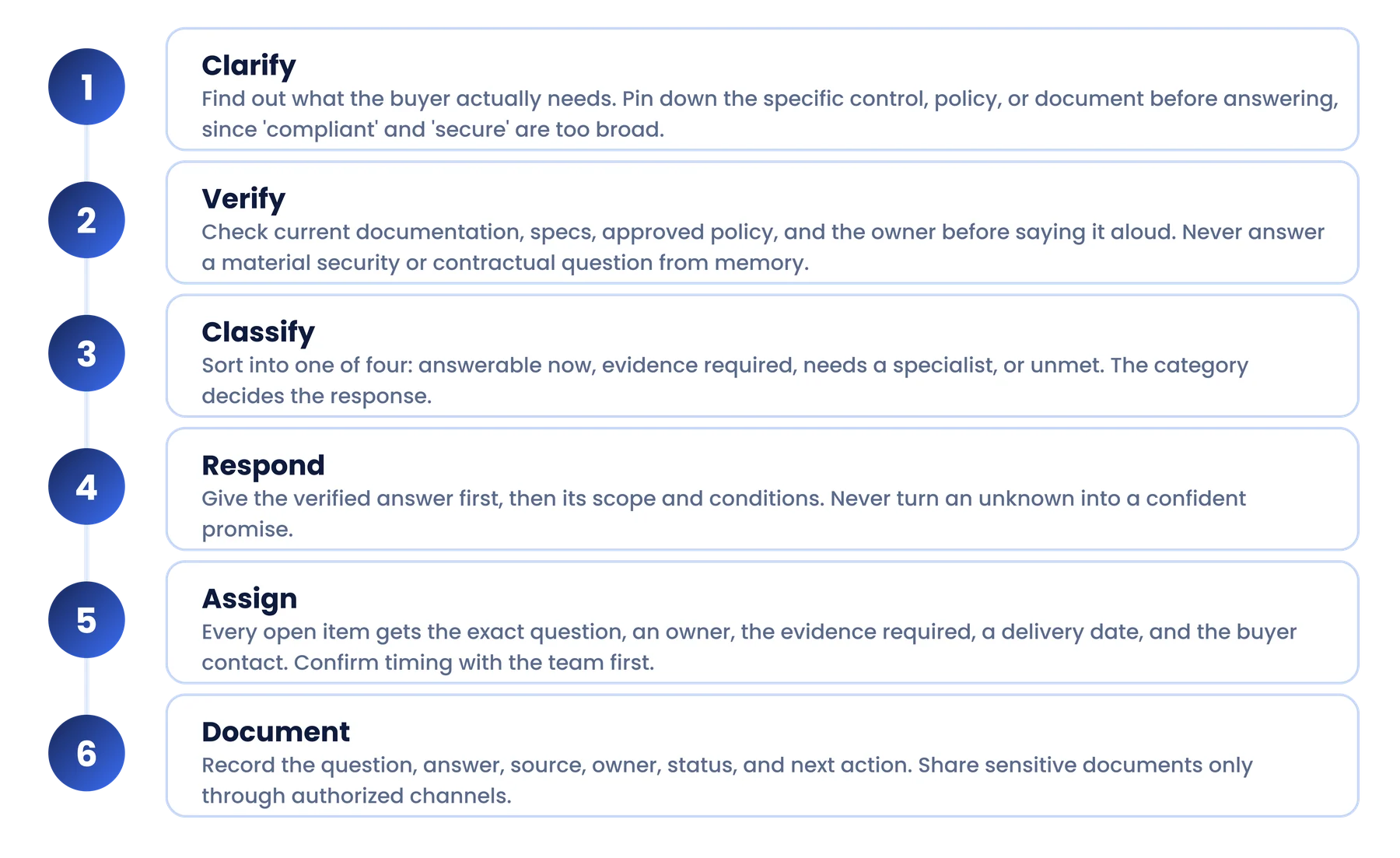
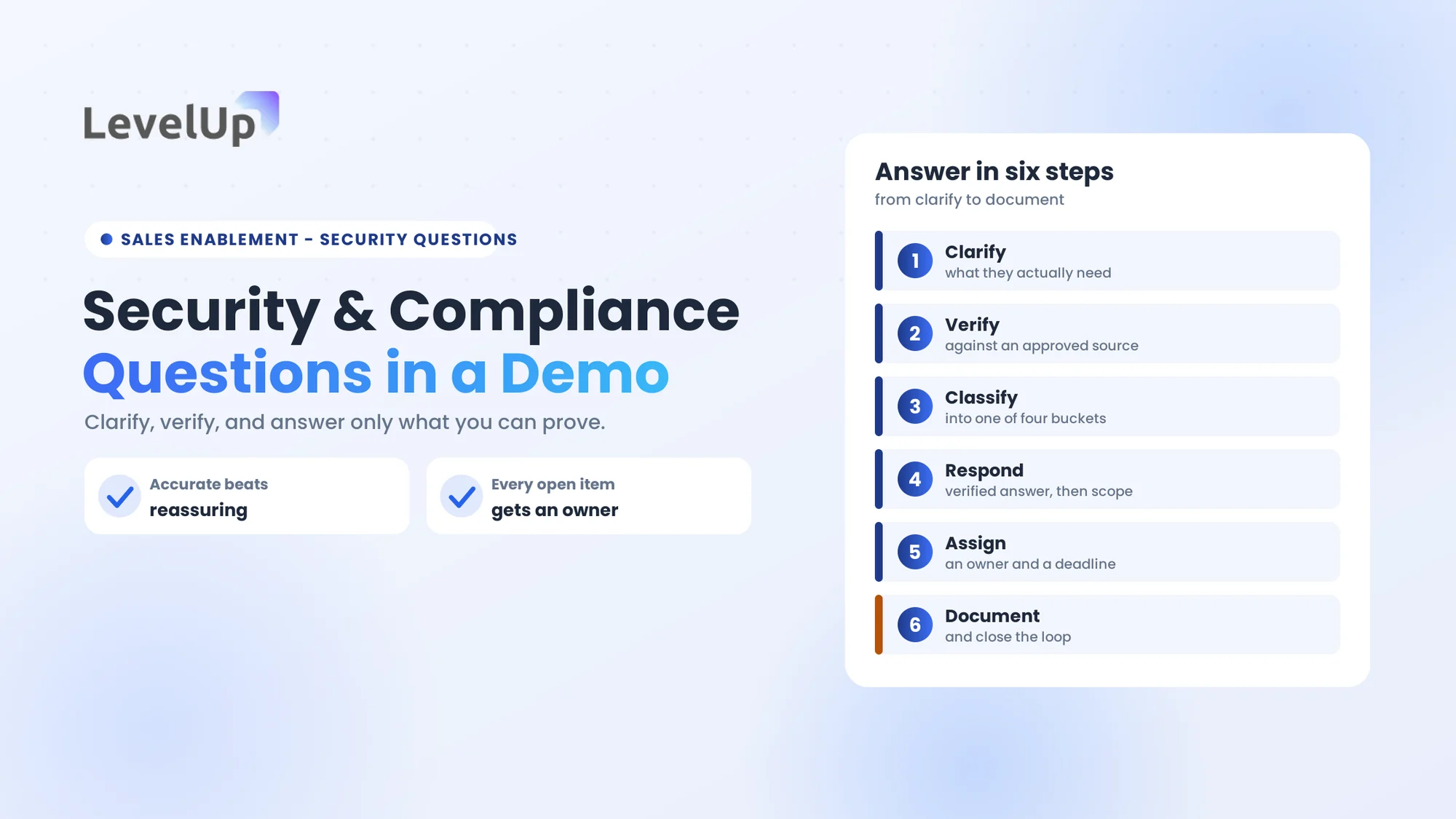
Six steps, in order: Clarify, Verify, Classify, Respond, Assign, Document. The point is to answer only what you can support, and to route the rest cleanly.
Step 1: Clarify the buyer’s actual requirement
Find out what the buyer needs before answering. “Are you compliant?” is unanswerable without knowing compliant with what. Useful clarifying questions: “Is this a mandatory requirement for vendor approval?” “Which specific control or document does your team need to review?” “Is there a particular policy or standard your team follows?” “Would a written response with supporting documentation meet your requirement?” Terms like secure, compliant, and enterprise-ready are too broad to answer without that context.
Step 2: Verify the answer against an approved source
Check the answer against current documentation, product specifications, approved policies, and the appropriate internal owner before saying it aloud. Do not rely on memory when the answer creates a material representation about security, privacy, legal, or contractual matters. An answer given from memory that later contradicts the company’s own written documentation can stall a deal on its own.
Step 3: Classify the question
Every question falls into one of four categories, and the category decides the response:
- Verified and answerable now: you have an approved, current answer and can give it.
- Verified but evidence required: the answer is known, but the buyer needs documentation or a formal review.
- Requires specialist confirmation: the answer depends on technical, security, legal, or configuration detail you are not authorized to confirm.
- Unsupported or unmet requirement: the company cannot currently substantiate or meet the requirement.
Step 4: Respond clearly without overpromising
Give the verified answer first, then its scope and any conditions. “We hold a current SOC 2 Type II report covering [scope], which I can share under NDA through our trust center” is useful. “We take security very seriously,” offered when someone asked a factual question about audit scope, is not. Never turn an unknown into a confident promise.
Step 5: Assign an owner and a deadline
When an answer needs follow-up, agree on the exact unanswered question, the person responsible for verifying it, the evidence or response required, the expected delivery date, and the buyer contact who needs it. Do not promise a turnaround time until the responsible team has agreed to it.
Step 6: Document the answer and close the loop
Record the buyer’s question, the verified response, the source, the owner, the status, and the next action in your approved sales workflow. Sensitive security documentation should be shared only through authorized channels with appropriate access controls, not ad hoc email attachments.
Example Responses to Difficult Security Questions
These are illustrative responses using placeholders. Replace anything in brackets with your organization’s verified information, and never present example wording as a factual claim.
| Buyer’s question | Establish first | Example response | Next step |
|---|---|---|---|
| “Are you SOC 2 certified?” | Current report status, scope, and observation period | “We hold a current SOC 2 Type II report covering [scope]. I can share access through our trust center under NDA.” | Share the report through the approved channel |
| “Where is our data hosted?” | Hosting region for production, backups, and DR | “Production data for [product] is hosted in [region] on [provider]. Let me confirm where backups and DR copies reside and follow up.” | Verify with engineering, respond by the agreed time |
| “Is our data used to train your AI models?” | The specific AI feature and provider arrangement | “For [feature], data is processed by [provider] under [terms]. Customer data is not used for model training under our current agreement. I will send the documentation.” | Share the applicable AI data-use documentation |
| “Can you guarantee compliance with our policy?” | The actual policy or requirements list | “I would rather map our controls against your specific requirements than offer a blanket guarantee. Can your team share the policy so we can review it against what we support?” | Schedule a security review with the right owner |
| “Can you send your security documentation?” | Which documents are needed and available | “We have [list]. Some are available through our trust center; others require an NDA. I will route this to our security team.” | Start document sharing through the approved process |
| “We need an answer today. Can you confirm now?” | Whether a verified answer already exists | “I can confirm [verified portion] now. For [unverified portion], I need our [security or engineering] team, and I will have an update by [realistic time].” | Confirm with the owner, deliver by the agreed deadline |
What to Do When You Don’t Know the Answer
Admitting uncertainty is usually safer and more credible than improvising. Buyers are not naive about risk; what damages trust is confidence that falls apart during the formal review. A repeatable pattern:
1
2
3
4
5
6
Example wording, not a guaranteed response time: “I don’t want to give you an unverified answer on that. I’ll confirm the exact requirement with our security team and follow up with the relevant documentation. When does your team need the response?”
Route each open question to the right owner: architecture and data-flow questions to engineering or solutions architecture, contractual and DPA questions to privacy or legal, certification evidence and control details to whoever owns the trust center or security program, AI-specific data handling to the product team that built the feature, and anything requiring a formal commitment to an authorized executive or control owner.
How to Prepare for Security Questions Before the Demo
Build a security-question answer library
Maintain a set of approved answers, each recording the question, the approved answer, the supporting source, the owner, the last review date, any scope or plan limitations, and the approved sharing method. Review it periodically, because old security answers become inaccurate as products, providers, and policies change.
Prepare a buyer-specific evidence pack
A document pack may include relevant policies, certificates or audit reports the company actually holds, privacy documentation, product security details, and approved answers to common questions. Not every vendor has every document, and sensitive materials should not all be shared publicly, so assemble the pack to the buyer’s likely requirements and route the restricted items through the approved channel.
Identify likely escalation points
Before the meeting, establish who can answer questions about architecture, identity, data handling, AI, contractual terms, and compliance evidence, and prepare an escalation route for anything the presenter is not authorized to answer. Knowing the owner in advance is the difference between a confident handoff and an improvised promise.
Add a security review to demo preparation
When the information is available, review the buyer’s stated requirements, industry context, data use case, and procurement process as part of preparing the demo, in the same way you would prepare for data migration questions. Do not infer a company’s security requirements from its industry alone; confirm them from what the buyer has actually said.
How to Follow Up After a Security Question Comes Up
An unresolved question becomes a clear next action through a short, specific follow-up. A realistic email keeps it from drifting:
Subject: Follow-up on your security questions from today’s demo
Hi [name], thanks for the questions on [topics] during the demo. To confirm what we covered: [verified information already provided]. The one item still being reviewed is [remaining question], which [owner or team] is confirming. We expect to have the documentation to you by [agreed date, if confirmed]. I have attached [approved document] and suggested [next meeting or review step] so your team has what it needs to proceed.
Keep the email to what is confirmed; do not overload it with every possible security detail. Then record the item in your sales workflow, update its status as it moves, and make sure the buyer receives the verified answer, the same discipline a mutual action plan applies to the wider evaluation.
Common Mistakes to Avoid When Answering Security Questions
Each mistake below has a safer alternative that costs nothing but discipline.
| Mistake | Safer alternative |
|---|---|
| Claiming a certification the company does not hold | State only the verified status, then confirm and follow up |
| Confusing an internal policy with an independent certification or attestation | Name what you actually have: a policy, a SOC 2 report, or an ISO 27001 certificate |
| Giving a blanket answer about AI data use | Verify the specific feature, provider, and terms before answering |
| Promising an unsupported feature, control, or compliance outcome | Confirm it against documentation first, or say it is under review |
| Sharing sensitive documents without authorization | Route the request through the approved channel, under NDA where required |
| Treating every question as an objection to overcome | Treat it as a requirement, a request for evidence, or a procurement gate |
| Leaving unanswered questions without an owner | Assign a named owner and an agreed deadline before the call ends |
| Promising a deadline before confirming availability | Check with the responsible team, then commit to a realistic date |
| Sending outdated documentation | Check the review date and scope before sharing anything |
| Blurring a product capability and a contractual commitment | Say explicitly which it is, since buyers rely on the difference |
Security Demo Preparation Checklist
An operational checklist to run before your next demo with a security-conscious buyer. Completing it does not certify compliance with any framework.
- Review the buyer’s stated security requirements, if available.
- Confirm the current approved answers in your answer library.
- Verify certification and audit report status, scope, and expiration.
- Check data hosting and data-handling documentation, including backups and DR.
- Confirm what can be shared with the buyer, and through which channel.
- Identify the technical, security, legal, and AI contacts for escalation.
- Prepare a response pattern for questions you cannot answer live.
- Agree internally on how follow-up items will be recorded.
- Confirm who owns each open question.
- Review the final response before sending it.
Keep open security questions from falling through the cracks
The hard part is rarely the first answer; it is tracking every unresolved question, owner, and follow-up across demos. LevelUp Demo helps teams organize that demo workflow, record open items, assign follow-up, and coordinate next steps in one place.
Frequently Asked Questions
What security questions should SaaS sales reps prepare for?
Prepare for questions on certifications and audits (SOC 2 Type II, ISO 27001), data hosting and residency, encryption in transit and at rest, single sign-on and access controls, data retention and deletion, incident response, subprocessors, DPAs, and AI data handling. Not every buyer asks every question, but these clusters cover most mid-market and enterprise evaluations.
How should a sales rep answer a security question they cannot verify?
Acknowledge the question, state what is known, name who will verify the rest, and agree on a realistic follow-up, then deliver. Checking an approved source and involving the right specialist beats improvising. A confident but unverified answer that your security team later contradicts in writing does more damage than saying you will confirm.
Should sales reps answer SOC 2 or ISO 27001 questions themselves?
Reps can communicate verified, approved information about the company’s status, for example that a current SOC 2 Type II report exists and its scope. They should not independently interpret audit scope, certify compliance, or make representations the organization has not authorized. A SOC 2 report is an attestation; an ISO 27001 certificate is a certification; neither should be summarized from memory.
What security documents might an enterprise buyer request?
Common requests include SOC 2 Type II reports, ISO 27001 certificates, penetration-test summaries, security questionnaire responses, data processing agreements, subprocessor lists, privacy policies, and architecture diagrams. Availability varies by vendor: not every company holds every document, and some require an NDA before sharing.
How should SaaS companies handle AI data privacy questions during demos?
Verify the specific AI feature, which provider processes the data, whether that provider retains or trains on the data, what opt-out controls exist, and which contractual terms apply. A blanket “we do not use your data for training” can be wrong if one AI subprocessor has different default terms, so confirm per feature and provider.
How do security reviews affect the SaaS sales process?
They add reviewers, evidence requests, and approval steps that can extend the timeline, which makes ownership and follow-up important. Treating the security review as a tracked stage of the deal, with named owners and deadlines, keeps it from becoming a disconnected blocker that resurfaces late in the cycle.
Conclusion: Make Security Answers Part of a Reliable Demo Process
The core principle stays the same across every deal: clarify the requirement, verify the answer, communicate its scope, involve the appropriate specialist, and document the next step. A credible answer, even one that ends in “I will confirm and follow up,” is better than a reassuring promise the company cannot substantiate.
A well-organized demo workflow helps a team track unanswered questions and follow-up actions so none of them drift, which is the operational role LevelUp Demo is built for. The practical takeaway is to prepare the evidence and the escalation path before the next demo, rather than improvising when a critical question arrives, because the question is coming; the only variable is whether you have already decided who answers it.