You are forty minutes into a demo. The buyer has been nodding along, asking good questions, and you can feel the deal forming. Then someone on their team unmutes.
“Do you support custom approval workflows?”
Six words. And in the next ten seconds, you will either strengthen this buyer’s confidence or start a slow erosion of trust that will not surface until the deal stalls three weeks later. Most reps default to one of four responses: a reflexive yes, a flat no, a rambling workaround explanation, or a vague promise about the product roadmap. Each one carries risk. The fifth option, asking what the buyer actually needs to accomplish, is almost always the better starting point. But it is only a starting point. You still owe them a verified answer.
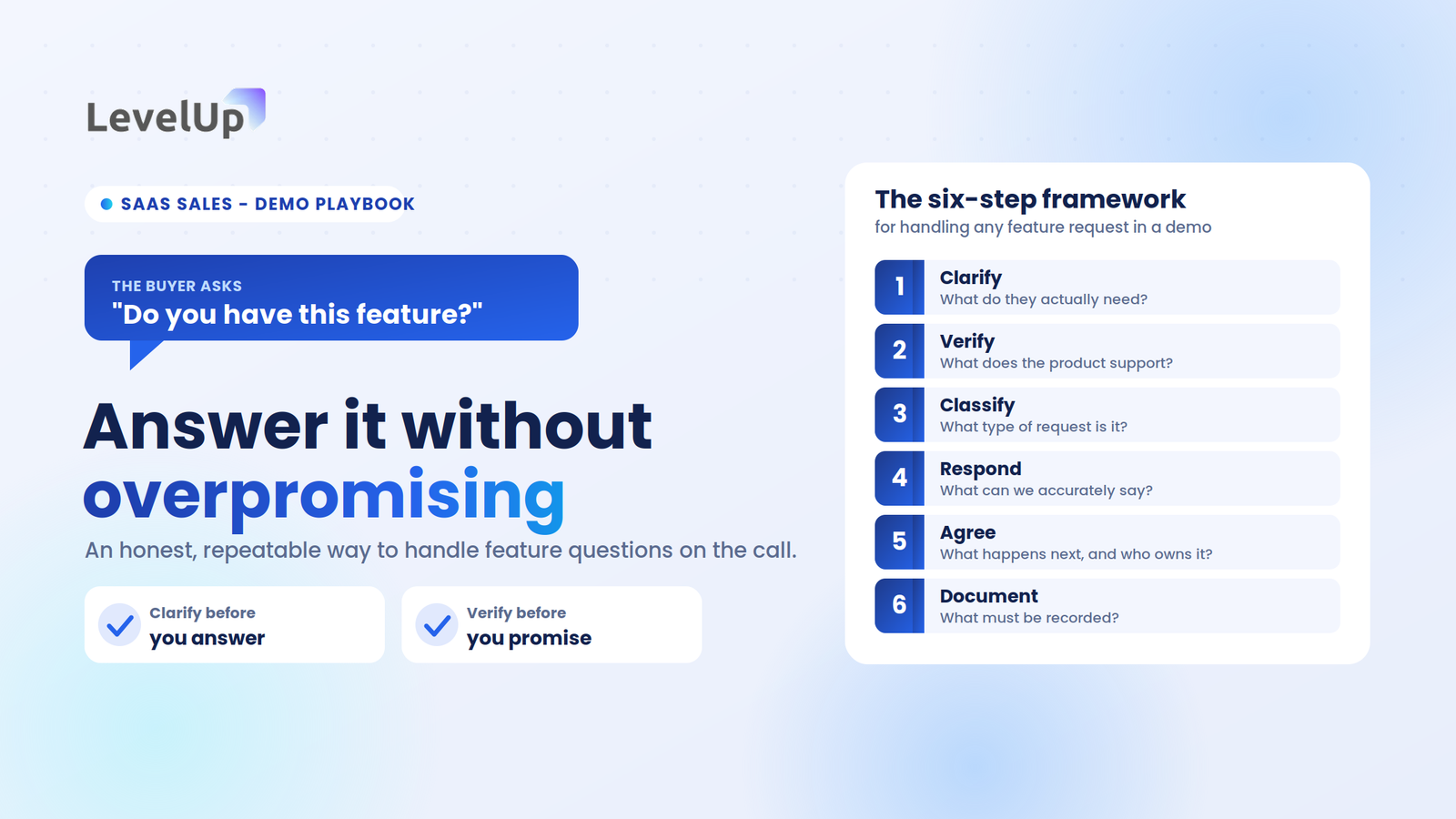
That is what this article covers: a practical, repeatable approach to how to handle feature requests during a SaaS demo, built around a six-step framework (Clarify, Verify, Classify, Respond, Agree on Next Steps, Document) you can use the next time a buyer asks about a capability you have not confirmed. You will walk away knowing how to respond honestly across seven common scenarios without derailing the conversation or promising something your product cannot deliver. If you want the full demo structure first, see the complete guide to running a SaaS demo.
When a buyer asks about a feature during a SaaS demo, clarify the underlying requirement first, verify the product’s actual capability second, and respond with only what you have confirmed. Suggest alternatives or promise follow-up only after those two steps are complete. A feature question is a request for an accurate answer, not a cue to improvise.
Why “do you have this feature?” is more complicated than it sounds
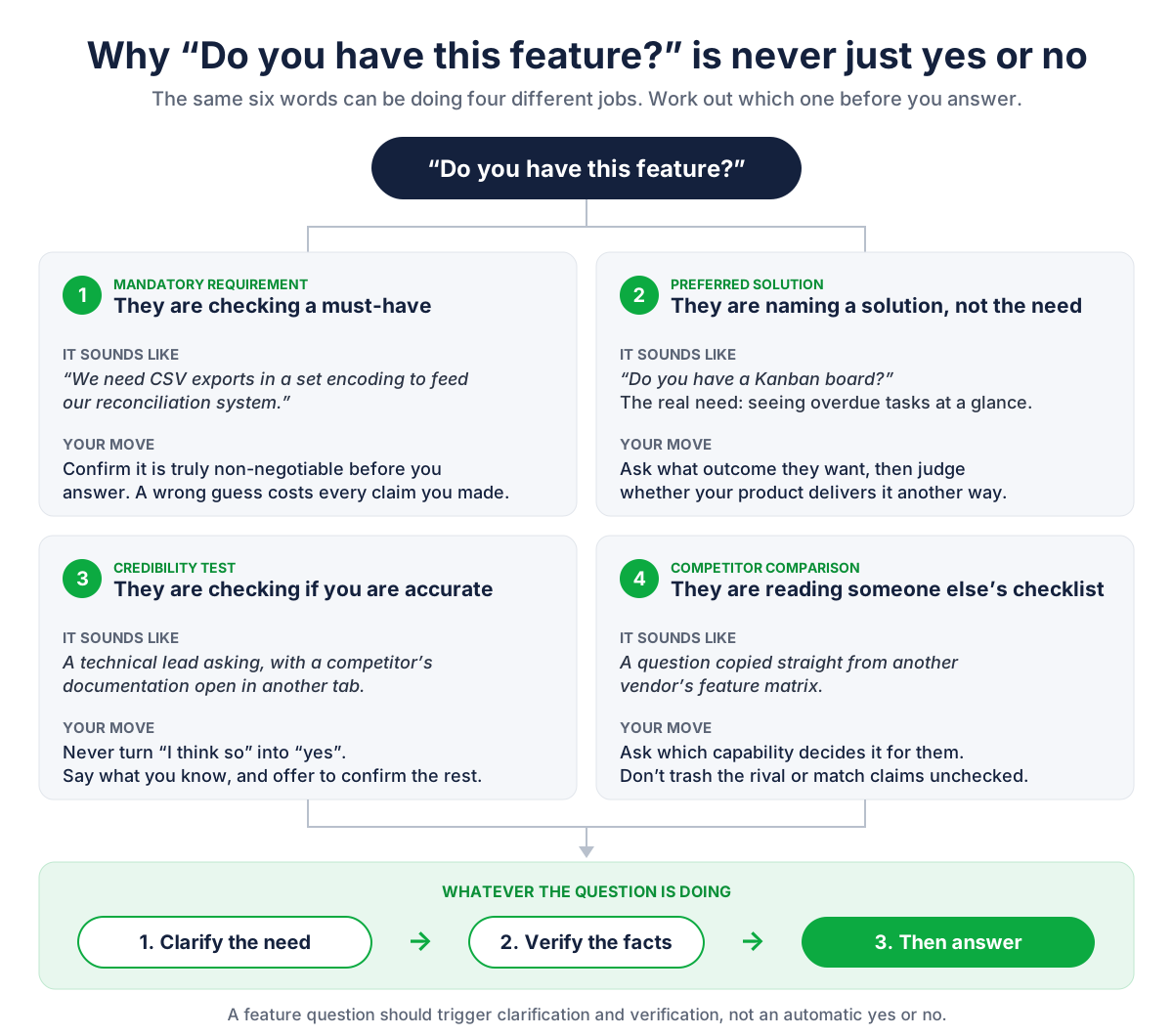
A yes-or-no question rarely has a yes-or-no answer. The same six words can mean six different things depending on who is asking and why. Before you answer, it helps to understand what the question might actually be doing.
The buyer may be checking a mandatory requirement
A finance team that needs CSV exports in a specific encoding to feed their reconciliation system is not expressing a preference. They are describing a procurement gate. If you guess wrong, you do not just lose credibility on one feature. You lose it on every claim you have made in the last forty minutes. The rep’s job here is to establish whether the requirement is genuinely non-negotiable before responding.
The buyer may be describing a preferred solution, not the actual need
Someone asks for a Kanban board. What they need is visibility into overdue tasks. The Kanban board is one interface that solves that problem. Your product might solve it differently, and that might be completely acceptable to the buyer. But you will not know until you ask. Clarifying the outcome does not mean dismissing the original request. It means understanding the job before you judge whether your product does it.
The buyer may be testing product credibility
Some feature questions are quiet credibility checks. A confident but inaccurate answer can undermine trust in both the rep and the product, especially when a technical lead is in the room with a competitor’s documentation open in another tab. The rep who treats “I think so” as “yes” is the one who gets caught. That distinction matters enormously to the person writing the evaluation summary.
The buyer may be comparing you with a competitor
The question might come straight from a feature matrix another vendor handed them. Ask what they have seen elsewhere and which capability actually matters to their decision. Resist the urge to trash the competitor or match their claim without verification. Understand the requirement first, then respond to the requirement rather than to the comparison.
A feature question should trigger clarification and verification, not an automatic yes or no.
The first rule: never guess about product capabilities
Sales confidence is an asset. Unsupported certainty is a liability. When a rep guesses, several things go wrong at once: the buyer builds expectations around inaccurate information, product limitations surface during implementation instead of evaluation, and your sales engineer inherits a mess they did not create. A single unverified “yes, we support SSO” that turns out to mean “we support SSO on the Enterprise plan, which was never quoted” can push a deal into weeks of rework and nearly kill it. The rep did not lie on purpose. They presented a hypothesis as a fact.
What to say when you are not sure
Rep: “I want to give you an accurate answer rather than guess. Let me confirm how that works in our current product and follow up with the specifics.”
This works because it communicates ownership. You are not stalling. You are telling the buyer their question matters enough to get right. The next move is to identify exactly what needs to be checked and who can verify it, so the follow-up is specific rather than vague.
What not to say when you have not verified the answer
These phrases feel harmless in the moment and create expectations you cannot support:
- “Yes, we should be able to do that.”
- “That is probably supported.”
- “I am sure our product team can build it.”
- And the classic: “It is on the roadmap,” when you have zero verified roadmap information.
There is a meaningful difference between a confirmed current capability, an unverified possibility, a requested enhancement, and an approved future commitment. Buyers deserve to know which one they are hearing, and blurring those four categories is how trust quietly erodes.
The six-step framework for handling feature requests during a SaaS demo
This process helps you respond accurately without turning every feature question into a detour. It is a guide for the conversation, not a rigid script to recite. One practice I recommend alongside it is keeping a simple one-page capability matrix beside your demo notes, with each common feature question tagged by status: native, configurable, integrated, workaround, beta, or not currently supported. The matrix is only useful because it connects to the steps below.
Step 1: Clarify what the buyer is trying to achieve
Do not assume the feature label is the requirement. Different buyers use the same term to mean automation, reporting, permissions, auditability, or an integration. Uncover the workflow, the desired outcome, who is affected, and any constraints.
Buyer: “Do you support custom approval workflows?”
Rep: “Could you walk me through the approval process you are trying to manage and where it breaks down today?”
Three follow-up questions that work when time is short:
- “What would you do with it?”
- “How are you handling that today?”
- “Is this required before launch, or would it be useful later?”
Step 2: Verify the actual product capability
Check reliable internal documentation or involve an authorized technical contact. Establish whether the capability is available now, requires configuration, depends on a specific plan tier or integration, or remains unverified. A practice that keeps this honest is a simple claim-level system you apply to your own statements: can you demonstrate it live, is it documented and verified, is it only technically plausible, or is it roadmap and exploratory? Only the first two should ever be presented as current product capability. Distinguish clearly between what you remember, what you believe, and what has actually been confirmed.
Step 3: Classify the request
Once you have verified, sort the request into one of six categories. These are not interchangeable, and treating them as the same is how vague answers happen:
- Fully supported.
- Supported through configuration.
- Achievable through a verified alternative workflow.
- Dependent on an integration or technical condition.
- Not currently supported.
- Unknown and requiring confirmation.
Step 4: Respond honestly and specifically
Give the buyer a direct answer based on what you have verified, describe any relevant limitations plainly, and avoid vague promises. Do not hide a limitation behind “that is something we can probably do.”
Step 5: Agree on a concrete next step
This could mean demonstrating the supported workflow, confirming a technical dependency, arranging a call with a sales engineer, or committing to a follow-up by a specific date. Whatever it is, it should be concrete and owned. For what a strong next step looks like, see what a SaaS demo next step should look like.
Step 6: Document the request
Capture the requirement, its business importance, the confirmed product status, any unresolved questions, the owner, and the follow-up date. Undocumented requests disappear into untracked inboxes, and a disappeared request is a broken promise waiting to happen.
| Step | Main question to answer |
|---|---|
| Clarify | What does the buyer actually need? |
| Verify | What does the current product support? |
| Classify | What type of request is this? |
| Respond | What can we accurately tell the buyer? |
| Agree | What happens next, and who owns it? |
| Document | What must be recorded and followed up on? |
Used well, the framework guides the conversation rather than turning it into an interrogation. The buyer should feel heard, not processed.
How to respond based on the type of feature request
Each scenario below includes the buyer’s question, suggested language you can adapt, why it works, and the appropriate next step. Treat the wording as a starting point, not a script to read verbatim.
1. The feature is fully supported
Buyer: “Can your product generate this report?”
Rep: “Yes, that reporting capability is supported. Let me show you the relevant workflow and how it relates to the outcome you described.”
Demonstrate the capability rather than merely asserting it exists. The practical signal of a successful response is the buyer agreeing to a concrete next step, not applause for your feature list. Use this as an illustrative pattern, not a claim about any specific product.
2. The feature exists but works differently
Rep: “We support that outcome, although the workflow is different from what you described. Let me walk you through the supported approach so we can check whether it meets your requirement.”
A buyer asking for a specific dashboard may accept a filtered report view. They may not. You will not know until you show them and ask. Use this wording only after you have verified that the alternative actually achieves the desired outcome.
3. The feature requires configuration
Rep: “This may be possible through configuration. Let me confirm the required settings and any limitations before giving you a definitive answer.”
Configuration can hide real scope. A capability that sounds like “just a toggle” can turn out to need admin-level access on a plan tier the buyer has not purchased, plus a setup step that takes the solutions team far longer than a toggle would suggest. “Just a configuration” can quietly become a scope change. Verify before you simplify.
4. The feature depends on an integration
Rep: “That depends on the integration and the data flow you need. Let us confirm the specific systems and requirements before we call it supported.”
“Supported” is ambiguous. A feature may work technically but lack audit logs, service-level guarantees, or documentation. Do not imply that a generic integration automatically supports every requested workflow.
5. The feature is not currently supported
Rep: “That specific capability is not currently supported. Could you tell me how essential it is to your workflow? We can then determine whether a suitable alternative exists or whether this is a genuine gap.”
State the limitation clearly while exploring whether the requirement can be met another way. Do not pressure the buyer into accepting an unsuitable workaround just to keep the conversation alive.
6. The answer is unknown
Rep: “I do not want to give you an inaccurate answer. I will confirm this with the relevant team and come back with what is supported, including any limitations.”
Acknowledge the uncertainty, take ownership of verification, and agree on a response deadline. If you leave the call with no owner and no date, the request will vanish.
7. The buyer asks for a future feature
Rep: “We do not currently have confirmation that this capability will be delivered. I can document the requirement and check what approved information we can share.”
Distinguish a request from an approved roadmap commitment, and never imply that submitting feedback guarantees development. A feature request is not a product commitment, and reps still blur that line more often than they realize.
How to find the real requirement behind a feature request
Discovery questions turn a feature label into a business problem you can actually solve. The goal is to understand the job the buyer needs done before recommending a different way to do it.
Ask outcome-based questions
- “What are you trying to accomplish?”
- “How does your current process work?”
- “What happens if this step stays manual?”
- “Who needs to use the output?”
- “What would prevent an alternative approach from working?”
Each question helps establish the actual requirement rather than the assumed one. The same discovery discipline that qualifies a deal works here, so it is worth revisiting how to qualify SaaS demo requests on need and fit.
Distinguish must-haves from preferences
Not every request carries the same weight. Sort them honestly:
- Mandatory technical or compliance requirements.
- Essential workflow requirements.
- Important but negotiable preferences.
- Convenience requests.
A prospect who says “that is a deal-breaker” is giving you a qualification signal. Determine whether it is truly mandatory or simply preferred before you react, and never dismiss a request as optional without confirming its importance with the buyer.
Confirm the requirement before suggesting alternatives
Summarize the buyer’s need back to them and get a yes before you propose a different path.
Rep: “So the core requirement is automated weekly exports to your ERP in CSV format, correct?”
Alternatives should be proposed only after both sides understand the problem the same way.
How to suggest a workaround without misleading the buyer
A workaround can be genuinely useful. It just must not be presented as equivalent to native functionality unless the evidence supports that. The difference between a helpful alternative and a misleading one is honesty about what it actually does and what it costs.
Explain what the workaround actually does
Describe the steps, the inputs, the outputs, and the result in plain terms. Use only verified or clearly hypothetical examples, never an aspirational description of how you hope it behaves.
Be clear about its limitations
Name the trade-offs where they apply: additional manual work, extra steps, dependencies on another system, or missing automation. A workaround that quietly adds an hour of manual effort per week is a different proposition from native support, and the buyer should get to weigh that.
Confirm whether it meets the buyer’s requirement
Rep: “Would this approach meet the requirement, or does the process need to happen automatically?”
The answer determines whether the alternative is actually viable or just a way to avoid saying no.
Know when not to suggest a workaround
When the requested capability is mandatory for security, compliance, technical compatibility, or a critical business process, an inadequate workaround is worse than an honest no. Do not present a partial solution as a complete one merely to preserve the deal. A workaround for a mandatory compliance control can create more risk than it solves.
How to handle feature requests that could put the deal at risk
Sometimes the honest answer is that the product does not do the thing, and the thing matters. Handling a genuine gap without becoming defensive or making unsupported promises is what separates a trusted rep from a desperate one.
Determine whether the gap is a deal-breaker
Clarify the requirement, its real business impact, and whether an acceptable alternative exists. A gap is only fatal if it blocks something the buyer cannot proceed without, and you cannot know that until you ask directly.
Separate current capability from roadmap possibility
Keep four things distinct: confirmed functionality, internal investigation, a requested enhancement, and an approved future commitment. Collapsing them into an optimistic “it is coming” is how trust breaks after the contract is signed.
Bring in the right internal stakeholder
When the requirement needs technical validation, a sales engineer or product specialist should confirm it rather than the rep guessing. An authorized voice on a genuine gap is far more credible than a hopeful one.
Agree on the next decision
Define what needs to be confirmed, who owns the follow-up, and when the buyer will receive an update. Even when the answer is no, a rep who handles the gap with clarity often preserves the relationship for a future cycle. If you want to see how gaps affect progression, it is worth tracking your demo-to-close rate against the deals where a hard requirement went unmet.
When should an AE bring in a sales engineer or product expert?
Not every feature question requires escalation, but uncertainty should never be hidden. The judgment call is about where your verified knowledge ends.
Handle it yourself when the answer is verified
Familiar capabilities, documented workflows, and straightforward product questions that fall within your knowledge do not need a specialist. If you can demonstrate it live and it is documented, demonstrate it.
Escalate when technical validation is needed
Complex integrations, architecture, security, compliance, data handling, or any request that involves a technical commitment belongs with an expert. So does any answer you simply cannot verify yourself.
Make the handoff useful
A good handoff saves the buyer from repeating the entire conversation. Give the specialist:
- The buyer’s underlying requirement.
- What has already been verified.
- What remains unknown.
- Relevant constraints.
- The decision the buyer needs to make.
How to follow up after a feature question
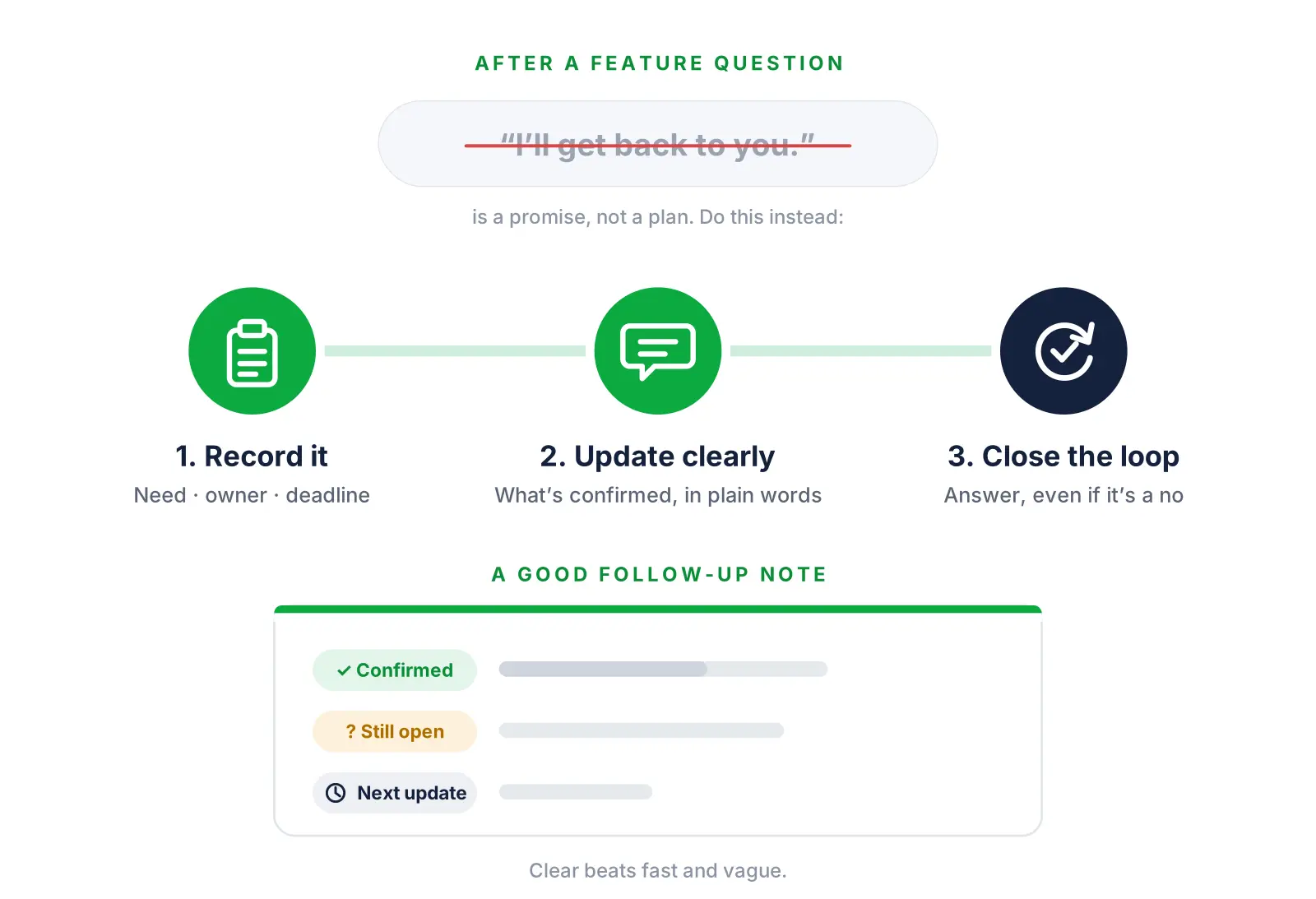
“I will get back to you” is not a follow-up plan. It is a promise with no mechanism. A real follow-up has a record, a specific update, and a closed loop.
Record the request
Capture the exact requirement, the business context, its importance, the confirmed status, any unresolved questions, the owner, and the deadline. The detail you skip recording is the detail you will misremember a week later.
Give a specific update
Communicate verified findings, limitations, and dependencies in plain language, without jargon that forces the buyer to decode what you actually confirmed.
Close the loop
Make sure the buyer receives the promised answer, including when the capability is unavailable or the answer is still unresolved. A short follow-up note that clearly separates confirmed information from outstanding questions does more for trust than a fast but vague reply.
How sales teams should track recurring feature requests
Individual rep behavior handles the single demo. The wider operation benefits when teams record and review requests consistently across demos, so patterns become visible instead of anecdotal. Worth tracking:
- Repeated requests across multiple accounts.
- Requests associated with a particular buyer segment.
- Mandatory requirements versus preferences.
- Questions caused by unclear positioning or documentation.
- Requests that frequently require technical escalation.
- Feedback that may help product teams investigate potential gaps.
One caution: request frequency alone does not prove market demand or justify a roadmap commitment. Ten buyers asking for the same thing is a signal worth investigating, not a decision already made. The purpose of tracking is to make feedback useful without turning every buyer request into a promise to build something.
Common mistakes when handling feature requests during a SaaS demo
Each of these is avoidable once you can name it. For each, the fix is the opposite behavior done deliberately.
1. Saying yes before verifying. Creates expectations your product cannot meet, and the gap surfaces at the worst possible moment, during implementation.
2. Giving an immediate no without understanding the need. Can kill a deal where a configuration or verified integration would have worked. Clarify before you decline.
3. Promising a roadmap feature. Turns internal exploration into an implied delivery commitment. Share only approved information.
4. Hiding limitations behind vague language. “That is something we can probably do” is not a verified answer. It is a deferred problem.
5. Suggesting a workaround without explaining its limits. A close cousin of overpromising. Name the trade-offs or do not offer it.
6. Letting one feature question derail the entire demo. Acknowledge it, capture it, and agree on when to return to it, then keep the demo moving.
7. Failing to follow up. Leaves the buyer recalculating risk in silence, usually against you.
8. Treating every feature request as a product gap. Sometimes the buyer needs a different explanation, not a different product.
Feature request handling checklist for SaaS sales reps
During the demo
- ☐Listen to the request without interrupting.
- ☐Clarify the desired business outcome.
- ☐Determine whether the requirement is mandatory.
- ☐Verify the current product capability.
- ☐Distinguish native support from configuration or alternatives.
- ☐Avoid unsupported claims.
- ☐Escalate technical uncertainty when necessary.
- ☐Agree on a concrete next step.
After the demo
- ☐Document the exact requirement.
- ☐Record what is confirmed and what remains unknown.
- ☐Assign an owner.
- ☐Set a follow-up deadline.
- ☐Communicate the verified answer.
- ☐Share recurring patterns with the appropriate internal team.
The test for both lists is simple: every unresolved question leaves the call with a clear owner and a follow-up plan. Do not promise an answer you have not verified. Promise a clear process for getting it.
How LevelUp Demo fits into a more consistent demo process
Feature questions get harder to manage when every rep runs a different demo workflow, uses outdated materials, or tracks follow-ups in personal notes. LevelUp Demo helps small sales teams centralize demo scheduling, lead qualification, outcome tracking, and follow-up management in one place, so the operational side of demo execution does not fall through the cracks. The clearer your process, the easier it is to qualify leads and keep every feature commitment accounted for.
Frequently asked questions
What should you say when a customer asks, “Do you have this feature?”
Clarify the underlying requirement before answering. Ask what outcome the buyer needs, verify whether the product supports it, and respond with only confirmed information. If you are unsure, say so and commit to a specific follow-up rather than guessing.
What if the SaaS product does not support the requested feature?
Say so directly. Then ask how essential the capability is to the buyer’s workflow, and determine whether a verified alternative meets the requirement or whether the gap is a genuine blocker. Honest communication protects the relationship even when the answer is no.
Should sales reps promise features that are on the roadmap?
No. A roadmap item is not a delivery commitment. Share only approved roadmap information, make clear that product plans can change, and never imply that submitting feedback guarantees development.
How do you handle a feature request you cannot answer during a demo?
Acknowledge the uncertainty, document the requirement, assign an internal owner, set a follow-up deadline, and tell the buyer exactly when they will hear back. Escalate to a sales engineer when the answer needs technical validation.
How can you tell whether a feature is a deal-breaker?
Ask directly: “Is this required for your team to move forward, or is it a preference?” A buyer attaching the feature to a compliance deadline or a procurement gate is signaling a hard requirement. Confirm necessity, constraints, and acceptable alternatives before you react.
Should you suggest a workaround when a feature is missing?
Only when the workaround is verified, you can explain its limitations clearly, and it genuinely meets the buyer’s requirement. A workaround for a mandatory compliance control may create more risk than it solves.
When should an AE involve a sales engineer?
When the answer depends on technical architecture, integration behavior, security, or data handling, or when you cannot verify the answer yourself. Bring the specialist in before a technical commitment is made, not after.
Final takeaway
A feature request is an opportunity to understand what the buyer needs and to demonstrate that your team gives accurate answers. It is not a cue to improvise.
Clarify. Verify. Classify. Respond. Agree on next steps. Document.
Buyers do not expect reps to know every answer on the spot. They do expect honest information, realistic expectations, and reliable follow-through. Get those three right, and the hardest feature question in the demo becomes one more moment where the buyer decides they can trust you.
Bring more consistency to your demo process
LevelUp Demo helps SaaS teams manage demo requests, qualification, outcomes, and follow-ups in one workflow, so feature commitments and next steps are never lost in an inbox.