You are twelve minutes into a demo. The prospect has leaned forward twice, asked a sharp question about integrations, and nodded when you showed the reporting workflow. Then it comes: “So, how much does this cost?”
Two things happen next in most demos, and both are wrong. The rep either blurts out a number with zero context (“It is $450 a month”), leaving the buyer to evaluate a price against nothing. Or the rep dodges: “Great question, let us circle back to that at the end.” The buyer hears evasion. Trust drops. The rest of the demo plays to a skeptical audience.
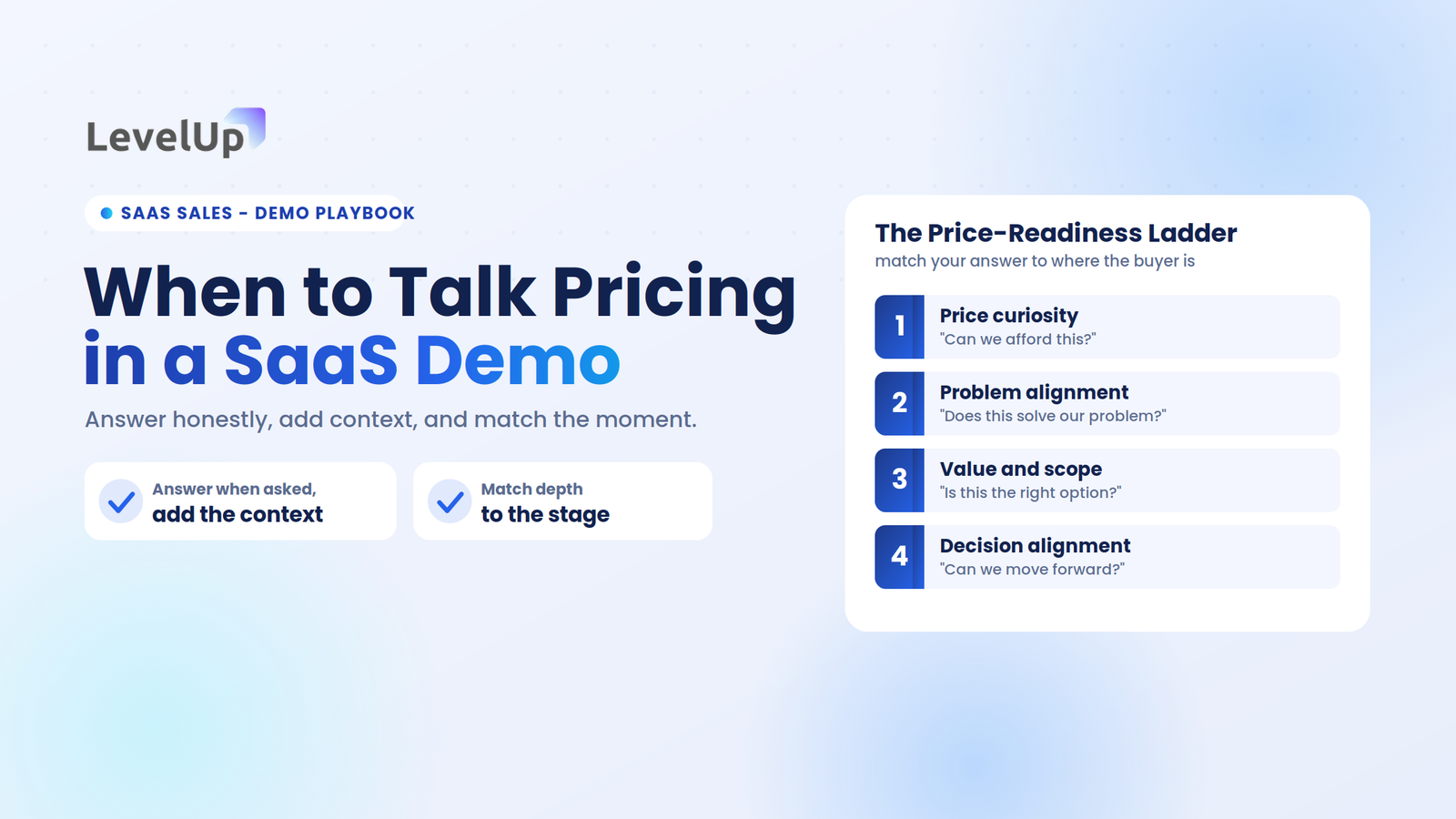
There is a better move, and it starts with knowing when to talk pricing in a SaaS demo: answer the question honestly, give the buyer enough context to interpret the number, and match the depth of the conversation to where the buyer actually is in their evaluation. That is the core of what we will cover here, along with an original framework called the Price-Readiness Ladder, copy-ready scripts, a decision tree, and a checklist your manager can use during call reviews. If you want the full demo structure first, see the complete guide to running a SaaS demo.
Share known pricing whenever the buyer asks, with enough context to interpret the number. If the buyer has not asked, establish the problem and the relevant value first, then run a commercial-fit check before the meeting ends. The goal is not to delay price to a perfect moment. It is to give honest pricing at the right level of detail.
When should you talk about pricing in a SaaS demo?
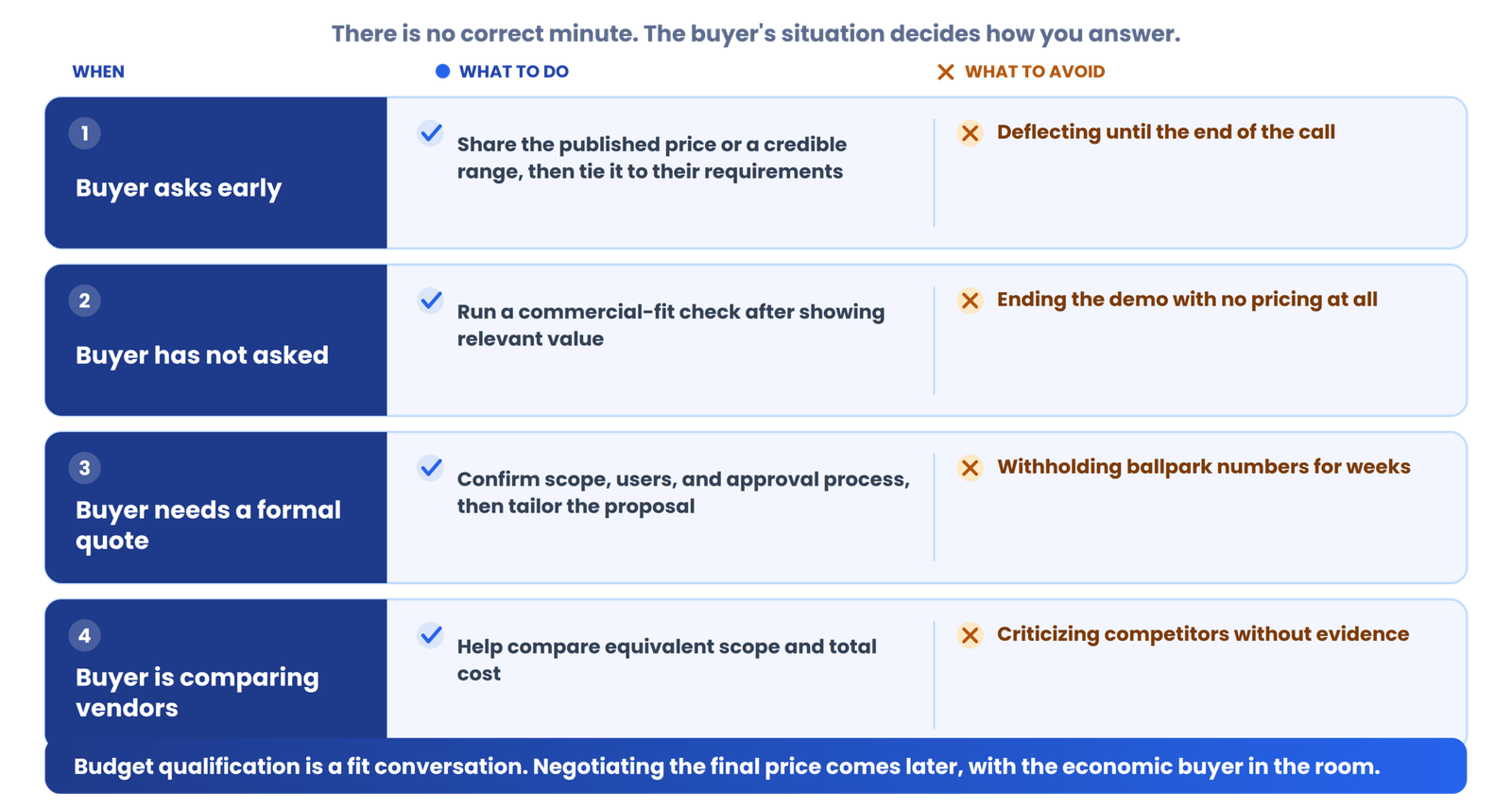
There is no correct minute. Pricing timing depends on whether the buyer asked, how complex your packaging is, whether your prices are public, the deal size, and how many stakeholders are involved in the purchase. Three situations cover most demos.
The buyer asks early. Answer directly. If your pricing page is public, give the relevant number. If the quote depends on scope, say so and offer a genuine range. Gong research on pricing conversations found that successful reps discussed pricing throughout the call rather than saving it for one big reveal, which suggests spreading commercial context across the conversation correlates with better outcomes, though correlation and causation are different things.
The buyer has not raised it. After you understand the problem and show the relevant workflow, introduce a commercial check before the meeting ends. Leaving affordability unaddressed wastes everyone’s time. If the product is outside their budget, you both want to know now. This is a good moment to qualify sales leads on budget and timeline.
The buyer needs a formal quote. Establish users, scope, implementation needs, and approval process first, but stay transparent about known pricing while you do it.
| Situation | What to do | What to avoid |
|---|---|---|
| Buyer asks early | Share the published price or a credible range, then connect it to their requirements | Deflecting until the end of the call |
| Buyer has not asked | Introduce a commercial-fit check after demonstrating relevant value | Ending the demo without any pricing discussion |
| Buyer needs a formal quote | Confirm scope, users, and approval process before tailoring the proposal | Withholding ballpark numbers while scoping takes weeks |
| Buyer is comparing vendors | Help compare equivalent scope and total cost | Criticizing competitors without evidence |
One distinction matters here: discussing budget context early is not the same as negotiating a final contract price. Budget qualification is a fit conversation. Negotiation comes later, with the economic buyer in the room.
The Price-Readiness Ladder: four stages of a better pricing conversation
This is a conversation aid, not a validated scientific model. Buyers jump between stages, and a direct price question at any stage deserves a direct answer. The ladder helps a rep choose what context to add around that answer.
Stage 1: Price curiosity
The buyer wants to know if your product is in the right ballpark. They are not comparing line items yet.
Rep: “Our plans start at [price]. The total depends on [seats, usage, integrations]. If you share a bit about your team’s setup, I can point you to the relevant option.”
This works because it respects the buyer’s time. A study of 1,000 SaaS companies found that 60% publish a pricing page, and among those, 79% list actual prices rather than hiding them behind a quote request. Buyers expect transparency. When your price is already public, withholding it on a call creates friction, not leverage.
Stage 2: Problem alignment
You now understand what the buyer wants to solve. Connect the use case to the product without turning it into a 20-minute pitch.
Rep: “You mentioned reps spend hours coordinating demos manually. Let me show the workflow that handles that, then we will map the right plan to your team size.”
Stage 3: Value and scope alignment
Clarify functionality, user count, integrations, implementation, and commercial scope. This is where you can qualify SaaS demo requests more precisely.
Rep: “Based on what we have discussed, the two main factors are the number of active users and whether you need the API integration. Let us use those to narrow down the recommendation.”
Stage 4: Decision alignment
Confirm the likely investment, surface concerns, identify who approves, and agree on the next step.
Rep: “Does this range fit what you had in mind? If so, let us confirm the requirements and set up the next conversation with your team.”
| Stage | Buyer’s question | Rep’s response | What to avoid |
|---|---|---|---|
| Price curiosity | “Is this in our budget?” | Share starting price or range | Refusing to give any number |
| Problem alignment | “Can it solve X?” | Connect use case to capability, then discuss the relevant plan | Feature-dumping before understanding the problem |
| Value and scope | “What would this look like for us?” | Scope users, integrations, implementation; recommend a package | Inventing ROI figures |
| Decision alignment | “What is the investment?” | Confirm price, surface concerns, agree on next step | Ending without a clear next step |
A buyer who asks “How much?” during Stage 1 still gets an answer. You just add the context appropriate to that stage, not the context from Stage 3.
What to say when a prospect asks about pricing too early
“How much does it cost?”
If you have fixed, public pricing, give the number. Period. If the quote depends on scope, explain the actual variables rather than saying “it depends” and stopping there.
Rep: “It depends on user count and which integrations you need. For a team your size, most customers land between $X and $Y per month. Can I ask a couple of questions to narrow that down?”
“Can you just send me your pricing?”
If your pricing is on your website, send the link. Do not hold information hostage to force a meeting.
Rep: “Absolutely, here is the pricing page. Want me to flag which plan usually fits teams doing [their use case]?”
“What is your cheapest plan?”
Answer factually, then check fit.
Rep: “The starter plan is $X a month. It includes [core capabilities]. Does it need to support [specific requirement they mentioned]? Because that feature is on the next tier.”
“We are comparing three vendors.”
Good. Acknowledge it, then help them compare the same scope. A buyer who shares their shortlist is further along than one who is just browsing, so this is also a moment to identify buying signals during a demo.
Rep: “That makes sense. To help you compare apples to apples, here is what is included in our quote: onboarding, support, [scope items]. Want me to map that against what the other vendors are quoting?”
“We only have a small budget.”
Determine whether the budget is fixed, whether a lower tier works, or whether timing can shift. Sometimes the right outcome is disqualification, not a forced discount.
Rep: “What range are you working with? If the full platform is outside that, I would rather tell you now than waste your evaluation time.”
A note on tone throughout: calm, concise, non-defensive. The moment a rep sounds evasive or rattled by a pricing question, the buyer’s guard goes up.
How to discuss price without making the product feel expensive
Price needs context. But context is not an excuse to hide the number behind a 30-minute feature tour. Link the capability to a problem the buyer described, clarify what is included in the quoted price, explain recurring versus one-time costs when they are relevant, and use buyer-specific outcomes rather than generic feature lists.
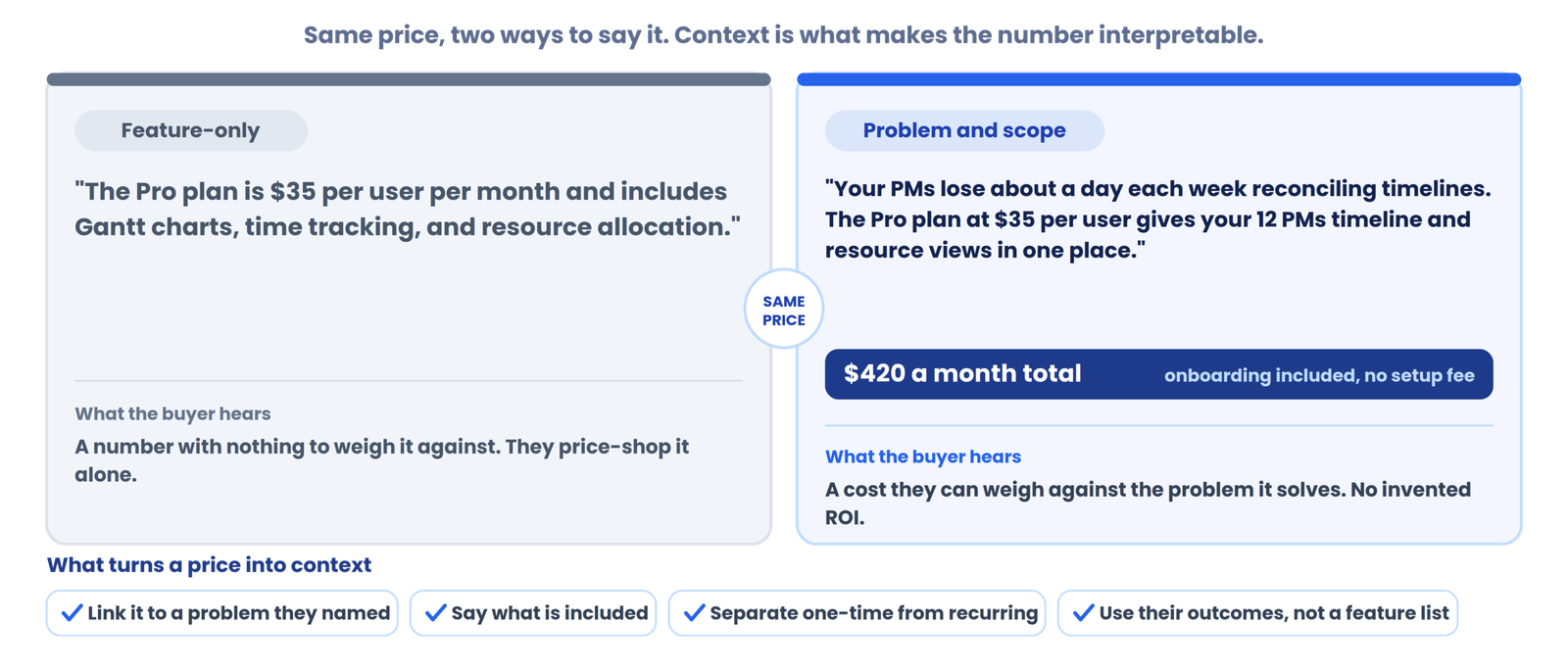
Here is the difference, using a fictional project-management SaaS (all figures illustrative):
Feature-only statement: “The Pro plan is $35 per user per month and includes Gantt charts, time tracking, and resource allocation.”
Problem-and-scope explanation: “You said your PMs lose about a day each week reconciling timelines across spreadsheets. The Pro plan at $35 per user per month gives your 12 PMs the timeline and resource views in one place. That is $420 a month total, and it includes onboarding for the first team, with no separate implementation fee.”
Same price. The second version makes the number interpretable. The buyer can weigh $420 a month against the cost of the problem, without the rep manufacturing an ROI claim.
How to handle “it is too expensive” during a demo
“Too expensive” is not one objection. It is at least four different concerns wearing the same words. Identify which one before you respond.
| What the buyer may mean | Helpful response |
|---|---|
| The budget is genuinely limited | Explore a lower tier or adjusted timing |
| The value is unclear | Revisit the buyer’s stated requirements and the specific workflow that addresses them |
| A competitor quoted less | Compare equivalent scope, onboarding, support, and total cost |
| Approval is needed from someone else | Identify the economic buyer and what they need to see |
| The buyer is negotiating | Understand the concern before offering concessions |
A realistic exchange shows the move in practice:
Prospect: “That is more than we expected.”
Rep: “I appreciate you telling me that. Can I ask what range you were expecting, and whether that was for the same scope we discussed?”
Prospect: “We were thinking closer to $200 a month.”
Rep: “Got it. The difference is mainly the API integration and dedicated onboarding. If you do not need the API, the standard plan at $220 a month might be closer. Would that cover your requirements?”
No panic. No immediate discount. No guilt trip. Sometimes the honest conclusion is that the product does not fit right now, and a no-decision loss tracked properly is more useful than a forced deal that churns in three months.
A simple decision tree for pricing conversations
Use this before or during a demo to decide what to say next. It never routes a buyer through an artificial delay before hearing a known price.
1Did the buyer ask about price?
Yes: go to the next step. No: after demonstrating relevant value, introduce a commercial check before the call ends.
2Is pricing fixed and publicly available?
Yes: share the relevant price and ask about their requirements. No: move to explaining what determines the quote.
3Explain what determines the quote
Cover users, usage, integrations, and support level. Provide a credible range when possible.
4Clarify the buyer’s requirements
Connect their stated requirements to the relevant plan or package.
5Check commercial viability
Confirm whether the price and scope are workable for the buyer.
6Agree on the next step
Confirm the next action, an owner, and a date.
For guidance on what that final step should look like, see how to define the next step after a demo.
What sales managers should track after the demo
Pricing conversations generate patterns, but only if you record them consistently. Use this review checklist on completed demos:
- Was pricing discussed during the demo?
- At what point did it come up?
- Did the buyer or the rep initiate it?
- Was a fixed price, range, or custom quote provided?
- What objection or concern emerged?
- Was the relevant scope established?
- Was the buyer commercially qualified on budget, authority, and timeline?
- Was a concrete next step agreed?
- Did the opportunity advance, stall, or close?
These fields help you investigate your own data. Timing alone does not prove that a conversation caused a win or loss. But if deals stall consistently when pricing is deferred to a second call, that is a pattern worth acting on. You can measure your demo-to-close rate to see whether pricing-conversation changes affect progression.
Teams using LevelUp Demo can standardize these fields across their demo workflow, recording qualification details, demo outcomes, objections, and follow-up ownership in one place rather than scattered across inboxes and calendar notes.
SaaS demo pricing checklist
Before you end the call, confirm each of these:
- ☐I know the buyer’s main problem.
- ☐I understand the relevant use case and scope.
- ☐I can explain the pricing model accurately.
- ☐I answered direct pricing questions honestly.
- ☐I connected relevant capabilities to the buyer’s requirements.
- ☐I addressed affordability or budget concerns without pressure.
- ☐I clarified remaining commercial questions.
- ☐I agreed on a concrete next step with an owner and date.
- ☐I recorded the outcome and follow-up owner.
Frequently asked questions
Should you discuss pricing before or after a SaaS demo?
Share known pricing whenever the buyer asks. If they do not ask, introduce a commercial-fit check after you have demonstrated relevant value and before the meeting ends. Leaving pricing entirely for a follow-up email risks the buyer disqualifying you silently. The goal is context, not suspense.
What should you say when a prospect asks for pricing at the beginning of a demo?
Give the available price or range immediately. Then explain what factors affect the final quote and offer to map the pricing to their specific requirements during the call. Transparency early builds trust for the rest of the conversation.
How do you handle a price objection during a product demo?
First, identify what “too expensive” actually means. Is the budget genuinely limited? Is the value unclear? Are they comparing a different scope from a competitor? Each root cause has a different response, and jumping to a discount before understanding the concern usually costs margin without solving the real problem.
Should SaaS companies reveal pricing on their website?
It depends on the sales motion. Self-serve and SMB products benefit from published pricing because it reduces friction and pre-qualifies buyers. Enterprise and custom-scoped products often show a starting price or a “plans from” indicator. Neither approach is universally correct, but hiding pricing entirely when competitors publish theirs creates unnecessary distrust.
How can sales teams tell whether pricing discussions are hurting demo conversions?
Track pricing questions, objections, qualification outcomes, and deal progression across enough comparable opportunities to see a pattern. A single lost deal after an early pricing question does not prove causation. A consistent trend across 30 or 40 demos with similar customer profiles and deal sizes starts to tell you something useful.
Make every demo conversation count
Pricing is not a trap to avoid. It is a fit conversation that helps both sides decide whether to keep going. Share known information clearly, give the buyer enough context to interpret the number, understand their concern when one surfaces, and agree on a next step with a date and an owner.
Bring more consistency to your demo process
LevelUp Demo helps SaaS teams manage demo requests, qualification, outcomes, and follow-ups in one workflow, so pricing conversations and next steps are never lost in an inbox.