Last reviewed: 27 October 2026. Product capabilities and pricing change; the details below reflect each vendor’s current public information and should be reconfirmed on the official sites before you buy.
Running sales demos involves more than showing the product. A team also has to manage inbound requests, qualify prospects, prepare the right experience, engage buyers, coordinate reps, and track what happens next. Different tools are built for different parts of that work, which is what makes comparing two demo platforms useful only once you know which job you are solving for.
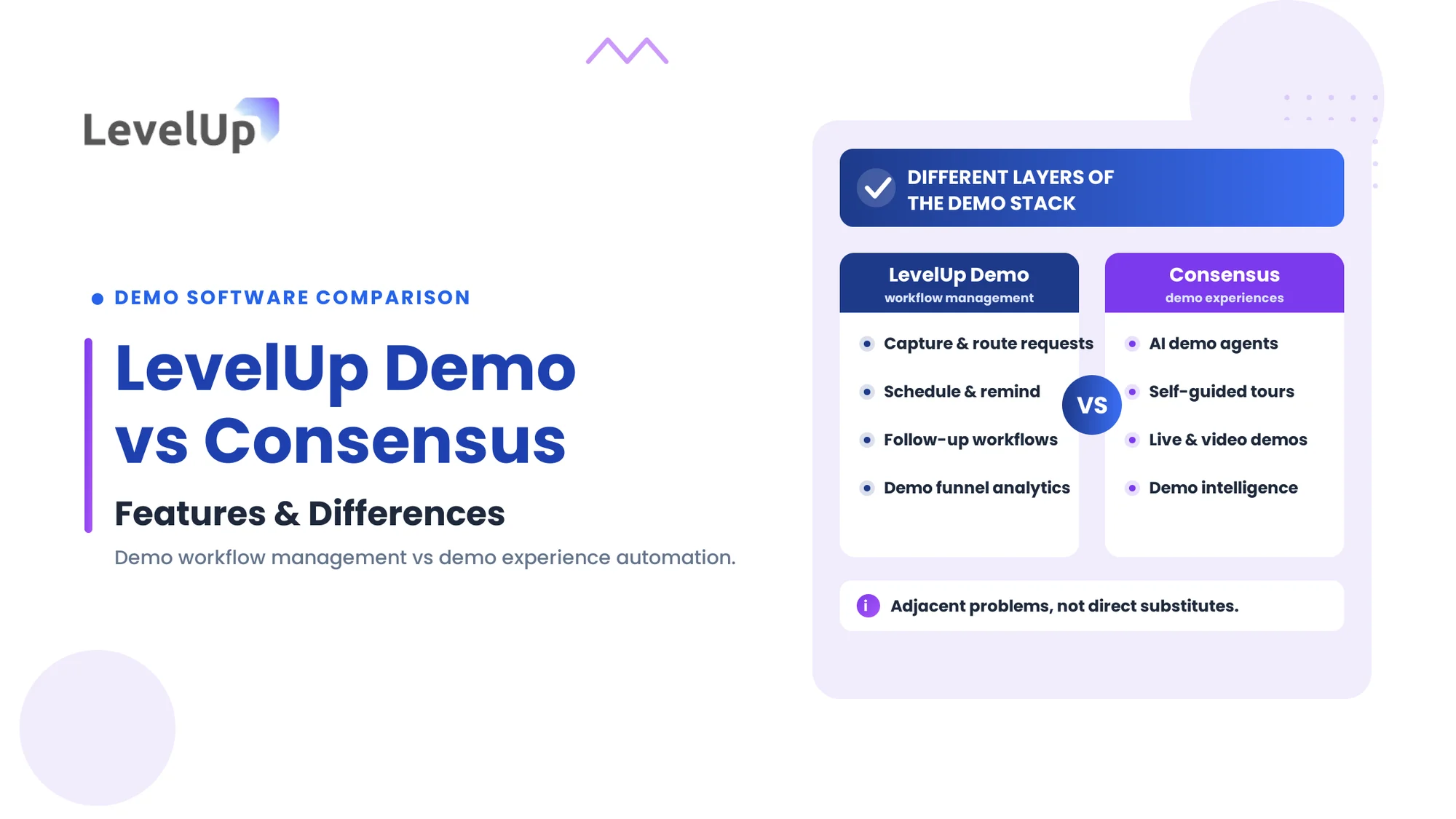
LevelUp Demo manages the operational workflow around a sales demo, from the inbound request through routing, scheduling, follow-up, and reporting. Consensus delivers buyer-facing demo experiences, using AI demo agents, self-guided tours, live demos, and video, then surfaces engagement intelligence back to sellers. Neither is a universal winner; the better choice depends on whether your bottleneck is coordinating the demo lifecycle or scaling the demo experience itself.
This article compares the two on capabilities, use cases, pricing transparency, integrations, and limitations, so you can decide which to evaluate first for your particular demo problem.
On this page
LevelUp Demo vs Consensus at a Glance
The table summarizes where each platform sits across the factors that matter in a demo-software evaluation. Treat it as a research framework, not a settled verdict: validate each row against current vendor documentation, and read a blank cell as not a documented core function rather than proof a capability is impossible.
| Comparison area | LevelUp Demo | Consensus |
|---|---|---|
| Core product focus | Demo workflow management | Interactive product demo experiences and automation |
| Primary problem addressed | Coordinating demo requests, routing, scheduling, prep, outcomes, and follow-up | Letting buyers experience the product through AI-led, self-guided, live, and video demos |
| Demo request handling | Unified inbox with source tagging and manual entry | Not a documented core function |
| Buyer-facing demos | Not a core capability | AI demo agents, self-guided tours, live demos, and video |
| AI capabilities | Internal: enrichment, qualification, prep briefs, summaries, lead scoring | Buyer-facing AI demo agents plus demo intelligence |
| Scheduling and routing | Self-booking, reminders, and automatic routing | Not a documented core function |
| Follow-up | Recap emails, event-triggered workflows, and an actions queue | Engagement signals routed to a connected CRM (verify) |
| Analytics | Demo funnel: conversion by source, rep, and product | Demo intelligence: stakeholder engagement and deal readiness |
| Integrations | Google Calendar, HubSpot (CRM push), ad sources | Salesforce, HubSpot, Slack, Gong, plus API and MCP |
| Pricing | Public plans by demo volume, plus custom Enterprise | Quote-based; not publicly disclosed |
| Best fit | Operational control across the demo lifecycle | Scaling buyer-facing demo experiences and automation |
What Is LevelUp Demo?
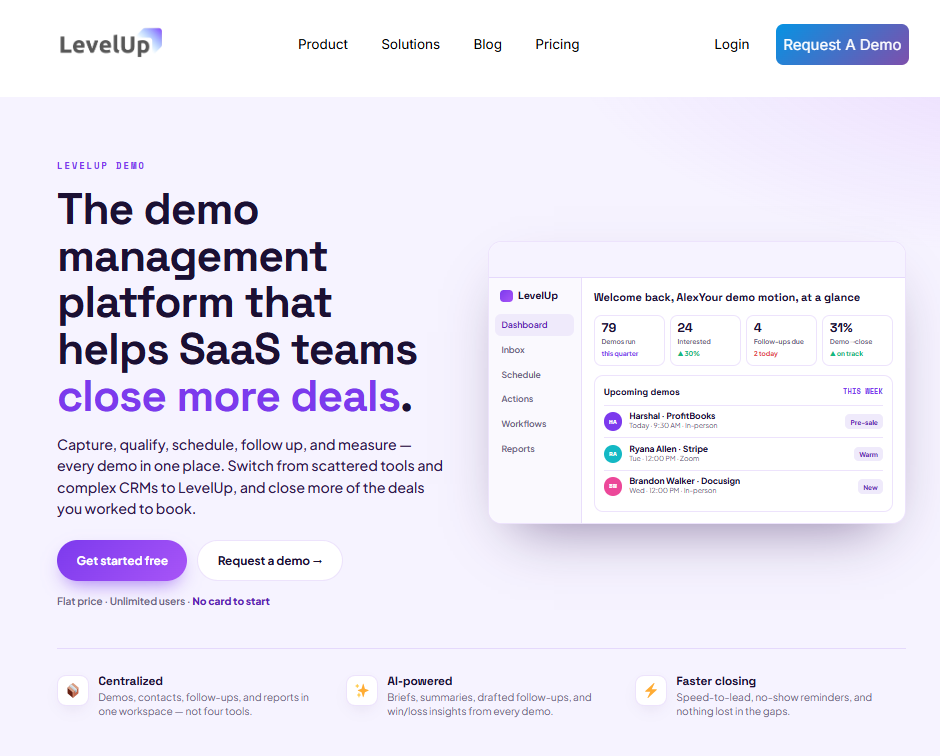
LevelUp Demo is a demo management platform for SaaS teams. It targets the operational work around the demo call, the capture, qualification, scheduling, and follow-up, rather than recording or authoring the demo itself.
Core capabilities
Organized by the stage of the demo motion each one addresses, its documented capabilities include:
- Capturing inbound requests: a unified inbox pulls demo requests from the website, Meta and Google Ads, and manual entry, auto-tagged by source, so requests stop scattering across forms and inboxes.
- AI enrichment and qualification: company size and industry are attached on arrival, good leads can be auto-qualified, and junk leads rejected in one click, which cuts manual research before a call.
- Scheduling and routing: prospects self-book with real-time availability and time-zone handling, and demos route to the right rep by territory, product, or workload.
- Reminders and no-show management: reminder emails fire ahead of the demo to reduce no-shows.
- Demo preparation and summaries: prep briefs (built from a rep’s recent demos) include a run-of-show, an objection playbook, and a best-fit read, addressing uneven call preparation.
- Outcome tracking and follow-up: outcomes log in one click, recap emails and event-triggered workflows fire automatically, and an actions queue keeps next steps owned so momentum does not stall after the call.
- Reporting and conversion insights: conversion by source, rep, and product, with win/loss summaries and rep scorecards, gives leadership visibility into where demos convert or break down.
Who is LevelUp Demo designed for?
Likely fits include SaaS sales teams managing a steady stream of inbound demo requests, small and growing teams trying to reduce manual coordination, teams that need clearer ownership of demo follow-up, and businesses that want visibility into demo outcomes and conversion patterns. These are appropriate use cases rather than guaranteed results; the right test is whether the operational gaps below match your own.
What problem does LevelUp Demo solve?
When requests, calendars, inboxes, and follow-up live in separate tools, gaps open up: leads sit unassigned, scheduling takes several email volleys, follow-up is inconsistent, and no one can see which demo motions actually close. Those gaps are a common reason leads go cold after booking a demo. LevelUp Demo is positioned to close them by centralizing the workflow, without claiming to replace every CRM, calendar, or sales-engagement tool a team already runs.
What Is Consensus?
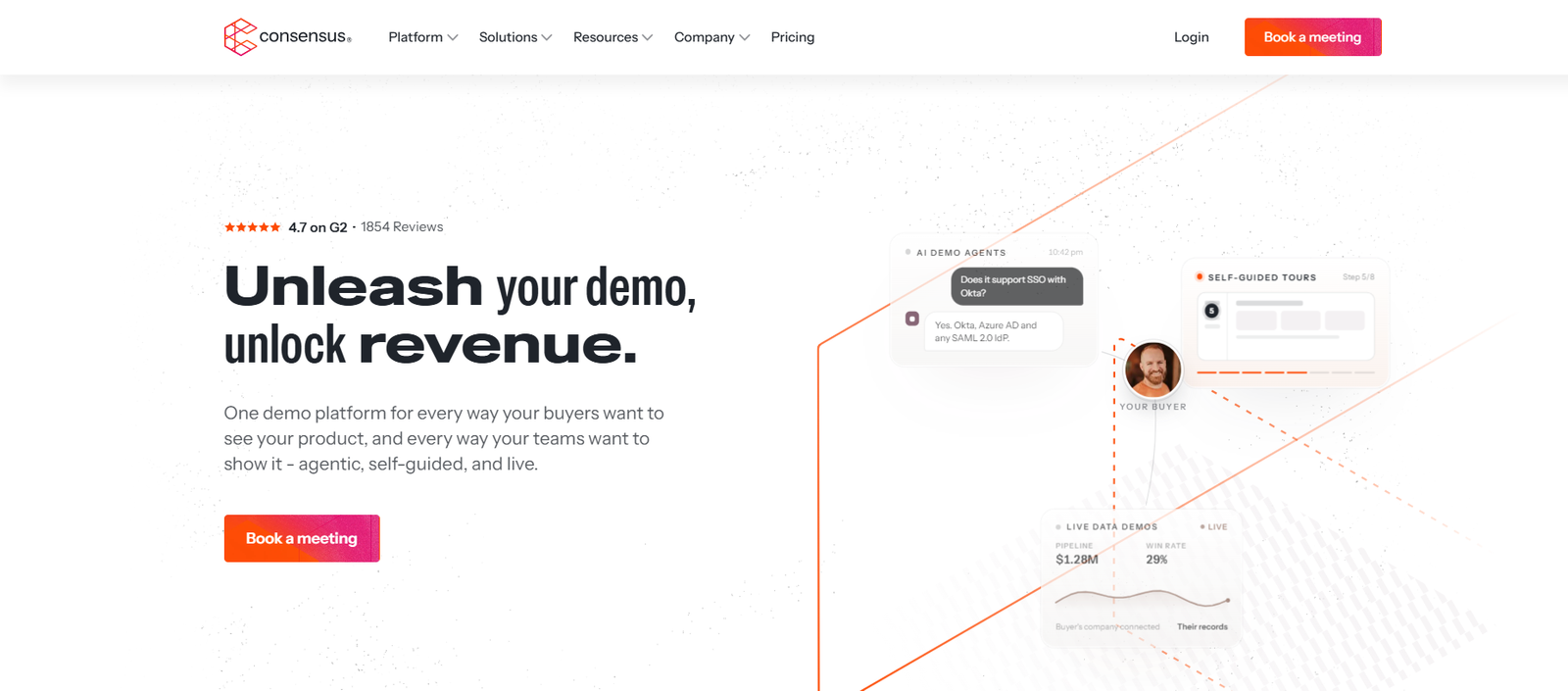
Consensus positions itself as interactive product demo software with AI, describing one platform for the different ways buyers want to see a product and the different ways teams want to show it. Its current product page spans AI-led, self-guided, live, and video demo formats.
Core capabilities
Based on its current documentation, Consensus offers:
- AI demo agents: a buyer-facing agent that answers product questions and guides a prospect through relevant features, available on demand.
- Self-guided interactive tours: buyers explore a product experience at their own pace through step-based tours.
- Live and video demos: tools for seller-led live sessions, including demos connected to a buyer’s own data, alongside shareable on-demand video demos.
- Demo intelligence: each agent conversation, interactive demo, and live session generates engagement data on who is involved and what they care about, which the platform frames as a read on deal readiness.
- Integrations and security: documented connections include Salesforce, HubSpot, Slack, and Gong, with API and MCP access, SSO/SAML, and SOC 2 Type II, GDPR, and CCPA compliance.
One recent change is worth confirming during an evaluation: in 2026 Consensus announced the acquisition of Saleo, an AI-native live-demo platform, and closed its acquisition of Peel, a conversational-AI company. Consensus describes these as extending its interactive tours and video demos into live and agent-led formats. Because that repositioning is recent, confirm how the combined capabilities are packaged into the plan you would buy rather than assuming every format is included.
Who is Consensus designed for?
Potential fits include SaaS companies that want buyers to explore product value through demo experiences, sales and presales teams supporting multiple stakeholders in a buying process, teams looking to scale demonstrations across different buyer contexts, and organizations interested in demo engagement insights. Each of these maps to a documented capability rather than an assumption that every customer uses every format.
What problem does Consensus solve?
Demo automation and buyer-facing experiences help a team make product information available to buyers at different stages of evaluation, including before or instead of a live call, which matters most when qualified opportunities outnumber the reps or solutions consultants available to run tailored demos. The caveat is that not every capability is included in every plan, so the scope of what a given team gets depends on the package.
LevelUp Demo vs Consensus: Key Feature Differences
Organized around buyer questions rather than two repeated product descriptions, here is where the platforms actually diverge.
1. Demo workflow management vs demo experience automation
The foundational split is what happens around the demo versus the demo itself. LevelUp Demo manages the operational journey: what happens before the demo (capture, qualification, routing, scheduling) and after it (follow-up, outcomes, reporting). Consensus creates and delivers the experience buyers interact with. The two can touch the same deal from different ends, so they are not direct substitutes in every scenario: a Consensus user still needs a way to manage who requested a demo and what happens next, and a LevelUp Demo user still needs a way to actually show the product.
2. Inbound demo requests, qualification, and routing
LevelUp Demo treats the request as the start of a managed pipeline: capture into a unified inbox, AI enrichment, qualification, and routing to an owner by territory, product, or load. For Consensus, buyer engagement signals, such as which features a prospect explored, act as implicit qualification data, but capturing a form submission and assigning it to a rep is not a documented core function; teams typically handle routing in their CRM or another tool. This distinction matters most for teams with high inbound demo volume that needs to be triaged and assigned quickly.
3. Buyer-led, seller-led, and automated demo experiences
The formats differ sharply. A live, seller-led demonstration is a rep showing the product in real time; a buyer-led or self-guided experience lets a prospect explore at their own pace; an automated or AI-assisted demo responds to a buyer without a rep present. Consensus documents all of these, including AI demo agents and self-guided tours. LevelUp Demo does not author interactive product tours; its role is managing the operational stages around whatever demo gets shown. Do not assume a workflow platform creates interactive tours, or that demo automation manages every operational stage around an inbound request.
4. AI capabilities and automation
The purpose of the AI differs more than the feature count. Consensus applies AI to the buyer-facing experience: agents that interact with prospects and intelligence that reads engagement. LevelUp Demo applies AI internally: enrichment, qualification, prep briefs, and post-demo summaries that help reps work faster, which pairs naturally with practices like structured, AI-assisted demo preparation. One is buyer-facing automation; the other is internal workflow assistance. Where documentation allows, note whether a specific capability is native, integration-dependent, or plan-dependent rather than assuming it is included.
5. Scheduling, follow-up, and post-demo actions
These platforms sit on opposite sides of the live-versus-self-serve line. LevelUp Demo documents self-booking, reminders, recap emails, follow-up workflows, and next-step tracking for a scheduled sales meeting. Consensus centers on buyer-driven experiences that a prospect accesses on their own time; its engagement signals can inform follow-up in a connected CRM, but managing the follow-up workflow itself is not its core function. The practical difference is between automating the buyer’s experience and making sure reps complete the operational work before and after a meeting.
6. Analytics and performance visibility
The two measure different things. LevelUp Demo reports on the demo funnel: request and scheduling performance, outcomes and follow-up completion, and conversion by source, rep, or product. Consensus reports on buyer engagement: which stakeholders viewed which demos, how long they engaged, and where interest clusters in a buying group. One answers how the sales team is performing across demos; the other answers how buyers behave inside a demo. Keep demo engagement distinct from downstream revenue attribution, and tie a comparison like standardizing demos across your team to the funnel view rather than the engagement view. Claim a specific metric only where documentation confirms it.
7. Integrations and existing sales stack
Both document integrations, but across different categories. LevelUp Demo pushes meetings, outcomes, and summaries to CRMs such as HubSpot and syncs bookings to Google Calendar, with ad platforms feeding the request inbox. Consensus documents Salesforce, HubSpot, Slack, and Gong, plus API and MCP access. Before buying either, verify the specific connectors, whether an integration is native or needs middleware, and whether it supports the exact workflow you need. A native integration between LevelUp Demo and Consensus is not publicly confirmed.
LevelUp Demo vs Consensus: Detailed Comparison Table
This table goes one level deeper than the summary, stating the status of each capability rather than a blanket checkmark. Where a function depends on an integration or is not a documented core feature, the cell says so.
| Criterion | LevelUp Demo | Consensus |
|---|---|---|
| Primary use case | Demo workflow management | Demo experience delivery and automation |
| Inbound demo workflow | Unified inbox, source tagging, manual entry | Not a documented core function |
| Automated demo experiences | Not a core capability | AI demo agents, self-guided tours, video |
| Lead qualification and routing | AI enrichment, auto-qualify, route by territory/product/load | Engagement signals as implicit qualification; routing not a core function |
| Scheduling and reminders | Self-booking, pre-demo reminders, no-show reminders | Not a documented core function |
| AI functionality | Internal: enrichment, prep briefs, summaries, lead scoring | Buyer-facing AI demo agents; demo intelligence |
| Post-demo workflow | Recap emails, triggered workflows, actions queue | Engagement signals routed to CRM (verify) |
| Analytics | Conversion by source, rep, product; win/loss; scorecards | Stakeholder engagement, deal-readiness signals |
| Integrations | Google Calendar, HubSpot (CRM push), ad sources | Salesforce, HubSpot, Slack, Gong, API, MCP |
| Pricing transparency | Public plans (Free, Starter, Growth) plus Enterprise | Quote-based; not publicly disclosed |
| Implementation notes | Flat-rate, unlimited users; set up capture, routing, follow-up | Recent acquisitions (Saleo, Peel) expanding scope; confirm packaging |
LevelUp Demo vs Consensus: Pricing and Total Cost
LevelUp Demo pricing
LevelUp Demo publishes its plans. Pricing is by demo volume rather than per seat, and paid plans include unlimited users. The current public tiers are a Free plan at $0 per month (up to 5 demos), a Starter plan at $25/month (10 demos per month), a Growth plan at $49/month (25 demos per month, marked most popular), and a custom Enterprise plan for unlimited demos with custom integrations and dedicated support.
Consensus pricing
Consensus does not publish complete pricing on its website; buyers are directed to request a quote through a sales conversation. Third-party listings discuss pricing, but the vendor itself does not post exact plan prices publicly. Because of that, treat any specific Consensus figure as unconfirmed until you have a quote, rather than inventing an estimate.
What should buyers compare beyond the subscription price?
A headline price rarely captures the real cost. Weigh:
- Number of users and teams the plan supports.
- Demo volume or usage limits (LevelUp Demo’s plans are explicitly volume-based).
- Required integrations, and whether they are native or need middleware.
- Implementation and ongoing administration effort.
- Additional tools the business may still need alongside the platform.
- Access to analytics and advanced capabilities at your plan tier.
Without sufficient pricing and usage evidence for both, a full total-cost-of-ownership calculation is not reliable; gather a Consensus quote and confirm LevelUp Demo’s volume fit before comparing.
Pros and Limitations of LevelUp Demo
Potential advantages
Its advantages follow from the documented workflow focus: centralized demo operations, structured qualification and scheduling, automatic follow-up and an owned next-step queue, and funnel reporting that shows where demos convert or stall. Public, volume-based pricing with unlimited users adds budgeting transparency before any sales conversation.
Considerations before choosing
LevelUp Demo is not built to deliver buyer-facing demo experiences. A team that specifically needs interactive product tours, self-guided experiences, or AI-guided buyer interactions should confirm that requirement is met elsewhere, since this is a fit consideration rather than a claim the product cannot perform a function. Verify that its routing, scheduling, and reporting match your specific requirements during evaluation.
Pros and Limitations of Consensus
Potential advantages
Its advantages follow from the current documentation: a demo-automation approach that scales buyer education without live rep time, a range of buyer-facing formats (AI-led, self-guided, live, and video), and stakeholder-level demo intelligence useful for account-based selling. Recent acquisitions extend the live and agent-led end of that range.
Considerations before choosing
Confirm whether Consensus covers the operational requirements you need: inbound request capture, lead routing, meeting coordination, post-demo follow-up, and workflow reporting, which are not its documented core functions. Pricing requires a sales conversation, which can slow evaluation for smaller teams. Do not treat a function as absent simply because it is not prominent on a marketing page; confirm through product documentation or raise it as an open question with the vendor.
LevelUp Demo vs Consensus: Which Should You Choose?
Rather than one universal winner, match the platform to the gap that costs you the most today.
Choose LevelUp Demo if…
Your primary challenge is managing the full operational journey around sales demos: request handling, qualification, scheduling, follow-up, and outcome tracking. If demo requests fall through the cracks, follow-up is inconsistent, and leadership lacks visibility into conversion, the workflow layer is the gap it addresses directly.
Choose Consensus if…
Your priority is the buyer-facing demo experience: scalable AI-led, self-guided, live, and video demos, plus the demo intelligence to see how a buying group engages. If buyers cannot experience your product without waiting for a live call, that is the gap it fills.
Consider evaluating both if…
Your team needs both a well-managed demo workflow and specialized buyer-facing experiences. Complementary use is only worth considering after you verify overlap, integration availability, data flow, implementation effort, and total cost; a native integration between the two is not publicly confirmed. If you are weighing the workflow layer specifically, how LevelUp Demo compares with another demo tool can help frame what the workflow category does and does not cover.
Questions to Ask Before Buying Demo Software
A short checklist to pressure-test either platform against your own process:
- Does the platform solve our main problem before, during, or after a demo?
- Can it support our current inbound volume and qualification process?
- Which demo formats does it actually support?
- Which integrations are native, and which need middleware?
- Can we track the outcomes that matter to our team?
- What exactly is included in the quoted plan?
- How much configuration and ongoing administration will it require?
- Can we test a representative workflow before committing?
Frequently Asked Questions
What is the difference between LevelUp Demo and Consensus?
LevelUp Demo manages the operational workflow around sales demos: request capture, qualification, scheduling, follow-up, and funnel reporting. Consensus delivers buyer-facing demo experiences through AI agents, self-guided tours, live demos, and video, then tracks engagement. They solve related but distinct parts of the demo lifecycle.
Is Consensus a demo workflow management platform?
Not in the operational sense. Consensus focuses on demo automation and buyer-facing experiences, with engagement intelligence and CRM integrations. It overlaps with workflow in specific areas, such as routing engagement signals to a CRM, but capturing, qualifying, routing, scheduling, and following up on requests are not its documented core functions.
Does LevelUp Demo support interactive product demos?
Based on current documentation, no. LevelUp Demo manages the workflow around a demo rather than authoring interactive product tours. Managing a demo workflow and creating interactive product experiences are different jobs, and LevelUp Demo is built for the former.
Can LevelUp Demo and Consensus be used together?
Potentially, since they address different parts of the demo lifecycle, but a native integration between the two is not publicly confirmed. Confirm compatibility, data flow, and setup with both vendors before assuming they work together seamlessly.
How much does LevelUp Demo cost compared with Consensus?
LevelUp Demo publishes plans priced by demo volume: Free at $0 (5 demos), Starter at $25/month (10 demos), Growth at $49/month (25 demos), and custom Enterprise, with unlimited users. Consensus does not publish complete pricing and directs buyers to request a quote, so a reliable price comparison requires getting that quote.
Which platform is better for a small SaaS sales team?
It depends on the team’s biggest problem. If it is operational demo management, lost requests, inconsistent follow-up, and no conversion visibility, LevelUp Demo fits. If it is scaling buyer-facing demo experiences without more headcount, Consensus fits. Identify the costlier gap first.
Conclusion: Pick the Platform That Solves Your Actual Demo Bottleneck
The decision comes down to where your demo process breaks. Teams struggling to coordinate demo requests, scheduling, follow-up, and outcomes should evaluate workflow management capabilities. Teams seeking scalable buyer-facing demo experiences should evaluate demo automation and engagement capabilities. Teams with both requirements should compare the complete workflow, integration needs, and total cost before deciding, and confirm how any combination would connect.
A practical next step: identify the most expensive or time-consuming gap in your current demo process, then test each platform against that one workflow. If the gap is operational, LevelUp Demo is a reasonable option to evaluate for demo workflow management, though the right fit always depends on your specific need rather than a blanket claim.
Find the operational gaps in your demo process
If your bottleneck is capturing, routing, scheduling, and following up on demos, see how LevelUp Demo manages the workflow across the lifecycle and whether that is your missing layer.