A lead books a demo on Tuesday. By Thursday, they have gone silent. The calendar invite sits there, confirmed, technically still on the books. Then the no-show. Or worse, they attend but act like they have never heard of your product.
The instinct is to blame lead quality. Sometimes that is fair. But pull five random booked demos from your CRM and check whether each one has a clear owner, a next task, and a confirmed agenda. If two or more don’t, the workflow is leaking intent before your rep ever opens their mouth.
A pre-demo process is the set of qualification, scheduling, confirmation, preparation, reminder, and workflow steps that occur between a prospect booking a demo and attending the sales conversation. A booking captures intent at a single moment; the pre-demo process is what preserves or loses that intent before the call.
Most SaaS teams have pieces of this. Few have connected them. This article covers nine specific gaps that cause booked demos to stall, what each one costs you in pipeline quality, and how to diagnose which gaps are active in your own funnel.
A demo booking is a transition point, not the final conversion. Buyer intent decays between booking and the call, and nine common gaps, from qualification to measurement, let it leak out. Diagnose which gaps are active, then fix the highest-leverage ones first.
- Booking confirms a click, not qualification, authority, budget, or fit.
- A calendar invite is a timestamp, not engagement. Pre-demo communication has to carry intent to the call.
- Time-to-meeting is one of the strongest predictors of attendance, so shorten it where you can.
- Measure what happens after the booking: attendance, qualification, and demo-to-opportunity, not booking volume alone.
Who should keep reading (and who shouldn’t)
This is for SaaS founders running their own demos, sales teams of one to five people, SDR and BDR leaders, RevOps professionals, and demand gen managers who are already generating demo requests but watching attendance or progression rates underperform.
If you are still working on getting enough inbound volume to fill a demo calendar at all, this isn’t your problem yet. Start with lead generation and positioning first, then come back once demos are booking but not converting.
What happens between a demo booking and the actual sales call?
Here is the conceptual flow most SaaS companies are running, whether they designed it intentionally or not. Every transition is a chance to either preserve buyer intent or introduce friction.
Lead capture. The prospect provides information through a demo form, chatbot, or landing page. This is your first and best chance to learn why they came.
Qualification. You determine whether the prospect fits, based on company, role, use case, problem, and buying context, ideally before the meeting is held.
Scheduling. The prospect picks an available time. The shorter the gap to the meeting, the more likely they attend.
Confirmation. The prospect receives confirmation and a clear picture of what happens next, not just a bare calendar event.
Preparation. Both sides get enough context to make the conversation useful: the rep knows the prospect, the prospect knows the format.
Reminder. The prospect gets appropriate, useful reminders and an easy way to reschedule rather than vanish.
Demo. The sales conversation takes place, ideally starting from context rather than redundant discovery.
The delay between booking and meeting matters more than most teams realize. Reply.io analyzed around 2,900 booked meetings and found a 6.9% no-show rate for same-day meetings versus 23% for meetings booked eight or more days out. Time-to-meeting is one of the strongest predictors of whether a booked demo actually happens, and most of the gaps below either increase that delay or fail to compensate for it.
9 reasons SaaS leads go cold after booking a demo
A lead can go cold because of lead quality, process friction, poor communication, operational gaps, or a combination of all four. Here are the nine most common, and how to tell if each is active in your funnel.
1. The lead was never properly qualified
Someone who books a demo and someone who is genuinely sales-qualified are not the same person. A booking means they clicked a button. It doesn’t confirm ICP fit, buying authority, budget, urgency, or even whether they have the problem your product solves. A meaningful share of booked demos aren’t qualified before the call, which means the rep walks in blind, discovers the lead is a poor fit, and both sides waste thirty minutes.
This doesn’t mean you need a twelve-field form. It means you need enough information, company size, role, use case, and stated problem, to know whether the meeting is worth holding. The gap isn’t “we don’t qualify.” It’s “we qualify after booking instead of before.”
2. There is no immediate response after booking
Speed-to-lead matters even after the demo is on the calendar. The moment between booking and the first confirmation is when the prospect’s intent is highest and their attention is still on you. If that window passes with nothing but an auto-generated calendar invite, you have missed the chance to set expectations and reinforce their decision.
A useful immediate response includes a confirmation with a clear agenda, who they will be meeting, what the demo will cover, and what, if anything, they should prepare. Contact information for a real person helps too. Not a drip sequence, a single well-structured message.
3. Sales lacks context about the prospect
When a rep enters a demo knowing only a name and email, the first ten minutes become redundant discovery. The prospect repeats what they already told your form, and the rep asks questions that feel generic.
What sales should have before the call: what the prospect requested, their company and role, the stated pain point, which product area triggered their interest, the lead source, any previous interactions, and qualification responses. Check five demo records in your CRM right now. If the rep notes are empty or just say “inbound demo request,” this gap is active.
4. The prospect doesn’t know what to expect
“Thanks for booking a demo” tells the prospect nothing about what is going to happen. Vague expectations create a specific kind of friction: the prospect doesn’t prepare, doesn’t invite the right stakeholders, and shows up passively waiting to be pitched.
A better pre-demo experience clarifies the approximate meeting structure, what the prospect can ask about, what to have ready, who from your side is joining, and what happens after the demo. This isn’t a rigid script. It is reducing ambiguity so the conversation starts at a higher level.
5. The calendar invite is treated as the entire follow-up
This is where most pre-demo processes quietly fail. A calendar confirmation is not buyer engagement. It is a timestamp. If the only touchpoint between booking and the demo is a calendar event, you are relying entirely on the prospect’s memory and motivation to carry them through.
Useful pre-demo communication includes a confirmation with agenda and logistics, one or two reminders (not five), relevant material if the demo is several days out, and a clear rescheduling option. Two or three purposeful touches across a week-long gap is preparation. Eight emails in three days is noise.
6. No-show prevention starts too late
If your no-show prevention strategy is a “join the meeting” reminder five minutes before the call, you are intervening after the decision has already been made. No-show prevention is really about maintaining engagement from the moment of booking: clear confirmation, timezone clarity, easy rescheduling, and useful pre-demo context.
High-risk bookings are identifiable too. Meetings booked far out, leads from low-intent sources, and prospects who didn’t complete qualification deserve a different cadence than a well-qualified lead booking for tomorrow. Check five of your invites; if any have timezone confusion or missing join links, fix the template before anything else.
7. Marketing and sales don’t share the same context
The handoff from marketing to SDR to sales is where lead context goes to die. Marketing knows the source, campaign, and content engaged with. The SDR knows the qualification responses. Sales sees a calendar invite and a name. Disconnected systems create repeated questions, poor personalization, delayed responses, inconsistent qualification, and unclear ownership.
A RevenueHero benchmark of 1,000 B2B SaaS companies found that 635 never responded to demo requests at all, and among those that did, the average response time was about one day and five hours. That kind of delay usually isn’t laziness, it is a routing and handoff problem. When booking, qualification, and CRM records are connected, context travels with the lead instead of getting trapped in someone’s inbox.
8. Reschedules and changes are handled manually
A prospect might reschedule, cancel, add attendees, ask a question, or request a different time. Each of these is a signal, and each should update the workflow state. When reschedules are handled as isolated manual tasks (someone notices an email, updates the CRM, maybe tells the rep), things fall through.
The fix that keeps surfacing in operator forums: when a prospect reschedules, offer two specific time options instead of sending them back to a blank calendar. It reduces friction and keeps the meeting alive. But that only works if your system knows a reschedule happened and triggers the right response.
9. The team doesn’t track what happens after the booking
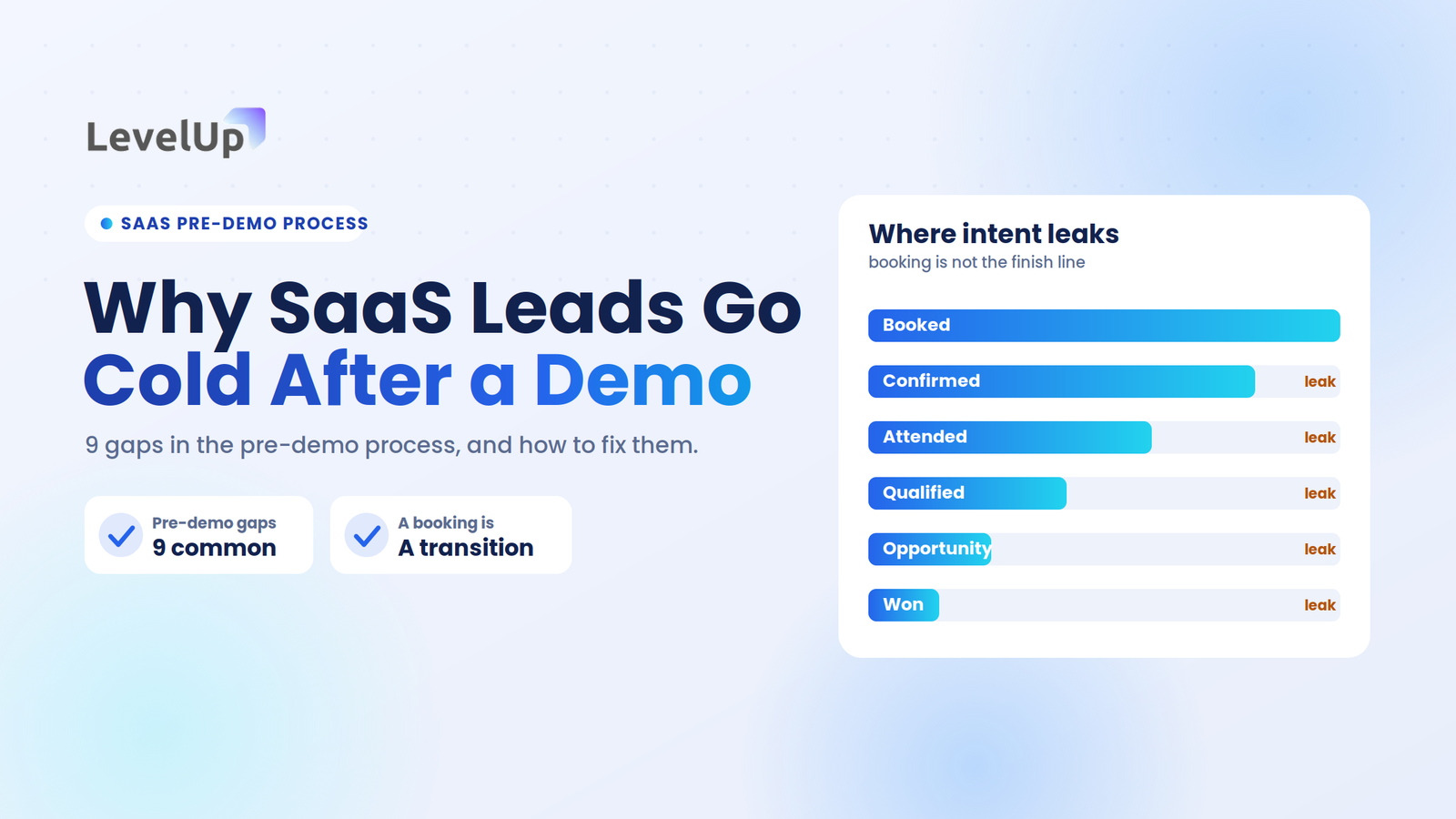
If your dashboard celebrates demo bookings as the finish line, you are optimizing for the wrong metric. The stages that matter run further than the booking:
Track attendance rate, qualification rate, demo-to-opportunity rate, rescheduling rate, cancellation rate, and source-level performance. Split no-shows by source, days-to-meeting, and rep. If one source produces far more no-shows, isolate that path and tighten qualification there specifically. Booking volume alone can be actively misleading when the real leak is two stages downstream.
How to find where your SaaS demo process is breaking
Turn the gaps into a diagnostic. Run five random booked demos through this table, then work the audit questions underneath it for the stages that look weak.
| Stage | Question to ask |
|---|---|
| Lead capture | Are we collecting enough information to understand the lead? |
| Qualification | Do we know whether the lead fits our ICP before the meeting is booked? |
| Booking | Is scheduling frictionless, with near-term slots available? |
| Confirmation | Does the prospect know what happens next? |
| Preparation | Does the sales rep have enough context to skip redundant discovery? |
| Reminder | Are we reducing avoidable no-shows with useful pre-demo touches? |
| Demo | Is the conversation aligned with the buyer’s stated needs? |
| Follow-up | Is there a defined next step? |
| Reporting | Can we see what happens to demos after they’re booked? |
Audit your lead capture
Audit qualification
Audit scheduling
Audit confirmation and preparation
Audit follow-up
Audit measurement
How to build a better pre-demo process
Four areas, in order of dependency.
1. Capture
Collect the information necessary to understand the lead without creating unnecessary form friction. Company, role, use case, and stated problem get you most of the way. Frictionless booking without qualification just moves the problem downstream.
2. Qualify
Use defined criteria to determine fit and intent before the meeting lands on a rep’s calendar. This doesn’t require a twenty-minute phone screen; a few well-chosen form fields or a short async exchange can separate demo-ready buyers from casual browsers.
3. Prepare
Prepare both sides. Give sales the lead context, source, qualification data, and company information. Give the prospect an agenda, logistics, and a reason to show up informed.
4. Orchestrate
Connect the steps. Automate confirmations, reminders, task creation, and routing, and keep humans on the exceptions: the reschedule that needs a personal touch, the high-value lead that deserves a custom agenda, the no-show that warrants a direct follow-up call.
A simple pre-demo workflow SaaS teams can implement
Even without a dedicated platform, you can run the pre-demo process as a defined sequence rather than a set of disconnected tasks. Each step has an output, and the final step branches on the outcome.
Where practitioners disagree
There is an active debate about how much qualification friction to add before booking. One camp argues that any additional form fields reduce conversion, so you should let everyone book instantly and qualify during the demo. The other holds that unqualified bookings waste rep time, inflate no-show rates, and pollute pipeline data. I land on the second side, with a caveat: qualification should be lightweight, three to four fields, not a gated questionnaire. Most companies haven’t even reached the point where this tradeoff is their binding constraint.
Where a demo workflow platform fits
The gaps above share a common thread: they are process problems, not people problems. When booking, qualification, confirmation, preparation, and follow-up live in disconnected tools, context gets lost and manual tasks get skipped. A demo workflow platform helps where the work is predictable and sequential.
Lead qualification
Qualification criteria become part of the workflow, so fit and intent are assessed before a meeting lands on a rep’s calendar, not discovered live in the first ten minutes.
Lead enrichment
Additional company and contact context is attached automatically, so the rep’s preparation starts from a fuller picture instead of a name and email.
Scheduling
Scheduling becomes part of a larger workflow rather than a standalone calendar event, with near-term slots, timezone handling, and routing built in.
Follow-up
Confirmations, reminders, and post-booking actions run automatically and proportionally, so engagement is maintained without manual chasing or email noise.
Outcome logging
What happened after the demo is recorded in a structured way: attended, qualified, opportunity, or no fit, so the funnel reflects reality rather than booking counts.
Conversion insights
The workflow connects back to the full funnel, so you can see where demos leak between stages:
Run the pre-demo process as one connected workflow
If you are hitting the handoff and orchestration problems in gaps 7 and 8, a connected demo workflow closes those leaks. LevelUp Demo handles qualification, scheduling, workflow automation, follow-up, outcome logging, and CRM connectivity in one system.
Frequently asked questions
Why do SaaS leads go cold after booking a demo?
Leads go cold because booking captures intent at a single moment, but that intent decays quickly if the pre-demo process doesn’t reinforce it. Gaps in qualification, confirmation, preparation, reminders, and sales context all contribute. The longer the delay between booking and the meeting, the more likely the prospect disengages, reprioritizes, or forgets.
What should happen immediately after a SaaS demo is booked?
A confirmation with a clear agenda, meeting logistics, timezone details, and a join link. The prospect should know who they are meeting, what the demo will cover, and what to prepare, within minutes of booking rather than hours later.
How can SaaS companies reduce demo no-shows?
Shorten time-to-meeting, send purposeful reminders with agenda context rather than just “don’t forget your meeting,” and make rescheduling easy. Identify high-risk bookings (booked far out, low-intent source) and adjust the communication cadence for those specifically.
What information should sales reps have before a demo?
The prospect’s company, role, stated pain point, product interest area, lead source, qualification responses, and any previous interactions. If two or more of those fields are blank across your last five demos, the handoff needs work.
How should SaaS companies follow up before a demo?
One confirmation immediately after booking, one reminder with useful context (agenda, preparation notes) a day before, and, if the meeting is more than three days out, one additional touch with relevant material. That is usually enough without crossing into noise.
What should SaaS companies measure after a demo is booked?
Attendance rate, qualification rate, demo-to-opportunity rate, rescheduling rate, cancellation rate, and eventual conversion, all segmented by lead source, booking delay, and rep.
Can automation improve the SaaS demo process?
Yes, with nuance. Automation handles predictable operational tasks: confirmations, reminders, routing, task creation, and outcome logging. Salespeople should still handle complex questions, discovery, relationship building, deal strategy, and exceptions. For a closer look at how demo workflow tools support this, start with the gaps most active in your own funnel.
A booking is a starting point, not the finish line
A demo booking is a signal of intent, a strong one, but it is perishable. The nine gaps above aren’t exotic failure modes; they are the default state of most SaaS demo funnels that grew organically without a designed pre-demo process. The fix is a sequence, not a slogan:
The fastest wins usually come from workflow fixes, not content changes or new lead sources. Check your last ten booked demos against the diagnostic table, find the two or three gaps that are most active, and fix those first. The pipeline visibility to see where demos are leaking is usually the starting point, and the process changes follow from there.
See where your booked demos are leaking
Stop optimizing for booking volume alone. LevelUp Demo connects qualification, scheduling, reminders, follow-up, and outcome tracking so buyer intent survives the gap between booking and the call.