Two weeks ago, I watched a VP of Sales roll out an AI agent demo on her company’s homepage. Within 72 hours, her AEs were fielding complaints: enterprise prospects felt the bot was “guessing” at their integration questions instead of answering them. Meanwhile, the mid-market pipeline quietly doubled because those buyers loved exploring the product at midnight without booking a call.
Same company. Same week. Two completely opposite outcomes based on who the buyer was and what job the demo needed to do.
The quick verdict
Live demos win when human expertise and complex evaluation matter most. Interactive demos win when you need scalable, self-guided exploration. AI/agent demos win when buyers want adaptive, conversational self-service. Most SaaS teams need a hybrid of at least two formats, matched to buyer intent and sales motion, not to whichever technology feels newest.
Live vs interactive vs AI demos: the short answer
There is no universally best format. The right choice depends on the buyer, the buying stage, product complexity, and how much human involvement the decision requires. Here’s the fast version:
Choose a live demo when
▸ Human expertise is the differentiator
▸ Evaluation is complex
▸ You need real-time discovery
▸ Technical questions arise
▸ Multiple stakeholders need alignment
Choose an interactive demo when
▸ Buyers want self-guided exploration
▸ You need scale
▸ The buyer is early in evaluation
▸ No meeting should be required
Choose an AI/agent demo when
▸ Buyers want conversational exploration
▸ The experience must adapt to questions
▸ You want always-on product guidance
▸ Repetitive education can be automated
Choose a hybrid approach when
▸ Different buyers have different needs
▸ You run both PLG and sales-led motions
▸ Some prospects need a human and others don’t
The evaluation lens
This comparison is built for B2B SaaS leaders choosing demo infrastructure across different buyer segments. The six criteria that matter: buyer intent level, product complexity, personalization depth, required human involvement, audience scale, and experience adaptability. If you are a founder deciding what belongs on your website versus what belongs in a sales cycle, these are the variables that actually determine the answer.
The three demo experiences solve different problems
Live demos solve for human-led evaluation
A live demo is a synchronous, rep-driven experience. The AE or SE conducts discovery, reads the room, adjusts the narrative, handles objections in real time, and aligns multiple stakeholders around a shared understanding. The core job is decision support for complex buying situations.
Interactive demos solve for self-guided exploration
An interactive demo is an asynchronous, predetermined product walkthrough. The buyer clicks through a designed path at their own pace, with no scheduling friction and no human dependency. The core job is scalable product education and early-stage engagement. For a deeper breakdown, the guide to interactive product demos covers the mechanics thoroughly.
AI/agent demos solve for adaptive self-service
An AI or agent demo uses a conversational AI layer to navigate the product experience based on the buyer’s questions and stated interests. Instead of following a fixed click path, the buyer says “Show me how reporting works for a marketing team” and the experience adapts. The core job is responsive exploration without requiring a human for every interaction.
Interactive demo says
“Here is the path we designed.”
AI demo says
“Tell me what you want to see.”
Live demo says
“Tell me what matters, and I will interpret and respond.”
If your decision really comes down to the first two formats, it’s worth seeing them head to head: this comparison of interactive product demos vs live product demos breaks down exactly when each one wins.
What actually determines which demo you should use
The Demo Experience Decision Framework™
Six variables. Score each one for your specific buyer segment, and the right format surfaces naturally.
Live demo vs interactive demo vs AI demo: the full comparison
| Decision Factor | Live Demo | Interactive Demo | AI/Agent Demo |
|---|---|---|---|
| Human interaction | High | Low | Low to medium |
| Scalability | Low | High | High |
| Buyer control | Medium | High | High |
| Real-time adaptability | High | Low | Potentially high |
| Discovery capability | Excellent | Limited | Potentially strong |
| Objection handling | Excellent | Limited | Depends on implementation |
| Complex technical evaluation | Strong | Limited | Variable |
| Early-stage exploration | Often excessive | Excellent | Excellent |
| Always-on availability | No | Yes | Yes |
| Standardized experience | Medium | High | Variable |
| Rep time required | High | Low | Low to medium |
| Governance/risk burden | Human-managed | Lower | Higher |
The most important rows are adaptability and discovery. Those two separate the formats more than anything else.
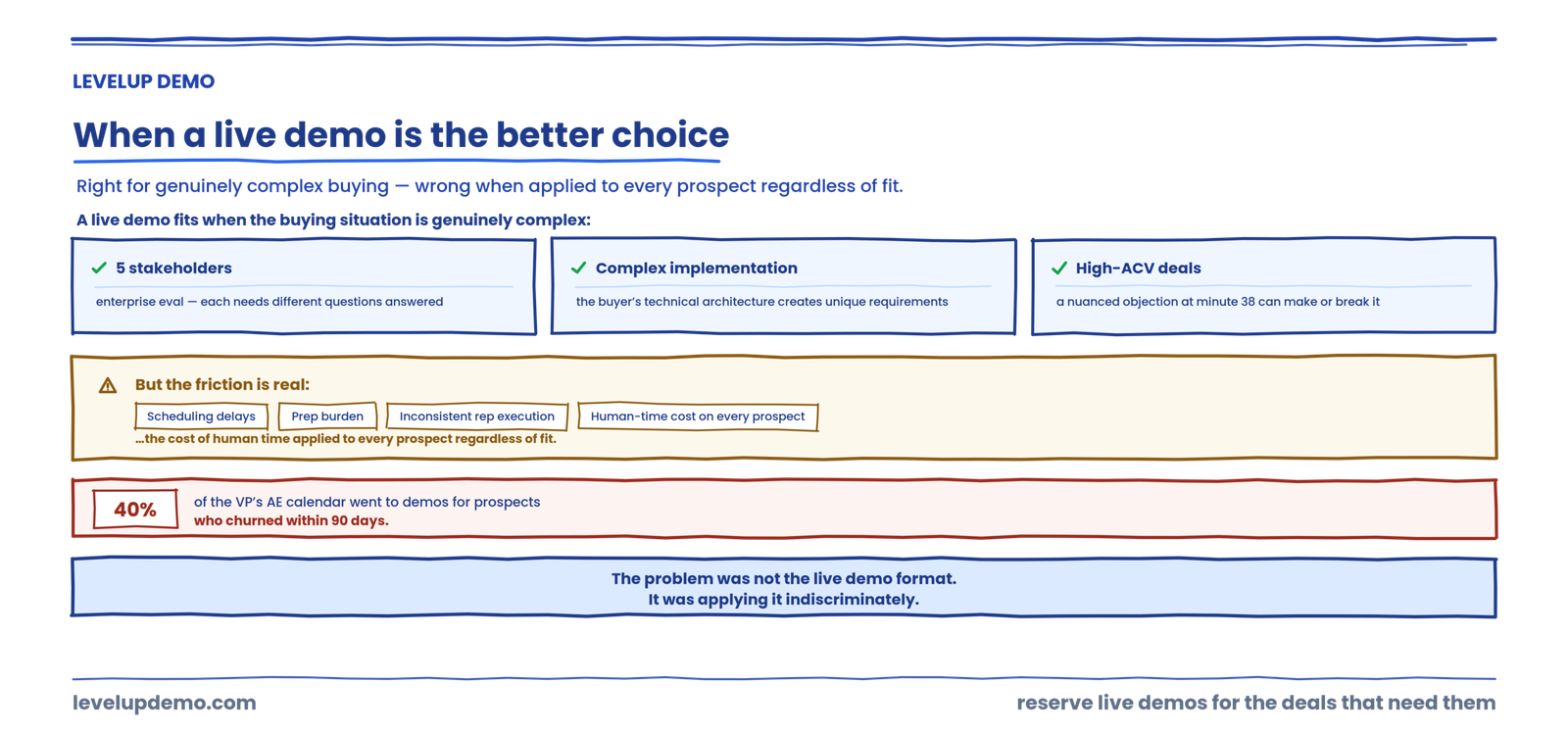
When a live demo is the better choice
Enterprise evaluation with five stakeholders who each need different questions answered. Complex implementation scoping where the buyer’s technical architecture creates unique requirements. High-ACV deals where a nuanced objection at minute 38 can make or break the outcome.
The friction is real: scheduling delays, preparation burden, inconsistent rep execution, and the sheer cost of human time applied to every prospect regardless of fit. That VP of Sales I mentioned earlier was spending 40% of her AEs’ calendar on demos for prospects who churned within 90 days. The problem was not the live demo format. It was applying it indiscriminately.
For practical guidance on making live demos actually convert, the product demo best practices resource addresses execution quality directly.
When an interactive demo is the better choice
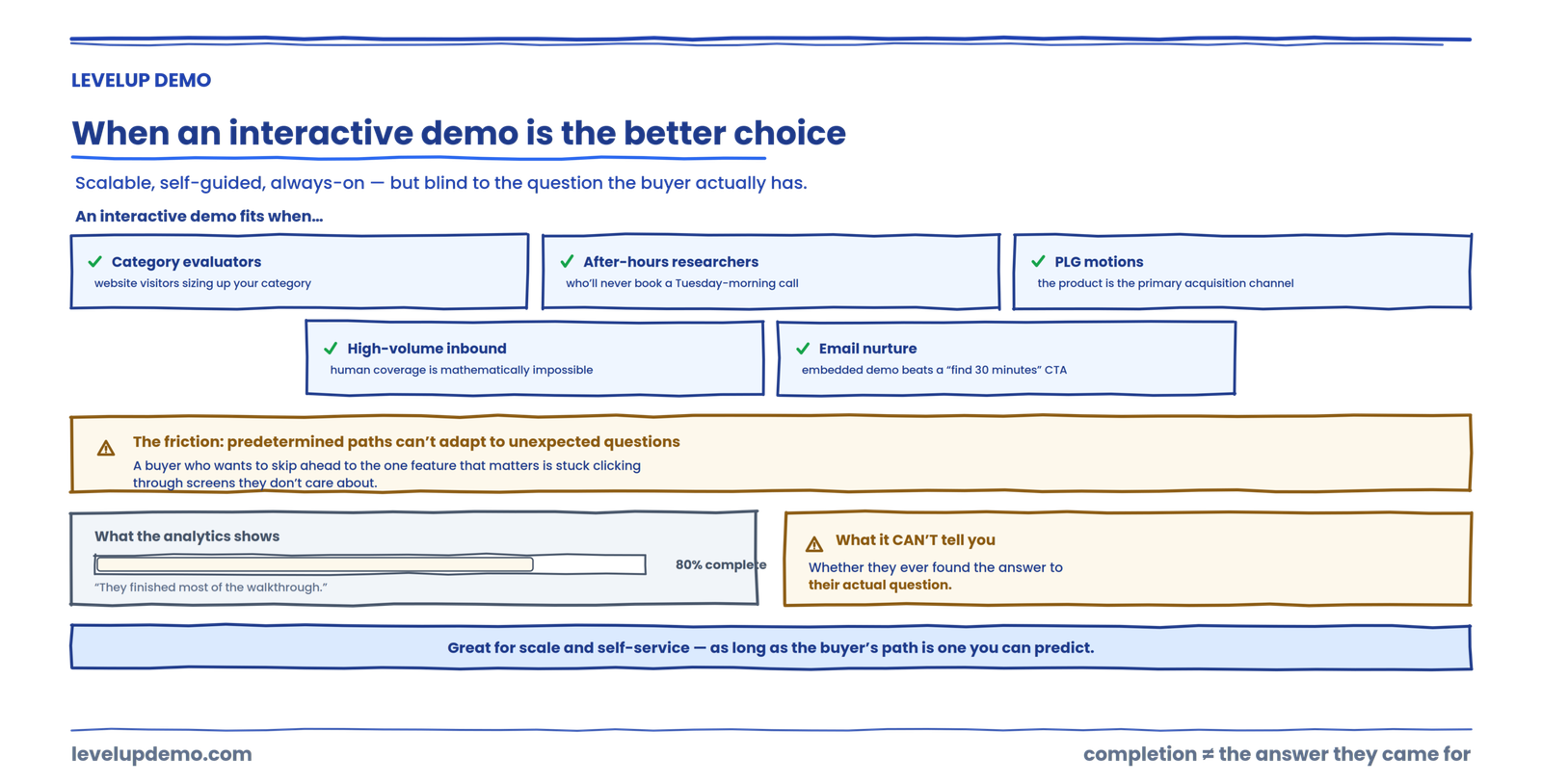
Website visitors evaluating your category. After-hours researchers who will never book a Tuesday morning call. PLG motions where the product itself is the primary acquisition channel. High-volume inbound where human coverage is mathematically impossible. Email follow-up sequences where a demo experience embedded in the nurture outperforms a “let’s find 30 minutes” CTA.
The friction: predetermined paths cannot adapt to unexpected questions. A buyer who wants to skip ahead to the one feature that matters to them is stuck clicking through screens they do not care about. Engagement data tells you someone completed 80% of the walkthrough. It does not tell you whether they found the answer to their actual question.
When an AI/agent demo is the better choice
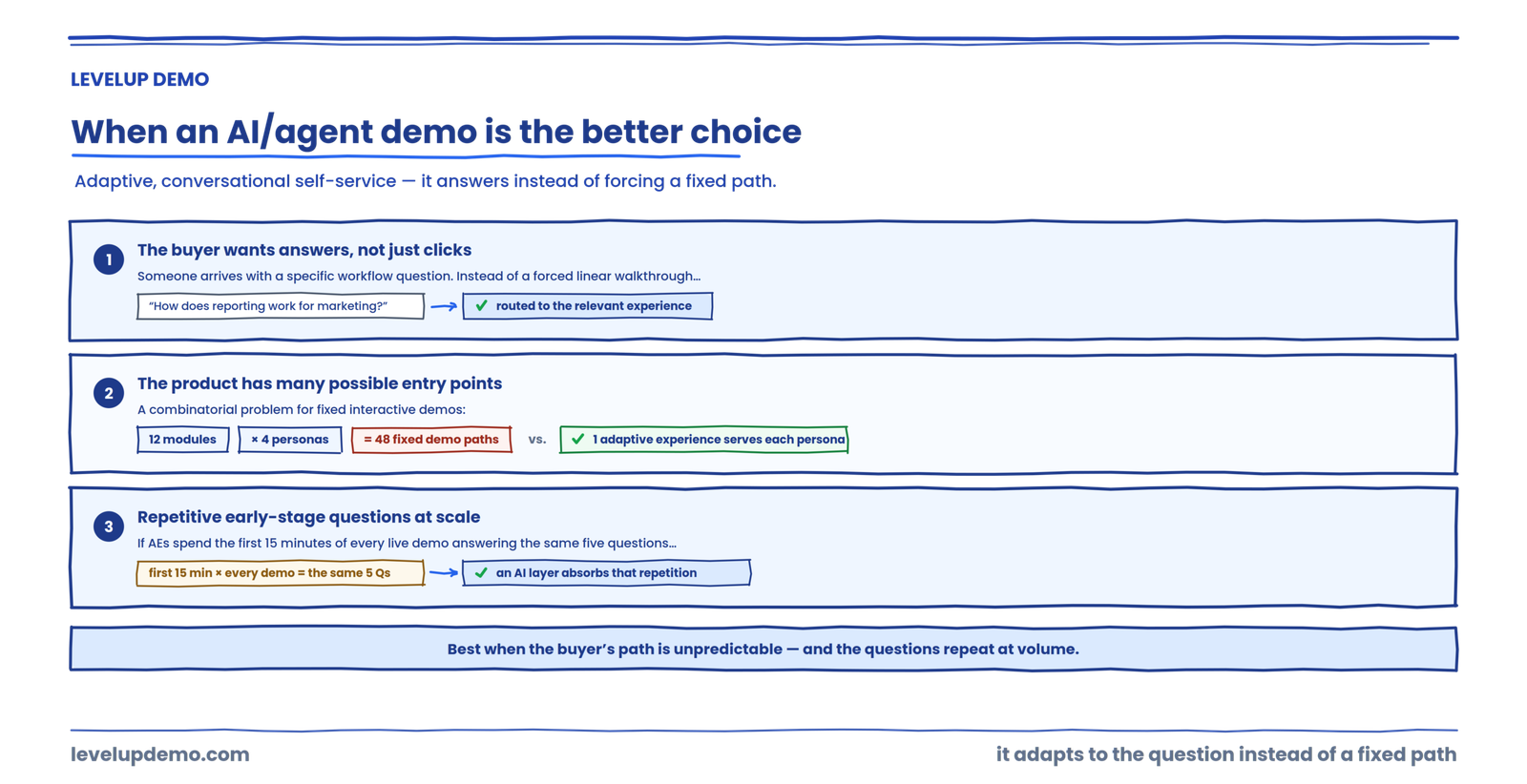
The buyer wants answers, not just clicks. If someone arrives with a specific question about how your product handles a particular workflow, an AI demo can potentially route them to the relevant experience immediately rather than forcing a linear walkthrough.
The product has many possible entry points. A platform with 12 modules and four buyer personas creates a combinatorial problem for fixed interactive demos. An adaptive experience can serve each persona differently without building 48 separate demo paths.
You need to handle repetitive early-stage questions at scale. If your AEs report spending the first 15 minutes of every live demo answering the same five questions, an AI layer can absorb that repetition.
When an AI demo may NOT be the right choice
High-stakes procurement decisions where buyers need to trust a human’s judgment. Situations involving sensitive data, unusual technical requirements, or complicated commercial negotiations. Immature AI implementations where the agent confidently provides incorrect product information. Storylane and Navattic both position their agent demo capabilities as evolving, and the honest assessment is that guardrails, knowledge accuracy, and graceful escalation to humans remain active challenges in this category.
Running more than one demo format? Connect them.
The gap between interactive, AI, and live experiences is where pipeline leaks. LevelUp Demo is the operational layer that captures, qualifies, routes, and tracks buyers across every format.
Should AI demos replace live demos?
Usually not. Automating product exploration is a different job than replacing human sales expertise. An AI agent can show a buyer how the dashboard works at 2 AM. It cannot read the political dynamics between a CFO and a VP of Engineering on a joint evaluation call and adjust the narrative accordingly.
The stronger position: AI can remove repetitive product education from the sales process without eliminating the human conversations that matter most. That is a complement, not a replacement.
The hybrid demo strategy
PLG SaaS
Website → interactive demo → free trial → AI-assisted exploration → human conversation if needed.
Enterprise SaaS
Website → qualification → live demo → technical deep-dive → stakeholder-specific follow-up experiences.
Mid-market SaaS
Website → interactive demo → qualification → live demo → post-demo interactive leave-behind. The demo management infrastructure becomes critical here because three formats create three disconnection points.
High-volume inbound
Website → interactive or AI experience → intent signal capture → qualification → human handoff.
A practical decision matrix
| If your situation is… | Start with… |
|---|---|
| High website traffic, low intent | Interactive |
| High-intent enterprise request | Live |
| Buyers exploring after hours | Interactive or AI |
| Many repetitive product questions | AI |
| Complex technical evaluation | Live |
| Multiple personas, different interests | Interactive + Live |
| Large inbound volume, limited reps | Interactive or AI + qualification |
| High-value strategic account | Live |
| PLG motion | Interactive + AI |
| Mixed GTM motion | Hybrid |
These are starting points. Your buyer data refines them.
The Demo Format Fit Test™
A quick self-assessment. Answer these six for a given buyer segment, then read the interpretation below.
Mostly self-service → Interactive
Mostly human-led → Live
High need for adaptive self-service → AI/Agent
Different answers across segments → Hybrid
How to know your current demo strategy is wrong
Every visitor gets the same experience regardless of intent. Reps spend hours demoing to poor-fit leads who could have self-qualified through an interactive walkthrough. Qualified buyers wait three days for a calendar slot while their urgency fades. Your interactive demo analytics show completions but no connection to pipeline. Your AI experience has no clear moment where a human takes over. Different demo experiences operate as disconnected systems with no shared data layer.
Where demo operations fits
Once multiple demo formats exist, the operational challenge shifts from “which demo tool should we buy?” to “how do we connect the buyer journey across experiences?” Capture, qualification, routing, scheduling, CRM synchronization, and outcome tracking become the actual bottleneck. If your team runs interactive demos on the website, AI exploration for mid-funnel, and live demos for enterprise, the gap between those experiences is where pipeline leaks. LevelUp Demo addresses that operational layer, functioning as the connective tissue between demo experiences rather than replacing any single format.
FAQ
What is the difference between a live demo and an interactive demo?
A live demo is a synchronous, human-led experience where a rep conducts discovery and adapts the presentation in real time. An interactive demo is an asynchronous, self-guided product walkthrough the buyer navigates independently through a predetermined path, with no scheduling or human dependency required.
What is an AI demo?
An AI or agent demo uses conversational AI to adapt the product experience based on what the buyer asks or wants to explore, rather than following a fixed sequence of clicks.
Are AI demos replacing live demos?
For most B2B SaaS companies, no. AI demos can absorb repetitive product education and serve buyers outside business hours, but live demos remain necessary for complex evaluation, multi-stakeholder alignment, and nuanced objection handling. The two formats serve different jobs.
When should SaaS companies use an interactive demo?
When you need always-on product exploration for high-volume audiences, early-stage buyers, PLG motions, or asynchronous evaluation. The complete guide to improving demo request workflows covers how to capture intent signals from these interactions.
Can SaaS companies use live, interactive, and AI demos together?
Yes. Most mature SaaS GTM strategies benefit from a hybrid approach where each format serves a specific stage, buyer type, or intent level within a coordinated journey.
Which demo format is best for enterprise SaaS?
Live demos typically anchor enterprise evaluation because of the complexity, stakeholder count, and personalization involved. Interactive and AI demos play supporting roles for pre-meeting education, post-demo reinforcement, and champion enablement.
Final takeaway
There is no universally best demo format. The strongest SaaS teams match the experience to the buyer, the buying stage, and the job the demo needs to accomplish.
Live = human expertise
Interactive = scalable exploration
AI/agent = adaptive self-service
Hybrid = coordinated buyer journey
The decision framework is simple: assess intent, complexity, personalization, human need, scale, and adaptability. The format that scores highest across those variables for a given buyer segment is the right one. Not the newest one. Not the cheapest one. The one that does the job.
Whichever formats you run, connect the journey
LevelUp Demo is the demo operating system that captures, qualifies, routes, schedules, and tracks every buyer across interactive, AI, and live experiences, so no pipeline leaks in the gaps between formats.