A rep finishes onboarding. They pass the product quiz. They shadow two demos. The manager says “you’re ready,” mostly because the pipeline is growing and the team needs coverage. It feels like a reasonable call. The rep knows the product, and they have seen it done.
Then the rep runs a live demo, and within twelve minutes a buyer asks why the implementation timeline differs from what a competitor quoted. The rep freezes, defaults to a feature walkthrough nobody asked for, and closes with “I’ll send over some resources.” No next meeting. No documented pain. The CRM entry reads “positive call.”
The problem here is not poor training. The rep genuinely knows the product. The problem is that the company never actually defined what “demo ready” means, so “ready” defaulted to “finished onboarding.” Those are not the same thing. Finishing training proves the rep absorbed information. It does not prove they can hold a real buyer conversation when the buyer stops cooperating with the plan.
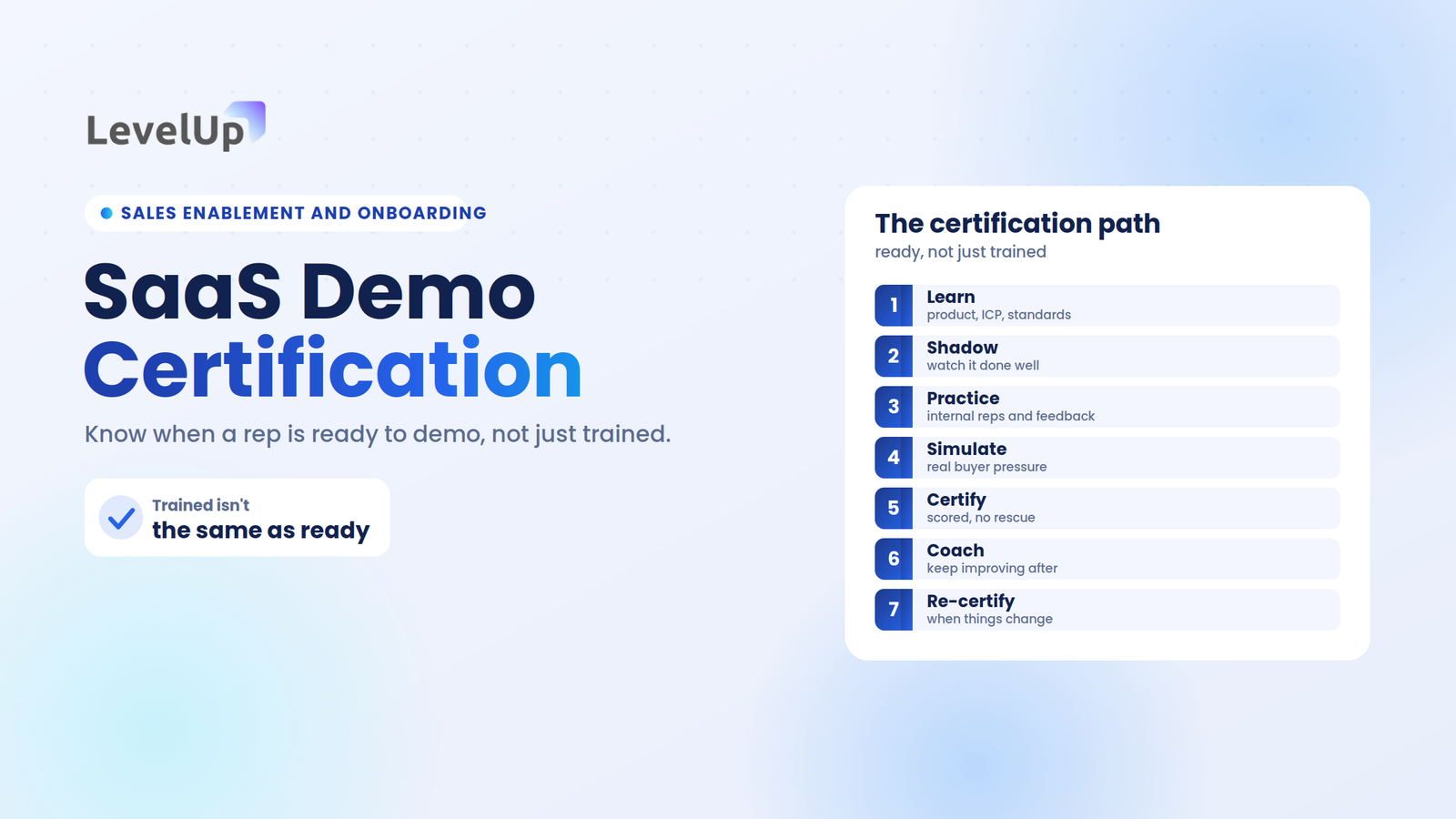
That gap is what demo certification exists to close. Certification is the quality gate between training and independent, customer-facing execution. Training creates knowledge. Certification verifies execution. This article walks through what a practical certification program evaluates, how to score it, how to run the simulation, and how to handle failure, built around a simple progression:
The goal is not to turn reps into scripted presenters who all sound the same. It is to verify that each rep can handle a real buyer conversation to a defined standard, then keep them sharp after they pass.
SaaS demo certification is a structured evaluation that determines whether a sales rep can independently deliver a customer-ready product demo against defined quality standards. It tests execution under realistic conditions, discovery, relevance, objection handling, accuracy, and next steps, not just product knowledge, and acts as the quality gate between training and unsupervised customer demos.
A rep is not demo-ready because onboarding is complete. They are ready when they can run a realistic buyer conversation to a defined standard without being rescued.
- Training creates knowledge; certification verifies execution. Certify judgment, not memorization.
- Test the whole demo a buyer experiences: preparation, discovery, relevance, engagement, objections, accuracy, and the next step.
- Use the progression Learn, Shadow, Practice, Simulate, Certify, Coach, Re-certify, with a scored rubric and mandatory fail criteria.
- Certify the standard, not the script: fix the quality bar and required behaviors, let reps own wording, examples, and style.
What is SaaS demo certification?
The confusion comes from everything that looks like certification but is not. A certification evaluates the whole demo as a buyer experiences it, which means it looks at more than one dimension:
- product knowledge and preparation
- discovery and demo structure
- relevance and personalization
- buyer engagement and objection handling
- technical judgment and accuracy
- next-step management
Certification is more than product training
A product quiz might prove the rep knows what a feature does. It does not prove they know when to show it, whether it matters to this buyer, how to explain it, what to ask before showing it, or how to respond if the buyer challenges it. Those are execution questions, and they only surface in a real conversation. A rep who aced every module in your LMS but cannot adapt when a VP redirects toward ROI has demonstrated memory, not readiness.
Certification is also different from demo coaching
Certification determines readiness. Coaching improves performance. One is a gate you pass or do not pass; the other is a continuous process that runs before and after the gate. Keeping them separate matters, because a rep can be certified (meets the standard) and still have plenty of room to improve (the job of coaching). Confusing the two turns certification into either an endless coaching loop with no decision, or a one-time event with no follow-up.
| Activity | What it actually proves |
|---|---|
| Product training | The rep understands the product |
| Shadowing | The rep has observed demos |
| Practice demos | The rep can rehearse a flow |
| A product quiz | The rep can recall information |
| Certification | The rep meets the required demo standard under realistic conditions |
| Coaching | The rep improves execution over time |
One practical note on timing: independent certification belongs near the end of a rep’s first month of ramp, not after a week of shadowing. The distance between “shadow for a week, then you’re live” and a month of structured practice and simulation is where most certification failures hide. Certification is the transition from learning to independent execution, and rushing it just moves the failure from a practice room to a live deal.
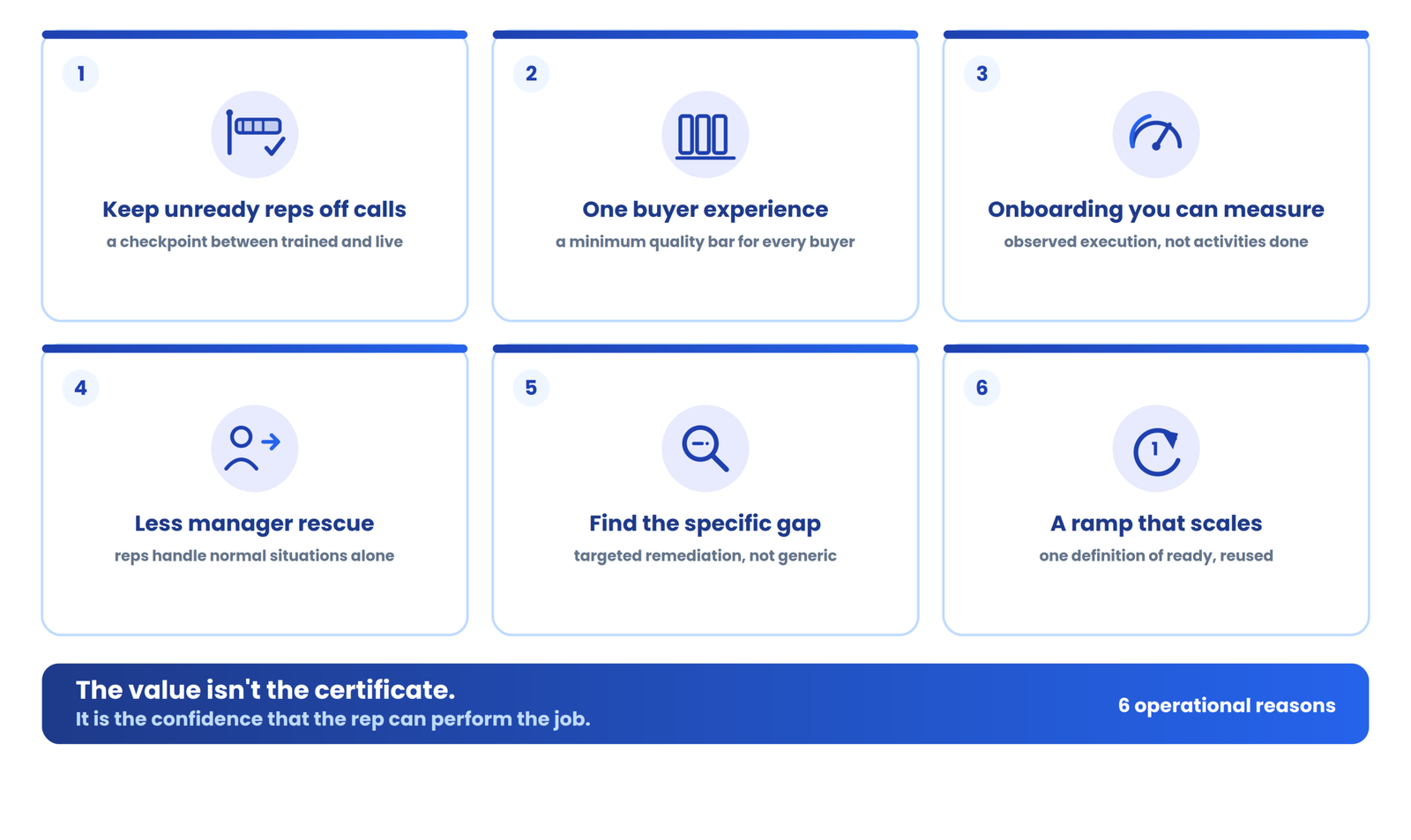
Why SaaS sales teams need demo certification
The case for certification is operational, not ceremonial. Each reason below solves a specific problem that otherwise shows up as a stalled deal or a manager’s weekend rescue call.
1. Prevent unprepared reps from running customer demos
Completing onboarding is an input, not a readiness signal. A rep should not be customer-ready simply because they finished the modules and watched a few calls. Certification puts a deliberate checkpoint between “trained” and “live” so the first real buyer is not also the first real test.
2. Create a consistent buyer experience
Without a standard, Rep A gives a discovery-led demo, Rep B gives a feature tour, Rep C skips discovery entirely, and Rep D makes claims the product cannot support. The buyer’s experience, and their impression of your company, depends on which rep they happened to get. Certification establishes a minimum quality bar every buyer can count on.
3. Make rep onboarding measurable
Certification replaces “the rep completed onboarding” with “the rep demonstrated the required behaviors in a realistic demo.” That is a far more useful signal for a manager deciding whether to hand a rep real pipeline, because it is about observed execution rather than completed activities.
4. Reduce manager dependency
When reps are certified against a clear standard, managers gain confidence that a rep can handle normal customer situations without constant rescue. That frees managers from shadowing every early call and lets them focus coaching where it actually moves the needle.
5. Identify specific skill gaps
A good certification does not just pass or fail; it shows where a rep struggles, whether that is product knowledge, discovery, storytelling, personalization, objection handling, or technical judgment. That makes remediation targeted instead of generic.
6. Create a repeatable ramp process
A certification standard gives you a common bar to apply across new hires, internal transfers, new product launches, and newly formed teams. Instead of re-inventing “ready” for every situation, you have one definition that scales.
The principle
The value of certification isn’t the certificate. It is the confidence that the rep can perform the job.
What should a SaaS demo certification program test?
A demo certification should test whether a rep can make good decisions during a buyer conversation, not whether they can memorize a product presentation. Ten dimensions cover the demo a buyer actually experiences.
1. Product knowledge
Can the rep accurately explain the relevant features, workflows, use cases, limitations, and integrations where relevant? Do not require memorizing every feature. Require accuracy on what matters to this buyer, and honesty about what the product does not do.
2. Pre-demo preparation
Can the rep understand the account, identify the likely buyer, prepare the relevant workflows, and set a clear objective for the demo before the call starts?
3. Discovery
Can the rep uncover the current process, the pain points, the business impact, the desired outcome, and the buyer’s priorities, before showing product?
4. Demo relevance
Can the rep translate discovery into demo decisions? If the buyer says implementation speed is the biggest concern, a certified rep prioritizes the relevant workflow rather than running a generic product tour.
5. Personalization
Can the rep adjust the examples, sequence, depth, terminology, and use cases to the buyer in front of them, rather than delivering the same demo to everyone?
6. Buyer engagement
Can the rep pause, ask questions, validate relevance, notice confusion, and respond to buyer signals, keeping the demo a conversation rather than a monologue?
7. Objection handling
Can the rep clarify the objection, answer accurately, avoid becoming defensive, and recognize when they need to bring in help rather than guessing?
8. Technical judgment
Can the rep tell the difference between “I can answer this” and “this should be handled by a solutions engineer,” and escalate at the right moment instead of improvising?
9. Accuracy
Can the rep avoid exaggerating capabilities, making unsupported claims, or promising functionality that does not exist? Accuracy is non-negotiable because an inaccurate demo creates a problem that surfaces later, in implementation or renewal.
10. Next-step management
Can the rep close the demo with a clear next step, an owner, a timeline, and the outstanding questions named? A demo that ends without a defined next action has not advanced the deal, however good it felt.
The principle
Certification should test judgment, not memorization.
Certify reps on the workflows they will actually use
LevelUp Demo helps teams manage the demo workflow from lead capture through outcome tracking, so the environments, workflows, and assets reps certify on match what they run in live customer demos. Keep the standard and the production reality in sync.
The certification framework: Learn, Shadow, Practice, Simulate, Certify, Coach, Re-certify
Certification should not happen immediately after product onboarding. It sits at the end of a dependency chain, where each stage proves something the next one requires. Rush a stage and the gap simply reappears later, usually in front of a buyer.
Stage 1: Learn
The rep learns the raw material: product, ICP, personas, use cases, positioning, demo standards, common objections, and technical boundaries, ideally against your demo operations playbook. Goal: build foundational knowledge. Gate: the rep demonstrates basic product and process understanding before moving on.
Stage 2: Shadow
The rep observes experienced demos, watching the opening, discovery, feature selection, transitions, buyer questions, objections, and next steps. Goal: exposure to how it is actually done. Gate: none, really, and that is the point. Shadowing demonstrates exposure, not readiness. A rep who has watched twenty demos has watched twenty demos.
Stage 3: Practice
The rep runs internal demos with peer role-play, manager feedback, repeated attempts, and specific coaching goals. Goal: turn knowledge into reps. Gate: consistent execution on the fundamentals in a friendly setting. Repetition matters here, and this is where most teams stop too early, because the practice demos feel good enough internally.
Stage 4: Simulate
Now introduce realistic buyer situations and pressure. A VP wants business impact while an operations manager wants implementation detail; then add complications: the buyer interrupts, asks a technical question, cuts the time from 45 minutes to 25, raises an objection, or surfaces a competing stakeholder priority. Goal: force real-time decisions about what to show, what to skip, and when to bring in help. Gate: the rep adapts without losing the thread.
Stage 5: Certify
Conduct the formal certification: a standardized scenario, an evaluator (two is better for calibration), a scorecard, and clear pass or fail criteria. Goal: verify readiness. Gate: the rep demonstrates the required behaviors without being rescued. The output is a pass, a conditional pass with documented gaps, or a fail with a specific remediation path.
Stage 6: Coach
Passing does not stop coaching. Managers keep reviewing early customer demos and naming improvement opportunities, so a certified rep keeps getting better rather than plateauing at the bar. If a rep did not pass, targeted coaching begins here, aimed at the specific gap the certification surfaced.
Stage 7: Re-certify
Re-certify when the conditions the original certification tested have materially shifted: major product changes, major positioning changes, role changes, prolonged inactivity, or recurring quality issues. Avoid an arbitrary annual certification applied to everyone; tie re-certification to change, not the calendar.
Put together, the chain looks like this:
How to build a SaaS demo certification checklist
A certification checklist should cover the entire demo lifecycle, before, during, and after the call, so readiness is judged on the whole arc rather than the presentation alone.
Before the demo
During the demo
After the demo
Not every checkbox should carry equal weight. Some are required (accuracy, discovery, a real next step), and failing them should fail the certification regardless of the rest. Others are scored (personalization, engagement), where a rep can be weaker and still pass. That distinction is what the scorecard formalizes next.
How to create a SaaS demo certification scorecard
Without a scorecard, certification becomes subjective: “I think they’re ready.” A scorecard replaces that with observable criteria and weights, so two evaluators watching the same demo reach similar conclusions. The weights below are illustrative, not an industry standard.
| Category | Weight | What to evaluate |
|---|---|---|
| Preparation | 10% | Account and buyer context |
| Discovery | 15% | Questions asked and listening |
| Relevance | 15% | Connection between needs and demo |
| Product knowledge | 15% | Accuracy and understanding |
| Buyer engagement | 10% | Interaction and validation |
| Personalization | 10% | Adaptation to the buyer |
| Objection handling | 10% | Clarification and response |
| Technical judgment | 5% | Appropriate escalation |
| Accuracy | 5% | No unsupported claims |
| Next steps | 5% | Clear progression |
Treat those weights as a starting point, not a rule. They should vary by product complexity, sales motion, role, buyer, deal size, and technical requirements. A technical, high-ACV product might push technical judgment and accuracy higher; a simple, high-velocity motion might weight discovery and next steps more.
Use an observable rating scale
Score each category on a scale anchored to observable behavior, not impressions:
1 – Not ready: the behavior was absent or incorrect, and it would create a problem with a real buyer.
2 – Inconsistent: the behavior appeared sometimes but could not be relied on.
3 – Meets standard: the behavior was present and competent; this is the pass line for most categories.
4 – Strong: the behavior was consistent and clearly effective.
5 – Exceptional: the behavior was a model other reps could learn from.
Why a high score shouldn’t always mean a rep passes
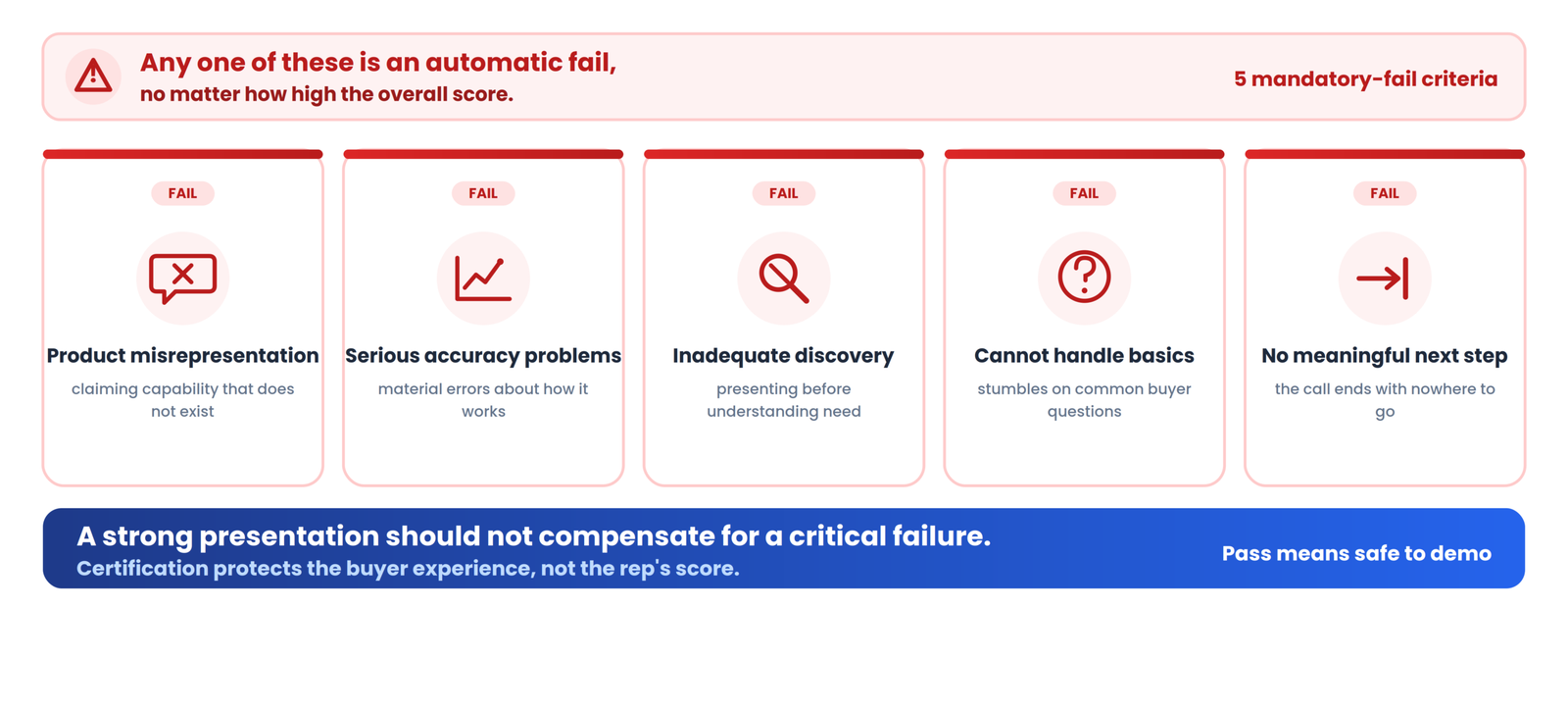
A strong average should not compensate for a critical failure. Some behaviors should override the overall number, because they create real risk with a buyer no matter how polished the rest of the demo was. These are mandatory fail criteria.
Product misrepresentation
The rep knowingly or repeatedly claims the product does something it does not. This is an automatic fail, because it manufactures a problem that surfaces in implementation or renewal, long after the demo felt like a win.
Serious accuracy problems
The rep provides materially incorrect product information. Even when it is not deliberate, a confidently wrong answer erodes trust and sets a false expectation the deal will later have to unwind.
Inadequate discovery
The rep immediately launches into a product tour without understanding the buyer. A demo built on no discovery is a guess, and a certified rep should not be guessing.
Cannot handle basic buyer questions
Not knowing an answer is not automatically a failure; everyone meets a question they cannot answer. Failing to manage the situation appropriately is the problem, for example bluffing, deflecting, or becoming defensive instead of clarifying and committing to follow up.
No meaningful next step
The rep finishes the presentation but does not progress the conversation. A demo is not complete because the product was shown; it is complete when the buyer has a reason and a date to continue.
The principle
A strong presentation should not compensate for a critical failure.
How to run a SaaS demo certification simulation
The simulation is where certification earns its value, because it tests decisions under conditions close to a real call. Run it as a defined, repeatable process.
1Create the scenario
Give the rep a company, industry, buyer role, business problem, existing process, objective, and constraints. Make it specific enough to prepare for, and realistic enough to be hard.
2Give the rep preparation time
Provide enough information to prepare, but do not allow unlimited preparation. Part of what you are testing is how well they prepare under normal time pressure.
3Introduce realistic complications
Mid-demo, add pressure: the buyer interrupts frequently, a technical stakeholder asks integration questions, a VP asks about ROI, the buyer says they only have 20 minutes, or the buyer asks for a feature the product does not support. One or two complications is usually enough.
4Observe decisions
Watch what the rep prioritizes and what they skip, when they ask questions, whether they adapt, and whether they escalate appropriately. The decisions matter more than the polish.
5Score against the rubric
Use the certification scorecard and the mandatory fail criteria. Two evaluators, scoring independently and then comparing, keep the result calibrated.
6Debrief
Walk the rep through strengths, gaps, the pass or fail outcome, and the next action. The debrief is where a certification becomes useful rather than just a verdict.
How to certify reps without making them sound scripted
The fear with certification is that it produces robotic reps who all deliver the same demo. It does not have to, if you are careful about what you standardize.
The principle
Certification should evaluate consistency of execution without demanding consistency of personality.
Standardize the things that protect the buyer and the business:
- the minimum quality bar
- discovery principles
- product accuracy
- the critical workflows
- escalation rules
- required outcomes and next-step expectations
Allow customization of the things that make a demo human and relevant:
- wording and conversational style
- personality and storytelling
- examples and use cases
- sequence, where appropriate
Certify the standard, not the script
The distinction is best seen in how a requirement is written. A bad certification requirement is: “You must say these seven sentences exactly.” A better requirement is: “The rep must establish the buyer’s priorities before selecting the demo path.” The first certifies recitation. The second certifies judgment, and lets a hundred different reps meet it in their own voice.
What happens when a rep fails demo certification?
Failure should not be punitive. A certification that only tells you whether someone passed has wasted most of its value; a good one tells you what to improve. Run failure as a loop:
Diagnose the failure
First, name the kind of gap. Was it a knowledge issue, a skill issue, a process issue, or a judgment issue? A discovery problem gets different remediation than a product-knowledge problem, and mislabeling it wastes everyone’s time.
Create a targeted coaching plan
Match the remediation to the gap rather than sending every failed rep through the same training.
| Failure | Remediation |
|---|---|
| Product knowledge | Focused training on the gaps, not the whole catalog |
| Weak discovery | Role-play focused on questioning and listening |
| Poor personalization | Buyer-scenario practice across personas |
| Objection handling | Objection drills with planted pushback |
| Technical judgment | AE and SE scenarios on when to escalate |
| Poor structure | Demo-flow practice against the framework |
Re-test the specific weakness
If only one competency failed, do not necessarily make the rep repeat everything. Re-test the specific weakness, with evidence that it has been addressed, then return to full certification if needed.
Return to certification
Require the rep to demonstrate the required behavior in at least a couple of coached sessions before they re-certify, so the re-test confirms a real change rather than a lucky run.
The principle
Certification failure should tell the team what to improve, not simply whether someone passed.
How demo certification should change for different rep experience levels
The certification standard can stay consistent while the scenarios become more sophisticated. What you test for should match the rep’s role scope.
New AEs
Focus on the fundamentals: product accuracy, discovery, a standard demo structure, and the ability to explain business outcomes clearly. The bar is competent, reliable execution, not brilliance.
Developing AEs
Focus on personalization, buyer engagement, objection handling, judgment, and consistency. The question shifts from “can they run a demo” to “can they run a good demo across different buyers.”
Experienced AEs
Focus on complex scenarios, multi-stakeholder demos, executive conversations, strategic storytelling, and technical judgment. Certification here means running a demo where the champion wants speed-to-value and the CFO wants adoption-rate projections, and serving both without losing either.
Senior AEs and demo experts
Focus on complex deal scenarios, peer coaching, experimentation, and leadership. At this level certification is less about proving the basics and more about raising the bar for everyone else.
The principle
The certification standard can stay consistent while the scenarios become more sophisticated.
How to measure whether demo certification is working
Be careful not to claim certification directly causes revenue. It is one component among many. Measure it in a hierarchy, from the program itself out to business outcomes, and be honest about what each layer can and cannot tell you.
Program metrics
Track the certification pass rate, time to certification, number of attempts, common failure categories, and re-certification rate. These tell you whether the program is calibrated. If everyone passes on the first try, the bar is too low; if nobody passes, the training is not preparing reps.
Rep performance metrics
Track demo quality score, next-step rate, demo-to-opportunity conversion, opportunity progression, rep-to-rep variance, and manager intervention rate on certified reps. If variance drops after certification, that is a signal it is testing the right things. If it does not, the certification may be testing the wrong things.
Business outcomes
Where appropriate, watch pipeline progression, sales cycle, conversion, and revenue. Treat these loosely: they are influenced by lead quality, market conditions, product-market fit, and a dozen other variables, so do not assume a change proves the certification worked.
The principle
Certification should reduce avoidable execution risk, not magically solve sales performance.
Common SaaS demo certification mistakes
Most broken certification programs fail in predictable ways. For each, the pattern is the same: what goes wrong, why it matters, and what to do instead.
1. Testing product knowledge instead of demo ability. A quiz proves recall, not execution, so reps pass the test and still freeze on a live call. Test the demo a buyer experiences, not the feature list.
2. Making certification a memorization exercise. Reps optimize for reciting rather than adapting, which is the opposite of what a buyer needs. Score judgment and decisions, not coverage.
3. Requiring a perfect script. A scripted rep cannot handle the moment a buyer goes off-script, which is every real demo. Certify required behaviors and let wording vary.
4. Using vague pass/fail criteria. “Good communication” means something different to every evaluator, so scores drift. Replace subjective language with observable behaviors anchored to examples.
5. Letting one strong skill hide a critical weakness. A charismatic rep who misrepresents the product still passes, and the risk ships to a real buyer. Use mandatory fail criteria that override the average.
6. Having no standardized evaluation. Two managers score the same demo differently, so certification means different things across the team. Use one rubric and calibrate evaluators.
7. Certifying once and forgetting about it. The product and positioning move on, but the certification does not, so “certified” slowly stops meaning current. Re-certify when conditions materially change.
8. Using the same scenario for every role. A new AE and a senior AE tested on the identical scenario tells you little about either. Match scenario complexity to role scope.
9. Treating failure as punishment. Reps hide weaknesses and game the test instead of improving, which defeats the purpose. Run failure as a diagnostic with a remediation path.
10. Certifying against outdated product information. If the scenario reflects last quarter’s UI, you certify reps on workflows that no longer exist. Keep certification scenarios aligned with the live product.
SaaS demo certification checklist
A standalone checklist you can lift into your own program, from designing the certification to what happens after a rep passes.
Certification program
Rep preparation
Certification
After certification
How LevelUp Demo supports a more consistent demo operation
Certification does not exist in isolation. For it to mean anything after the gate, reps need access to the same demo standards, workflows, assets, environments, and processes they are expected to use once they are certified. A certification that tests one reality while reps operate in another drifts out of date fast.
This is where a structured demo operation helps. When the environments and workflows reps train and certify on are the same ones they run in production, the standard stays real, and new product changes flow into certification instead of quietly invalidating it.
LevelUp Demo helps teams manage the demo workflow from lead capture through outcome tracking, so the process reps learn during certification matches the process they operate in live customer conversations. Certification establishes the standard; a structured demo operation helps reps consistently execute against it.
Keep your certification and your live demos in sync
LevelUp Demo gives SaaS teams one place to run the demo workflow end to end, so the standard you certify against is the standard reps actually operate in. Book a walkthrough and see how it fits your motion.
Frequently asked questions
What is SaaS demo certification?
SaaS demo certification is a structured evaluation that determines whether a sales rep can independently deliver a customer-ready product demo meeting defined quality standards. It tests execution under realistic conditions, not just product knowledge or presentation polish, and serves as the quality gate before reps run unsupervised customer demos.
How do you certify a SaaS sales rep to give demos?
Through a staged progression: learn the product and buyer context, shadow experienced reps, practice with role-play, simulate with realistic pressure, certify against a scored rubric, then coach and re-certify after meaningful changes. For what the demo itself should include, a demo readiness checklist is a useful companion.
What should a SaaS demo certification test?
Preparation, discovery, relevance, personalization, buyer engagement, objection handling, technical judgment, accuracy, and next-step management. Product knowledge is necessary but not sufficient on its own. The aim is to test decisions a rep makes during a buyer conversation, not memorized content.
Should every sales rep be certified before giving demos?
In most SaaS teams, yes: certification is the checkpoint that keeps an unprepared rep off a real buyer call. The standard can scale with role, with a lighter bar for simple, high-velocity motions and a heavier one for complex, high-ACV deals, but the gate itself should apply to anyone running customer demos.
How long does SaaS demo certification take?
It depends on the product and the rep, but certification usually belongs near the end of a rep’s first month of ramp rather than after a week of shadowing. The learn-shadow-practice-simulate stages take the time; the certification itself is a single structured session.
What happens if a rep fails demo certification?
Diagnose the specific gap, because a discovery problem needs different remediation than a product-knowledge problem. Assign targeted practice, re-test the specific weakness, and return to certification once the rep demonstrates the behavior in a couple of coached sessions. Failure is a diagnostic, which is where demo coaching picks up.
Should demo certification use a script?
No. Certify the standard, not the script. Standardize the quality expectations, required behaviors, and accuracy thresholds, and allow flexibility in wording, personality, and conversation style. If you need a reference for what those demo standards should include, that is a separate but connected question.
How often should sales reps be re-certified?
When conditions change: major product updates, new modules, positioning changes, role changes, prolonged inactivity, or recurring quality issues flagged in pipeline reviews. Arbitrary annual re-certification creates busywork; triggered re-certification keeps the standard current.
What’s the difference between demo readiness and demo certification?
Readiness is the state (the rep can run a customer demo to standard); certification is the process that verifies it. A rep can feel ready without being certified, and a certification exists precisely so that “ready” is an observed, evaluated judgment rather than a manager’s gut feel under pipeline pressure.
Final takeaway
A rep is not ready to demo because onboarding is complete, because they watched the training, because they shadowed another AE, or because they can navigate the product. They are ready when they can independently handle a realistic buyer conversation to the required standard, choosing which workflows matter, demonstrating them accurately, handling the unexpected, and moving the conversation to a concrete next step.
The framework is simple to say and harder to build well:
The principle
The goal of demo certification isn’t to create reps who all sound the same. It is to create reps who can consistently deliver a customer-ready demo while still thinking and adapting like salespeople.
Certify the standard, not the script. And if you do not have a standard yet, that is the first problem to solve.