Eighteen months ago, a mid-market SaaS company I was advising ran a single demo format: a 45-minute live call, booked through a form, delivered by an AE. By late 2026, that same company was running interactive product tours on its pricing page, an AI-assisted sandbox for technical evaluators, and a shortened live demo reserved for late-stage validation. Nobody planned that stack. It grew because buyers kept showing up to live calls already knowing the product, having clicked through a self-serve tour days earlier. The demo didn’t die. It fragmented.
That fragmentation is the real story heading into 2027. Not “AI replaces demos” and not “interactive kills live.” The shift is structural: the SaaS demo is becoming a product-experience layer spread across the entire buying journey, and the operating model underneath it has to catch up.
By the end of this piece, you’ll have a clear framework for where demos are heading, which 2026 evidence supports each direction, and what remains genuinely uncertain.
The short version
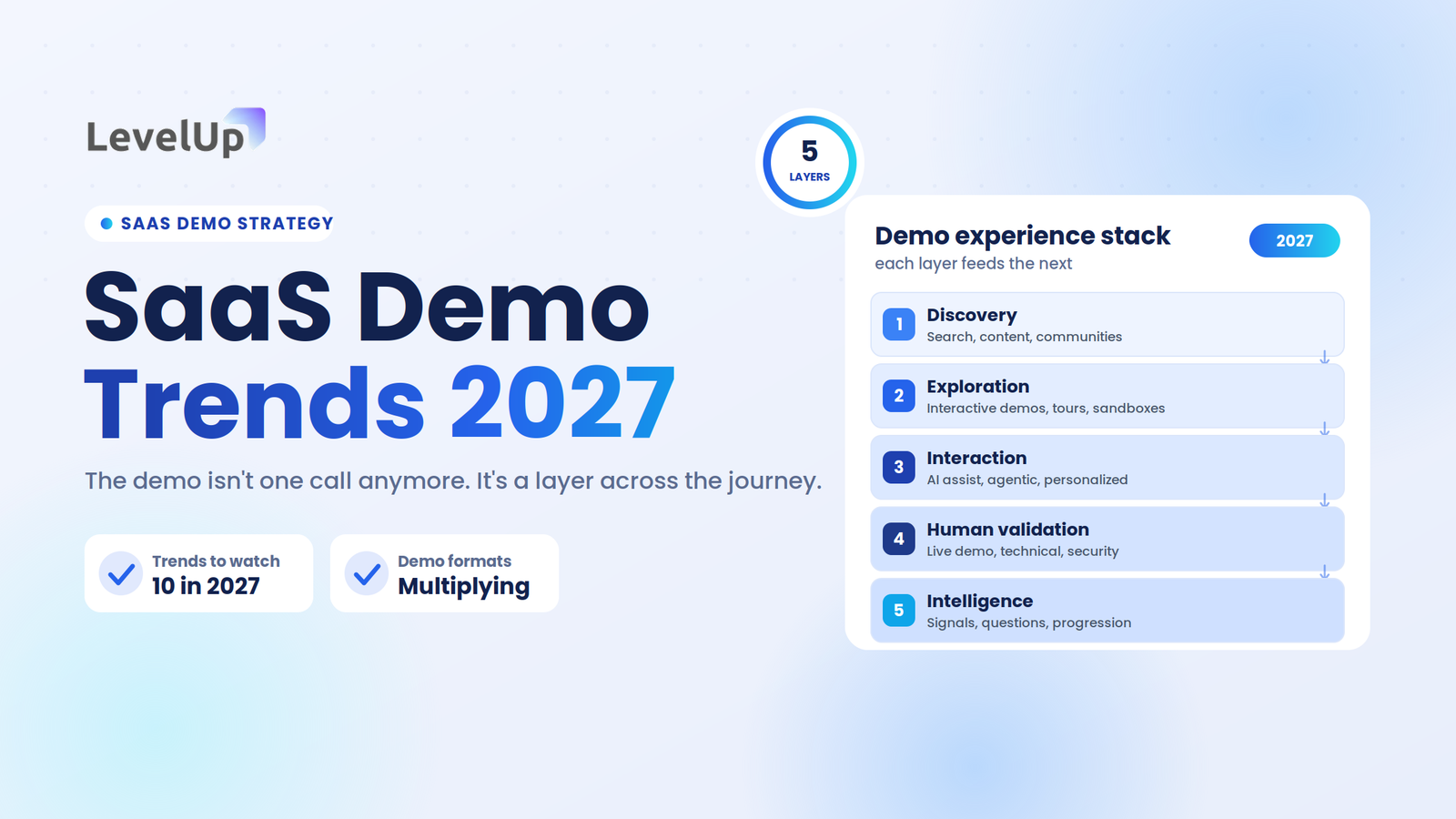
The SaaS demo is no longer one scheduled call. It is fragmenting into a product-experience layer that spans discovery, self-serve exploration, AI-assisted interaction, human validation, and the intelligence a team learns from all of it.
- Interactive demos are moving earlier, before the first sales call.
- AI is entering demo creation and maintenance more than demo delivery.
- Agentic demos add an adaptive layer, but the governance work is the hard part.
- Live demos shift toward validation as buyers arrive already oriented.
- The 2027 challenge is coordinating formats across the journey, not picking one.
Who this is for (and who should read something else)
If you’re a SaaS founder, a small sales or presales team, or a RevOps leader trying to figure out how your demo motion needs to evolve, this is written for you. You already know what an interactive demo is. You’ve probably tested one.
If you’re looking for a side-by-side tool comparison of demo platforms, that’s a different article. LevelUp Demo’s breakdown of live demo vs interactive demo vs AI demo covers format selection directly.
What is changing about SaaS product demos?
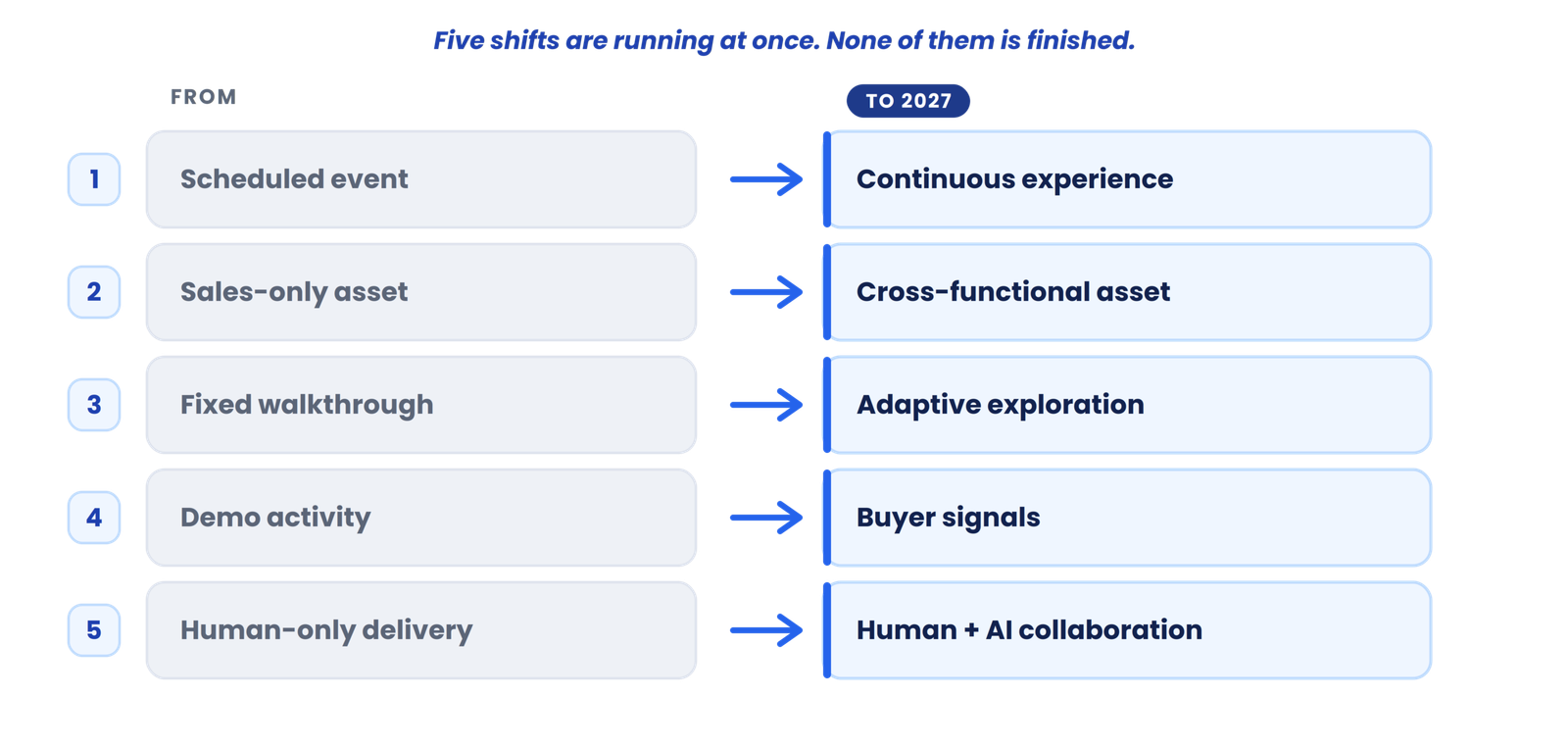
Five shifts are running simultaneously. None of them is finished.
From scheduled event to continuous experience
The traditional path (website, form, SDR call, AE demo) assumed the demo was a single calendar event. Increasingly, buyers encounter product experiences at multiple touchpoints before, during, and after that event. The demo is no longer a moment. It’s a layer.
From sales-only asset to cross-functional asset
Supademo’s 2026 research found interactive demos being used across product, sales, and marketing teams, not just by AEs running live calls. That cross-functional spread means demo content is no longer solely a sales engineering deliverable.
From fixed walkthrough to adaptive exploration
A standard interactive demo follows a predetermined click path. Agentic demos, which emerged as a distinct product category in 2026 from vendors including Navattic and Storylane, can potentially respond to buyer input and adjust the experience. The path is no longer fixed by the builder.
From demo activity to buyer signals
Reprise’s 2026 survey of 531 industry respondents found that teams increasingly value next-step conversion and win rate over simple engagement metrics like views or completion rates. What matters is what happens after the demo, not just during it.
From human-only delivery to human + AI collaboration
AI is entering demo workflows at the creation, personalization, and interaction layers. But Reprise’s same research reported that surveyed SEs still emphasized authenticity and human interaction as critical. The collaboration model is forming. The replacement model is not.
The 2027 demo experience stack
Here’s how we at LevelUp Demo think about the emerging architecture. This isn’t an industry standard; it’s our view of how these layers connect.
Each layer feeds the next. A buyer who completes a self-serve exploration arrives at a live demo with context. The SE who reads the intelligence layer knows which features to skip and which to dig into.
The future demo experience isn’t one format replacing another. Different formats can occupy different layers of the same buying journey.
10 SaaS demo trends to watch in 2027
These are forward-looking trends based on developments visible in 2026. Treat them as directional developments rather than guaranteed outcomes.
1. Interactive demos will move earlier in the buying journey
Navattic’s 2026 research found interactive demo CTAs on 18% of the 5,000 B2B SaaS websites it analyzed, up from 12% in 2024. It also documented increasing use of multiple demo placements across product pages, homepages, and feature-specific landing pages.
That movement matters because it changes when the buyer first touches the product. Instead of waiting for a booked meeting, they can explore on a Tuesday night, share with a colleague on Wednesday, and show up to the sales call on Thursday already oriented. The demo becomes part of discovery and evaluation, not something that happens only after a meeting is booked.
2. AI will move further into demo creation and maintenance
This needs careful framing. Current 2026 evidence from Reprise shows AI being used primarily for environment configuration, demo data generation, asset maintenance, and repetitive setup rather than replacing presenters.
The implication for 2027: AI may have more impact on the work required to produce a good demo than on who tells the story. Building and maintaining demo environments is time-intensive, error-prone, and often the bottleneck. If AI compresses that work, SEs spend more time on discovery and less time on data cleanup. That’s a workflow shift, not a headline about AI avatars.
3. Agentic demos will push interactive demos beyond fixed paths
An agentic SaaS demo is a product experience in which an AI agent can dynamically guide or interact with a buyer based on their requests, rather than limiting them to a fixed demonstration path. Terminology is still evolving, and different vendors define this differently.
The distinction from a standard interactive demo is significant. Interactive demos let buyers click through a predefined sequence. Agentic demos can potentially understand a request, navigate to relevant product areas, answer questions, and adapt the experience in real time.
But “agentic” introduces operational requirements that most teams haven’t scoped: product grounding, guardrails around approved knowledge, fallback behavior, human handoff logic, and governance. Calling something agentic doesn’t make it trustworthy. The testing and governance layer is where most teams will spend their time in 2027, not on the AI itself.
4. Self-serve product exploration will keep growing
Calendly reported that 69% of surveyed revenue teams said getting leads to actually schedule a meeting is the hardest part of inbound sales. Self-serve exploration sidesteps that friction entirely. Buyers can explore independently, return later, share with colleagues, and skip sections that aren’t relevant.
Self-serve doesn’t mean “no sales team.” It often means “let the buyer build context before involving the sales team,” which is a very different proposition. One source reports interactive demos converting at a 38% demo-to-close rate versus 25% for traditional screen shares, suggesting that pre-educated buyers may close at higher rates.
5. Demo experiences will become more multi-persona
A buying committee includes business buyers, end users, technical evaluators, security reviewers, finance, and executive sponsors. One generic walkthrough rarely answers all their questions.
The 2027 direction isn’t necessarily one demo per person. It’s more likely one product experience with multiple relevant paths, so a security evaluator can find compliance information without sitting through a marketing overview. That’s a content architecture problem, not just a technology problem.
6. Live demos will shift toward validation
This is one of the strongest strategic signals. If buyers arrive having already explored the product through interactive or AI-assisted experiences, the live demo doesn’t need to prove basic functionality. It can focus on specific workflows, technical requirements, integrations, edge cases, implementation questions, and stakeholder alignment.
I spent three hours watching recorded demo calls for a client last quarter, and the pattern was consistent: the most productive calls were the ones where the buyer had already seen the product. The worst ones started from zero. Self-serve handles product exploration. Live sessions handle contextual validation. That split is emerging, not universal, but the signal is clear.
7. Demo personalization will become more contextual
Reprise’s 2026 research reports personalization as a significant concern among surveyed teams. The distinction that matters: cosmetic personalization (swapping a logo) versus workflow personalization (showing the buyer’s actual use case). Changing a company name in a demo header is trivial. Routing a healthcare buyer to HIPAA-relevant workflows while a fintech buyer sees transaction monitoring is substantive.
Contextual inputs include industry, role, company size, product interest, previous engagement, and buying stage. The hard part isn’t collecting those inputs. It’s building demo content flexible enough to respond to them.
8. Demo analytics will shift from engagement to buying signals
Views, completion rates, and clicks tell you someone was there. They don’t tell you what the buyer cared about, what they skipped, what they revisited, or whether the interaction led to a meaningful next step. Connecting demo engagement to demo intelligence and attribution is where the analytical value actually lives.
9. Demo operations will become more important as formats multiply
Imagine running live demos, interactive demos, AI demos, agentic experiences, sandboxes, personalized leave-behinds, and async recordings simultaneously. Who owns version control? Who retires outdated assets? Who manages the demo environments underneath all of it?
That operational complexity is the question nobody in the “AI demos are coming” conversation is answering clearly. The technology layer gets attention. The demo operations layer, the governance, routing, scheduling, handoffs, and QA, is where most teams will actually struggle. If you’re running multiple demo formats without a coordination layer, you’re building a content sprawl problem with buyer-facing consequences.
The formats multiply. The coordination layer is what’s missing.
If you’re starting to see this operational complexity in your own demo workflow, LevelUp Demo was built to centralize the capture-to-conversion path so nothing falls between formats.
10. Human + AI will become a more practical demo model
AI handles research, preparation, data creation, personalization, environment setup, maintenance, basic product questions, and signal extraction. Humans handle discovery, storytelling, complex objections, technical judgment, stakeholder alignment, and trust-building. That’s the emerging division, not AI versus humans but AI on repeatable work, humans on judgment and nuance.
| AI can assist with | Humans can focus on |
|---|---|
| Research | Discovery |
| Preparation | Storytelling |
| Data setup | Judgment |
| Personalization | Complex objections |
| Environment setup | Technical validation |
| Demo maintenance | Stakeholder alignment |
| Signal extraction | Relationship building |
I’m still forming my view on how fast this division stabilizes, because the “repeatable” category keeps expanding as AI capabilities improve. But the 2026 evidence from Reprise’s surveyed SE audience strongly favors a collaboration model over a replacement model, at least for complex B2B sales.
Where practitioners disagree
There’s a live debate about whether agentic demos should be deployed on public-facing pages or restricted to controlled, post-qualification environments. One camp argues that ungated agentic experiences maximize top-of-funnel engagement. The other argues that without proper guardrails, an AI agent answering product questions on a public page creates liability and brand risk. I lean toward controlled deployment first, because the governance tooling isn’t mature enough for most teams to trust a public-facing agent. But this is genuinely unsettled.
What probably won’t change in SaaS demos
For all the movement, a few things hold. This section is the counterweight that keeps a trends piece honest.
Interactive demo vs live demo vs AI demo vs agentic demo
These formats are often discussed as competitors. It is more useful to compare them on what each one is actually for.
| Experience | Primary purpose | Buyer control | Human involvement | Adaptability |
|---|---|---|---|---|
| Live demo | Guided evaluation | Medium | High | High |
| Interactive demo | Self-guided exploration | High | Low | Medium |
| AI demo | AI-assisted interaction | High | Low to medium | High |
| Agentic demo | Adaptive exploration | Very high | Low to medium | Very high |
These categories can overlap. A company may combine interactive, AI, and live experiences rather than choosing only one. There is no single winner here, only a fit between a format and the stage of the journey it serves.
What SaaS teams should prepare for in 2027
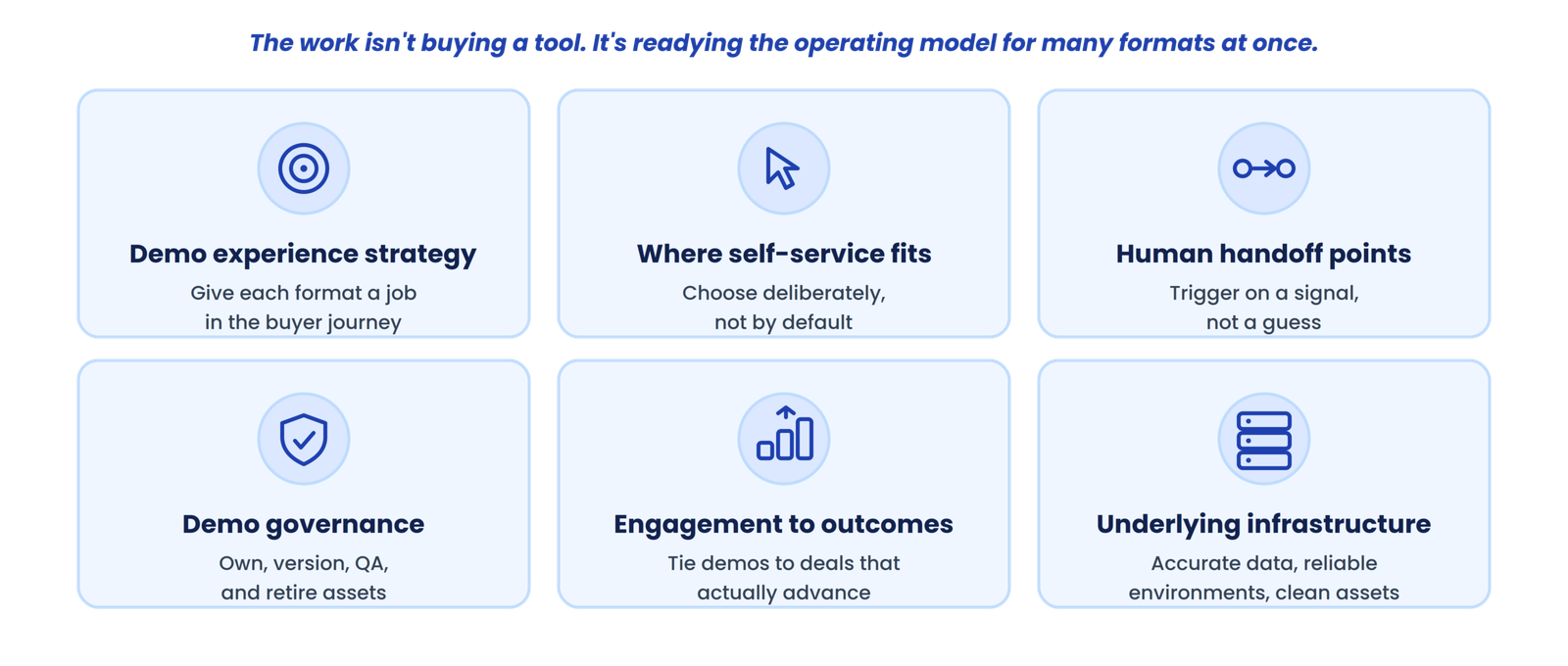
The practical work isn’t buying a tool. It’s getting the operating model ready for more than one demo format at once.
Build a demo experience strategy
Think beyond individual demo assets. Decide which experiences serve discovery, which serve exploration, and which serve validation, so each format has a job instead of overlapping with the others by accident.
Decide where self-service makes sense
Not every product or use case needs an interactive or AI experience. A complex, high-consideration purchase may still lead with a person, while a well-understood workflow benefits from letting the buyer explore first. Choose deliberately rather than by default.
Define human handoff points
When should the buyer move from self-service or AI to an AE or SE? A clear handoff, triggered by a signal rather than a guess, is what keeps self-serve from becoming a dead end and keeps live time reserved for validation.
Establish demo governance
As formats multiply, someone has to own the rules. Governance means naming who owns each asset, how versions are controlled, how accuracy is checked, how experiences are QA’d, and when outdated demos are retired.
Connect demo engagement to downstream outcomes
Don’t stop at views. Tie what buyers do in a demo to whether the opportunity actually advanced, so you learn which experiences move deals rather than which ones simply get clicked.
Prepare the underlying infrastructure
AI experiences still depend on the basics being right: accurate product information, reliable demo environments, current assets, good workflows, and clean data. Weak foundations do not get better because an AI layer sits on top of them.
How to tell whether a demo trend actually matters
Before you invest in any trend on this list, run it through the LevelUp Demo 5-Question Trend Test.
If a trend fails two or more of those, it’s probably technology for technology’s sake.
The new SaaS demo operating model
Pull the whole picture together and two layers appear. The first is the operational journey most teams already run:
Capture → Qualify → Route → Schedule → Prepare → Demo → Follow-up → Analyze
The second is the new experience layer forming on top of it:
Self-serve + Interactive + AI + Agentic + Live + Technical validation
The operational challenge of the future isn’t choosing one demo format. It’s coordinating the right experience at the right stage of the buyer journey, and making sure the operational system underneath can connect them. This is where a coordination layer earns its place, so self-serve exploration feeds AI-assisted interaction, which feeds human validation, which feeds intelligence that improves the whole cycle.
Frequently asked questions
What are the biggest SaaS demo trends for 2027?
The most significant shifts include interactive demos moving earlier in the buying journey, AI entering demo creation and maintenance workflows, agentic demos emerging as a distinct category beyond fixed interactive paths, live demos shifting toward validation rather than basic product education, and demo analytics evolving from engagement metrics toward buyer signals and downstream conversion outcomes.
Will AI replace live SaaS demos?
Current evidence says no. Reprise’s 2026 survey found that SEs value AI for backend demo work but still see human interaction as critical for complex sales conversations.
What is an AI-powered SaaS demo?
An AI-powered SaaS demo uses AI to assist the demo experience, most often behind the scenes: generating demo data, configuring and maintaining environments, personalizing content, answering basic product questions, and extracting buyer signals. The term covers a range of implementations, from AI-assisted setup to buyer-facing AI interaction, so it’s worth clarifying which layer a vendor means.
What is an agentic demo?
An agentic SaaS demo is a product experience where an AI agent can dynamically guide a buyer based on their questions and requests, rather than limiting them to a predefined click path. Terminology varies across vendors.
Are interactive demos replacing live demos?
They’re supplementing them, not replacing them. Interactive demos handle early-stage exploration. Live demos increasingly focus on validation, technical depth, and stakeholder alignment.
Why are SaaS companies using interactive demos?
Because they let buyers explore the product on their own terms before committing to a meeting. Buyers can understand basic value independently, return later, share with colleagues, and arrive at a sales conversation already oriented, which also sidesteps the friction of getting leads to schedule in the first place.
How will AI change SaaS demo operations?
Mostly by compressing the work behind demos: environment creation, demo data generation, content and asset maintenance, personalization, repetitive setup, and signal analysis. That frees SE time for discovery and validation, but it raises the importance of governance, accuracy, and clean underlying data as more formats run at once.
What should SaaS teams measure in future demo experiences?
Features explored, questions asked, stakeholders who engaged, what happened after the demo, and whether the interaction led to a meaningful next step. Activity metrics alone don’t tell you much.
What comes next
The demo is no longer only a scheduled meeting. It has become a product experience buyers can discover, explore, interact with, validate, and revisit across the entire buying journey.
The shape of that evolution is consistent: discovery feeds exploration, exploration feeds interaction, interaction feeds human validation, and validation feeds the intelligence that improves the whole cycle. Different formats occupy different layers rather than competing to be the only one.
So teams don’t need to choose between live, interactive, AI, and agentic demos. The more important question is where each experience fits into the buyer journey and whether your current workflow can even support multiple experience types without things falling apart between the handoffs. If you’re planning your 2027 demo strategy, that coordination problem is the first one to solve, not which AI tool to buy.
Coordinate every demo format from one system.
As live, interactive, AI, and agentic experiences multiply, LevelUp Demo gives small teams one place to capture, route, schedule, and track demos through to outcomes, so nothing falls between the handoffs.