Your demo calendar is full. Reps are booked back to back. But demo-to-opportunity rate is sliding, and nobody can explain why.
The instinct is to fix the demo itself. New deck. Better talk track. More product training. That instinct is usually wrong, because the demo is one stage in a ten-stage process, and the breakdown almost always lives somewhere else: a routing delay nobody measured, a follow-up that never triggered, a qualification step that exists on paper but not in the CRM.
A checklist tells you what should happen. An audit tells you whether it actually happens, where it breaks, and what evidence proves the gap.
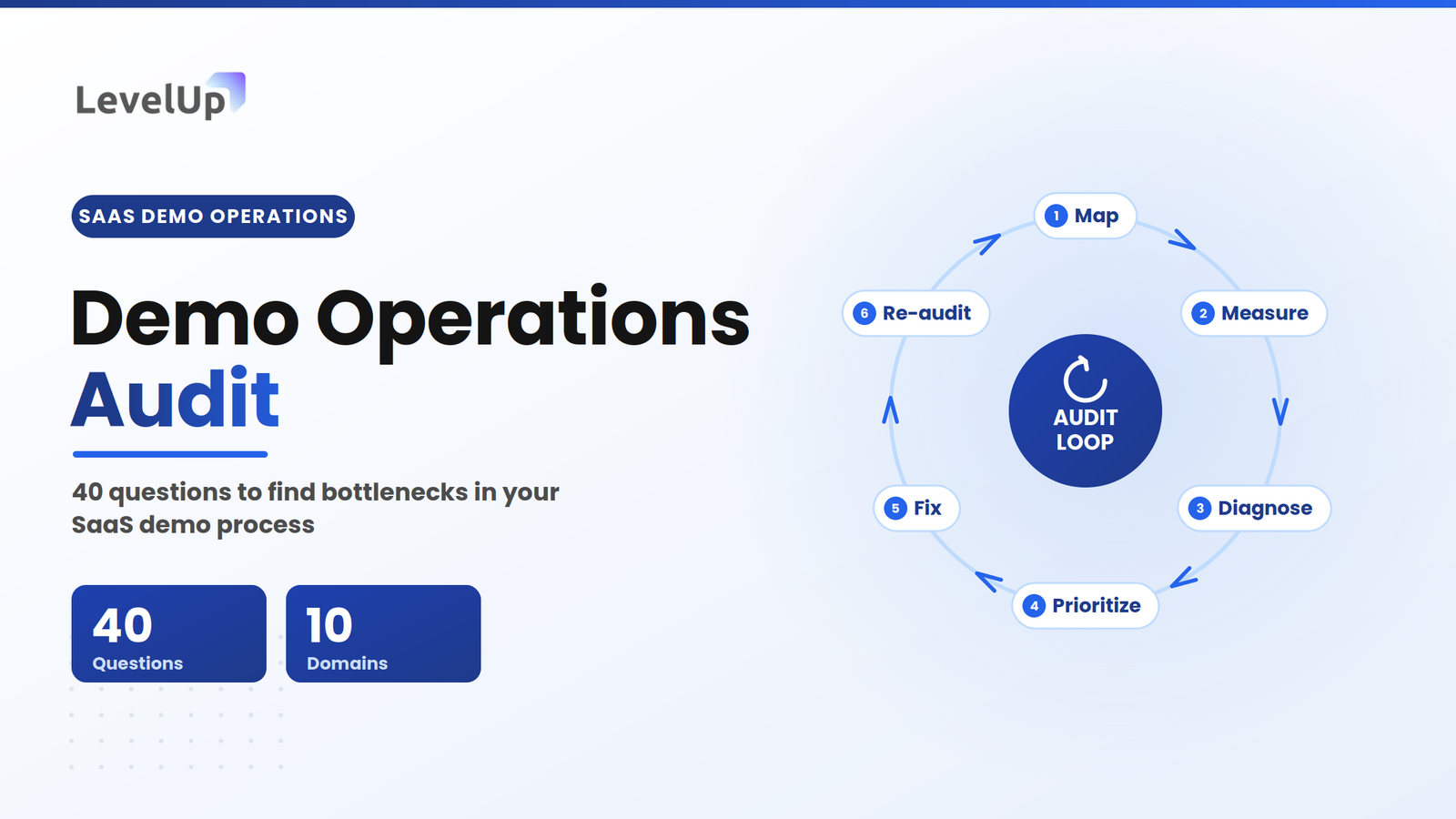
This article gives you a 40-question audit across 10 demo-operation domains, built on one methodology: Map, Measure, Diagnose, Prioritize, Fix, Re-audit. By the end you will know how to run an evidence-based audit across your entire demo operation, identify the real bottleneck, and decide what to fix first.
What is a demo operations audit?
A demo operations audit is a systematic review of the processes, data, people, systems, and handoffs that move a prospect from demo request to revenue. It surfaces operational gaps using evidence from CRM records, calendars, forms, and workflow systems rather than assumptions about how things should work.
It examines process consistency, ownership, response and handoff times, data quality, demo preparation, demo execution, follow-up, outcome capture, intelligence, and the connection to revenue. It is broader than an individual demo checklist and narrower than a full RevOps audit.
That scope distinction matters. A demo checklist helps a rep execute one call. A demo operations audit evaluates the system producing hundreds of calls. If you are looking for a pre-call preparation tool, the SaaS demso checklist is the right resource. If you need to design the overall operation from scratch, start with a demo operations playbook. This article assumes you have a process. You need to know whether it is actually working.
Important distinction: a demo operations audit is not the same as reviewing whether individual reps give good demos. It audits the system around the demo, not just the conversation itself.
Demo operations audit vs. demo checklist vs. demo readiness
These resources answer different questions. Knowing which one you need keeps you from auditing a process you have not designed yet.
| Resource | Main question |
|---|---|
| SaaS Demo Checklist | How should an individual demo be run? |
| Demo Operations Playbook | How should the overall demo process be designed? |
| Demo Readiness Checklist | Is the process ready to scale? |
| Demo Capacity Planning | How many demos can the team handle? |
| Demo Operations Audit | Where is the existing process breaking, and what evidence proves it? |
If your team is pre-process, with no documented workflow and no CRM tracking, an audit will not help yet. Build the process first.
Why demo processes break as SaaS teams scale
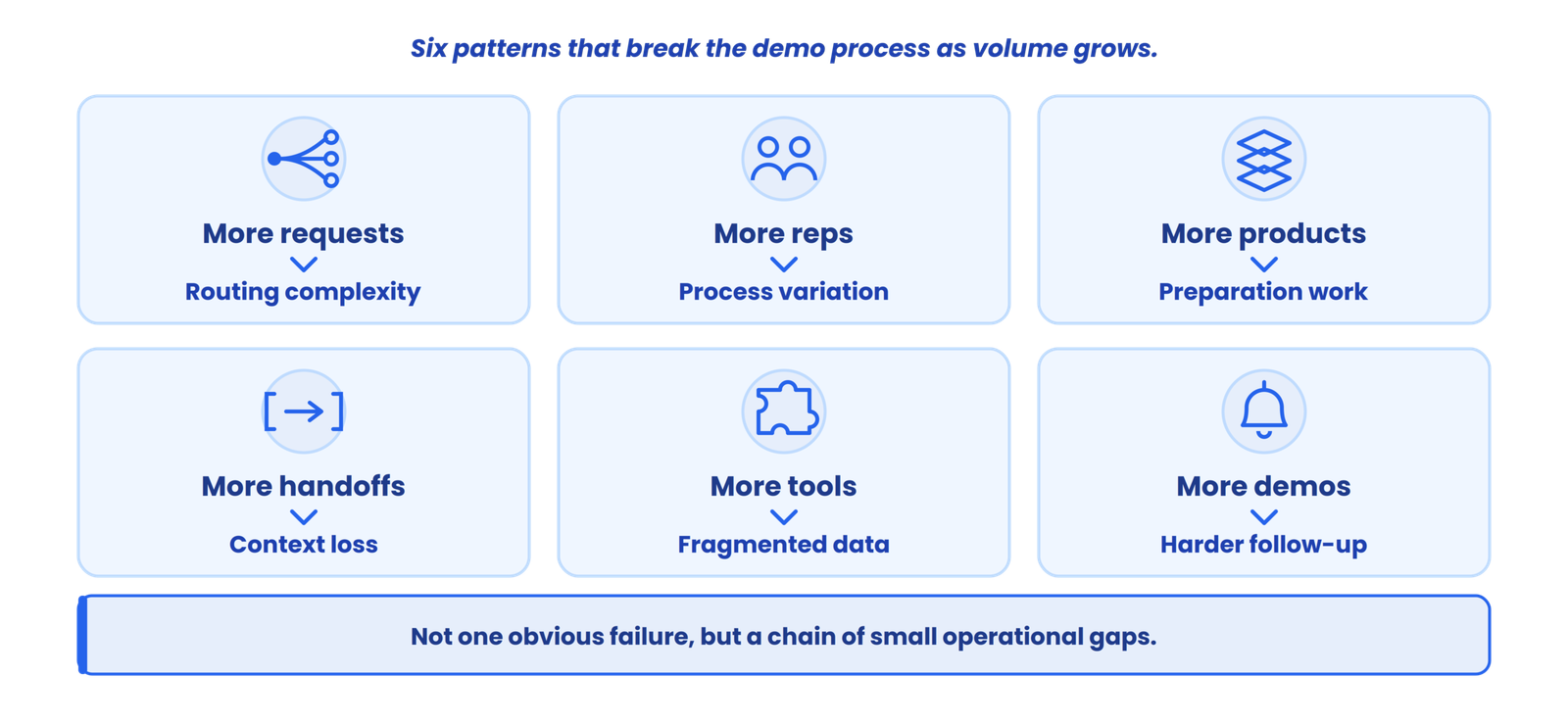
Process drift is quiet. Nobody announces that they stopped logging demo outcomes or that a routing rule broke when a rep went on vacation. The drift accumulates until a metric drops and everyone stares at the dashboard wondering what changed. Six patterns drive most of it.
More demo requests create more routing complexity
When a handful of requests a week becomes dozens a day, manual assignment stops scaling. Round-robin rules, territories, and exceptions multiply, and a single broken rule can strand qualified requests for hours.
More reps create more process variation
One founder running every demo is one consistent process. Add a second rep, an SDR, and a scheduler, and each person develops their own habits for qualifying, preparing, and recording outcomes.
More products and use cases create more preparation work
Every additional product line, persona, or use case adds another version of the demo to prepare and another environment to keep current, so preparation quietly falls behind the roadmap.
More handoffs create more context loss
Capture to qualification to routing to the demo owner is a chain of handoffs. Each one is a place where the context already collected fails to travel with the request.
More tools create more fragmented data
Forms, CRM, calendar, and workflow tools each hold part of the story. When they are not connected, no single system can answer where a request actually stalled.
More demos make manual follow-up harder to control
Following up on five demos from memory is manageable. Following up on fifty is not, and without an automated trigger the ones that slip through are invisible.
The result is often not one obvious failure. It is a chain of small operational gaps.
The Demo Operations Audit Loop
LevelUp’s audit methodology follows six stages. The loop matters because an audit that ends at “here are your problems” is just a report. The re-audit stage is what turns a one-time exercise into an operating discipline.
How to run a demo operations audit
Before the 40 questions, set up the method. These eight steps turn a list of questions into a repeatable audit.
Step 1 – Map the current demo journey
Document the stages a request actually moves through. The exact stages vary by company, but a typical flow looks like this:
Step 2 – Assign an owner to every stage
For each stage, answer four questions: Who owns it? What system records it? What happens if the owner is unavailable? Is the process documented? A stage with no owner is a stage that drifts.
Step 3 – Collect evidence before judging the process
Push every critical stage up the Evidence Ladder before you draw conclusions:
Assumption is “we usually respond quickly.” Process is “our SLA says reps respond within X.” Evidence is the actual timestamps that show what happened. Outcome is whether response time actually affected downstream progression.
Step 4 – Run the 40-question audit
Work through the ten domains below. For each question, record the evidence that supports the answer instead of a simple yes or no.
Step 5 – Identify symptoms vs. root causes
A symptom like “demo-to-opportunity conversion declined” can have many causes: poor request quality, weak qualification, incorrect routing, poor preparation, demo execution problems, or weak follow-up. Do not assume the final conversion metric identifies the root cause.
Step 6 – Prioritize findings
Rank findings by Impact multiplied by Frequency multiplied by Effort. This framework deliberately avoids an arbitrary 0 to 100 audit score, which hides which stage is actually broken.
Step 7 – Assign corrective actions
Each important finding should carry six things: the finding, the evidence, an owner, a corrective action, a target date, and the measurement that will confirm the fix worked.
Step 8 – Re-audit
Fixing something once is not enough. Processes drift back, new reps join, and tools change. Re-auditing after material changes is what keeps a fix from quietly reverting.
The 40-question demo operations audit
Ten audit domains, four questions each. For each question, do not simply answer yes or no. Record the evidence that supports the answer, in the format Question, Evidence to inspect, and what a gap might look like.
1. Demo Request Capture
What enters the process when a buyer requests a demo.
Q1. Does every demo request enter a defined workflow automatically or through a documented process?
Evidence to inspect
- Demo forms
- CRM/workflow records
- Automation rules
- Manual intake procedures
Potential gap: Requests arrive through multiple channels without a consistent intake process.
Q2. Does request capture collect enough information to determine whether the prospect belongs in the intended demo motion?
Evidence to inspect
- Demo request fields
- Qualification criteria
- Historical request data
Potential gap: Reps receive demo requests without enough context to determine fit.
Q3. Can you identify the source and timestamp of every demo request?
Evidence to inspect
- CRM records
- Marketing attribution
- Form submissions
- Timestamp fields
Potential gap: Requests exist, but their source or entry time cannot be reliably identified.
Q4. Can you identify requests that entered the process but never progressed?
Evidence to inspect
- CRM pipeline
- Workflow logs
- Demo request records
Potential gap: There is no clear visibility into requests that disappeared after submission.
2. Demo Qualification
Whether the right prospects enter the demo process.
Q5. Are your demo qualification criteria documented?
Evidence to inspect
- Qualification framework
- CRM fields
- Rep documentation
- Routing rules
Potential gap: Qualification depends primarily on individual rep judgment.
Q6. Are qualification criteria applied consistently across reps and segments?
Evidence to inspect
- Qualified vs. unqualified records
- Rep-level data
- Segment-level data
Potential gap: Similar prospects receive different qualification outcomes.
Q7. Can you distinguish qualified, unqualified, and unclear requests in your data?
Evidence to inspect
- CRM status fields
- Qualification fields
- Historical records
Potential gap: Qualification status is missing, inconsistent, or buried in notes.
Q8. Can you measure whether your qualification process improves or worsens demo quality?
Evidence to inspect
- Qualification status
- Held-demo rate
- Opportunity conversion
- Downstream outcomes
Potential gap: Qualification exists, but its relationship to downstream outcomes is unknown.
3. Demo Request Routing
Whether the right person receives the request.
Q9. Does every qualified demo request have a clearly defined owner?
Evidence to inspect
- Assignment records
- CRM ownership
- Routing workflows
Potential gap: Qualified requests sit unassigned or ownership is unclear.
Q10. Are your routing rules documented?
Evidence to inspect
- Routing logic
- Territory rules
- Segment rules
- Rep assignment rules
Potential gap: Routing knowledge exists only in people’s heads.
Q11. Can you measure the time between qualification and assignment?
Evidence to inspect
- Qualification timestamp
- Assignment timestamp
Potential gap: You cannot determine how long qualified leads wait for ownership.
Q12. What happens when the assigned rep is unavailable?
Evidence to inspect
- Backup routing
- Escalation rules
- Vacation/absence workflows
Potential gap: Requests remain stuck when the assigned owner cannot respond.
4. Demo Scheduling
Friction between qualification and booked meeting.
Q13. Can you measure the time between qualification and scheduled demo?
Evidence to inspect
- Qualification timestamp
- Booking timestamp
- Calendar records
Potential gap: Scheduling delays are invisible.
Q14. How many scheduling interactions typically occur before a demo is booked?
Evidence to inspect
- Scheduling records
- Email/calendar activity
- Booking data
Potential gap: The team doesn’t know how much back-and-forth is required.
Q15. Can you distinguish reschedules and no-shows from normal completed demos?
Evidence to inspect
- Calendar outcomes
- CRM statuses
- Demo records
Potential gap: Reschedules, no-shows and completed demos are grouped together.
Q16. Do different segments experience different scheduling friction?
Evidence to inspect
- Segment-level booking data
- Region/time-zone data
- Rep-level scheduling data
Potential gap: Scheduling problems affect particular segments but are hidden in aggregate reporting.
5. Demo Preparation
Whether the rep receives the context required to prepare.
Q17. Does the demo owner receive the relevant qualification context before the call?
Evidence to inspect
- CRM fields
- Handoff records
- Pre-call briefs
Potential gap: Reps need to rediscover information already collected during qualification.
Q18. Can the rep see the prospect’s stated use case before the demo?
Evidence to inspect
- Form responses
- CRM notes
- Qualification data
- Pre-call documentation
Potential gap: The rep enters the demo without knowing the buyer’s stated reason for booking.
Q19. Is the demo environment and content prepared consistently?
Evidence to inspect
- Demo environment
- Demo assets
- Preparation checklist
- Asset/version records
Potential gap: Preparation depends on individual rep habits.
Q20. How much manual preparation time is required per demo?
Evidence to inspect
- Rep time estimates
- Preparation workflows
- Calendar activity
- Internal processes
Potential gap: Preparation consumes significant rep/SE capacity but isn’t measured.
6. Demo Execution
Whether the actual experience is consistent and relevant.
Q21. Does every demo have a defined objective?
Evidence to inspect
- Demo agendas
- Discovery notes
- Demo records
- Rep documentation
Potential gap: Demos are conducted without a clear intended outcome.
Q22. Is the demo adapted to the prospect’s use case or persona?
Evidence to inspect
- Demo structure
- Buyer context
- Persona/use-case data
- Demo notes
Potential gap: The same product walkthrough is used regardless of buyer context.
Q23. Are demo assets and environments current?
Evidence to inspect
- Product changes
- Demo assets
- Environment versions
- Product release documentation
Potential gap: Reps use outdated product flows, screenshots, environments or messaging.
Q24. Is there a fallback when the intended demo experience fails?
Evidence to inspect
- Backup environments
- Alternative demo paths
- Recovery procedures
Potential gap: A technical or environment failure can derail the entire demo.
7. Outcome Capture
Whether the team records what happened.
Q25. Is every completed demo assigned a structured outcome?
Evidence to inspect
- CRM outcome fields
- Demo statuses
- Post-demo records
Potential gap: Outcomes exist only in free-text notes or aren’t recorded.
Q26. Are next steps captured structurally?
Evidence to inspect
- CRM fields
- Tasks
- Opportunity records
- Calendar events
Potential gap: Next steps are mentioned during the call but not captured in a trackable format.
Q27. Can you distinguish a completed demo from a demo with a meaningful next step?
Evidence to inspect
- Outcome fields
- Opportunity creation
- Follow-up records
Potential gap: “Demo completed” is treated as equivalent to “buyer progressed.”
Q28. Are lost and no-decision outcomes categorized consistently?
Evidence to inspect
- Loss reasons
- No-decision categories
- Rep-level records
Potential gap: Every unsuccessful demo receives a vague or inconsistent reason.
8. Demo Follow-Up
Whether the process reliably creates the next action.
Q29. Is follow-up ownership explicit after every completed demo?
Evidence to inspect
- Tasks
- CRM ownership
- Workflow rules
Potential gap: Everyone assumes someone else will follow up.
Q30. Can you measure the time from demo completion to follow-up?
Evidence to inspect
- Demo timestamp
- Email/task timestamp
- CRM activity
Potential gap: Follow-up happens, but the delay isn’t measurable.
Q31. Are next steps tied to a specific owner and date?
Evidence to inspect
- Tasks
- Calendar events
- Opportunity records
Potential gap: “We’ll follow up next week” is recorded without ownership or a date.
Q32. Can you identify demos that received no meaningful follow-up?
Evidence to inspect
- Demo records
- Email activity
- Tasks
- Opportunity activity
Potential gap: There is no reliable way to identify post-demo drop-off.
9. Demo Intelligence
Whether demo data becomes usable information.
Q33. Can you measure conversion between the major demo stages?
Evidence to inspect
- Funnel reports
- CRM stages
- Demo workflow data
Potential gap: The team reports total demo volume but not stage-by-stage progression.
Q34. Can you segment demo performance by source, segment, rep, or product?
Evidence to inspect
- Analytics
- CRM reports
- Attribution data
Potential gap: Aggregate conversion hides meaningful differences between segments.
Q35. Can demo outcomes be connected to downstream opportunity data?
Evidence to inspect
- CRM opportunity records
- Demo IDs
- Account/contact relationships
- Revenue data
Potential gap: Demo activity and revenue data exist separately.
Q36. Are recurring demo problems documented and analyzed?
Evidence to inspect
- Demo notes
- Win/loss data
- Rep feedback
- Support/product feedback
Potential gap: The same objections, technical issues or buyer questions recur without being systematically analyzed.
10. Revenue and Feedback Loop
Whether the organization connects demo activity back to pipeline and revenue.
Q37. Can you trace a demo to its downstream opportunity or revenue stage?
Evidence to inspect
- CRM relationships
- Opportunity records
- Revenue attribution
Potential gap: You can count demos but cannot connect them reliably to commercial outcomes.
Q38. Can you distinguish demo volume from demo-generated or demo-influenced revenue?
Evidence to inspect
- Demo records
- Opportunity data
- Revenue attribution model
Potential gap: High demo volume is treated as proof of commercial performance.
Q39. Do win/loss findings feed back into demo preparation, content, or qualification?
Evidence to inspect
- Win/loss analysis
- Demo content updates
- Qualification changes
- Rep coaching
Potential gap: The team collects feedback but doesn’t use it to change the demo process.
Q40. Do you re-audit the process after making significant changes?
Evidence to inspect
- Previous audit findings
- Change logs
- New process documentation
- Updated metrics
Potential gap: Changes are implemented without checking whether the original problem was actually resolved.
That’s a lot of process to audit by hand.
If your audit is surfacing gaps in how demo requests are captured, routed, tracked, and followed up, LevelUp Demo gives small teams a single system to run the whole workflow, so the evidence is there the next time you audit.
Don’t audit without evidence
The Evidence Ladder is what separates a real audit from a status meeting. Each claim about the process sits at one of four levels, and only the top two prove anything.
| Statement | Level |
|---|---|
| “We respond quickly.” | Assumption |
| “Our SLA says reps respond within X.” | Process |
| “Our median response time is X.” | Evidence |
| “Requests responded to within X progressed at a different rate.” | Outcome |
Key takeaway: a documented process does not prove that the process is actually being followed. Audit what the system shows happened, not what people say happens.
How to find the real demo bottleneck
Start with the visible symptom
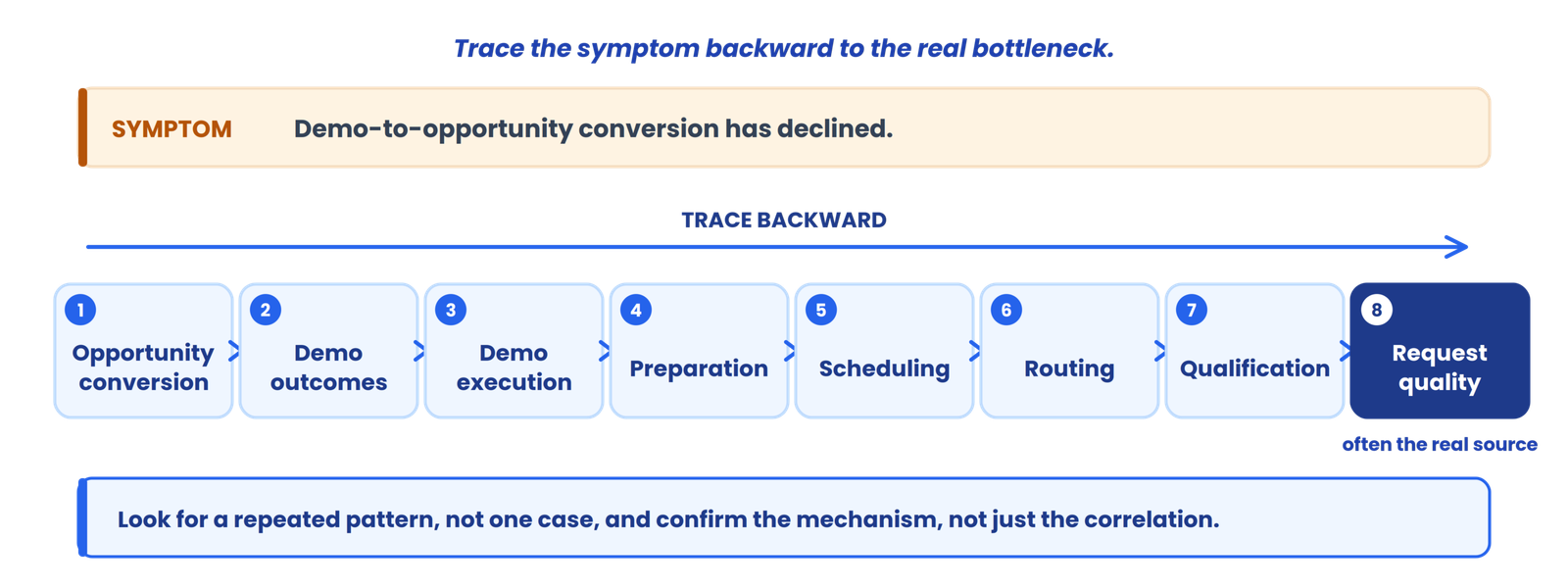
Begin where the pain shows up, for example: demo-to-opportunity conversion has declined. That is the symptom, not the bottleneck.
Trace the process backward
Walk back through the stages that feed the symptom, checking each for evidence of a break:
Look for repeated evidence
Do not declare a root cause based on one anecdote. A single slow request is noise; a pattern across dozens of records is a finding.
Separate correlation from causation
Two metrics moving together does not prove one caused the other. Before assigning a fix, confirm the mechanism, not just the correlation.
How to prioritize audit findings
A 40-question audit can surface twenty problems. You cannot fix them at once. Weigh three factors: Impact (how much could fixing this matter), Frequency (how often the problem occurs), and Effort (how difficult it is to fix).
| Finding | Impact | Frequency | Effort | Priority |
|---|---|---|---|---|
| Unassigned qualified requests | High | High | Low | High |
| Inconsistent demo notes | Medium | High | Medium | Medium |
| Outdated demo asset | High | Low | Medium | Depends on use |
Do not turn this into another artificial numerical score. The point is to sequence the work, not to generate a number.
What audit findings might look like
These are illustrative examples, not real LevelUp or customer data.
Example 1: Routing bottleneck
Observation: Qualified requests exist but assignment timestamps are inconsistent.
Evidence: CRM records.
Possible cause: Manual routing.
Action: Review routing rules and ownership fallback.
Example 2: Follow-up bottleneck
Observation: Completed demos exist without documented next steps.
Evidence: CRM records.
Possible cause: Outcome capture is not part of the workflow.
Action: Make next-step capture a required process step.
Example 3: Preparation bottleneck
Observation: Reps spend significant manual time preparing similar demos.
Evidence: Rep workflow and preparation records.
Possible cause: Context and reusable assets are not surfaced consistently.
Action: Standardize pre-demo context and preparation resources.
Common symptoms and their community fixes
| Symptom | Root cause | Common fix |
|---|---|---|
| Demo requests come in but few book | Form has too many fields | Remove nonessential fields, enrich after submission |
| High no-show rate | Slow time from request to meeting | Auto-send instant confirmation plus 24-hour and 1-hour reminders |
| Reps forget follow-up | No automated post-demo sequence | Trigger follow-up from booking or meeting-end event |
| Demo outcomes are impossible to report | CRM fields are optional or inconsistent | Force a required outcome field before stage advance |
| Founder is always the bottleneck | One person owns all demos | Build reusable interactive demos for repeat use |
| Prospect says the demo was irrelevant | Discovery was weak or skipped | Use pre-demo qualification to limit the walkthrough to stated priorities |
Where practitioners disagree
There is an active debate about whether qualification should happen before or after the demo is booked. One camp, common in product-led and high-velocity motions, argues that booking speed matters more than pre-call qualification, and you should qualify during the first five minutes of the call. The other camp, more common in enterprise and technical sales, insists that unqualified demos waste SE time and tank conversion metrics. For teams with limited capacity, pre-demo qualification usually wins, because the downstream cost of a wasted 45-minute technical demo is harder to recover than a slightly longer booking flow. But this is not settled, and your motion should dictate the answer.
What to fix first after the audit
There is no universal “always fix X first.” Select fixes based on severity, frequency, revenue and process impact, effort, dependencies, and ownership. Then record each one in a corrective-action table so nothing stays unowned.
| Finding | Evidence | Root cause | Action | Owner | Deadline | Metric |
|---|---|---|---|---|---|---|
| Qualified requests unassigned | 22% of records lack assignment timestamps | Manual routing | Document routing rules and add ownership fallback | RevOps | 2 weeks | Median time to assignment |
| Next steps missing after demos | 31% of completed demos have no next step | Outcome capture not required | Require a next-step field before stage advance | Sales Ops | 1 week | % demos with structured next step |
How often should you audit demo operations?
Audit frequency depends on demo volume, team size, process complexity, major GTM changes, new routing systems, CRM or workflow changes, product changes, and significant performance shifts.
Rather than claiming an arbitrary universal cadence, re-audit after material process changes, after significant volume shifts, and after conversion drops you cannot explain. A two-person team running fifteen demos a month needs a different frequency than a team running two hundred.
Demo operations audit template
Turn the 40 questions into a reusable operational template. For each question, capture the columns below. Use a status of Verified, Partially Verified, or No Evidence instead of an arbitrary 100-point score.
| Domain | Audit Question | Evidence | Status | Finding | Root Cause | Action | Owner | Priority | Re-Audit Date |
|---|---|---|---|---|---|---|---|---|---|
| Routing | Does every qualified request have an owner? | Assignment records | Partially Verified | 22% lack timestamps | Manual routing | Add fallback rule | RevOps | High | +30 days |
Frequently asked questions
What is a demo operations audit?
A demo operations audit is a structured, evidence-based review of the processes, handoffs, systems, data, and outcomes surrounding SaaS demos. It covers the full lifecycle from initial request through revenue attribution and identifies operational gaps and bottlenecks using system data rather than assumptions.
What should a SaaS demo operations audit include?
It should cover the full demo lifecycle across ten domains: capture, qualification, routing, scheduling, preparation, execution, outcome capture, follow-up, intelligence, and the revenue feedback loop. For each, it inspects the process, the owner, the system of record, and the evidence that the step actually happens.
What are the main stages of a demo operations process?
A typical flow runs demo request, qualified, routed, scheduled, held, follow-up completed, opportunity, and closed-won. The exact stages vary by company and motion, but every stage should have a clear owner and a system that records it.
How do you identify bottlenecks in a demo process?
Map the intended workflow against actual CRM and calendar data. Look for stages where work accumulates, handoffs where ownership is unclear, and gaps between timestamps that indicate delays. Then separate symptoms, such as conversion dropping, from root causes, such as routing taking 36 hours, before assigning fixes.
What evidence should you collect during a demo operations audit?
Form submission timestamps, CRM ownership history, calendar booking and attendance records, stage change logs, follow-up task completion data, source attribution, rep assignment records, and demo outcome fields. If you cannot pull this data, that is your first finding.
How is a demo operations audit different from a sales demo checklist?
A checklist helps one rep prepare for and execute one demo call. An audit evaluates the operational system producing all demos across the team, inspecting routing, scheduling, preparation, follow-up, and measurement.
How often should SaaS teams audit their demo process?
Audit after major process changes, significant volume shifts, and conversion drops you cannot explain, then at whatever cadence fits your operating rhythm, rather than on a fixed calendar. A two-person team running fifteen demos a month needs a different frequency than a team running two hundred.
Should a demo operations audit use a scoring system?
No. This framework uses evidence and a status of Verified, Partially Verified, or No Evidence for each finding rather than an arbitrary universal score. A single number hides which stage is broken and invites teams to optimize the score instead of the process.
Conclusion: from checklist to continuous audit
A demo operations audit isn’t about getting 40 questions “right.” It’s about finding where the actual process differs from the process you think you have.
Run the loop, and keep running it:
Once the gaps are visible, the fix usually lives somewhere in the broader demo workflow that LevelUp Demo is built around:
The next problem you will hit after running this audit is deciding who owns each fix when the findings span marketing, sales, and ops. That ownership question is worth resolving before you touch a single workflow, because an unowned audit finding is just a document nobody reads.
Turn your audit findings into a working system.
Once you know where the process breaks, LevelUp Demo gives small teams one place to capture, route, schedule, and track demos through to outcomes, so the fixes actually hold and the next audit is faster.