
Last Tuesday, I watched a sales rep celebrate a “killer demo.” The prospect had nodded along, asked sharp questions, even said, “This looks great, let’s talk next week.” That next week never came. Three follow-ups. Zero replies. The deal died in silence.
Here’s what stings: this wasn’t a bad rep. It wasn’t a bad product. It wasn’t about bad product demos. It was a broken process that nobody audited.
Most content on this topic blames the buyer. They were “just browsing.” They “weren’t serious.” That framing is lazy—and it’s wrong. The data points somewhere far more uncomfortable: 71% of buyers ghost after demos, and in most cases, the seller’s process created the conditions for it.
By the end of this guide, you’ll be able to diagnose exactly where your demos lose momentum, score ghosting risk before it happens, and run a post-demo playbook that keeps deals alive.
Why Buyer Ghosting Happens After Product Demos
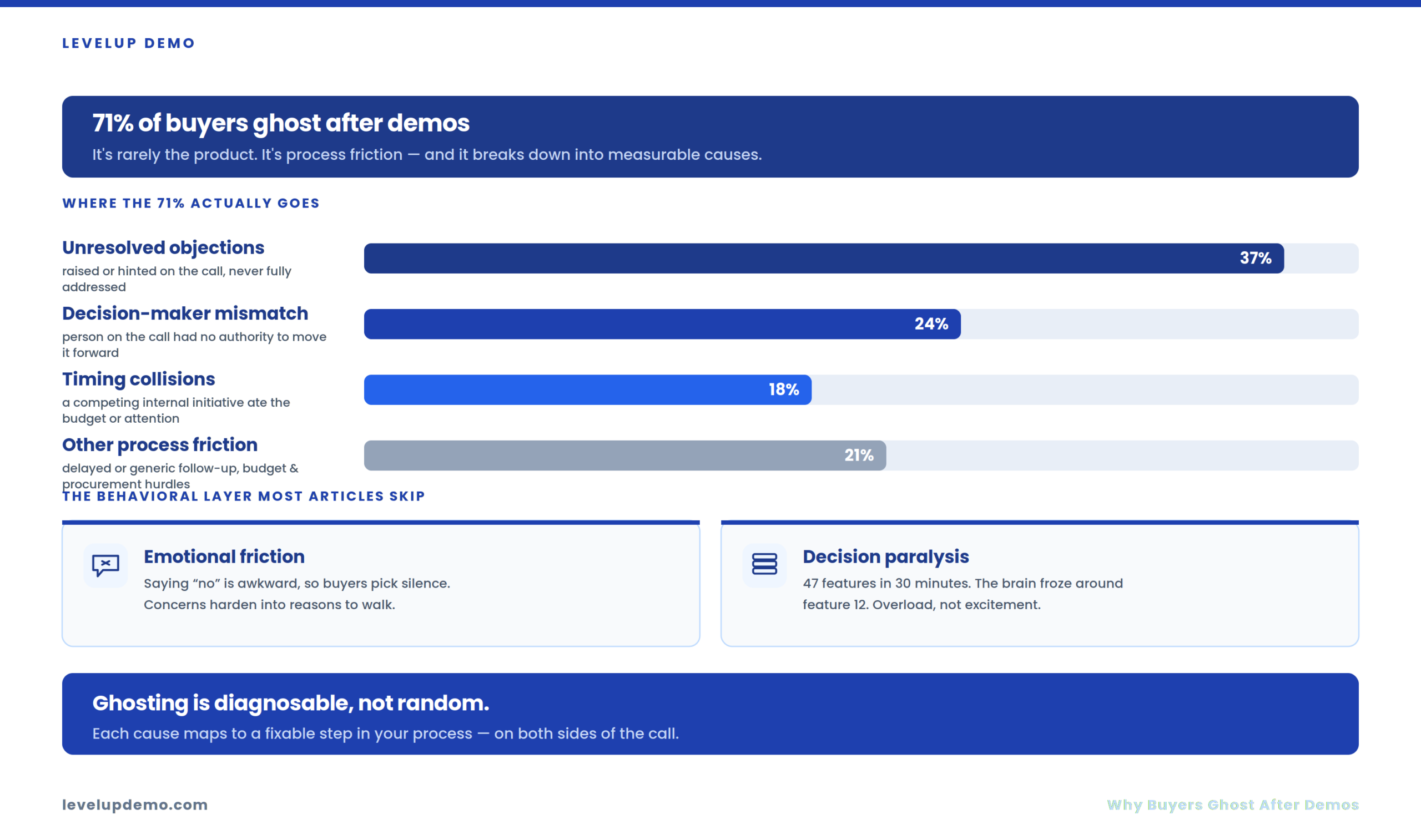
Buyers ghost after product demos because the demo failed to address their specific business problem, key decision-makers weren’t present, follow-up was delayed or generic, internal priorities shifted, or procurement and budget hurdles emerged. Ghosting is rarely about your product—it’s about process friction on both sides.
Let’s break down the behavioral layer most articles skip.
Emotional friction is the silent killer. Prospects don’t enjoy saying “no.” It’s awkward. It creates conflict. So they take the path of least resistance: silence. When a buyer doesn’t feel a safety net to share concerns openly during the demo, those concerns go home with them and quietly harden into reasons to wait—or walk.
Then there’s decision paralysis. You showed 47 features in 30 minutes. The buyer’s brain shut down somewhere around feature 12. Information overload doesn’t create excitement; it creates freeze.
And the one nobody talks about on LinkedIn: timing collisions. Research suggests roughly 18% of ghosts happen because a competing internal initiative is consuming the same budget or executive attention. Your demo was fine. The timing wasn’t.
The uncomfortable truth? 37% of ghosting traces back to unresolved objections—objections the buyer raised (or hinted at) during the call that the rep didn’t fully address. Another 24% stems from decision-maker mismatch, where the person on the call simply didn’t have authority to move things forward.
The Hidden Cost of Demo Ghosting
Demo ghosting costs SaaS teams far more than a lost deal. It inflates sales cycles, destroys forecast accuracy, wastes presales engineering hours, and creates false pipeline confidence that misleads leadership. When 75% of demos fail to close within 90 days, the compounding cost of ghosting is staggering.
Here’s what it actually looks like:
The real damage isn’t one lost deal. It’s the systematic erosion of demo win rate across your entire team because nobody’s diagnosing where deals actually break.
The LevelUp Demo Ghosting Diagnostic Framework
Most teams know they’re getting ghosted. Few can pinpoint where the breakdown occurs. This framework evaluates five stages to identify the exact failure point.
Score each item 0 (not done), 1 (partially done), or 2 (fully done).
1Before the Demo
- ☐ ICP confirmed (company fits ideal profile)
- ☐ Decision-maker and budget authority invited
- ☐ Agenda shared in advance
- ☐ Business pain identified in discovery
- ☐ Demo scheduled within 3 days of request
2During the Demo
- ☐ Personalized to buyer’s stated pain
- ☐ Discovery questions asked (not just presented)
- ☐ Fewer than 5 core features shown
- ☐ Objections surfaced and addressed live
- ☐ Buyer engagement confirmed (questions, reactions)
3Immediately After
- ☐ Recap sent within 1 hour
- ☐ Next meeting scheduled before call ended
- ☐ Champion kit delivered within 24 hours
- ☐ Specific action items documented
4Buying Process
- ☐ Decision-making process mapped
- ☐ Budget range confirmed
- ☐ Timeline established
- ☐ Procurement requirements understood
- ☐ Multi-threading initiated (2+ contacts engaged)
5Sales Process
- ☐ CRM updated with demo outcome
- ☐ MAP created with mutual milestones
- ☐ POC exit criteria defined (if applicable)
- ☐ Pipeline stage accurate
Scoring:
Track this across your team using demo analytics to spot patterns, not just individual failures.
10 Common Reasons Buyers Ghost After Product Demos
Each reason below maps to a specific process failure—not a buyer character flaw.
The Demo Momentum Curve
Buyer enthusiasm isn’t static. It peaks during the live demo and decays rapidly if nothing reinforces it. Understanding this curve changes how you structure every post-demo action.
The first value milestone—a tangible win delivered within 24 hours—is the single most effective momentum accelerator. This could be a personalized ROI calculation, a pre-built workspace, or a 2-minute Loom video showing their specific use case configured.
When demos are scheduled 8+ days out, no-show rates jump to 23%. Intent decay is real, and it starts the moment the calendar invite is sent. Offering interactive product demos as a bridge between booking and the live call can maintain engagement during that gap.
Buyer Ghosting Risk Score
Run this checklist after every demo. Each risk factor carries a weight. Total your score and categorize.
Risk Categories:
Teams tracking demo quality scores alongside this risk assessment can predict ghosting with surprising accuracy.
The 24-Hour Post-Demo Playbook
What high-performing teams do after the demo matters more than what happens during it. Here’s the sequence:
Within 1 hour:
- Send a personalized recap (not a template) referencing 2–3 specific pain points discussed
- Confirm the next meeting date/time agreed on the call
- Log demo outcome and notes in CRM
Within 24 hours:
- Deliver the champion kit: executive summary (3 slides max), ROI calculation, and a 2-minute Loom walkthrough of their specific use case
- Connect with a second stakeholder on LinkedIn (multi-threading)
- Send relevant case study matching their industry or company size
Within 3 days:
- Share a signal ping—not “checking in,” but a relevant insight, article, or data point related to their stated pain
- Confirm internal next steps (“Have you had a chance to share with [CFO name]?”)
Within 7 days:
- If no response, send a brief “permission to close” message: “I want to respect your time—should I keep this open or close it out for now?”
- Engage a second contact if single-threaded
Ongoing nurture (if no response):
- Add to a value-based nurture sequence (not product pitches)
- Re-engage when trigger events occur (funding round, leadership change, job posting matching your use case)
Keep Deals From Dying in Silence
LevelUp Demo gives your team visibility into every demo outcome, follow-up status, and pipeline stage—so nothing slips through. See how demo management works
Ghosting Prevention Checklist
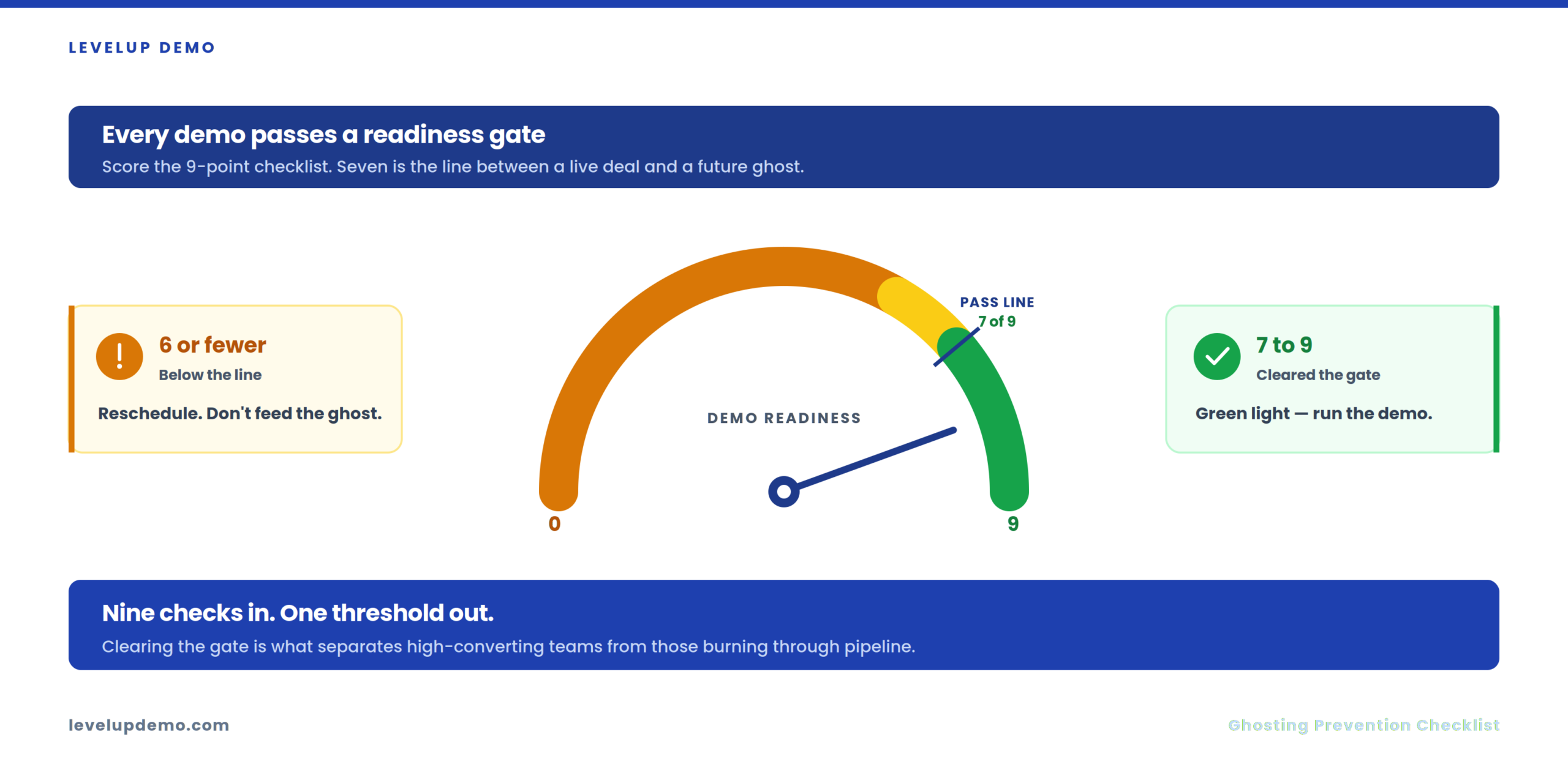
Use this before every demo. If you can’t check at least 7 of 9, consider rescheduling.
- ☐ ICP fit confirmed
- ☐ Decision-maker confirmed as attendee
- ☐ Business pain identified in discovery call
- ☐ Agenda sent 24 hours in advance
- ☐ Demo personalized to their top 2–3 pain points
- ☐ Budget range discussed or bracketed
- ☐ Timeline expectations set
- ☐ Champion kit prepared and ready to send
- ☐ Next step pre-planned (not “we’ll follow up”)
This checklist maps directly to the product demo best practices that separate high-converting teams from those burning through pipeline.
How LevelUp Helps Sales Teams Maintain Demo Momentum
Ghosting is a process problem, and process problems need infrastructure. LevelUp Demo is built for teams that want to manage the full demo lifecycle—from the moment a lead requests a demo to the moment the deal closes or is formally disqualified.
Where this connects to the frameworks above:
- Lead qualification happens at intake, so unqualified demos don’t consume rep time
- Scheduling and routing reduce the booking-to-demo gap, fighting intent decay
- Outcome tracking gives managers visibility into which demos convert and which ghost—and why
- Follow-up management ensures no deal sits in limbo without a next action
- Analytics surface demo operations KPIs that reveal process breakdowns before they become patterns
You can implement every framework in this article with a spreadsheet. But if you’re running more than a handful of demos per week, the manual tracking itself becomes a source of dropped balls.
Built for Small Sales Teams Who Can’t Afford to Lose Deals
Explore LevelUp Demo’s pricing and see if it fits your workflow.
Frequently Asked Questions
Why do prospects stop responding after product demos?
Prospects typically stop responding because the demo didn’t address their specific business pain, the wrong stakeholders attended, follow-up was delayed or generic, internal priorities shifted, or they experienced emotional friction around saying “no” directly. It’s rarely about your product quality.
How long should I wait before following up after a demo?
Send your initial recap within one hour of the demo ending. Deliver your champion kit within 24 hours. Research shows leads contacted within 5 minutes qualify at 21x the rate of those contacted after 30 minutes—speed signals professionalism, not desperation.
How many follow-ups are too many?
There’s no universal number, but the quality matters more than quantity. Three to five value-driven touchpoints over two weeks is a reasonable cadence. Replace “checking in” messages with signal pings—relevant insights, data, or resources connected to their stated pain.
Does buyer ghosting mean the deal is lost?
Not necessarily. Roughly 40% of ghosted deals can be re-engaged with the right trigger—a leadership change, budget cycle reset, or relevant industry event. Add ghosted prospects to a value-based nurture sequence rather than writing them off entirely.
What should I include in a post-demo follow-up?
Include a personalized recap referencing specific pain points discussed, a champion kit (executive summary, ROI calculation, short video walkthrough), confirmed next steps, and a relevant case study. Avoid generic templates.
What metrics should I track after demos?
Track demo win rate, time-to-follow-up, ghosting rate by rep and segment, number of stakeholders engaged, and next-meeting-scheduled rate. These demo analytics reveal where your process breaks down.
The 71% ghost rate isn’t a buyer problem. It’s an engineering problem—and it’s fixable. Start with the Diagnostic Framework, score your next ten demos, and you’ll see exactly where deals are leaking. That’s the only way to stop blaming buyers and start fixing the machine.
Stop blaming buyers. Start fixing the machine.
LevelUp Demo gives your team visibility into every demo outcome, follow-up status, and pipeline stage—so deals stop dying in silence. Score your next ten demos and see exactly where they leak.