Is Storylane the right demo platform for your SaaS team? That is the question this review answers, and in 2026 it is harder to answer than it used to be.
Storylane started as a way to build interactive product demos. The current product has expanded well past that. Today it covers interactive demos, HTML demos, AI-assisted creation, personalization, analytics, Hubs, and other buyer-experience capabilities. Storylane also runs RepX, an AI SDR product, which broadens the platform further.
Evaluating Storylane now requires looking beyond “can it make an interactive demo?” The real question is whether Storylane’s combination of demo creation, personalization, buyer engagement, analytics, and AI capabilities matches what your team actually needs, and whether the plan you can afford includes the parts you will use.
The short version
Storylane is a capable, fast interactive-demo platform that has grown into a broad buyer-experience suite. The 2026 buying decision is less about demo quality and more about how much of its wider demo, AI, and buyer-engagement stack your team actually needs, and which tier includes it.
- Core demo creation is fast and well-liked (G2 rates it 4.7 from ~1,614 reviews).
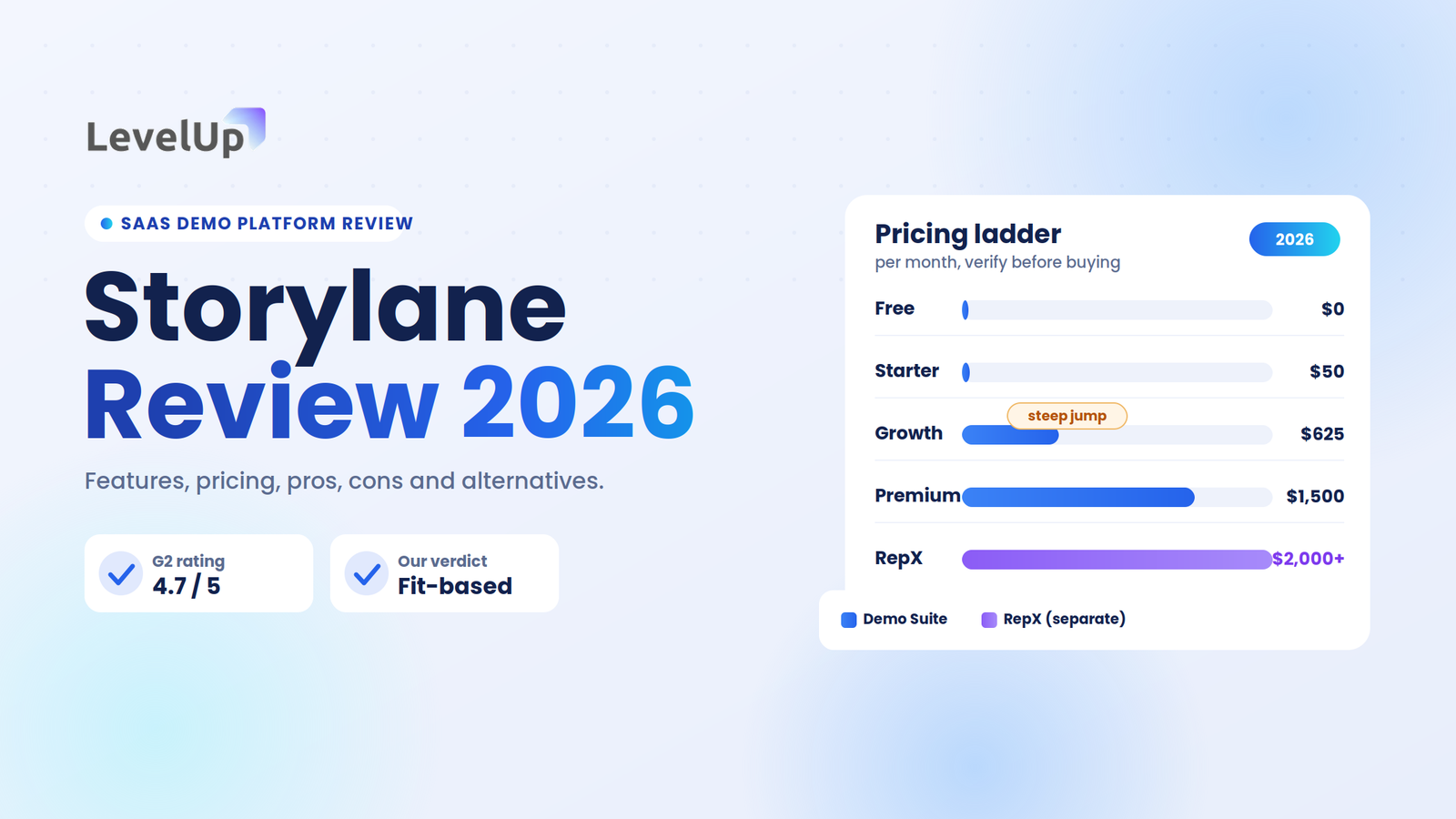
- Pricing rises steeply: Free $0, Starter $50/mo, Growth $625/mo, Premium $1,500/mo.
- HTML demos and A/B testing start at Growth; Salesforce, SSO, and Hubs at Premium.
- RepX (the AI SDR) is priced separately, from $2,000/mo, with the Demo Suite bundled in.
- Storylane builds the demo experience; it does not run the operational workflow around demos.
Storylane review at a glance
| Question | Summary |
|---|---|
| What is Storylane? | Interactive demo and buyer-experience platform |
| Core strength | Creating and distributing interactive product experiences |
| Main users | Marketing, sales, presales/SE, and product teams |
| AI capabilities | AI demo creation, editing, personalization, voiceovers, and more |
| Advanced capabilities | HTML demos, Hubs, analytics, deal intelligence, RepX AI SDR |
| Starting price | Free plan available; paid from $50/month (verify current pricing) |
| Free option | Yes, the current plans page shows a Free plan |
| Main consideration | Match the capabilities you need to the correct plan |
Storylane’s official plans currently show a Free Demo Suite plan, Starter at $50/month, Growth at $625/month, and Premium at $1,500/month; RepX is priced separately from $2,000/month for Growth. (pricing verified against Storylane and G2 in September 2026; re-check the official plans page before you buy, as tiers change).
What is Storylane?
Storylane is a platform for creating interactive product demos. It supports screenshot and video-based demos as well as HTML demos, so buyers can interact with guided product experiences rather than watch a static recording. Teams distribute those demos through links, embeds, and other channels, and Storylane has expanded into analytics, personalization, Hubs, and AI capabilities on top of the core builder.
Quick answer
Storylane is an interactive product demo platform that lets SaaS teams create, personalize, distribute, and analyze self-guided product experiences. Its current platform also includes AI-powered demo creation and editing, Hubs, analytics, and AI sales capabilities through its RepX product.
What does Storylane do?
It helps to see Storylane as a workflow rather than a feature list. The product moves a buyer experience through six stages.
Storylane features
Rather than list functionality, each feature below follows the same pattern: what it does, why it matters, who needs it, and what to consider.
Interactive demos
What it does: Creates guided, clickable product experiences from screenshot, video, or HTML/CSS capture, with tooltips, hotspots, chapters, CTAs, lead capture, and embeds. Storylane’s documentation explicitly supports all three capture types.
Why it matters: Interactive demos let buyers explore the product before a sales call, which shifts product understanding earlier in the buying journey.
Who needs it: Product marketing and sales teams that want self-guided demos on the website or in outreach.
What to consider: Evaluate creation speed, fidelity, editing flexibility, guidance, distribution, and how much maintenance a demo needs after your product UI changes.
HTML demo editor
What it does: Captures the product as editable HTML so teams can change text, elements, and images and create a more realistic interaction than a screenshot allows.
Why it matters: HTML demos feel closer to the real product, which matters for higher-stakes or technical evaluations.
Who needs it: Teams whose screenshot demos are not flexible enough, or who need to swap data and edit layouts.
What to consider: Storylane places HTML demo editing in its higher paid tiers (Growth and above). Ask yourself whether you actually need HTML-level customization, or whether screenshot and video demos already solve the use case.
AI demo creation
What it does: Uses AI to generate guides and content, produce voiceovers and video, generate synthetic data, edit HTML, and convert existing media into demos.
Why it matters: It compresses the manual work of building and maintaining demos, which is often the real bottleneck.
Who needs it: Teams producing many demos who want to reduce repetitive build and cleanup time.
What to consider: AI-assisted demo creation is not the same thing as an AI agent conducting the demo. Keep the two separate when you evaluate.
AI personalization
What it does: Personalizes demos with names, logos, currencies, buyer-specific data, language, and personalized links.
Why it matters: Relevant demos hold attention better than generic ones.
Who needs it: Sales and marketing teams running demos across different industries, roles, or accounts.
What to consider: Distinguish cosmetic personalization (a changed logo) from contextual personalization (a buyer-relevant workflow). The second is the version that changes what the buyer actually experiences.
Media-to-Demo
What it does: Uses AI to transform existing video and screenshots into an interactive demo. Storylane markets this as Media to Demo.
Why it matters: It turns assets you already have (Loom recordings, webinars, product videos, screenshots) into interactive experiences without rebuilding from scratch.
Who needs it: Teams sitting on a library of recorded product content.
What to consider: Verify how much editing the converted output needs before it is buyer-ready.
Hubs
What it does: Curates a collection of buyer-facing assets (interactive demos, PDFs, videos, interest screens, and other embedded content) into one space.
Why it matters: A single curated space suits multi-stakeholder deals, sales follow-up, buyer enablement, and product launches better than a lone demo link.
Who needs it: Sales and marketing teams running multi-asset, multi-stakeholder deals.
What to consider: Storylane’s pricing places Hubs in the Premium tier, so confirm the tier before you plan around it.
Analytics and buyer engagement
What it does: Reports engagement, completion, time spent, drop-off, form fills, visitor and company information, and demo performance.
Why it matters: It moves the product past sharing a demo into understanding how buyers interact with it.
Who needs it: Teams that want to know which parts of a demo buyers actually use.
What to consider: An engagement event is context, not proof of buying intent. Treat it as a demo signal, not a closed deal.
Deal Intelligence
What it does: Connects demo engagement to CRM deals, including HubSpot and Salesforce, so demo activity sits alongside pipeline context.
Why it matters: It is where the product moves from demo builder into pipeline measurement and demo attribution.
Who needs it: Revenue teams trying to connect demo activity to pipeline, not teams that only want to build demos.
What to consider: Salesforce connection sits at Premium; confirm your CRM is supported at the tier you are budgeting for.
RepX AI SDR
What it does: RepX is an AI SDR that engages inbound website visitors through text, voice, and video, using interactive demos, documentation, websites, and sales material to answer product questions, qualify, handle objections, book meetings, present demos, and hand off to CRM or Slack.
Why it matters: It represents Storylane’s most aggressive expansion, from demo creation into buyer interaction.
Who needs it: Teams that want an AI agent engaging inbound visitors on the website.
What to consider: Do not treat RepX as just another interactive-demo feature. It is a separate AI SDR capability, priced separately from the Demo Suite.
Storylane AI: what is actually AI-powered?
Storylane uses “AI” across very different jobs. Splitting it into five categories keeps the buying decision clear.
Storylane’s AI footprint now spans both demo production and buyer engagement, which is why bundling it all under one “AI” label obscures what you are actually buying.
Storylane integrations
Grouped by purpose rather than dumped as a logo wall:
Buyer question: is the specific integration you need included in the plan you are considering, not just on the integrations page?
Storylane pricing
Storylane splits into two priced products: the Demo Suite and RepX. (pricing verified against Storylane and G2 in September 2026; re-check the official plans page before you buy, as tiers change).
Free: $0
Starter: $50/month
The 2-seat minimum matters: the headline $50 is a per-seat figure, not the complete cost for a team that needs integrations.
Growth: $625/month
Premium: $1,500/month
RepX pricing (separate from the Demo Suite)
Pricing and plan packaging can change. Verify the current official Storylane pricing page before purchasing, and confirm whether you are pricing the Demo Suite alone or the full RepX-inclusive platform.
Is Storylane worth the price?
There is no blanket yes or no. Price should be evaluated against the capabilities your team actually needs, not against the headline starting price.
Potentially good value when
Look more closely when
Storylane pros
Evidence-backed strengths
Storylane cons
Reported considerations
What do users say about Storylane?
This is a synthesis of patterns across many reviews rather than any single testimonial. G2 currently shows Storylane at 4.7 out of 5 from around 1,614 reviews; that number changes over time, so recheck it before relying on it.
Common positive themes
Common negative themes
Storylane builds the demo. Who runs the workflow around it?
If your bottleneck is capturing demo requests, qualifying leads, routing them, scheduling, and closing the follow-up loop, LevelUp Demo runs that operational layer, whichever tool you use to build the demo itself.
Who is Storylane best for?
Product marketing teams
For website demos, product launches, self-guided experiences, and personalization.
Sales teams
For personalized demos, follow-up, buyer engagement, and sales enablement.
Sales engineering and presales teams
For technical demos, reusable experiences, presenter mode, and controlled environments (verify which sit at Premium or Enterprise).
Product and customer teams
For onboarding, training, and product education. Storylane explicitly markets solutions to several of these functions.
Who might not need Storylane?
Storylane may be more platform than you need if:
Storylane alternatives
Use-case based, not a ranking. Confirm each current capability before you rely on it; cells marked verify should be checked against the vendor’s current pages.
| Platform | Core focus | Interactive demos | AI | Sandbox | Demo workflow | Analytics |
|---|---|---|---|---|---|---|
| Storylane | Demo experience | Yes | Yes | Verify | Partial | Yes |
| Navattic | Interactive demos | Yes | Yes | Verify | No | Yes |
| Walnut | Sales demo experiences | Yes | Yes | Verify | Limited | Yes |
| Supademo | Lightweight demo creation | Yes | Yes | No | No | Yes |
| Reprise | Enterprise demo environments | Yes | Verify | Yes | Limited | Yes |
| LevelUp Demo | Demo operations | Different focus | Yes | Different focus | Yes | Yes |
For a deeper look, the best Storylane alternatives for SaaS teams breaks each option down in more detail.
Storylane vs LevelUp Demo
These two tools are often mentioned together, but they solve different primary problems.
| Storylane | LevelUp Demo | |
|---|---|---|
| Primary problem | Creating and distributing product-demo experiences | Operating the workflow around demos |
| Centered on | Create, personalize, share, analyze | Capture, qualify, route, schedule, prepare, demo, follow up, analyze |
| Best when | You need to build interactive product experiences | Your bottleneck is the demo operation, not the demo itself |
The products can overlap, but a team evaluating the two should first identify whether its primary problem is creating and distributing product-demo experiences or operating the workflow surrounding demos.
Questions to ask before buying Storylane
Pricing questions
Demo questions
AI questions
Integration questions
Operations questions
Storylane review methodology
This review assessed Storylane across product capabilities, demo creation, editing, AI, personalization, analytics, integrations, pricing, user feedback, use-case fit, and enterprise capabilities. Evidence followed a hierarchy: official Storylane documentation first, independent review platforms (G2, Capterra) second, third-party analysis third. Throughout, facts, vendor claims, user feedback, and editorial analysis are distinguished rather than blended. No hands-on product testing was conducted for this review.
Frequently asked questions
What is Storylane?
Storylane is an interactive product demo platform that lets SaaS teams create, personalize, distribute, and analyze self-guided product walkthroughs using screenshot, video, or HTML capture. It has expanded into AI-powered demo creation, Hubs, analytics, deal intelligence, and an AI SDR product called RepX.
How much does Storylane cost?
As published at the time of writing, Storylane offers a Free plan, Starter at $50/month, Growth at $625/month, and Premium at $1,500/month, with Enterprise pricing custom. RepX is priced separately, starting at $2,000/month for Growth. Verify the current official pricing before purchasing.
Is Storylane free?
Yes. The Free plan includes one seat and one published demo with unlimited views, basic analytics, and lead capture. It is useful for testing, not for a production-scale demo program.
What can you create with Storylane?
Interactive product demos from screenshot, video, or HTML capture, with guided steps, tooltips, chapters, CTAs, and lead forms; personalized and translated versions; buyer-facing Hubs that combine multiple assets; and analytics-tracked experiences you can distribute by link, embed, email, or CRM.
Does Storylane use AI?
Yes, across several distinct jobs: generating guides, content, media, and data; editing HTML and styling; personalizing demos; analyzing engagement; and, through RepX, interacting with buyers directly. AI-assisted creation is separate from an AI agent conducting the demo.
What is Storylane RepX?
RepX is Storylane’s AI SDR product. It engages inbound website visitors through text, voice, and video, using demos, documentation, and sales material to answer questions, qualify prospects, and book meetings. It is priced separately from the Demo Suite.
Does Storylane offer sandbox demos?
Storylane documents sandbox-style, enterprise-grade demo environments, but plan availability should be verified on the current pricing page, as sandbox functionality is typically positioned in higher tiers.
What integrations does Storylane support?
Storylane lists CRM (HubSpot, Salesforce), sales engagement, automation (Zapier), and marketing and analytics integrations. Availability varies by plan; Salesforce in particular sits in the Premium tier.
Is Storylane good for sales teams?
Yes, for personalized demos, buyer engagement, follow-up, and sales enablement, especially with HubSpot. Teams on Salesforce should confirm it is available at their budgeted tier, and teams whose core problem is demo scheduling and routing may need a workflow tool alongside it.
What are the best Storylane alternatives?
Depending on the use case: Navattic and Supademo for interactive demo creation, Walnut for sales demo experiences, Reprise for enterprise demo environments, and LevelUp Demo for the operational workflow around demos (capture, qualify, route, schedule, follow up).
Final verdict
Storylane is a broad interactive-demo and buyer-experience platform. It has grown well past the demo builder it started as.
It stands out on interactive demo creation, personalization, AI capabilities, analytics, and increasingly broad buyer-engagement functionality, and G2 reviewers consistently praise how fast and easy the core workflow is.
What buyers need to watch is the pricing architecture: the tiers rise steeply, several capabilities are gated (HTML at Growth, Salesforce and Hubs at Premium), RepX is a separate purchase, and reported concerns around customization and mobile deserve their own check. Map your exact requirements to a specific plan before signing anything.
Storylane makes the most sense for teams looking to build and operate sophisticated interactive product experiences. Teams whose primary challenge is the operational workflow around demos, capturing requests, qualifying, routing, scheduling, and following up, may need to evaluate a demo-management platform alongside an interactive-demo tool.
The demo is only half the job
If your primary challenge is managing what happens before and after the demo (capturing requests, qualifying leads, routing to the right rep, tracking outcomes, and closing follow-up loops), LevelUp Demo handles that operational layer specifically.