
Last quarter I audited a B2B SaaS company running 80+ demos a month. Calendar was packed. SDRs were busy. Marketing was celebrating request volume. Revenue was flat.
The CEO’s first instinct: “We need more leads.” But when I asked whether anyone could trace a single closed customer back to the original demo request, including why they’d asked, who qualified them, what happened in the meeting, and how the opportunity progressed, the room went quiet. Five teams owned five pieces of the journey. Nobody owned the connection between them.
That gap is what this article is about. By the end you’ll understand why a demo-to-revenue funnel is fundamentally different from a stage-based funnel report, and you’ll have a framework for deciding where your own connections are broken.
Who this is for (and who should read something else)
This applies to demo-led SaaS teams where a meaningful share of pipeline originates from inbound demo requests. If you’re a founder watching demos climb while revenue doesn’t follow, a sales leader trying to find where deals die after the meeting, or a RevOps practitioner stitching CRM data together across handoffs, you’re in the right place.
If you’re looking for a walkthrough of individual funnel stages and where prospects drop off, read the SaaS demo funnel most teams don’t track. If you need specific KPI definitions, the Demo Operations KPIs piece covers that ground. This article sits above both. It’s the connective layer.
What a demo-to-revenue funnel actually is
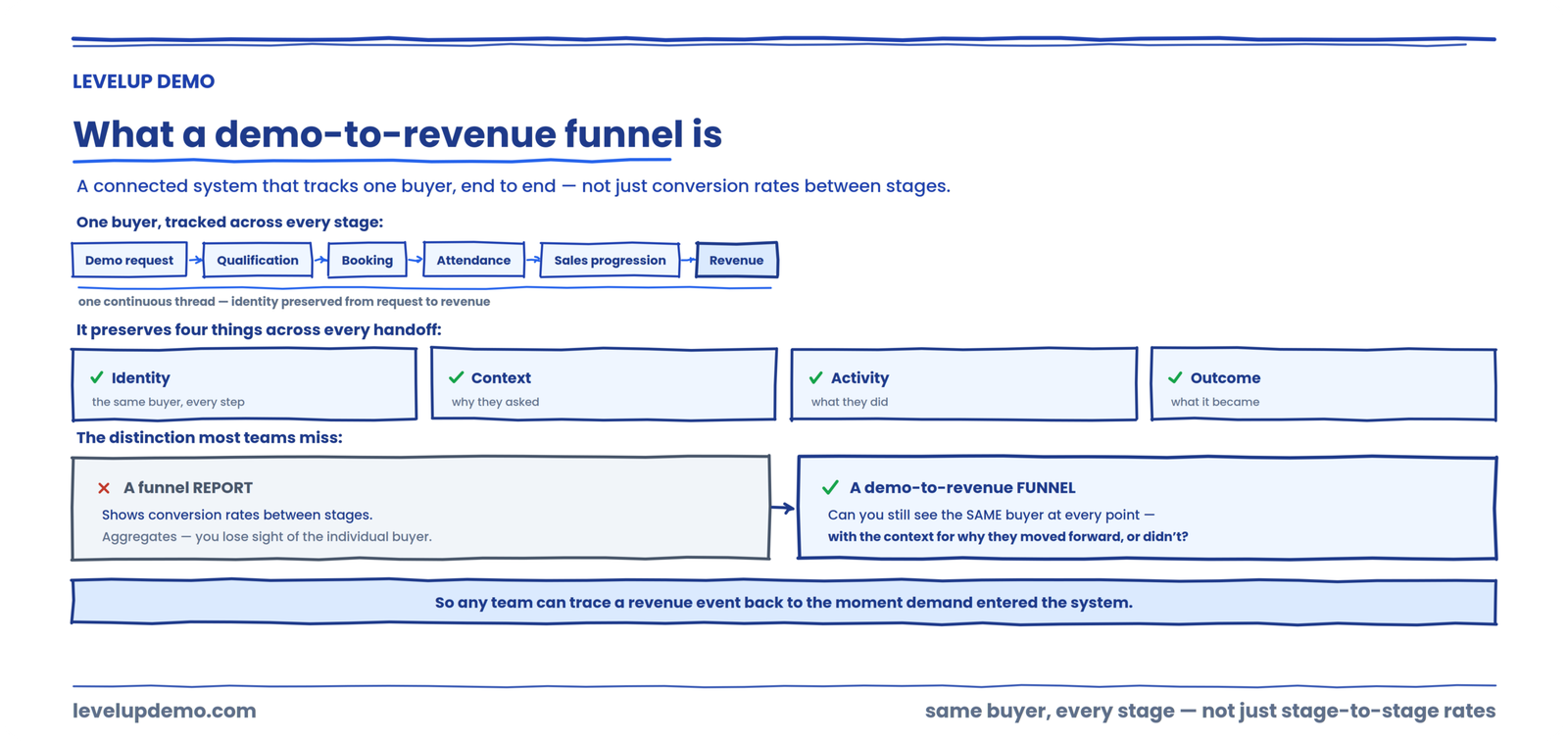
A demo-to-revenue funnel is the connected system that tracks how a prospect moves from requesting a demo through qualification, booking, attendance, sales progression, and closed revenue, with every stage linked to the same buyer journey. It preserves identity, context, activity, and outcome data across every handoff so that any team can trace a revenue event back to the moment demand entered the system.
That last part is the distinction most teams miss. A funnel report shows you conversion rates between stages. A demo-to-revenue funnel answers a harder question: can you still see the same buyer at every point in the journey, with the context that explains why they moved forward or didn’t?
Why stage-based funnel reporting isn’t enough
Traditional funnel metrics tell you what percentage of demo requests became booked meetings, what percentage showed up, what percentage converted to opportunities. Useful numbers. But they describe aggregates, not journeys.
Here’s what stage reporting can’t answer. Which acquisition sources produce demos that actually close? Does context from the original request survive into the sales conversation? Are successful journeys structurally different from failed ones, and if so, where do they diverge?
The difference is between stage visibility and journey visibility. One tells you that 35% of demos don’t convert to opportunities. The other tells you that demos sourced from paid search with a specific ICP match and a sub-15-minute lead response time convert at twice the rate of everything else. Same data, completely different insight. The second version requires connected stages.
Stage visibility
“35% of demos don’t convert to opportunities.” A conversion rate between stages.
Journey visibility
“Paid-search demos with an ICP match and sub-15-min response convert at 2× the rate.” Same data, connected.
The Connected Demo-to-Revenue Funnel™
At LevelUp Demo, we think about the demo-to-revenue journey as nine connected stages. Not because nine is a magic number, but because each represents a point where ownership, data, or context can break.
→
Demo request
→
Qualification
→
Booking
→
Attendance
→
Demo outcome
→
Opportunity
→
Pipeline progression
→
Revenue
Demand is where the prospect originates, the channel, campaign, or referral that brought them in. Demo request is the moment they raise their hand. Qualification determines whether the request fits. Booking converts that qualified request into a scheduled meeting. Attendance is whether the meeting actually happens (and common no-show rates fall in the 20% to 50% range, according to community-reported SaaS benchmarks). Demo outcome captures what happened during and immediately after the call. Opportunity is the formal pipeline entry. Pipeline progression tracks movement through sales stages. Revenue is the commercial result.
Each stage has dedicated coverage elsewhere in our content. The demo operations playbook covers workflow design. The attribution and revenue-per-demo articles handle measurement. This article is about the thing none of those pieces can solve alone: keeping the connections alive between stages so the full journey remains visible.
The real problem is broken connections between stages
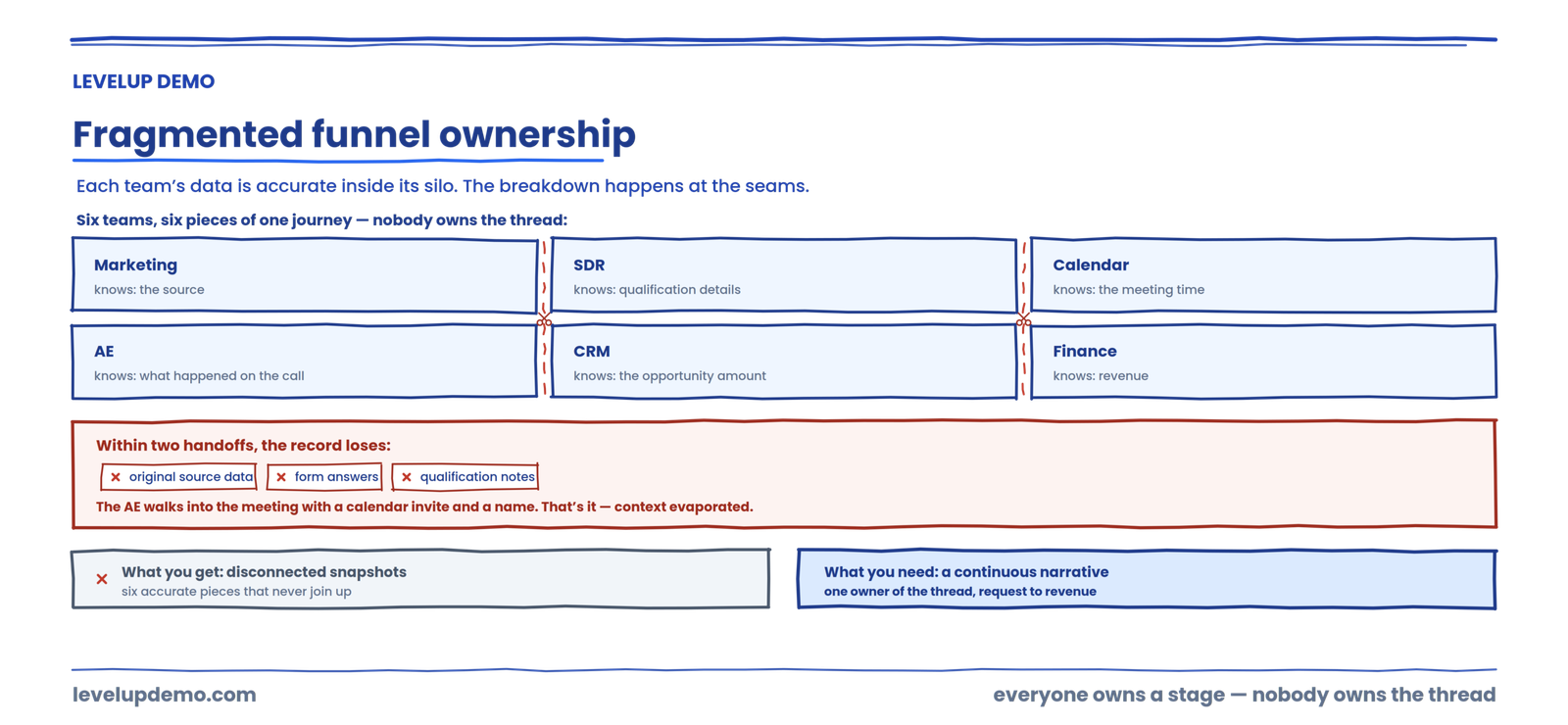
Marketing knows the source. The SDR knows qualification details. The calendar tool knows the meeting time. The AE knows what happened on the call. The CRM knows the opportunity amount. Finance knows revenue.
Each team’s data is often accurate within its own silo. The breakdown happens at the seams.
I’ve seen this pattern repeatedly when auditing demo workflows: a prospect requests a demo, and within two handoffs the original source data, form answers, and qualification notes have already disappeared from the record. The AE walks into the meeting with a calendar invite and a name. That’s it. Context evaporated. And when that deal closes (or doesn’t), nobody can reconstruct the full path.
This is what I call fragmented funnel ownership. Every team owns a stage. Nobody owns the thread that runs through all of them. The consequence is that demo reporting becomes a collection of disconnected snapshots rather than a continuous narrative.
The Demo-to-Revenue Connection Model™
Four types of connection need to survive the entire journey. When any of them breaks, the funnel becomes a set of isolated activities rather than a measurable revenue system.
Where the funnel usually breaks
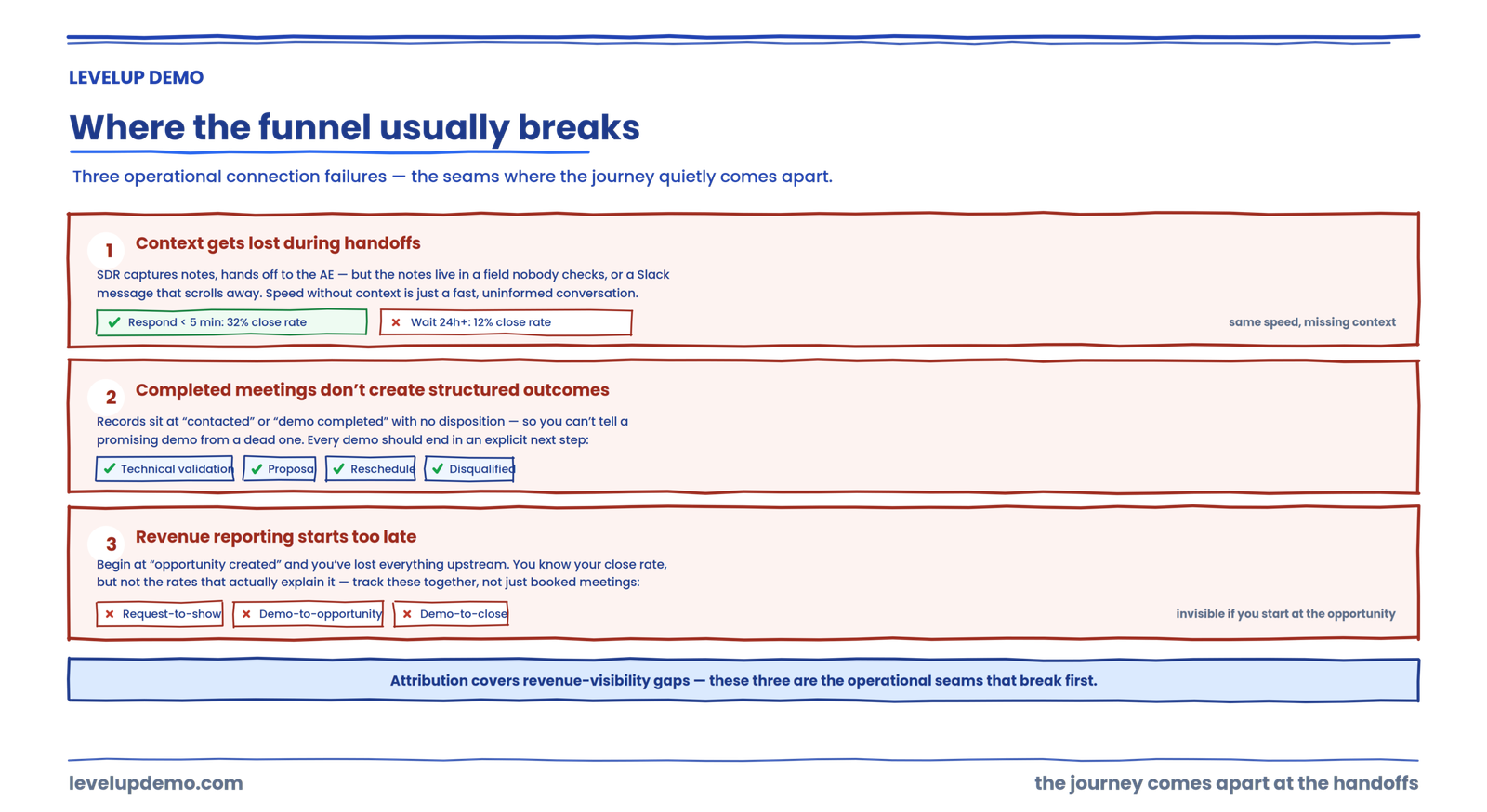
I want to focus on operational connection failures specifically, since the demo attribution content covers revenue visibility gaps in detail.
Context gets lost during handoffs. The SDR qualifies a request, captures notes, and passes ownership to an AE. But the notes live in a field nobody checks, or they’re in a Slack message that scrolls away. A follow-up playbook cited by sales communities found a 32% close rate for teams responding within five minutes versus 12% when waiting 24+ hours. Speed matters, but speed without context just means a fast, uninformed conversation.
Completed meetings don’t create structured outcomes. After a demo, the next step should be explicit: technical validation, proposal, reschedule, disqualified. Instead, many records sit at “contacted” or “demo completed” with no clear disposition. That makes pipeline reporting unreliable because you can’t distinguish a promising demo from a dead one.
Revenue reporting starts too late. If your revenue funnel begins at “opportunity created,” you’ve already lost visibility into everything that happened upstream. You know your close rate. You don’t know your demo-to-close rate, your request-to-show rate, or which sources produce demos that actually convert. Community guidance consistently emphasizes that request-to-show, demo-to-opportunity, and demo-to-close should all be tracked together, not just booked meetings.
The ghost errors nobody warns you about
| Problem | The weird fix | Where it surfaces |
|---|---|---|
| Leads vanish after form submit | Auto-create CRM records and preserve original source data; manual entry is the root cause | RevOps community threads on broken form-to-CRM sync |
| Report says demos are up but revenue is flat | Stop tracking booked demos as the headline metric; measure request-to-show and demo-to-close together | SaaS operator forums discussing misleading dashboards |
| Duplicate contacts receive duplicate outreach | Flag duplicates and check for existing opportunities before enrolling sequences | HubSpot and Salesforce community posts on routing hygiene |
| Replies feel generic and get ignored | Use role-specific or industry-specific proof points in follow-up instead of a one-size template | Community reports of a roughly 20% conversion lift after combining follow-up email with a customized feedback form |
| Reps say “I never got the lead” | Assign by segment and territory with a backup owner; no-owner leads rot silently | Operations teams documenting SLA enforcement gaps |
Where practitioners disagree
There’s an active debate about whether demo-to-revenue tracking should live inside the CRM as a single pipeline or be assembled across systems using a RevOps data layer. CRM-native teams argue that a single pipeline keeps reporting simple and adoption high. RevOps practitioners counter that forcing the full journey into one pipeline creates stage bloat and misrepresents how buying actually works. I lean toward the RevOps position for teams above ten reps, because the handoff between marketing-qualified and sales-qualified stages almost always involves different systems. But for small teams running lean, a single CRM pipeline with clear stage definitions works. This isn’t settled.
The metrics that matter across the entire journey
A connected funnel lets you measure at every stage instead of only at the top and the bottom. Rather than one giant KPI list, it helps to organize metrics by where they sit in the journey, each pointing to the deeper resource that defines it.
The point isn’t to track everything. It’s that a connected funnel is what lets each of these metrics reference the same underlying journey, so they tell one coherent story instead of five conflicting ones.
How to build a connected demo-to-revenue funnel
Connection is built at the transitions, not bolted on afterward. Seven steps, in order.
Keep the journey connected at every handoff
LevelUp Demo links lead capture, qualification, scheduling, outcome tracking, and follow-up in one system, so identity and context survive from request to revenue.
The Revenue Visibility Test™
A quick diagnostic we use at LevelUp Demo. Ask your team five questions about any recently closed customer:
If you can answer all five, your funnel has strong journey visibility. Three or four means important connections are missing but the structure exists. Two or fewer means you’re managing activities, not a connected revenue system. The funnel exists operationally, but not visibly.
How different teams use the same funnel
Marketing looks at this funnel and asks which sources produce demos that become revenue. Sales looks at it and asks where conversion drops after the meeting. RevOps looks at it and asks whether data continuity survives every handoff. Leadership looks at it and asks where revenue leakage is happening.
Same journey. Different questions. That’s the point. A connected demo-to-revenue funnel doesn’t require every team to care about every stage. It requires every stage to remain connected so each team can ask their own questions and get reliable answers. For a deeper comparison of how the demo journey relates to the broader sales process, the SaaS demo funnel vs sales funnel breakdown covers that distinction.
What a healthy demo-to-revenue funnel looks like
A healthy funnel isn’t defined by a benchmark number, it’s defined by characteristics. If most of these are true, your journey is connected:
Demo funnel vs demo attribution vs revenue per demo
These are related but distinct concepts. The SaaS demo funnel identifies where prospects drop off between stages. Demo attribution determines which demos influence pipeline and revenue. Revenue per demo calculates the economic value of each completed demo. The demo-to-revenue funnel is the connective layer: how the entire journey stays linked from request to revenue so that drop-off analysis, attribution, and revenue measurement all have reliable data to work with.
| Concept | The main question it answers |
|---|---|
| SaaS demo funnel | Where do prospects drop off? |
| Demo attribution | How do demos influence pipeline and revenue? |
| Revenue per demo | How much revenue does each demo generate? |
| Demo-to-revenue funnel | How does the entire journey stay connected from request to revenue? |
Your demo workflow has connection gaps. Most do.
LevelUp Demo connects lead capture, qualification, scheduling, outcome tracking, and follow-up in one system, so context doesn’t disappear between handoffs.
From funnel visibility to demo intelligence
Connected stages are the foundation, not the ceiling. The maturity path builds one layer at a time:
→
Measurement
→
Connected funnel
→
Attribution
→
Insight
→
Optimization
→
Demo intelligence
The maturity path moves from raw activity tracking to measurement, then to a connected funnel, then to attribution, then to the kind of pattern recognition that tells you which demo motions produce the most efficient revenue. That last layer is what we call demo intelligence, and it’s impossible to reach if the underlying journey data is fragmented.
Typical SaaS demo conversion rates are reported in the 20% to 40% range. But that number means very little if you can’t segment it by source, by rep, by ICP fit, by time-to-meeting. A connected funnel is what makes segmentation possible.
FAQ
What is a demo-to-revenue funnel?
A demo-to-revenue funnel is the connected system that tracks a prospect’s complete journey from requesting a demo through qualification, booking, attendance, opportunity creation, pipeline progression, and closed revenue, preserving identity and context at every stage so the full path remains visible.
How is a demo-to-revenue funnel different from demo attribution?
Demo attribution answers which demos influenced revenue. The demo-to-revenue funnel is the underlying connected journey that makes attribution possible. Without connected stages, attribution models are working with incomplete data.
What is the difference between a demo funnel and a sales funnel?
A sales funnel tracks the whole buying process from first touch to close across every channel. A demo funnel is the demo-specific slice of that journey: request, qualification, booking, attendance, and demo outcome, plus how those connect to pipeline and revenue. The demo funnel sits inside the sales funnel and focuses on the stages where a demo is the pivotal interaction.
Why do demo funnels lose visibility?
Because different teams own different stages and use different systems. Marketing captures the source, SDRs qualify, scheduling tools book, AEs run the demo, and the CRM tracks the opportunity. Each transition is a point where data, context, or ownership can break. The compounding effect of small losses at each handoff creates large gaps by the time you try to connect a closed deal to its origin.
Can a small team build a connected demo-to-revenue funnel?
Yes, and smaller teams often have an advantage because fewer handoffs mean fewer places for connections to break. The key requirements are consistent CRM hygiene, preserved source data, structured demo outcomes, and a shared view of the full demo workflow. You don’t need a complex tech stack. You need discipline at the transitions.
What’s the first thing to fix if demo volume is up but revenue isn’t?
Stop looking at booked demos as the headline metric. Start measuring request-to-show rate, demo-to-opportunity rate, and demo-to-close rate together. If those numbers tell different stories, the breakdown is between stages, not at the top of the funnel. Review your pricing and packaging alongside conversion data to rule out offer-level issues.
The next problem you’ll hit after building this connected view is deciding what to do with it: which segments to double down on, which handoffs to redesign, which stages need automation versus human judgment. That’s where the funnel stops being a report and starts being an operating system.