
The moment the real problem surfaces
You are staring at a Salesforce report on a Friday afternoon, and the numbers refuse to make sense. Forty-seven demos booked this week. Revenue influenced? Unknown. Average demo cycle time? Nobody tracks it. Which reps actually convert demos into pipeline? The spreadsheet just blinks back at you.
That frustration is where this comparison actually begins. Not with feature checklists. With a question most SaaS leaders eventually hit: Is my problem getting meetings booked, or is my problem everything that happens once a demo enters the pipeline?
The quick verdict
Chili Piper is the stronger choice for teams whose primary bottleneck is converting inbound demand into booked meetings through qualification, routing, and scheduling. LevelUp Demo is built for teams whose core challenge starts after the booking: managing, measuring, and improving the full demo operation. They solve different problems at different stages, and for some organizations, both may belong in the stack.
The short answer
Both tools improve the buyer journey, but they solve different problems at different stages. The useful question isn’t which is “better” overall, it’s where in your revenue and demo journey the problem actually lives.
Choose Chili Piper if your primary challenge is
▸ Converting inbound demand
▸ Qualifying leads
▸ Routing leads to the right rep
▸ Reducing scheduling friction
▸ Booking meetings faster
Consider LevelUp Demo if your primary challenge is
▸ Managing the broader demo operation
▸ Understanding demo workflows
▸ Improving demo performance
▸ Connecting demo activity to outcomes
▸ Seeing the full demo-to-revenue journey
How we evaluated this comparison
Every claim below maps to one of five criteria drawn from how RevOps and sales leaders actually evaluate tooling:
These criteria reflect distinct jobs-to-be-done. A marketing leader optimizing form conversion cares deeply about criterion one. A Head of Demo Operations losing sleep over inconsistent follow-up cares about criteria two through four. The comparison respects that difference throughout.
What is Chili Piper?
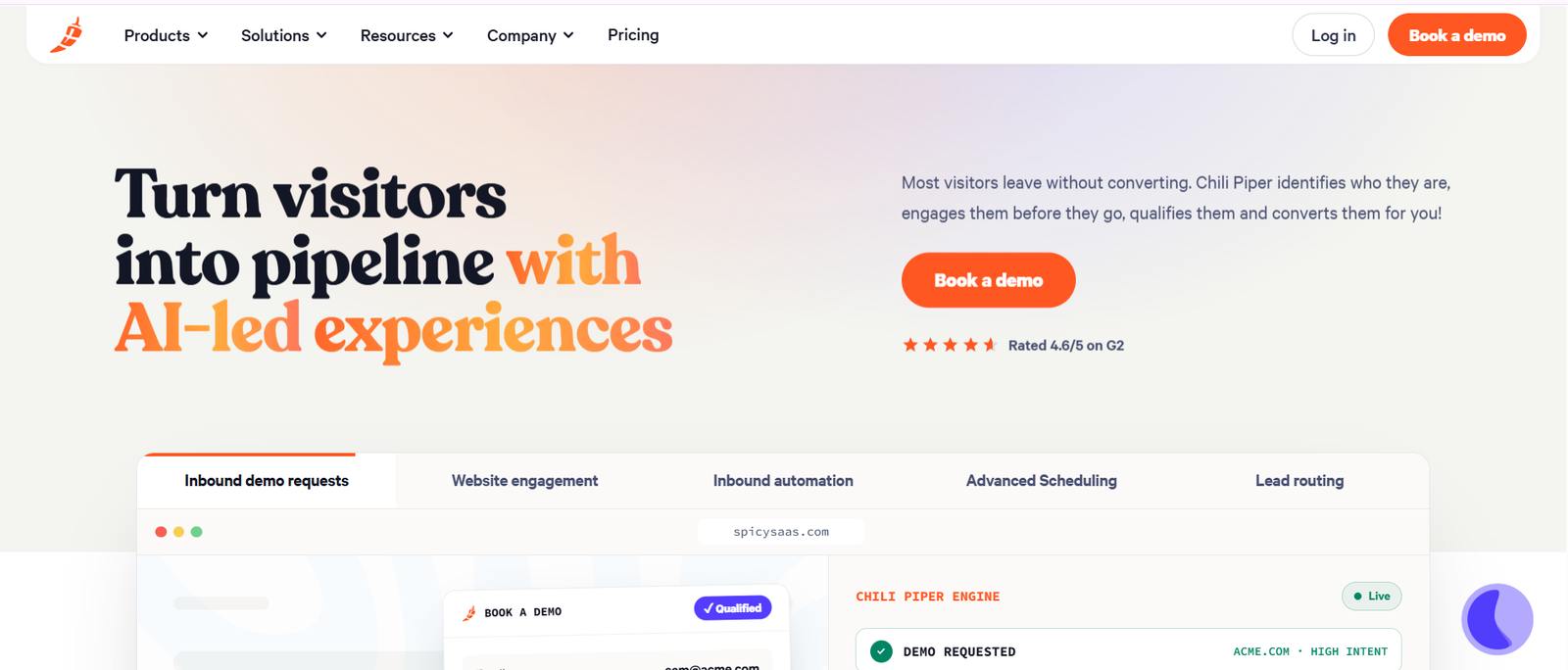
Based on Chili Piper’s current official product pages, the platform focuses on converting inbound demand into pipeline. Its product suite addresses form qualification (Concierge), lead routing and distribution (Distro), scheduling (Instant Booker), automated handoffs, website chat engagement, data enrichment, and CRM-connected automation. Chili Piper describes its mission around the idea that every qualified buyer should reach a sales rep instantly, without friction or delay.
The platform integrates with Salesforce, HubSpot, and other CRMs. Its routing logic supports round-robin, territory-based, and account-ownership rules. G2 reviewers frequently highlight the speed of implementation and the measurable lift in inbound conversion rates.
What is LevelUp Demo?
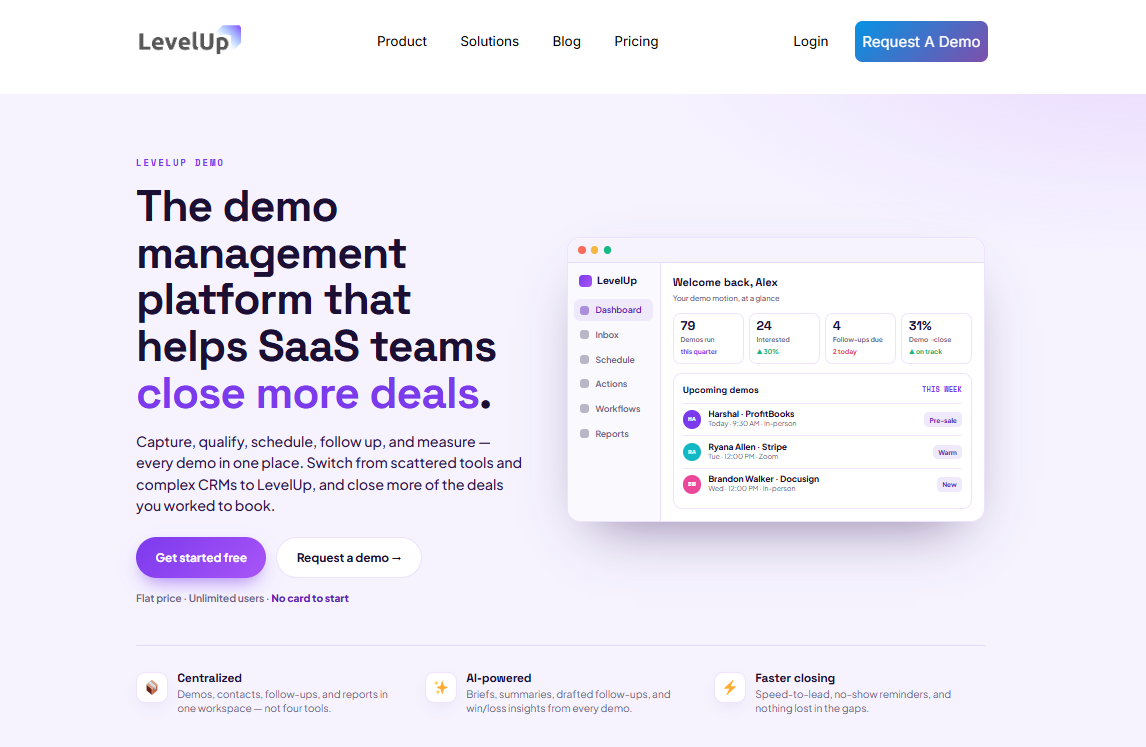
LevelUp Demo positions itself as a demo operations platform that runs the entire demo journey in one place, from capturing and qualifying inbound requests, through self-serve scheduling with no-show reminders, to demo preparation, delivery workflows, follow-up tracking, performance analytics, and demo-to-revenue measurement. Rather than stopping at the booking moment, its depth is concentrated on everything that turns a booked demo into a closed deal.
The platform is oriented toward RevOps leaders, sales managers, and demo teams who need to understand not just how many meetings were scheduled, but how those demos performed, where operational friction exists, and how demo activity connects to revenue outcomes.
The biggest difference: where each platform creates value
The Demo Operations Fit Map™ — think of the buyer journey as a sequence of operational stages:
→
Qualification
→
Routing
→
Scheduling
| booking |
Preparation
→
Demo delivery
→
Follow-up
→
Performance analysis
→
Revenue learning
Orange = where Chili Piper goes deepest (inbound conversion, stages 1–4) · Navy = where LevelUp Demo goes deepest (the demo operation, post-booking). LevelUp Demo also covers stages 1–4.
Chili Piper’s published capabilities concentrate on the first four stages. The platform is engineered to ensure that qualified prospects reach the right rep’s calendar as fast as possible. That is a specific, high-value problem, and Chili Piper solves it with purpose-built tooling.
LevelUp Demo spans the whole journey, but its depth is concentrated in the stages after the booking confirmation lands: preparation workflows, delivery management, follow-up orchestration, demo analytics, and connecting demo performance to pipeline and revenue data. It also captures, qualifies, and schedules on the front end, so the same system carries a lead from request all the way to revenue learning.
This is not a quality judgment. It is a scope distinction. A team drowning in unqualified form fills needs a different solution than a team struggling to understand why booked demos are not converting to opportunities.
Feature comparison at a glance
A capability-by-capability view. LevelUp Demo runs the full demo funnel (capture, qualify, schedule, run, follow up, measure), while Chili Piper goes deeper on enterprise inbound conversion. “✓” means the platform covers that job, “~” means it’s supported but lighter than the specialist, and “—” means it isn’t a focus by design, not that it’s deficient.
| Capability | LevelUp Demo | Chili Piper |
|---|---|---|
| Lead qualification | ✓ | ✓ |
| Lead routing | ~ basic | ✓ advanced |
| Meeting scheduling & no-show reminders | ✓ | ✓ |
| Instant form-to-calendar handoff | ~ partial | ✓ advanced |
| Demo workflow visibility | ✓ | — |
| Demo performance analysis | ✓ | — |
| Demo-to-revenue measurement | ✓ | — |
| Demo operations optimization | ✓ | — |
✓ covered · ~ supported but lighter than the specialist · — not a focus by design
The pattern is the point: LevelUp Demo covers the whole demo funnel and goes deepest on the post-booking demo operation, while Chili Piper goes deepest on high-volume, enterprise-grade inbound conversion and routing. Where they overlap, on qualification and scheduling, the difference is depth and focus. That’s why “which is better” is the wrong question, and “which stage is costing you more” is the right one.
Feature-by-feature showdown
Demand-to-meeting conversion
The task: A prospect fills out a demo request form on your website. How quickly does each platform get that person to a qualified rep’s calendar?
Chili Piper’s Concierge product handles this in real time. The form submission triggers instant qualification based on enrichment data and custom rules. Qualified prospects see available time slots immediately, often booking within seconds of submitting the form. The progress indicator updates live as the system matches the prospect to a rep. Chili Piper wins this task cleanly.
Chili Piper friction point: Configuring complex routing rules across multiple territories and ownership hierarchies requires careful CRM hygiene. If your Salesforce data has inconsistent account ownership, the routing logic can misfire, sending leads to the wrong rep. That debugging process is not always intuitive inside the Chili Piper admin panel.
LevelUp Demo friction point: LevelUp Demo is not primarily designed as an inbound conversion tool. Teams looking for instant form-to-calendar booking will find that this is not LevelUp Demo’s core workflow. Trying to force LevelUp Demo into this role would be a misapplication of the platform.
Winner for this category: Chili Piper.
Demo workflow management
The task: A demo is booked for Thursday. How does each platform help the team prepare, deliver, and follow up?
This is where the operational gap becomes visible. After researching both platforms’ published documentation, Chili Piper’s workflow ends, by design, once the meeting is booked and the calendar invite is sent. What happens between booking and demo delivery is largely managed outside Chili Piper, typically in your CRM, Slack threads, or spreadsheets.
LevelUp Demo addresses this stage directly. The platform provides structured demo preparation workflows, delivery tracking, and follow-up management. When a rep opens their LevelUp Demo dashboard before a Thursday demo, they see preparation checklists, relevant context, and workflow status rather than hunting through CRM activity logs.
LevelUp Demo friction point: Teams accustomed to lightweight scheduling tools may find that LevelUp Demo’s workflow structure requires more upfront configuration to match their specific demo process. The operational depth is valuable but not instant.
Chili Piper friction point: There is no real friction here because Chili Piper does not attempt to manage this stage. That is not a flaw; it is a scope boundary.
Winner for this category: LevelUp Demo.
Analytics and performance visibility
The task: Your VP of Sales asks, “Which demo formats are converting best this quarter, and where are prospects dropping off?”
Chili Piper provides meeting-level analytics: conversion rates from form fill to booking, routing speed, rep availability metrics. These are valuable for understanding inbound efficiency. But the analytics are oriented around the scheduling moment, not the demo outcome.
LevelUp Demo’s analytics layer is designed to answer the post-booking question. Demo performance metrics, conversion rates from demo to opportunity, cycle time analysis, and identification of operational bottlenecks across the demo journey are part of the platform’s core reporting. When you pull up the analytics view, the data is organized around demo outcomes, not just booking volume.
Chili Piper friction point: Extracting demo-to-revenue attribution from Chili Piper requires building custom Salesforce reports or using a separate BI layer. The platform does not natively connect the booking event to downstream revenue in a demo-specific way.
LevelUp Demo friction point: LevelUp Demo’s analytics value depends on consistent data input from the demo team. If reps skip workflow steps or fail to log demo outcomes, the reporting becomes incomplete. The system reflects what you put into it.
Winner for this category: LevelUp Demo.
Financial deep dive: the true cost
Based on Chili Piper’s published pricing page (as of 2025-07-12), plans start at $150 per user per month for Instant Booker, with Concierge and Distro priced at higher tiers. A platform fee applies to certain products. Enterprise pricing requires a custom quote.
LevelUp Demo publishes simple, volume-based pricing with unlimited users on every tier: a Free plan at $0/month (5 demos), Starter at $25/month (10 demos/month), Growth at $49/month (25 demos/month, the most popular tier), and a custom-quoted Enterprise plan for large organizations. Every paid tier includes custom templates, advanced AI analytics, the Demo Coach, and all integrations, and pricing scales with demo volume rather than per user.
| Scenario | Chili Piper | LevelUp Demo |
|---|---|---|
| Entry pricing | From $150/user/month (Instant Booker) | Free $0/mo; paid from $25/mo (Starter) |
| Pricing model | Per user, per month; platform fee on some tiers | Flat monthly by demo volume; unlimited users |
| Paid tiers | Instant Booker, Concierge, Distro (higher tiers) | Starter $25 (10 demos), Growth $49 (25 demos) |
| How cost scales | Grows with team size (per-seat) and product tiers | Grows with demo volume, not headcount |
| Enterprise | Custom quote | Custom quote |
Scaling consideration: The two platforms price on different axes. Chili Piper’s per-user model means cost grows with team size, and features like advanced routing and Concierge sit on higher-tier plans, creating a step function as needs expand. LevelUp Demo prices by demo volume with unlimited users, so cost tracks how many demos you run rather than how many people touch the tool.
For a small demo team that runs a moderate volume of demos but wants everyone to have access, LevelUp Demo’s volume-based, unlimited-user model can be markedly more predictable. For a large inbound operation optimizing form-to-calendar speed across many reps, Chili Piper’s per-seat model buys depth on the conversion stage. Map each model against your own user count and monthly demo volume before deciding.
If the gap is “meeting booked” vs “revenue understood”
That’s the demo-operations problem LevelUp Demo is built for: managing, measuring, and improving the full demo lifecycle after the booking.
Quick picks: which tool fits your team?
| Team Profile | Recommended Platform |
|---|---|
| Marketing teams focused on inbound conversion | Chili Piper |
| RevOps teams building routing and scheduling automation | Chili Piper |
| Demo teams needing workflow and delivery management | LevelUp Demo |
| Sales leaders tracking demo-to-revenue performance | LevelUp Demo |
| Organizations wanting both inbound speed and demo operations | Consider both |
When neither is the right answer: If your team runs fewer than ten demos per month and your primary need is a simple calendar link, a general-purpose scheduling tool like Calendly or HubSpot’s native meeting scheduler may be more cost-appropriate than either platform.
The brand bridge
For teams that recognized themselves in the demo workflow and analytics sections above, where the gap between “meeting booked” and “revenue understood” is the actual pain point, exploring how LevelUp Demo approaches full-lifecycle demo operations connects directly to closing that visibility gap.
The Demo Operations Fit Test™
Answer honestly:
“My biggest problem is that qualified prospects are not getting to reps fast enough.” → Chili Piper is built precisely for this.
“My biggest problem is that I cannot see what happens between the booking and the closed deal.” → LevelUp Demo addresses this operational blind spot.
“My biggest problem is that demo performance varies wildly across reps and I have no data to coach with.” → LevelUp Demo’s analytics orientation fits here.
“My biggest problem is that leads are routed to the wrong reps.” → Chili Piper’s routing engine handles complex distribution logic.
“I need to improve both the front end and the back end of the demo journey.” → Evaluate whether the two platforms can coexist in your stack.
Can LevelUp Demo and Chili Piper work together?
Yes, conceptually. Chili Piper handles the demand-to-booking stage. LevelUp Demo manages the booking-to-outcome stage. If both platforms integrate with your CRM, a team could use Chili Piper for qualification and routing while using LevelUp Demo for demo workflow management and performance analytics.
Before assuming complementary use, verify specific integration capabilities with both vendors. The technical feasibility depends on CRM compatibility and data flow between systems.
Pros and cons
Chili Piper — strengths
✓ Instant form-to-calendar booking
✓ Real-time qualification and enrichment
✓ Complex routing (round-robin, territory, ownership)
✓ Fast implementation; measurable inbound lift
Fit considerations
· Workflow ends at the booking by design
· Demo-to-revenue attribution needs custom reports or BI
· Routing depends on clean CRM ownership data
LevelUp Demo — strengths
✓ Structured demo preparation and delivery workflows
✓ Follow-up orchestration and handoff tracking
✓ Demo-outcome analytics and cycle-time analysis
✓ Connects demo activity to pipeline and revenue
Fit considerations
· Not an inbound form-to-calendar booking tool
· Requires upfront configuration to match your process
· Analytics reflect the data the team logs
Every product has trade-offs. The list above frames them as fit boundaries, not flaws, because each platform is doing exactly the job it was built for.
Which should you choose?
Choose Chili Piper when
Your immediate problem is demand conversion, qualification, routing, or scheduling.
Choose LevelUp Demo when
Your core challenge is demo operations, demo performance, workflow visibility, or improving the demo journey.
Consider both when
You need strong inbound conversion and strong demo operations, and both integrate with your CRM.
Frequently asked questions
Is LevelUp Demo a direct Chili Piper alternative?
Not exactly. They address different stages of the revenue journey. Chili Piper focuses on converting inbound demand into booked meetings through qualification, routing, and scheduling. LevelUp Demo focuses on managing and optimizing the demo operation that follows the booking. A team replacing Chili Piper with LevelUp Demo would lose inbound conversion tooling; a team replacing LevelUp Demo with Chili Piper would lose demo operations visibility.
Which platform is better for demo analytics?
LevelUp Demo, based on published product positioning. Its analytics are built around demo performance and outcomes. Chili Piper’s analytics focus on meeting conversion and scheduling efficiency.
Is Chili Piper only a scheduling tool?
No. Chili Piper’s product suite includes qualification (Concierge), routing (Distro), scheduling, chat engagement, enrichment, and automated handoffs. Calling it “just scheduling” significantly understates its scope.
Can Chili Piper and LevelUp Demo be used together?
Conceptually, yes. Chili Piper can handle the demand-to-booking stage while LevelUp Demo manages the booking-to-outcome stage, provided both integrate with your CRM and data flows cleanly between them. It’s not automatically an either/or decision, sometimes the best answer is using each tool for the stage it’s built for. Verify the specific integration capabilities with both vendors before assuming complementary use.
What should a SaaS team evaluate first when choosing between these platforms?
Start with the problem. Map where your biggest operational friction lives on the demo operations journey. If it is upstream (getting meetings booked), evaluate Chili Piper first. If it is downstream (understanding and improving demo performance), evaluate LevelUp Demo first. Consider reviewing a SaaS demo funnel framework to identify exactly where conversion breaks down. Teams building a demo-to-revenue measurement practice will find the downstream tooling distinction especially relevant, while those focused on improving demo attribution should assess which platform connects to their CRM reporting layer.
What should teams consider before choosing a demo operations platform?
Decide which stage is costing you more revenue right now, confirm the tool actually covers that stage (booking versus post-booking operations), check CRM and data-flow compatibility, and weigh total cost of ownership. Note the two price on different axes: Chili Piper is per user with platform fees on some tiers, while LevelUp Demo is flat monthly by demo volume with unlimited users (Free, $25 Starter, $49 Growth, or custom Enterprise). Be honest about whether one platform, or a combination, best matches where your friction actually lives.
The bottom line
Chili Piper wins the demand-to-meeting race. It is purpose-built for speed, qualification accuracy, and routing precision. If your revenue team’s primary constraint is getting qualified buyers onto rep calendars faster, Chili Piper deserves serious evaluation.
LevelUp Demo wins the demo operations race. It is designed for teams that have moved past the booking problem and now need to understand, manage, and improve what happens across the full demo lifecycle.
The smartest question is not which platform is better. It is which problem is costing you more revenue right now.
Past the booking problem? That’s where LevelUp Demo starts.
See how LevelUp Demo manages, measures, and improves the full demo operation, from preparation through demo-to-revenue learning.