Last reviewed: 4 November 2026. This article is general sales-enablement guidance. Evaluation practices vary by product, buyer, and industry, so treat the examples as illustrations rather than rules.
A demo goes well. The sales team walks the buying committee through the platform, shows the features that map to what the buyer described, and answers questions. The prospect is interested. Then their technical team surfaces a different set of questions: will it integrate with our existing systems, can it handle our data, will it support our internal workflow, and does it meet our technical and operational requirements?
That is the gap between understanding what a product does and validating whether it will work in a specific business environment. A SaaS demo demonstrates the product’s capabilities, workflows, and potential value. A proof of concept, or POC, tests whether a proposed solution can meet specific, agreed requirements. A demo can establish initial fit; a POC provides additional evidence when important questions remain.
A demo answers “could this product address our problem?” A POC answers “will it work in our environment and meet our requirements?” This guide covers their differences, how they compare with pilots and free trials, when to use each, how to structure a POC, and how to manage the move between evaluation stages. Not every purchase needs a POC, and a demo is more than a sales presentation.
On this page
What Is a SaaS Product Demo?
A SaaS product demo is a guided demonstration of a software product that helps potential customers understand its functionality, workflows, and relevance to their business needs. A useful demo is not a tour of every feature; it connects specific product capabilities to the prospect’s stated requirements.
What is the main objective of a SaaS demo?
For the buyer, a demo is a way to understand how the product works, see relevant features in action, explore workflows tied to their problems, evaluate usability, ask questions, and decide whether the solution deserves further consideration. For the sales team, it is also a chance to understand the prospect’s requirements, surface objections, and establish appropriate next steps.
What happens during a typical SaaS demo?
Formats vary by product complexity, audience, and sales process, but most demos move through a recognizable sequence:
1
2
3
4
5
What can a SaaS demo help validate?
When the relevant capabilities are actually shown, a demonstration can establish whether the product has a particular feature, whether a workflow appears suitable, whether the interface and experience are appropriate, whether the product supports a stated use case, and whether the buyer understands how it might fit their operations.
What cannot always be established through a demo?
A standard demonstration may not establish whether a complex integration works in the prospect’s environment, whether their actual data can be migrated, whether performance meets a specific workload, whether a complex workflow holds up under real conditions, or whether every technical and security requirement is satisfied. Some of these can be answered through documentation, technical discussions, architecture reviews, or other evidence, so not every unanswered question requires a POC. A buyer asking whether a specific capability exists, for example, is often closer to an unverified feature question than to a validation that needs a formal test.
A demo helps buyers understand the product and assess potential fit. It does not automatically validate every technical or operational requirement.
What Is a Proof of Concept (POC) in SaaS?
A proof of concept is a limited, structured evaluation designed to establish whether a proposed solution can satisfy a particular technical or business requirement. A POC begins with a question or assumption that needs to be tested. As an illustration only: a company considering an accounting platform might want to confirm that a required data-import workflow can process its existing transaction format correctly. A demo might show the import feature; a POC could test that agreed workflow against a representative sample dataset.
What is the main objective of a SaaS POC?
A POC aims to reduce uncertainty before a larger commitment. It helps the buyer and vendor establish whether a specific requirement can be met, whether an important technical assumption is valid, whether a proposed workflow functions as expected, and whether the solution is worth progressing to the next evaluation or implementation stage.
What does a SaaS POC typically include?
Most structured POCs share the same components:
- Defined problem: the specific issue or requirement being evaluated.
- Scope: what will and will not be tested.
- Test setup: the agreed environment, configuration, sample data, or technical access needed.
- Participants: who executes, reviews, and approves the evaluation.
- Success criteria: the conditions that determine whether the POC met its objective.
- Timeline: the agreed evaluation period and milestones.
- Results: observations, outcomes, limitations, and unresolved issues.
What can a POC test?
Scope is tailored to the product and the buyer’s requirements, but common examples include whether a required integration exchanges data correctly, whether a particular data format can be imported, whether a critical business workflow can be completed, whether a system supports a specified technical requirement, and whether the solution performs against an agreed workload or test condition. These are possible examples, not mandatory components of every POC.
What is the expected outcome of a POC?
A POC should produce evidence that supports a decision. The result might be that the requirement was demonstrated successfully, that it was partially met with limitations identified, that it cannot currently be met, that more testing or clarification is needed, or that the evaluation should not proceed.
A POC is not simply a longer demo. It is a focused evaluation with defined questions and agreed success criteria.
SaaS Demo vs POC: Key Differences Explained
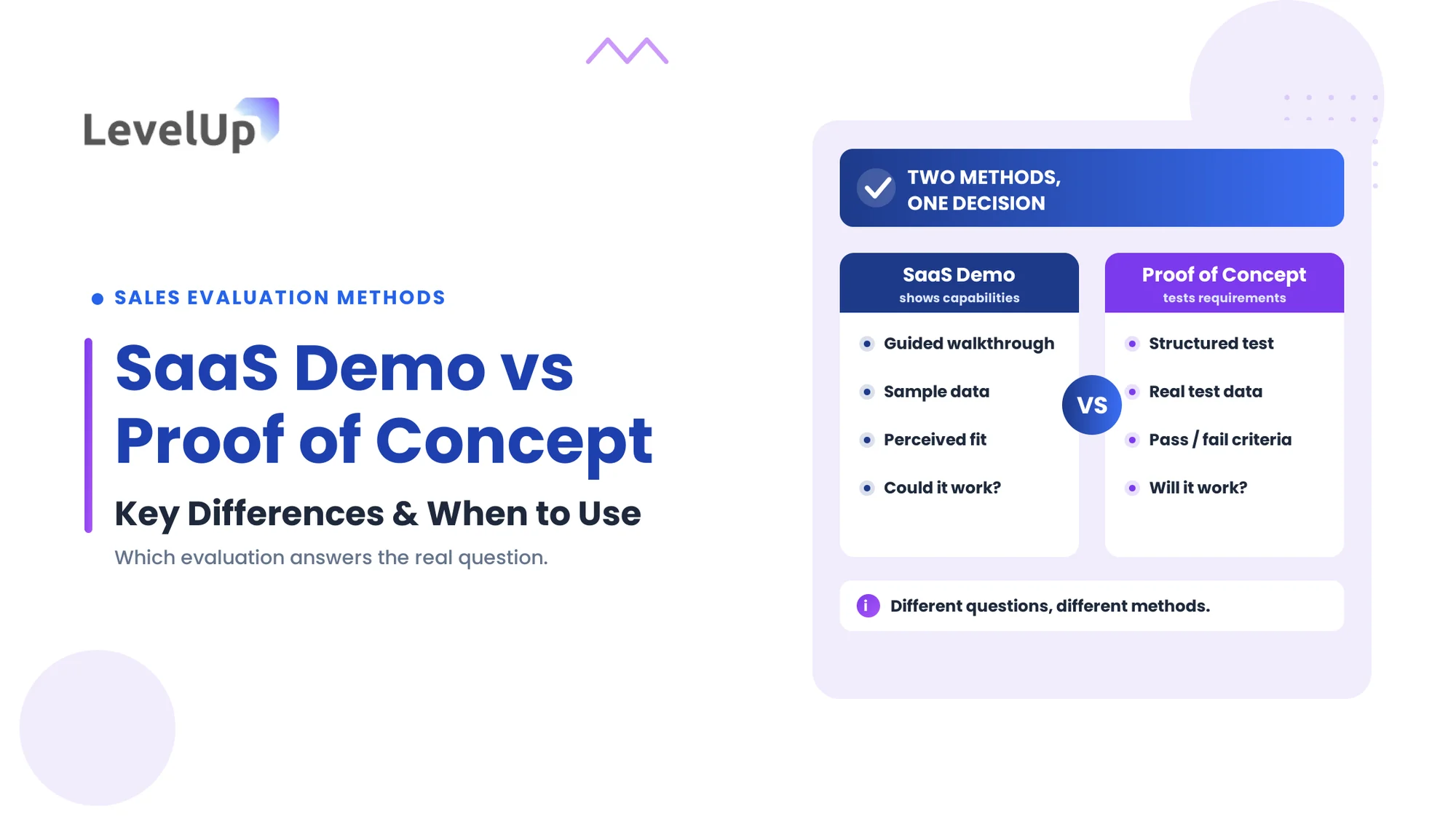
Both demos and POCs help buyers evaluate software, but they serve different purposes. A demo focuses on demonstrating capabilities; a POC focuses on testing specific requirements.
| Comparison factor | SaaS Demo | Proof of Concept |
|---|---|---|
| Primary purpose | Demonstrate product capabilities | Validate specific requirements |
| Main question | What can the product do? | Can it meet this particular requirement? |
| Focus | Features, workflows, and use cases | Defined technical or business assumptions |
| Approach | Guided product walkthrough | Structured evaluation or test |
| Environment | Usually a demonstration environment | Agreed test environment or setup |
| Data | Often sample or demonstration data | Data appropriate to the agreed test |
| Participants | Sales team, prospect, stakeholders | Technical teams, business owners, relevant stakeholders |
| Preparation | Research, qualification, and demo planning | Scope definition, technical preparation, and test planning |
| Success measurement | Buyer understanding, interest, and product fit | Results against predefined success criteria |
| Duration | Often one or more meetings | Depends on scope and complexity |
| Deliverable | Demonstration outcomes and next steps | Documented evaluation results |
| Typical next step | Further discussion, trial, POC, or purchase evaluation | Proceed, resolve gaps, test further, or stop |
Difference in purpose
Showing a capability is not the same as validating it against a specific requirement. A demo can show that an approval workflow exists; a POC confirms whether that workflow can be configured to match a buyer’s particular approval rules with their data and users.
Difference in process
A demo is generally led by the person presenting the product. A POC requires agreed responsibilities for setup, execution, evaluation, and results, with both sides contributing.
Difference in success criteria
A demo is usually assessed by whether the prospect understands the product and sees potential relevance. A POC requires predefined conditions against which the test results can be judged.
Difference in outcomes
A demo may lead to another meeting, a technical discussion, a trial, a POC, or a purchase evaluation. A POC may provide evidence to proceed, identify gaps, require further testing, or end the evaluation. No single sequence is mandatory for every company.
SaaS Demo vs POC vs Pilot vs Free Trial
Vendors and buyers often use these terms interchangeably, even though they describe different evaluation approaches. Keeping them distinct avoids scoping the wrong exercise.
- Product demo: a vendor-led or representative-led guided walkthrough focused on capabilities and relevance, to help buyers understand the product.
- Proof of concept: a limited, requirement-focused evaluation that tests a specific assumption against agreed success criteria and produces evidence for a decision.
- Pilot: a limited deployment in a more realistic operating context, often with actual users and workflows, to evaluate operational suitability and adoption. A pilot may follow a successful POC, but the two are not the same.
- Free trial: time-limited access to explore the product directly, which may be self-service or vendor-supported, with features, usage limits, and support set by the vendor’s trial terms.
| Evaluation method | Primary purpose | Typical approach | Main question |
|---|---|---|---|
| Demo | Understand the product | Guided walkthrough | Does this solution appear relevant? |
| POC | Validate a requirement | Structured test | Can it meet this specific requirement? |
| Pilot | Evaluate operational use | Limited real-world deployment | Does it work in our operating context? |
| Free trial | Explore the product | Temporary product access | Can we use and evaluate it ourselves? |
Are these stages always followed in order?
No. There is no universal sequence. A buyer may start with a demo, use a free trial, request a POC, or run a pilot depending on product complexity and evaluation needs. Some organizations also use the term proof of value, or POV, for an outcome-focused evaluation with agreed business metrics. Treat these as options to match to the buyer’s questions, not as a fixed funnel.
When Should a SaaS Team Use a Product Demo?
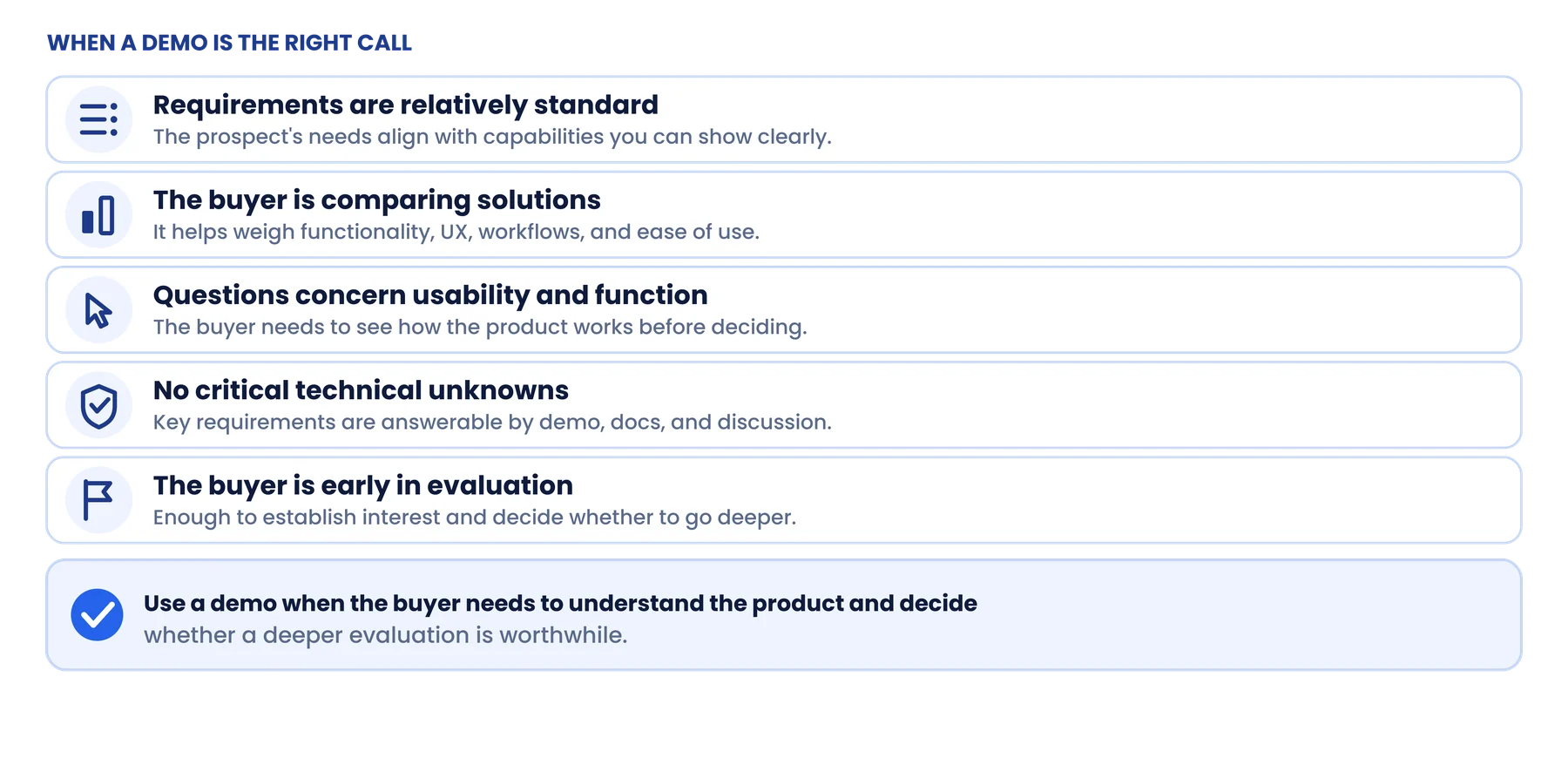
A demo is usually the right starting point when the buyer needs to understand capabilities before committing time and resources to deeper evaluation. It fits well in several situations:
- Requirements are relatively standard, so the prospect’s needs align with capabilities that can be shown clearly.
- The buyer is comparing solutions, and a demonstration helps them weigh functionality, user experience, relevant workflows, and ease of use (though a demo alone does not establish complete technical suitability).
- The main questions concern usability and functionality, and the buyer needs to see how the product works before deciding whether to evaluate further.
- There are no critical unresolved technical questions, because the important requirements can be answered through demonstrations, documentation, and technical discussion.
- The buyer is early in evaluation, and a demo is enough to establish interest and decide whether a more detailed evaluation is justified.
A demo is usually the right next step when the buyer needs to understand the product, see relevant capabilities, and decide whether further evaluation is worthwhile.
When Should a SaaS Team Move from a Demo to a POC?
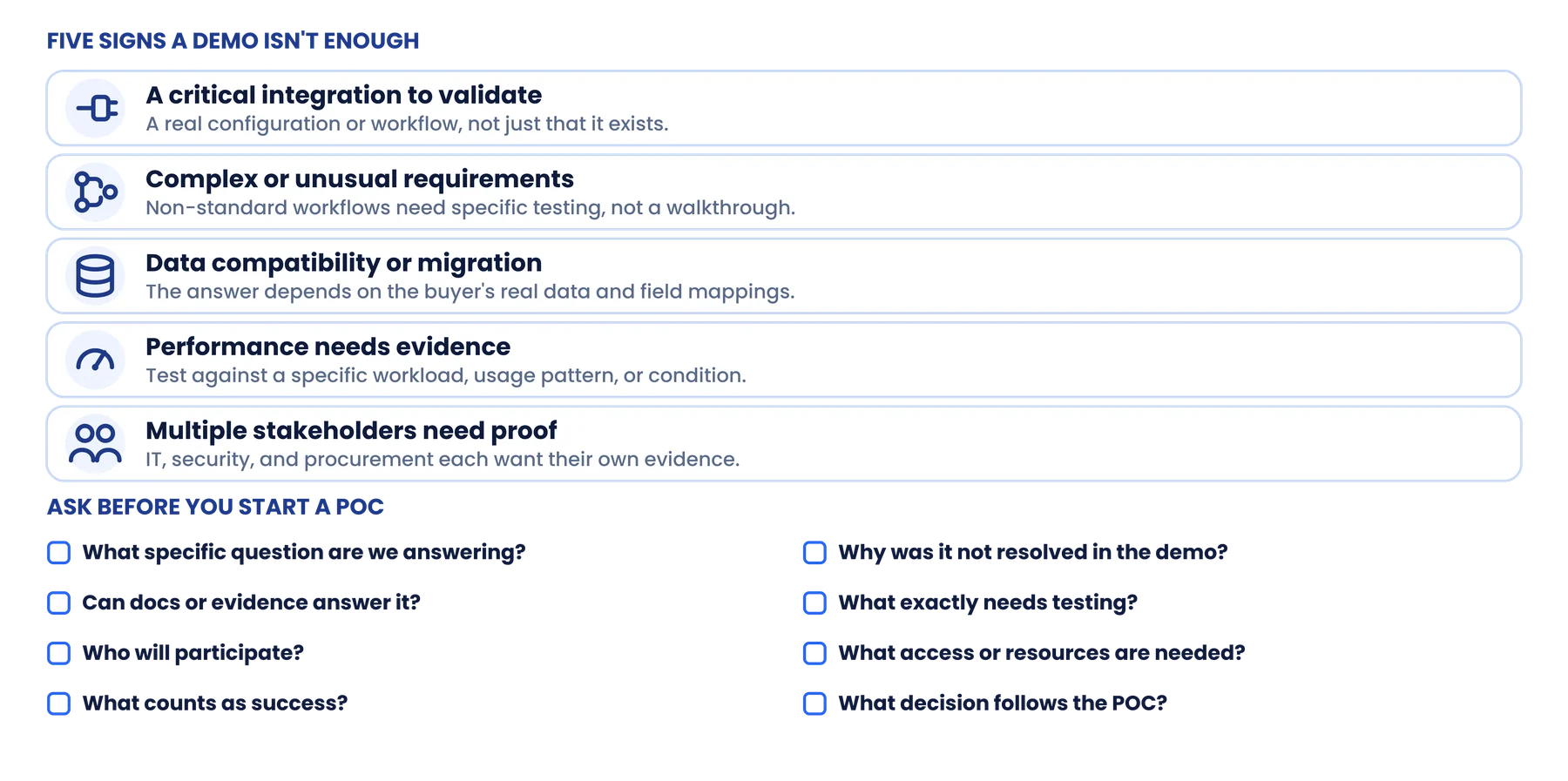
A POC becomes useful when an important requirement remains uncertain after the demo and cannot be adequately established through a conversation, documentation, or existing technical evidence.
When a critical integration needs validation
A prospect may need to test whether the product can exchange data or communicate correctly with a specific external system. Showing that an integration exists is different from validating a particular configuration or workflow, especially with identity providers and systems of record, where permissions, data models, and exception paths matter.
When the buyer has complex or unusual requirements
Requirements that go beyond standard product workflows, such as an unusual approval hierarchy or a non-standard process, often need specific testing rather than a general walkthrough.
When data compatibility or migration needs testing
Data formats, field mappings, transformation requirements, and data quality can introduce uncertainty that a slide cannot resolve. The same reasoning applies to data migration questions raised during a demo: if the answer depends on the buyer’s real data, a structured test is more reliable than an assurance.
When technical performance needs evidence
Some buyers need to evaluate performance against a specific workload, usage pattern, or technical condition. A POC can provide that evidence, without implying any guarantee about what a vendor can promise.
When multiple stakeholders need evidence before approval
Technical teams, business owners, IT, security, and procurement may each have different questions, including security and compliance questions that need their own evidence. A POC can resolve a specific set of uncertainties, provided those requirements are included in its scope.
Questions to ask before starting a POC
Before agreeing to a POC, confirm that it has a defined purpose rather than becoming an open-ended technical exercise:
- What specific question are we trying to answer?
- Why was the question not resolved during the demo?
- Can existing documentation or technical evidence answer it?
- What exactly needs to be tested?
- Who will participate in the evaluation?
- What resources or access are required?
- What will count as success?
- What decision will follow the POC?
How to Plan and Execute a SaaS Proof of Concept: A Six-Step Framework
An effective POC needs more than access to software. It needs clear objectives, boundaries, responsibilities, and evaluation criteria agreed before testing begins.
Step 1: Define the business problem and POC objective
Start by identifying the uncertainty the POC is meant to resolve: the business problem, the technical or operational requirement, why it matters to the buyer, and what decision depends on the result. For example, a prospect might need to confirm whether a platform can process a particular transaction file format. The objective is to test that specific process, not to evaluate every feature.
Step 2: Identify the requirements and define the scope
Translate the objective into specific test requirements: the requirements to be tested, the features or workflows included, technical dependencies, data requirements, exclusions, and any assumptions and constraints. Limit the scope deliberately, because adding unrelated requirements makes a POC unnecessarily complicated.
Step 3: Establish measurable success criteria
Agree the success criteria before testing: the expected result, how it will be observed, what evidence will be collected, what counts as a pass, partial pass, or failure, and who approves the result. The examples below are illustrative, and actual criteria must be agreed by the buyer and vendor:
| POC objective | Example success criterion |
|---|---|
| Validate data import | The agreed sample file is imported with the required fields mapped correctly |
| Test an integration | The agreed data exchange works under the defined test conditions |
| Validate a workflow | The specified workflow completes without a critical failure |
| Evaluate performance | The system meets the agreed threshold under the test workload |
Step 4: Assign responsibilities and prepare the test environment
Both sides need clarity on ownership. Depending on the POC, roles may include the vendor’s sales or account team coordinating the evaluation, a sales or solutions engineer supporting test planning, a product or engineering team assisting with specialist input, the customer’s technical team providing access and integration support, and the customer’s business owner confirming the requirements and evaluating outcomes. Not every POC needs all of these. Settle access and permissions, test-data preparation, environment configuration, dependencies, and security and data-handling considerations up front.
Step 5: Execute the POC and record results
Run the agreed tests against the documented scope: record the test conditions, capture expected and actual results, document errors and limitations, and track unresolved questions. Do not change the success criteria midway without agreement, and base results on observed evidence rather than subjective impressions.
Step 6: Evaluate results and agree on the next step
Compare results against the original success criteria, identify what was met, document what was partially met or unmet, review limitations and dependencies, and decide whether further testing is needed. Then agree whether to proceed, resolve gaps, or stop. A POC is useful only when its results lead to a clear decision:
| POC result | Possible next step |
|---|---|
| All critical criteria met | Proceed to the next buying or implementation stage |
| Some criteria met, others unresolved | Agree specific follow-up actions or additional tests |
| Critical criteria not met | Review alternatives or discontinue the evaluation |
| Results inconclusive | Identify missing evidence and decide whether another test is justified |
Common Mistakes SaaS Teams Make During Demo and POC Evaluations
Most of the time lost in evaluations comes from a handful of avoidable mistakes.
- Starting a POC without a clear objective. Vague goals produce unclear outcomes and wasted effort; define the question first.
- Using a POC to answer questions a demo could have resolved. Technical testing should not replace a basic walkthrough or a straightforward clarification.
- Defining success criteria after testing begins. Criteria set after results come in lead to subjective evaluations and disagreement.
- Letting the POC scope expand continuously. Scope creep brings new requests, delays, and resource pressure; keep a “not tested” list.
- Involving the wrong stakeholders. Technical validation and business approval may need different participants, including the person who owns the budget decision.
- Failing to document results. Verbal feedback is not enough when several people are evaluating the solution; record evidence against the criteria.
- Ending the POC without a defined next step. A technically successful evaluation can still lose momentum if nobody agrees on the next decision.
The common thread is ownership: a well-managed evaluation needs a clear owner from the initial demo through the final decision.
Moving from a SaaS Demo to a POC: Managing the Handoff
The transition should be driven by unresolved requirements, not treated as an automatic step in every sales process. A few disciplines keep it from losing momentum.
Capture questions and requirements during the demo
Record the prospect’s objectives, required capabilities, technical questions, integration requirements, objections, unresolved concerns, and the agreed next steps while they are fresh, not from memory afterward.
Separate questions that need clarification from questions that need testing
Some questions can be answered with product documentation, technical specifications, security documentation, a follow-up discussion, or existing integration information. Only requirements that genuinely need additional evidence should be considered for a POC.
Confirm whether a POC is necessary
Assess the importance, complexity, and uncertainty of the remaining requirements. If they are low-risk or already answerable, a POC adds cost without adding clarity.
Agree POC scope and ownership
Confirm the objective, responsibilities, resources, success criteria, and timeline before beginning anything. A mutual action plan is a useful way to keep both sides accountable for who owns the next action and by when.
Establish the next decision point
Agree when results will be reviewed and what decision follows. A simple path makes the sequence explicit:
Demo completed → questions and requirements documented → unresolved requirements assessed → POC scope agreed → POC executed → results reviewed → next decision.
A POC is only one possible next step. Depending on the evaluation, the buyer may proceed directly, request more information, use a trial, or choose another approach.
How Demo Workflow Management Supports the SaaS Evaluation Process
The initial demo and the evaluation that follows involve many activities and handoffs. When those are handled across disconnected tools or informal messages, teams lose track of prospect requirements, unresolved questions, and follow-up ownership.
Why demo information needs to be captured consistently
Demo request details, prospect qualification, meeting preparation, demo outcomes, unresolved questions, and follow-up actions are each easy to lose when they live in scattered notes. Captured consistently, they become the record the next evaluation stage runs on.
Why follow-up and ownership matter
A missing action or an unclear owner delays the next stage. Deciding whether a requirement needs a clarification or a POC is only useful if someone owns the follow-up and it is tracked.
How demo workflow management helps organize the process
A demo workflow management platform organizes the operational activities around demos: capturing incoming requests, supporting qualification and routing, coordinating scheduling and reminders, helping teams prepare, recording demo outcomes, tracking next actions and follow-ups, and giving visibility into demo operations.
Where LevelUp Demo fits
LevelUp Demo is a platform focused on managing the operational workflow around SaaS demos: capturing requests, organizing preparation and scheduling, managing follow-ups, and maintaining visibility into demo activity. It supports the process around demonstrations. It is not a technical POC testing platform and does not validate integrations on its own, so the POC steps in this guide remain the buyer and vendor’s technical work.
Keep demo outcomes and follow-ups from slipping
When a demo ends, the requirements, open questions, and next steps are what move a deal toward the right evaluation. LevelUp Demo helps you manage the demo workflow from request through conversion, so the operational side of your process does not become the bottleneck.
Frequently Asked Questions
What is the difference between a SaaS demo and a POC?
A demo is a guided presentation where the vendor shows how the product works, usually tailored to the buyer’s stated requirements. A POC is a structured, time-boxed evaluation that tests whether the product can meet specific requirements under defined conditions. The demo builds understanding; the POC builds evidence.
Is a proof of concept the same as a product demo?
No. They are different evaluation methods, even when both appear in the same sales process. A demo demonstrates capabilities and relevance; a POC validates whether a specific requirement can be met against agreed success criteria. One shows what the product can do, the other tests whether it does what the buyer needs.
When should a SaaS company offer a POC?
A POC is appropriate when an important technical or business requirement remains uncertain after the demo and cannot be settled through documentation, references, or a technical discussion. It should have a defined question, agreed success criteria, and a decision that depends on the result.
How long does a SaaS proof of concept take?
There is no universal timeframe. Duration depends on scope, complexity, technical dependencies, the availability of participants, and the tests involved. A simple configuration check may be short, while an evaluation involving integrations, security review, and several stakeholders takes considerably longer.
Does every SaaS buyer need a POC before purchasing?
No. Many purchases can proceed after a demo, a documentation review, a technical discussion, or a trial. A POC is worth the effort only when additional validation is genuinely necessary to answer a material, unresolved requirement.
What should be included in a SaaS POC success criteria document?
At a minimum: the objective, the specific requirements, the test conditions, the expected outcomes, how results will be measured, the responsibilities on both sides, and the decision criteria. Clear pass, partial-pass, and fail definitions keep the final review objective.
What is the difference between a POC and a pilot?
A POC generally validates a specific assumption or requirement in a controlled setting. A pilot evaluates the solution in a limited real-world operating context, often with actual users doing real work. A pilot may follow a successful POC, but organizations use the terms inconsistently, so confirm what the buyer means.
Can a SaaS demo include technical validation?
A demo can demonstrate technical capabilities and answer many technical questions. A formal POC becomes necessary when the buyer needs evidence that a requirement works under specific test conditions, with their own data, systems, or configuration, rather than in a demonstration environment.
Conclusion: Choose the Evaluation Method That Answers the Right Question
Each evaluation method answers a different question. A demo helps buyers understand the product. A POC helps validate a specific requirement. A pilot helps evaluate the solution in a limited operational context. A free trial lets users explore the product under the vendor’s trial conditions. The point is not to run every stage, but to choose the one that matches the buyer’s actual question and the evidence needed to decide.
Pick the method that resolves the real uncertainty, scope it before you start, and agree the decision that follows. Keeping the operational side organized, from the first demo through follow-up and next steps, is where LevelUp Demo supports the process, so the right deals move forward and the ones that only need a quick answer are not held up.