A prospect requests a demo. They show up, ask sharp questions about integrations and implementation timelines, get visibly excited about one specific workflow. The rep sends a recap email that evening. Then silence. A week passes. The rep sends a second email: “Just wanted to circle back.” More silence. Two weeks later, the deal is marked “stalled” in the CRM, and nobody can explain what went wrong.
I’ve watched this pattern repeat dozens of times. The demo itself was fine. The product fit was real. What collapsed was everything between the end of the call and the next concrete action. That collapse is almost never about the prospect losing interest. It’s a process failure: no captured context, no owned next step, no structured reason to re-engage.
SaaS follow-up is the structured process of continuing communication with a prospect after a sales or buying interaction, with the goal of maintaining momentum, providing relevant value, addressing objections, and moving the opportunity toward a defined next step. By the end of this piece, you’ll understand how to build a follow-up system that matches each prospect’s actual situation rather than blasting the same cadence at everyone.
Who this is for (and who should stop reading)
This applies to SaaS founders running their own sales process, AEs and SDRs at B2B companies with deal cycles that involve demos, and RevOps leaders trying to create visibility into what happens after the call ends. If your team is doing fewer than five demos a week and you’re losing track of outcomes, this is especially relevant.
If you’re looking for cold outbound prospecting sequences or email marketing nurture campaigns, those are different problems with different mechanics. The statistics, timing, and channel logic diverge significantly from post-demo SaaS follow-up, and mixing them creates misleading conclusions.
What actually breaks after a SaaS demo
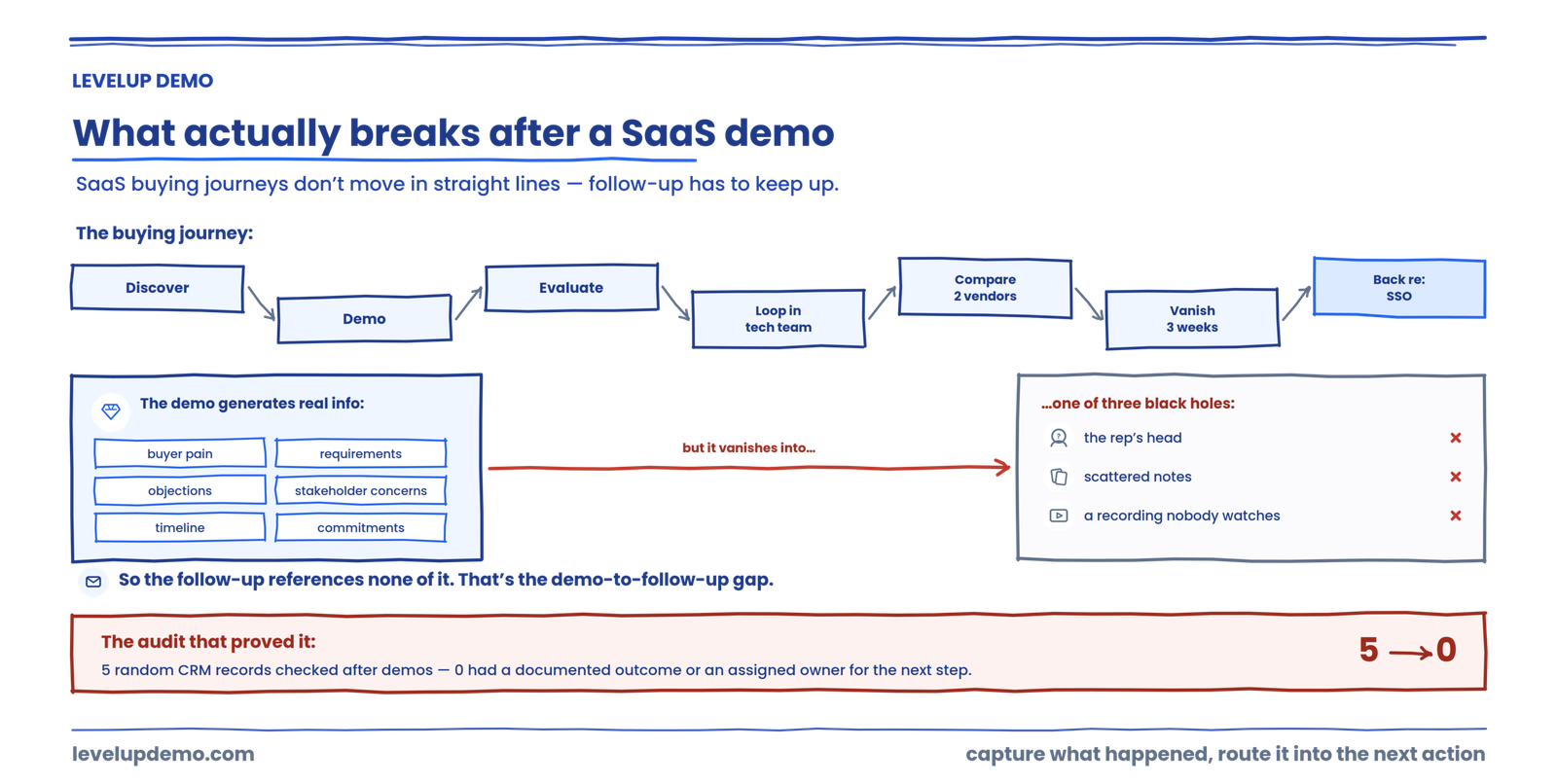
SaaS buying journeys don’t move in straight lines. A prospect might discover your product, request a demo, evaluate it, loop in their technical team, compare two other vendors, disappear for three weeks while budget gets approved, and then come back asking about SSO. The job of follow-up is to maintain continuity across all of those stages without becoming noise.
Most teams break somewhere in what I’d call the demo-to-follow-up gap. The demo generates real information: buyer pain, requirements, objections, stakeholder concerns, timeline, commitments. But that information lives in the rep’s head, maybe in scattered notes, maybe in a recording nobody watches. The follow-up that follows doesn’t reference any of it.
I spent a painful first week at one company auditing their CRM records after demos. Five random records, zero had a documented outcome or assigned owner for the next step. The reps weren’t lazy. The workflow simply had no system for capturing what happened and routing it into a follow-up action.
The SaaS follow-up framework
Every follow-up worth sending has seven components. Miss one, and you’re just adding noise to someone’s inbox.
Follow-up strategies that actually match the buyer’s situation
| Situation | Objective | What the follow-up should do |
|---|---|---|
| Demo completed | Maintain momentum | Personalized recap referencing their specific pain, plus a confirmed next step |
| No-show | Recover the meeting | Offer two specific reschedule times, keep the tone recovery-framed |
| Trial started | Drive activation | Help with the specific blocker, not a generic onboarding drip |
| Proposal sent | Remove decision blockers | Address stakeholder concerns, clarify implementation |
| No response | Reopen with a new angle | Bring new value: a benchmark, a use case, an answer to an unstated objection |
| Stalled deal | Diagnose the real blocker | Ask directly what changed, don’t just resend the proposal |
That table is the thing I wish someone had handed me three years ago. The instinct is to build one sequence and run everyone through it. But a no-show and a completed demo require fundamentally different follow-up logic.
When every follow-up must add something new
Community guidance on Reddit consistently favors honest, low-pressure language and concrete alternatives over “just bumping this.” The rep who sends five versions of “checking in” isn’t persistent. They’re demonstrating they have nothing new to offer.
The step that took longer than expected when I rebuilt a follow-up process: creating a library of value-add assets mapped to common objections and buyer stages. The temptation is to start writing sequences. But sequences without assets to attach become exactly the kind of empty cadence that trains prospects to ignore you.
A strong follow-up after a demo might include the implementation timeline the technical stakeholder asked about. After a proposal, it might be a one-page ROI summary the champion can forward to their CFO. After a trial, it might be a short video showing the exact feature they haven’t activated yet.
Following up with the champion, not just the contact
The person who attended the demo is often not the person who signs the contract. They need ammunition to sell internally: a forwardable summary, a clear problem statement, relevant proof, and an obvious next step. Recent post-demo guidance increasingly emphasizes creating something the champion can share without having to re-explain the entire demo.
I’d frame it this way: your follow-up should be forwardable. If the champion can’t send it to their VP with a two-line intro and have it make sense, it’s not doing its job.
Using buyer signals without being creepy
Signals like proposal opens, trial activity, repeated website visits, and stakeholder additions can help you adjust timing and relevance. But the principle matters: use signals to improve relevance, not to manufacture pressure. “I noticed you opened the proposal six times” is surveillance. “I wanted to share the security documentation your team might need during evaluation” is helpful.
Stop running every prospect through one sequence
LevelUp Demo captures what happened in each demo and routes the right follow-up to the right owner, so a no-show and a completed demo never get the same generic email.
The cadence question
There is no single ideal SaaS follow-up cadence. I’m not being evasive. The answer genuinely depends on context.
For a high-intent opportunity where you confirmed a next step during the demo, follow-up is context-driven and relatively frequent. For a no-response prospect, a 2026 deliverability guide from Lemlist recommends monitoring bounce rates under 5% and spam complaints under 0.1%, which practically means fewer touches with changing angles rather than a seven-email drip of the same ask. For enterprise deals with long buying cycles, you follow the buyer’s process, not your arbitrary timeline.
The thing I’d do differently if starting over: I’d stop worrying about the “optimal number of touches” and start worrying about whether each touch has a reason to exist.
The ghost errors nobody talks about
| Problem | Root cause | The community fix |
|---|---|---|
| Demo no-show never gets rescheduled | Follow-up asks “let me know what works” | Offer two exact time slots; keep the tone recovery-framed |
| Replies come in but don’t convert | Nobody owns the next step after the demo | Add CRM tasks for days 3, 7, and 14 post-demo; confirm the next action before ending the call |
| Follow-ups land in spam | Domain authentication or list quality is broken | Configure SPF, DKIM, and DMARC; warm the sending domain; remove bounced contacts quickly |
| Team loses track of outcomes | CRM stage isn’t updated | Mark the record with a clear status immediately and trigger the correct sequence |
| No-show follow-ups feel pushy | Messaging is repetitive and self-focused | Send a short Loom or custom recap tied to the prospect’s use case |
That third row caught me off guard when I first encountered it. A team I worked with assumed their messaging was the problem because response rates had dropped. Turned out their sending domain had no DKIM configured, and half their follow-ups were hitting spam. The “weird fix” was entirely technical, not copywriting.
Where practitioners disagree
There’s a live debate about whether no-show recovery rates of 35 to 55% within 48 hours (a figure published by Growbots, a sales agency) are realistic for most SaaS teams. Some practitioners treat that as a reliable benchmark and build aggressive 4-touch no-show cadences around it. Others argue the number reflects agency-optimized conditions and that most internal teams with less polished sequences see significantly lower recovery. I land on the skeptical side: use a structured no-show cadence, but don’t measure your team against a benchmark from a different operating context. If you want reference points that are easier to reason about, ground your targets in SaaS sales benchmarks rather than a single agency-published figure.
How AI fits into SaaS follow-up (and where it doesn’t)
AI can turn a demo transcript into structured buyer information: pain points, objections, questions, commitments, next steps. It can draft a personalized recap that references what the prospect actually said. It can recommend which case study or documentation to attach. It can flag stalled opportunities that haven’t had activity in two weeks.
What AI shouldn’t do: blindly send follow-ups without human review on important deals, handle sensitive negotiation conversations, or replace the judgment call about whether a prospect is actually ready for the next step. A conversation intelligence tool like Gong or Fireflies can capture demo context, but the CRM remains the system of record for opportunity status and ownership, and a human still needs to decide what to do with the information.
I’m still forming my opinion on how far AI-drafted follow-ups can go before prospects notice and disengage. The drafting quality is good enough now that the risk isn’t “this sounds robotic.” The risk is that every vendor’s follow-up starts sounding identically polished, and the signal value of a well-written email drops.
AI prompts for faster, sharper demo follow-up
If you’re using AI to speed up follow-up, the quality of your output depends entirely on the quality of your prompt. A vague “write a follow-up email” produces the generic, identically-polished output the section above warns about. A specific prompt that feeds the model real demo context produces something worth sending. Below are prompts mapped to the situations in the framework. Paste in your actual demo notes or transcript where indicated, and always review the draft before it goes out, especially on important deals.
1. Turn a demo transcript into structured notes
“Here is the transcript of a product demo [paste transcript]. Extract and organize the following into a structured summary: the prospect’s stated pain points, the specific questions they asked, any objections raised, commitments or next steps mentioned, and which stakeholders were referenced. Flag anything left unresolved at the end of the call.”
2. Draft a personalized post-demo recap
“Write a same-day follow-up email to a prospect after a completed demo. Reference this specific pain point they raised: [paste]. Answer this unresolved question: [paste]. Include one relevant next step: [a 15-minute technical review Thursday]. Keep it under 120 words, professional but not stiff, and end with one clear call to action. Do not use phrases like ‘just circling back’ or ‘touching base.'”
3. Recover a no-show
“Write a short, recovery-framed email to a prospect who missed a scheduled demo. Assume a genuine reason, not disinterest. Offer two specific reschedule times: [Tuesday 11am, Wednesday 3pm]. Keep the tone warm and low-pressure, no guilt, and under 80 words.”
4. Build a forwardable champion summary
“Turn these demo notes [paste] into a one-page summary my champion can forward to their VP without re-explaining anything. Include: the problem in one sentence, how our product addresses it, one relevant proof point, and the proposed next step. Write it so it makes sense to someone who wasn’t on the call.”
5. Reopen a no-response prospect with a new angle
“Write a follow-up to a prospect who has gone quiet after [number] touches. Do not repeat the previous ask. Instead, open with a new angle: [a relevant benchmark, a use case, or an answer to an objection they never voiced]. Keep it to three or four sentences and end with a single low-friction question.”
6. Diagnose a stalled deal
“Draft a direct but respectful message to a prospect whose deal has stalled. The goal is to diagnose the real blocker, not to resend the proposal. Ask what has changed since we last spoke and give them an easy way to tell me if priorities shifted, budget froze, or another vendor entered. Two to three sentences.”
One caution worth repeating from the section above: AI should automate capture, summarization, drafting, and prioritization, not the decision about whether to send. Feed it real context, use these prompts as a starting point rather than a send button, and keep a human in the loop on anything that matters.
For a broader library beyond follow-up, these prompts every SaaS sales rep should use cover prospecting, discovery, and objection handling as well.
Making follow-up a workflow instead of a memory test
The manual version looks like this: demo ends, rep tries to remember key points, opens inbox, writes something, maybe updates the CRM, creates a reminder, forgets the reminder, manager asks for an update two weeks later.
The structured version: demo completes, outcome is captured, owner is assigned, next step is defined with a due date, the task surfaces when it’s due, status is tracked, stalled deals get identified automatically.
That gap between those two versions is where pipeline leakage lives. It’s also where most small SaaS teams operate, because their CRM wasn’t designed to manage the demo-to-follow-up handoff.
Measuring whether your follow-up process works
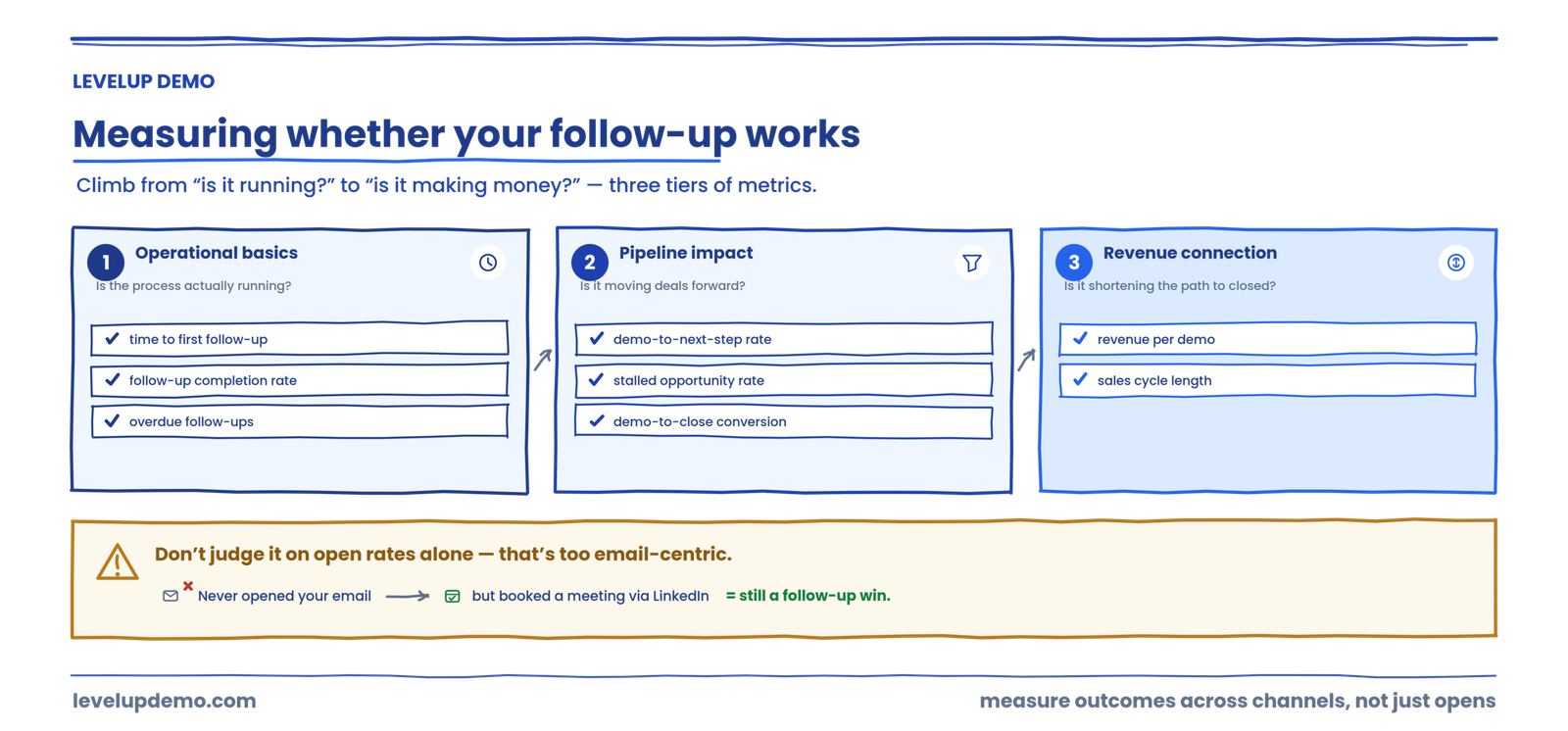
Track time to first follow-up, follow-up completion rate, and overdue follow-ups as operational basics. For pipeline impact, watch demo-to-next-step rate, stalled opportunity rate, and demo-to-close conversion. If you want to connect follow-up performance to revenue, revenue per demo and sales cycle length tell you whether faster, better follow-up is actually shortening the path to closed deals. For the full measurement framework, demo operations KPIs covers twenty metrics worth tracking.
Open rates alone are too email-centric to evaluate a multi-channel follow-up process. A prospect who doesn’t open your email but books a meeting through LinkedIn still represents a follow-up success.
Common SaaS follow-up mistakes
Saying “just following up” with nothing new attached. Sending the same message with only the date changed. Asking for a meeting without referencing why. Contacting only the person who attended the demo when the decision involves four stakeholders. Treating every lead identically regardless of their stage, intent, or objections. Failing to assign ownership so the follow-up belongs to nobody. And tracking follow-ups across email, calendar reminders, sticky notes, and Slack messages instead of one visible system.
That last one is the quiet killer. Not because any individual tool is wrong, but because a fragmented response system means nobody can see what’s actually happening after demos end.
Frequently asked questions
How soon should you follow up after a SaaS demo?
Same-day follow-up after a completed demo is the strongest baseline because context is fresh for both sides. For proposals, within one business day. For no-responses, allow enough time for the buyer’s internal process before changing your angle. Speed matters, but a fast follow-up that references nothing from the conversation loses to a next-day follow-up that addresses the prospect’s actual concern.
How many follow-ups should you send?
Deliverability-focused guidance from Woodpecker suggests 3 to 4 emails maximum in a sequence, because reply rates decline after the first message and spam complaint rates rise beyond that. For warm post-demo prospects, the number matters less than whether each touch introduces a new reason to respond.
What should a post-demo follow-up include?
A reference to the prospect’s specific problem, an answer to their most important unresolved question, one relevant resource, and a single clear next step. If you don’t know what their most important question was, the follow-up problem started during the demo.
Can AI automate SaaS follow-up?
AI can automate capture, summarization, drafting, and prioritization. It should not automate the decision about whether to send, the judgment about deal sensitivity, or the relationship layer of important conversations. The strongest use of AI in follow-up is turning unstructured demo notes into structured next actions, not replacing the rep’s judgment about what the buyer actually needs.
What should you do when a SaaS prospect stops responding?
Don’t assume disinterest. The silence might be internal approval, a competing priority, or an unresolved objection nobody voiced. Change the angle: bring a new insight, a relevant benchmark, or a direct question about what’s blocking the decision. After several unanswered touches with varied approaches, a clean “should we close this out?” message often gets a response when nothing else did.
The next problem you’ll hit after building this system is figuring out which follow-up content actually moves deals forward versus which just generates replies that go nowhere. That’s a demo analytics question, and it requires tracking not just activity but outcomes tied to specific follow-up approaches.
When follow-up depends on memory, deals slip through
LevelUp Demo connects demo capture, outcome tracking, and follow-up management so the next action after every call is defined, assigned, and visible.