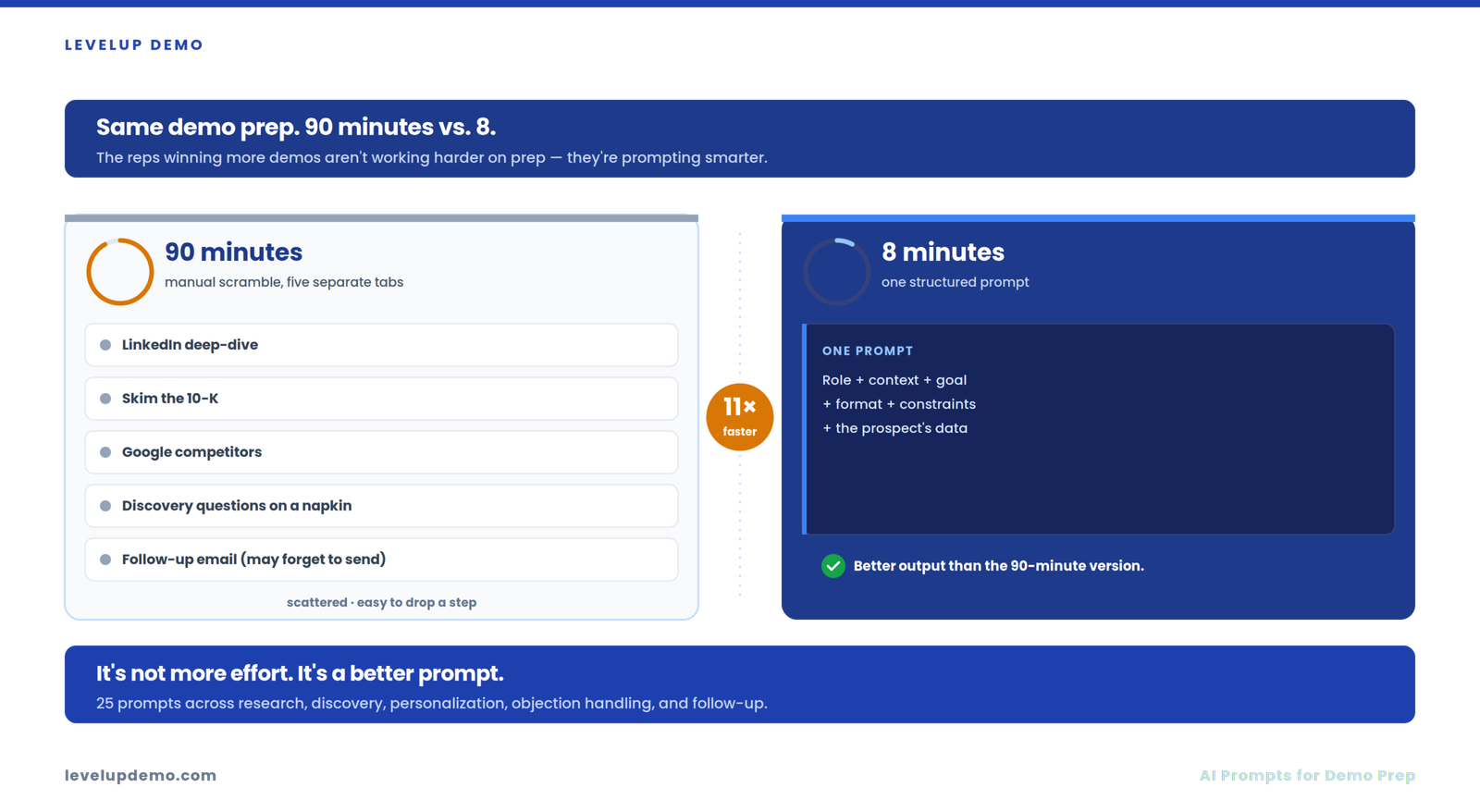
I burned 90 minutes prepping for a SaaS sales demo last Tuesday. I pulled up the prospect’s LinkedIn, skimmed their 10-K, Googled competitors, drafted discovery questions on a napkin, and wrote a follow-up email I’d probably forget to send anyway.
Then I ran one structured prompt in Claude.
Eight minutes.
Better output than my 90-minute scramble.
That’s not a flex—it’s a pattern I keep seeing across SaaS sales teams. The account executives and sales engineers winning more demos aren’t working harder on preparation. They’re using AI more strategically, with prompts designed for research, personalization, discovery, objection handling, and follow-ups.
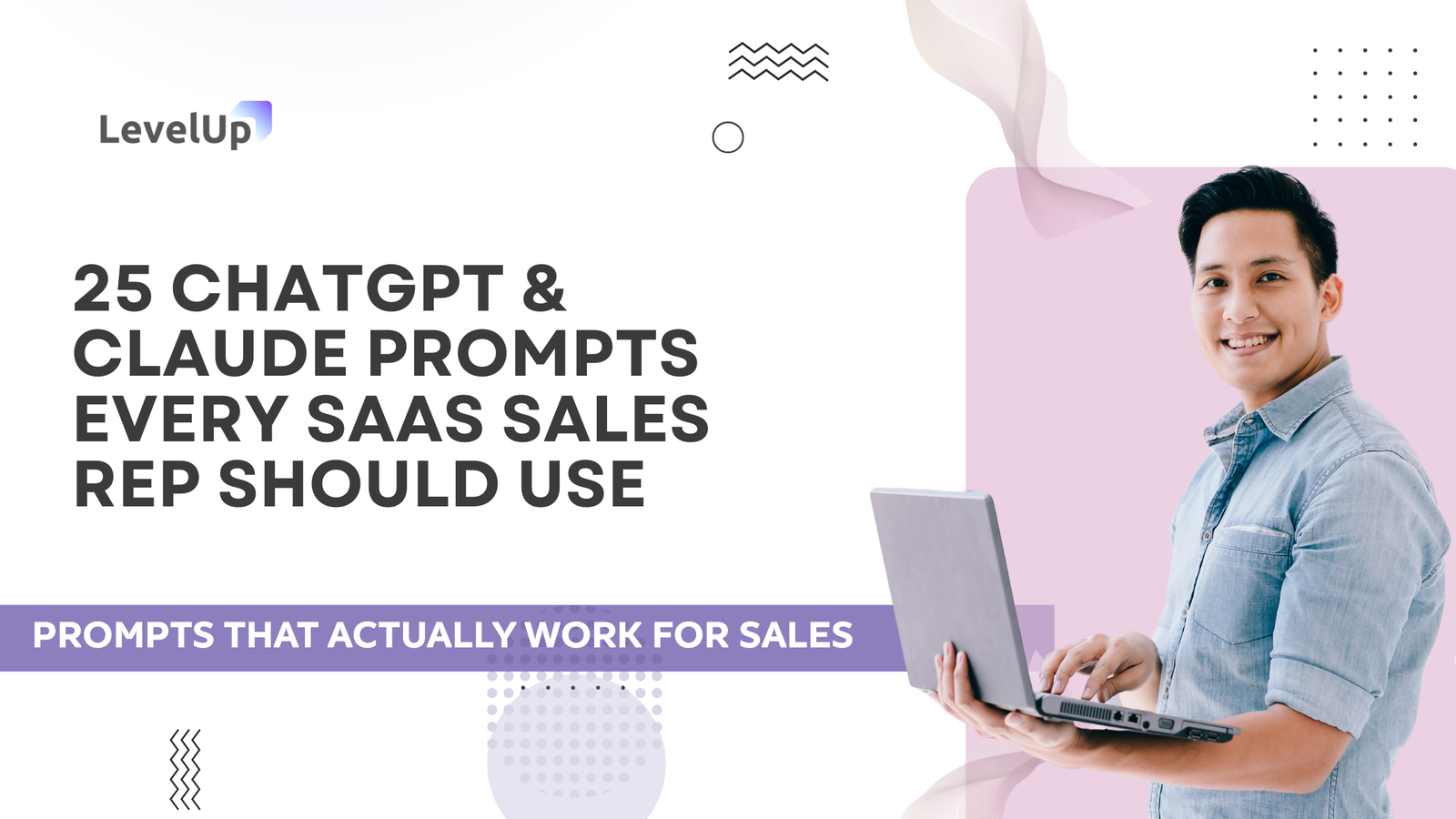
In this guide, you’ll get 25 battle-tested ChatGPT and Claude prompts for SaaS sales, organized across the entire product demo lifecycle. You’ll also learn which AI model works best for each task and discover three proprietary frameworks that transform generic prompting into a repeatable competitive advantage for SaaS sales teams.
Why AI Prompting Is a Core Sales Skill Now
AI prompting for sales is the ability to give structured instructions to tools like ChatGPT, Claude, or Perplexity that produce research, messaging, objection handling, and follow-up content tailored to a specific deal. Reps who prompt well consistently outperform those who don’t—not because AI replaces selling, but because it compresses preparation time from hours to minutes.
Here’s what changed. Tools like Gong, Fireflies, and Fathom already capture what happened on calls. Clay and Apollo automate who to contact. But the gap between “I have data” and “I’m actually ready for this demo” is still manual for most teams. That’s the gap prompting fills.
The reps I see struggling? They open ChatGPT, type “help me prepare for a demo,” and get useless fluff. The reps closing? They use what I call the Context Layering Method—they stack persona, company intel, deal stage, and desired output format into every prompt.
Which brings me to the skill itself.
How to Write Prompts That Actually Work for Sales
Most prompt advice is too abstract. Here’s the practical version—the Prompt Quality Framework™ I use with every sales team I enable:
| Element | What It Does | Example |
|---|---|---|
| Context | Grounds the AI in your deal | “We sell demo automation software to mid-market SaaS companies” |
| Role | Shapes tone and depth | “Act as a senior AE preparing for a VP-level buyer” |
| Goal | Defines the output | “Generate 5 discovery questions focused on their demo workflow pain” |
| Format | Controls structure | “Return as a numbered list with a one-sentence rationale per question” |
| Constraints | Prevents hallucination | “Only reference publicly available information. Do not invent statistics” |
| Company Data | Personalizes everything | Paste in the prospect’s About page, recent press release, or job posting |
One thing people miss: upload documents. Claude handles long PDFs well. Drop in a prospect’s annual report or a competitor’s pricing page and ask specific questions against it. ChatGPT is faster for quick brainstorms. Perplexity is better when you need real-time, cited research. NotebookLM shines when you’ve got multiple source documents to synthesize.
No single model wins everything. Use the right one for the task.
The AI Demo Preparation Framework
Before I give you the 25 prompts, here’s how they’re organized. Every prompt maps to one stage of this workflow:
I also use what I call The Prompt Stack™ for the most critical prompts. Instead of one prompt, I show you three versions—Basic, Better, Expert—so you can see why adding context dramatically improves output.
25 Prompts Every SaaS Sales Rep Should Use
Before the Demo
Prompt 1: Company Research Brief
Goal: Build a one-page account brief in under 5 minutes.
When to Use: Immediately after a demo gets booked.
You are a B2B sales researcher. I have a demo booked with [Company Name],
a [industry] company with approximately [size] employees.
Research their business model, recent news, likely tech stack, and
top 3 strategic priorities based on publicly available information.
Return a one-page brief with sections: Company Overview, Recent Developments,
Likely Pain Points, Key Stakeholders to Research, and Conversation Hooks.
Constraints: Do not fabricate any data. Flag anything you're uncertain about.
Example Output: A structured brief with their recent Series B, a new VP of Sales hire (signals process change), and three pain points tied to scaling their demo workflow.
Pro Tip: Paste their About page and a recent blog post into the prompt for dramatically better output.
Best Tool: Perplexity for real-time research with citations. Claude for synthesizing uploaded documents into the brief.
Prompt 2: Prospect LinkedIn Analysis
Goal: Understand the individual buyer’s priorities and communication style.
When to Use: Before personalizing your demo agenda.
Analyze this LinkedIn profile summary and recent activity for [Prospect Name].
Identify: their likely priorities, communication style (data-driven vs.
narrative-driven), topics they care about publicly, and 2 personalization
hooks I can use in my demo opening.
[Paste LinkedIn summary and recent posts]
Pro Tip: Claude tends to produce more nuanced personality reads. ChatGPT is faster but sometimes surface-level.
Prompt 3: Discovery Questions (The Prompt Stack™ in Action)
Goal: Generate discovery questions that surface real pain, not rehearsed answers.
Basic Prompt:
Give me 10 discovery questions for a SaaS demo.
(Output: generic, usable by anyone, zero personalization.)
Better Prompt:
I'm an AE selling demo management software to a VP of Sales at a
50-person SaaS company. Generate 8 discovery questions that uncover
pain around demo scheduling, follow-up tracking, and conversion visibility.
(Output: relevant to the product and persona, but still somewhat templated.)
Expert Prompt:
I'm preparing for a discovery-heavy demo with [Name], VP Sales at [Company].
They recently posted about "losing deals in the follow-up black hole."
They use HubSpot CRM and Calendly. Team of 6 AEs.
Generate 8 discovery questions using the MEDDICC framework that:
- Surface their current demo-to-close process
- Identify the economic buyer and decision process
- Quantify the cost of their current pain
- Test whether they have a champion internally
Format: Question + the insight I'm trying to extract with each.
Why the Expert version wins: It gives the AI deal-specific context, a qualification framework, and a clear output format. The result is something you’d actually say on a call—not a list you’d skim and ignore.
Prompt 4: ICP Fit Scoring
Goal: Quickly assess whether this prospect is worth a full custom demo or a lighter touch.
When to Use: During demo qualification before investing prep time.
Based on the following company profile, score this prospect's fit
against our ICP on a scale of 1-10 across these dimensions:
Company Size, Industry Fit, Tech Stack Compatibility, Likely Budget,
and Urgency Signals. Explain each score in one sentence.
Our ICP: [describe your ideal customer]
Prospect: [paste what you know]
Prompt 5: Competitive Positioning
Goal: Anticipate which competitors will come up and prepare differentiation.
When to Use: When you know (or suspect) the prospect is evaluating alternatives.
I sell [your product] in the [category] space. This prospect is likely
also evaluating [Competitor A] and [Competitor B].
Create a comparison table with columns: Capability, Our Strength,
Competitor A Approach, Competitor B Approach, and Talking Point for Me.
Focus on: [list 4-5 key capabilities]. Be factual—do not disparage competitors.
Best Tool: ChatGPT handles comparison tables well. For current competitor pricing or features, run Perplexity first, then feed findings into ChatGPT.
Prompts 6-10: Personalization, Agenda, and Demo Flow
For space, here’s the condensed format:
| # | Goal | Key Prompt Element |
|---|---|---|
| 6 | Pain Point Identification | “Based on [industry + role + company stage], list the top 5 operational pains and rank by urgency” |
| 7 | Industry Trend Briefing | “Summarize 3 trends in [industry] that affect how [role] evaluates [your category]” |
| 8 | Personalized Demo Hooks | “Generate 3 opening statements that connect [prospect’s recent initiative] to our value prop” |
| 9 | Demo Agenda Creation | “Build a 30-minute agenda: 5-min context, 15-min use-case walkthrough, 5-min ROI, 5-min next steps” |
| 10 | Demo Flow Script | “Create a demo narrative arc for [persona] that starts with their pain, shows 3 use cases, and ends with a value hypothesis” |
These prompts work best when you’ve already run Prompts 1-3 and paste those outputs as context. That’s the Context Layering Method™ in practice—each prompt builds on the last.
During the Demo
Prompts 11-17 are for real-time support (used on a second screen or prepped beforehand):
| # | Goal | When to Fire |
|---|---|---|
| 11 | Objection Response | “The prospect said [exact objection]. Draft 3 responses: one empathetic, one data-driven, one reframe” |
| 12 | ROI Calculation | “If a team of [X] saves [Y] hours per week on demo prep at $[Z]/hour, calculate annual savings” |
| 13 | Feature-to-Outcome Translation | “Translate these 4 features into business outcomes for a [role] at a [stage] company” |
| 14 | Pricing Conversation Prep | “Generate 3 ways to frame [price point] as an investment, using their pain quantification from discovery” |
| 15 | Technical Question Handler | “Explain [technical capability] in non-technical language for a VP-level buyer” |
| 16 | Stakeholder-Specific Messaging | “Reframe my value prop for: CFO (cost), VP Sales (revenue), RevOps (efficiency)” |
| 17 | Executive Summary Slide | “Write a 3-sentence executive summary connecting [their pain] to [our solution] to [expected outcome]” |
After the Demo
This is where most reps drop the ball. The demo goes well, then the follow-up is late, generic, or missing entirely. These prompts fix that—and they directly improve your demo win rate by keeping momentum alive.
| # | Goal | Prompt Essence |
|---|---|---|
| 18 | Follow-up Email | “Write a follow-up referencing [3 specific things discussed], restate the value hypothesis, and propose next steps with dates” |
| 19 | Meeting Summary | “Summarize this demo call in 200 words: key pains discussed, features shown, objections raised, and agreed next steps” |
| 20 | CRM Notes | “Convert this meeting summary into structured CRM fields: Stage, Pain Points, Champion, Decision Process, Next Step, Risk Flags” |
| 21 | Mutual Action Plan | “Generate a MAP with milestones for both sides: technical validation, stakeholder review, procurement, go-live” |
| 22 | Success Plan | “Draft a 90-day success plan assuming they buy: onboarding, first value milestone, expansion trigger” |
| 23 | Risk Assessment | “Based on what we learned, flag the top 3 deal risks and suggest a mitigation action for each” |
| 24 | Win Probability Estimate | “Using MEDDICC criteria, score this deal’s likelihood to close and identify the weakest qualification element” |
| 25 | Executive Recap | “Write a 5-sentence executive recap I can send to my VP of Sales summarizing this opportunity, its stage, and what I need” |
Best Tool for Prompts 18-25: Claude handles long-form synthesis and nuanced writing better here. ChatGPT is faster for structured outputs like CRM fields and tables.
The AI Tool Recommendation Matrix
| Task | Best Tool | Why |
|---|---|---|
| Real-time company research | Perplexity | Cites sources, pulls current data |
| Long-form follow-ups and summaries | Claude | Better at nuance and tone |
| Quick brainstorms and tables | ChatGPT | Faster, good at structured output |
| Analyzing uploaded documents | Claude or NotebookLM | Handles large context windows |
| Competitive intelligence | ChatGPT + Perplexity | Combine current data with synthesis |
Mistakes That Kill Your AI-Assisted Demo Prep
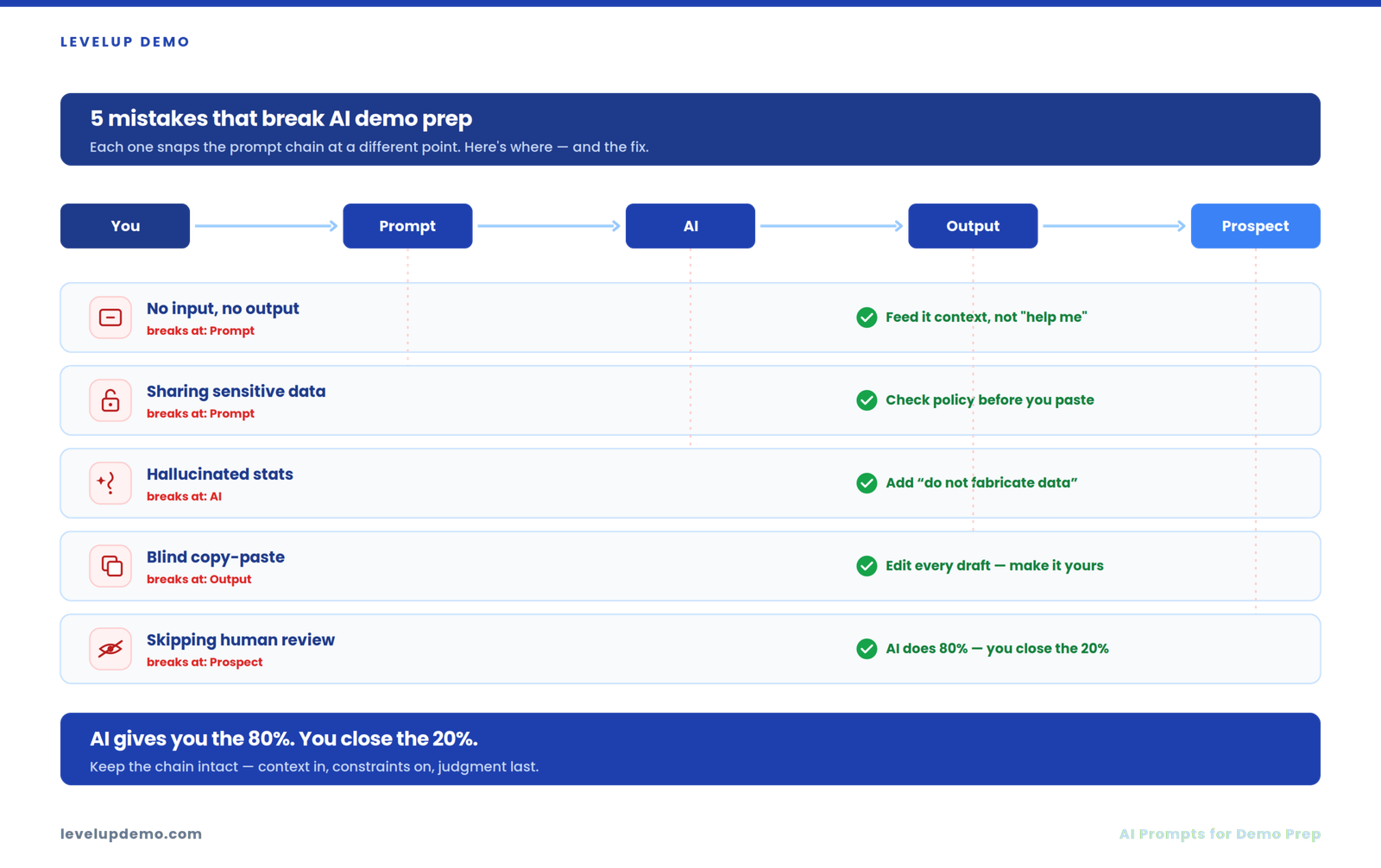
- Blind copy-paste. If you send AI output without editing, prospects will notice. It reads like a template because it is one.
- No input, no output. Typing “help me with a demo” produces garbage. Context is everything.
- Hallucinated stats. AI will invent metrics if you don’t constrain it. Always add “do not fabricate data.”
- Sharing sensitive deal data. Don’t paste confidential customer information into public AI tools without checking your company’s policy.
- Skipping the human review. AI gives you the 80%. Your judgment, tone, and deal knowledge are the 20% that actually closes.
AI Doesn’t Replace Great Reps. It Exposes Lazy Ones.
The AEs I work with who’ve adopted these prompts aren’t winning because AI is magic. They’re winning because they show up to every demo already knowing the prospect’s pain, the buying committee’s priorities, and the three objections most likely to surface. That preparation compounds across every deal.
The reps who ignore this? They’re still spending Monday mornings Googling prospects and writing follow-ups from scratch on Friday afternoons—by which point the deal has gone cold.
Your demo workflow doesn’t end with a good prompt.
If you’re looking to connect AI-powered prep to actual demo scheduling, follow-up tracking, and outcome analytics, LevelUp Demo ties those pieces together—so the research you do before the call actually flows into what happens after it.
The prompts get you ready. The workflow gets you closed.