
Your dashboard says 32% of demos converted last quarter. That number gets dropped into a slide, someone nods, and the meeting moves on.
Nobody asks why the other 68% didn’t close.
Was it pricing? A missing decision-maker on the call? Weak qualification that let bad-fit leads through? A follow-up email that landed three days late with zero personalization? Or did a genuinely interested buyer just lose internal momentum because your rep never sent something the champion could forward to their CFO?
A conversion percentage can’t answer any of those questions. And if you can’t answer them, you can’t fix them. That gap between knowing what happened and understanding what it means is the exact space demo intelligence occupies.
By the end of this piece, you’ll have a working definition of demo intelligence that goes beyond what any single vendor is currently publishing, a clear framework for distinguishing it from demo analytics, and enough structure to evaluate whether your team is actually doing intelligence work or just staring at charts.
TL;DR
Demo intelligence is the practice of collecting, connecting, interpreting, and acting on data from the entire SaaS demo lifecycle to understand buyer behavior, demo performance, deal outcomes, and the actions most likely to improve conversion and revenue. It differs from demo analytics the way a diagnosis differs from a blood test. Analytics tells you what happened. Intelligence connects the what to the why, identifies what it means, and recommends what to do next. It draws on workflow data, interaction signals, business context, and outcome records. SaaS teams need it because demos generate far more usable signal than most organizations capture, and that uncaptured signal is where pipeline leaks silently.
What is demo intelligence?
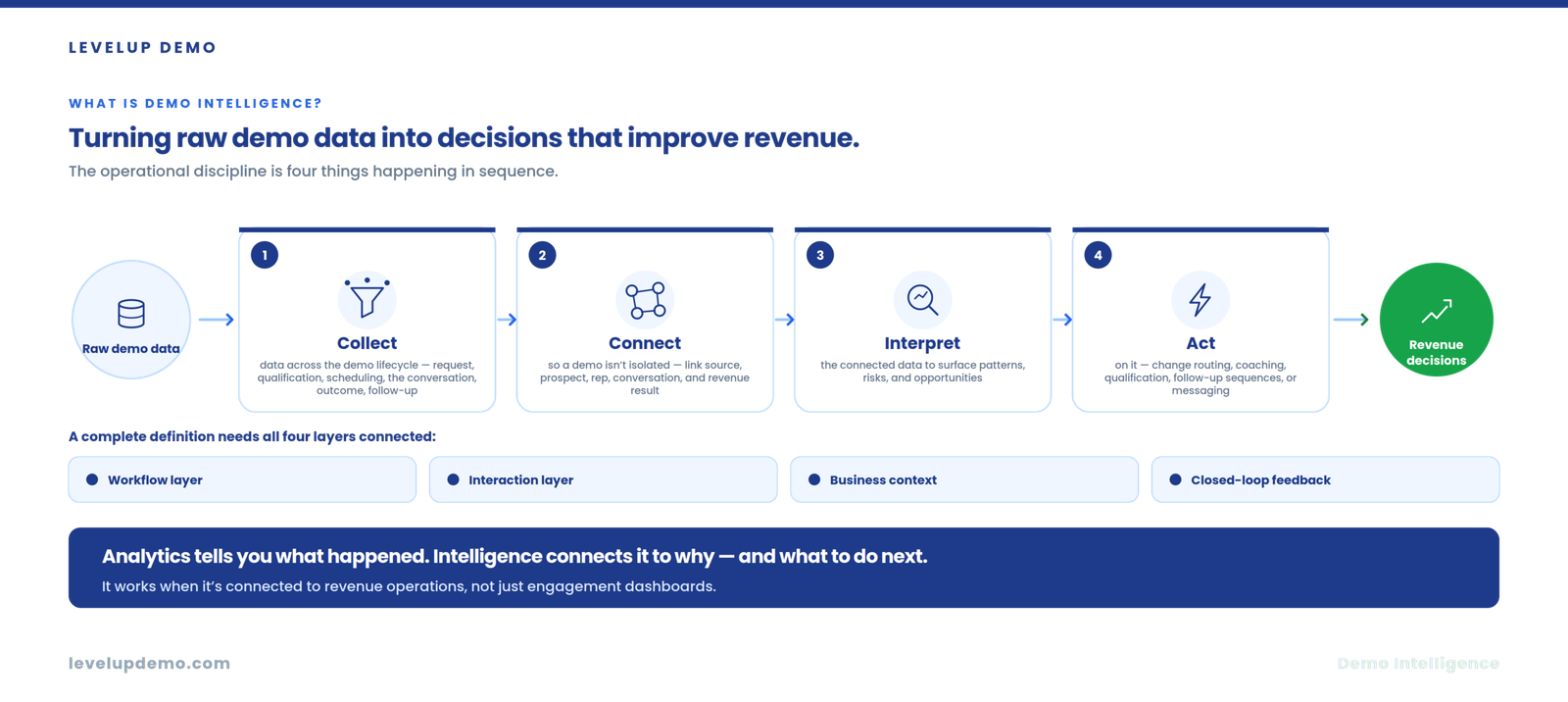
Demo intelligence is the operational discipline of turning raw demo data into decisions that improve revenue outcomes.
That means four things happening in sequence. You collect data across the demo lifecycle (request, qualification, scheduling, the conversation itself, outcome, follow-up, deal progression). You connect that data so a single demo isn’t an isolated event but a linked record tying the source, the prospect, the rep, the conversation, and the revenue result together. You interpret the connected data to surface patterns, risks, and opportunities. And you act on those interpretations by changing routing, coaching, qualification criteria, follow-up sequences, or messaging.
The market is still defining this category. Walnut frames demo intelligence around buyer behavioral data and deal-level decisions. Demostack connects it to demo engagement and GTM motions. HowdyGo’s 2026 guide treats demo intelligence software as one of four distinct sales-demo categories. These aren’t wrong, but they’re partial. A complete operating definition needs to include the workflow layer (what happened operationally before, during, and after the demo), the interaction layer (what was said, asked, objected to), the business context (account, opportunity stage, source, rep), and the closed-loop feedback that feeds outcomes back into future decisions.
Different platforms define demo intelligence differently, and that’s expected in an emerging category. The definition above reflects how the concept works when it’s actually connected to revenue operations, not just engagement dashboards.
Demo analytics vs demo intelligence
This distinction matters more than almost anything else in the article, so here it is as plainly as I can put it.
| Capability | Demo analytics | Demo intelligence |
|---|---|---|
| Count demos | ✓ | ✓ |
| Track conversion | ✓ | ✓ |
| Measure attendance | ✓ | ✓ |
| Identify patterns across demos | Limited | ✓ |
| Explain why outcomes differ | Limited | ✓ |
| Detect buying signals | Limited | ✓ |
| Connect buyer behavior to revenue | Limited | ✓ |
| Recommend next actions | Limited | ✓ |
| Feed insights back into the workflow | Limited | ✓ |
Analytics answers “what happened?” with numbers. One hundred demos ran, 72 were attended, 24 closed, the conversion rate was 34%. That’s genuinely useful. But it doesn’t change anything by itself.
Intelligence starts where analytics stops. It asks why those 24 closed, what the 48 that didn’t close had in common, whether a specific objection pattern predicted failure, and whether changing the follow-up cadence or rep assignment would shift the ratio. Then it asks whether the change actually worked.
Think of it as a loop, not a report.
The Demo Intelligence Loop
This is the core operating model. Eight stages, each feeding the next.
Skip any stage and the loop breaks. Most teams get stuck between Capture and Connect because their demo data is fragmented across scheduling tools, CRM records, call recording platforms, and email threads.
The Demo Intelligence Stack
Four layers, bottom to top.
Layer one is workflow data: the request, qualification score, routing decision, scheduling, attendance, and outcome status. This is the operational backbone. If you can’t reliably tell me whether a demo happened, who owned it, and what the outcome was, nothing above this layer matters.
Layer two is interaction data: what was discussed, questions asked, objections raised, engagement level, sentiment. Conversation intelligence tools like Gong and Fireflies operate primarily at this layer, and they’re very good at it.
Layer three is business context: the account, the opportunity, the acquisition source, the rep, the product line, the deal stage. This is where CRM data joins the picture.
Layer four is intelligence itself: the patterns, predictions, recommendations, and actions that emerge when you connect the three layers below. This is where the actual value lives, and it’s the layer most teams never reach because the foundation underneath it is incomplete.
Why SaaS demos generate more intelligence than most teams capture
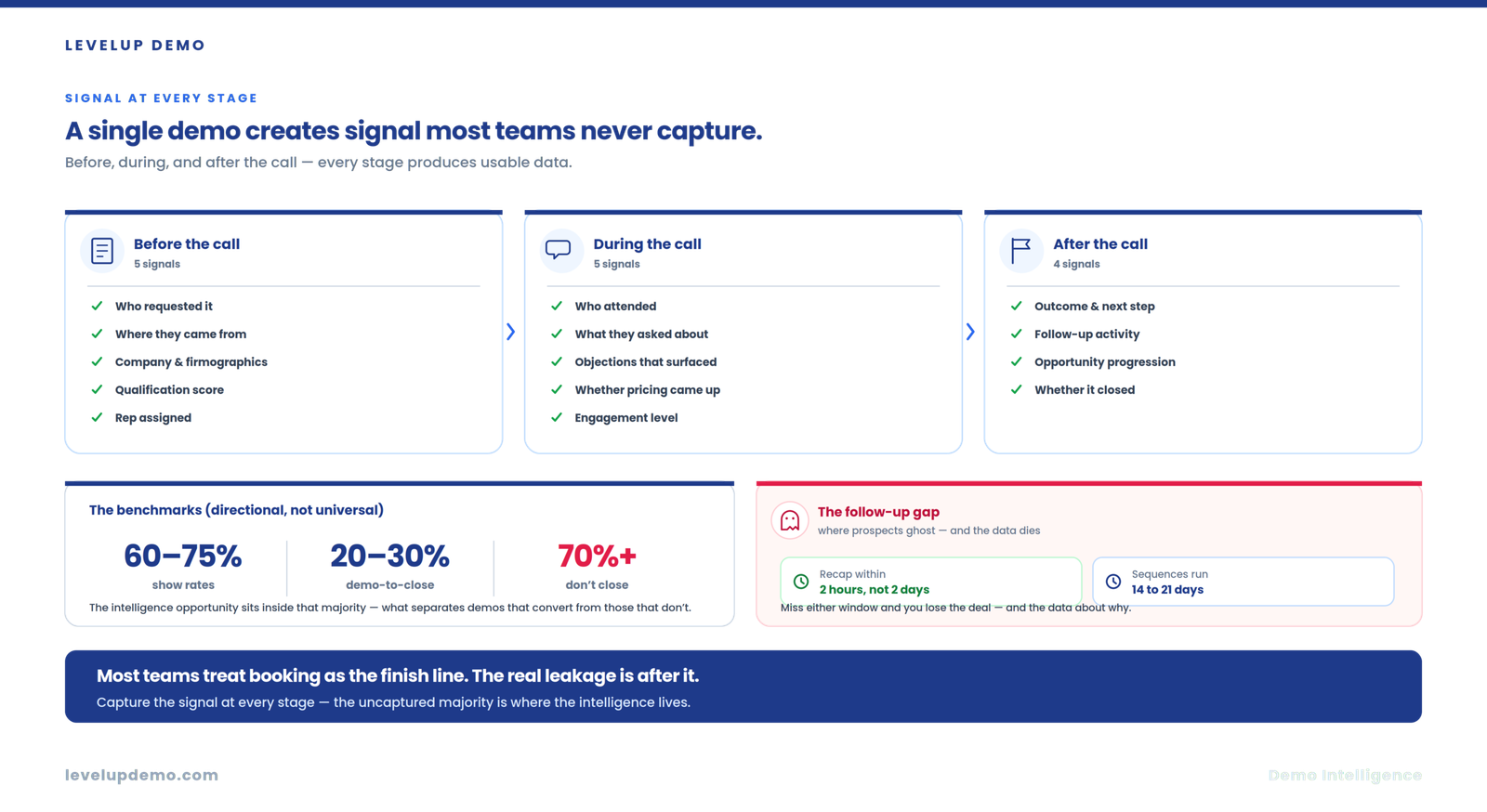
A single demo creates signal at every stage. Before the call, you know who requested it, where they came from, what company they’re at, how they scored on qualification, and which rep was assigned. During the call, you can capture who attended, what they asked about, what objections surfaced, whether pricing came up, and how engaged they were. After the call, you track the outcome, the follow-up, the next step, whether the opportunity progressed, and whether it eventually closed.
Practitioner benchmarks suggest show rates typically land between 60% and 75%, with demo-to-close rates around 20% to 30% at growth-stage companies. Those numbers are directional, not universal. But even at the high end, 70% or more of demos don’t result in a closed deal. The intelligence opportunity sits inside that majority: understanding what separates the demos that convert from the ones that don’t.
Most teams treat booking as the finish line. The real leakage happens in the follow-up gap, where prospects ghost because the recap was generic, late, or disconnected from their actual objections. One operational benchmark that keeps surfacing in practitioner communities: the first post-demo recap should go out within two hours, not two days. Structured follow-up sequences typically run 14 to 21 days. Miss either window and you’re not just losing a deal; you’re losing the data about why you lost it.
Demo intelligence signals worth tracking
Not every data point qualifies as a signal. These ten tend to carry the most weight when connected to outcomes.
Demo source: Where the lead originated often predicts close rates more reliably than anything the rep does on the call.
Qualification score: Tighter qualification means fewer wasted demos and better stage-to-stage conversion.
Company fit: Firmographic alignment is a leading indicator that most teams assess too loosely.
Stakeholder participation: A solo attendee from a mid-market account usually means the deal needs internal selling.
Engagement during the demo: How actively the prospect participates can provide useful context around interest.
Questions asked: Questions around implementation, timeline, and integration can indicate genuine buying intent.
Objections: Recurring objections that cluster in lost deals can reveal patterns worth addressing.
Pricing discussion: Whether pricing came up, and how the conversation unfolded, can provide useful context.
Demo outcome status: Outcomes should be logged consistently so they can be compared against other signals.
Post-demo activity: Did the prospect open the follow-up, click the resources, respond, or go silent?
None of these signals mean much in isolation. The intelligence comes from connecting them. If demos sourced from paid search consistently lose at higher rates than demos from partner referrals, and the objection pattern in those lost deals clusters around pricing, you have something actionable. You can adjust qualification for paid-search leads, change the messaging, or route them to a rep who handles pricing objections well.
The Demo Intelligence Maturity Model
Five levels. Most teams are at one or two.
Where demo intelligence fits in the sales technology stack
This category sits adjacent to several others, and the boundaries aren’t always clean.
CRM is the system of record. It tells you what’s been logged, which is only as good as what reps actually enter. Conversation intelligence (Gong, Fireflies) focuses on extracting insight from customer interactions: topics, sentiment, speaker behavior, objections. It’s powerful at the interaction layer but doesn’t inherently connect to demo workflow data. Product analytics focuses on how users behave inside the product, a post-sale or product-led concern. Interactive demo platforms focus on the demo experience itself.
Demo intelligence connects demo-specific operational signals (request, routing, scheduling, attendance, outcome) with interaction data and business context to produce actionable insight tied to revenue outcomes. The differentiator isn’t sophistication. It’s scope and connection.
The ugly truth about demo intelligence
| Problem | The weird fix | Where it surfaces |
|---|---|---|
| Demo booked but nobody shows | Same-day confirmation with a clear agenda, calendar invite verification, timezone checks | Practitioner forums, RevOps communities |
| Prospects vanish after a strong call | Same-day recap tied to their specific objection, with one concrete next action and a forwardable summary for stakeholder enablement | Sales operations discussions |
| CRM says follow-up sent but prospect never received it | Manual deliverability spot-checks on a small sample, consistent sender identity | Email deliverability threads |
| Nobody knows who owns the lead | Enforce a simple owner field and a response-time SLA for every demo request | Ops team retrospectives |
| Great demos don’t convert | The champion can’t sell internally; send a short summary they can forward to their CFO or VP | Win/loss analysis reviews |
A lot of demo intelligence initiatives fail not because the strategy is wrong but because the underlying data hygiene is poor. If five random CRM records show missing or outdated notes, your intelligence layer is built on sand.
Where practitioners disagree
There’s an active debate about whether demo intelligence should live inside a dedicated platform or be assembled from existing tools (CRM plus conversation intelligence plus scheduling plus spreadsheets). Ops leaders at larger companies tend to favor assembling from best-of-breed tools they already own. Founders and small teams tend to prefer a single connected system because they don’t have the headcount to maintain integrations. I lean toward the connected-system approach for teams under 20 reps, because the integration tax on small teams is real and it’s where most data fragmentation starts. But this isn’t settled, and the right answer depends on what you already have in place.
When demo data, qualification, and outcomes live in the same workflow
LevelUp Demo connects demo capture, AI enrichment, qualification, routing, scheduling, outcome tracking, follow-up, win/loss insights, rep scorecards, and closed-loop scoring in a single system, so the intelligence layer has something reliable to work with.
Seven demo intelligence mistakes
Treating dashboards as intelligence. Collecting data nobody reviews. Measuring activity (demos completed) instead of outcomes (demos that progressed). Ignoring pre-demo signals like source and qualification. Ignoring post-demo signals like follow-up timing and prospect engagement. Automating recommendations without validating them, because AI can misinterpret context, especially with small sample sizes. And the most common one: failing to close the feedback loop so that what you learn actually changes what happens next.
Frequently asked questions
Is demo intelligence the same as conversation intelligence?
No. Conversation intelligence focuses on extracting insight from customer interactions, including topics, sentiment, objections, and speaker dynamics. Demo intelligence incorporates conversation data but also connects it with demo request data, qualification, scheduling, attendance, workflow activity, outcomes, and revenue results. Conversation intelligence is one input layer. Demo intelligence is the connected operating model.
How does demo intelligence differ from CRM reporting?
CRM reporting reflects what’s recorded in the CRM. Demo intelligence connects demo-specific operational and interaction signals with outcomes to surface patterns and recommendations that CRM fields alone can’t produce. If your CRM has clean, complete demo data, great. Most don’t.
What tools provide demo intelligence?
Several vendors use the term differently. Walnut frames it around buyer behavior and deal decisions. Demostack connects it to demo engagement and revenue. Gong and Fireflies approach intelligence from the broader conversation and revenue side. LevelUp Demo connects demo workflow management with outcome tracking and closed-loop scoring. The category is still forming, and no single vendor owns the complete definition.
How does AI improve demo intelligence?
AI can accelerate pattern recognition, surface objection clusters, generate post-demo summaries, and flag at-risk deals faster than manual review. It doesn’t replace the human judgment needed to decide whether a pattern is meaningful or whether an intervention is worth running. Incomplete data in, incomplete intelligence out.
What comes next
If your team currently tracks demo volume and conversion rate, you have analytics. The next problem you’ll hit is figuring out why your numbers look the way they do and whether the answer lives in qualification, routing, rep performance, follow-up timing, or something upstream you haven’t instrumented yet. That’s where the intelligence work starts, and it starts with connecting the data you’re already generating but probably not linking together.
Turn demo data into decisions
LevelUp Demo connects capture, qualification, routing, scheduling, outcomes, follow-up, and closed-loop scoring in one system — so your intelligence layer is built on reliable data, not sand.