
What is demo workflow management?
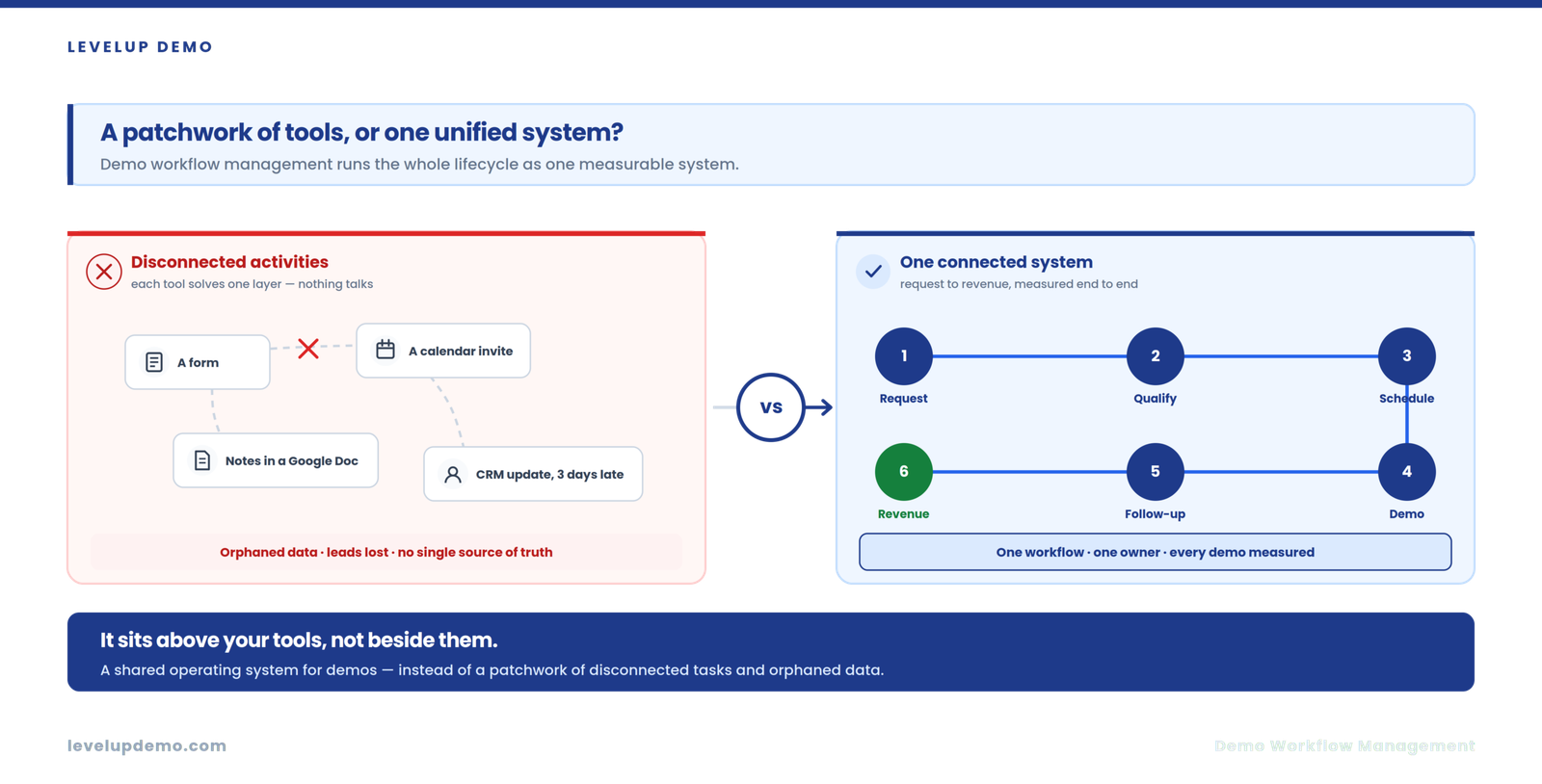
Demo workflow management is the operational discipline of designing, connecting, and measuring every stage of the product demo lifecycle as one unified system. It sits above individual tools like scheduling software, conversation intelligence, or interactive demo platforms. Teams that adopt it gain a shared operating system for demos instead of a patchwork of disconnected tasks and orphaned data.
Most SaaS teams treat demos as a collection of disconnected activities: a form here, a calendar invite there, scattered notes in a Google Doc, a CRM update that happens three days late (if it happens at all). Demo workflow management treats the entire demo lifecycle, from request capture through revenue attribution, as a single measurable system. This guide defines the discipline, introduces the Demo Workflow Framework for evaluating your own maturity, and explains why managing pre-demo, live-demo, and post-demo stages as one connected workflow produces measurably better pipeline outcomes than optimizing any single stage in isolation.
Who this guide is for (and who should skip it)
This applies to you if you’re running a SaaS sales motion where product demos are a meaningful part of how deals move forward. Specifically: founders doing their own demos, small revenue teams of one to five people, RevOps leads trying to build repeatability, and presales managers who’ve inherited a mess.
If you’re at a company with a mature demo operations function, a dedicated sales engineering org, and clean CRM hygiene, you’ll find the maturity model useful but the foundational sections familiar. You might get more from our demo operations KPIs breakdown instead.
What demo workflow management actually is
Demo workflow management is the discipline of designing, executing, and measuring the complete demo lifecycle as one connected system rather than a series of isolated tasks. It covers everything from the moment a prospect requests a demo through qualification, routing, scheduling, preparation, the live session, intelligence capture, follow-up, CRM sync, analytics, and revenue attribution.
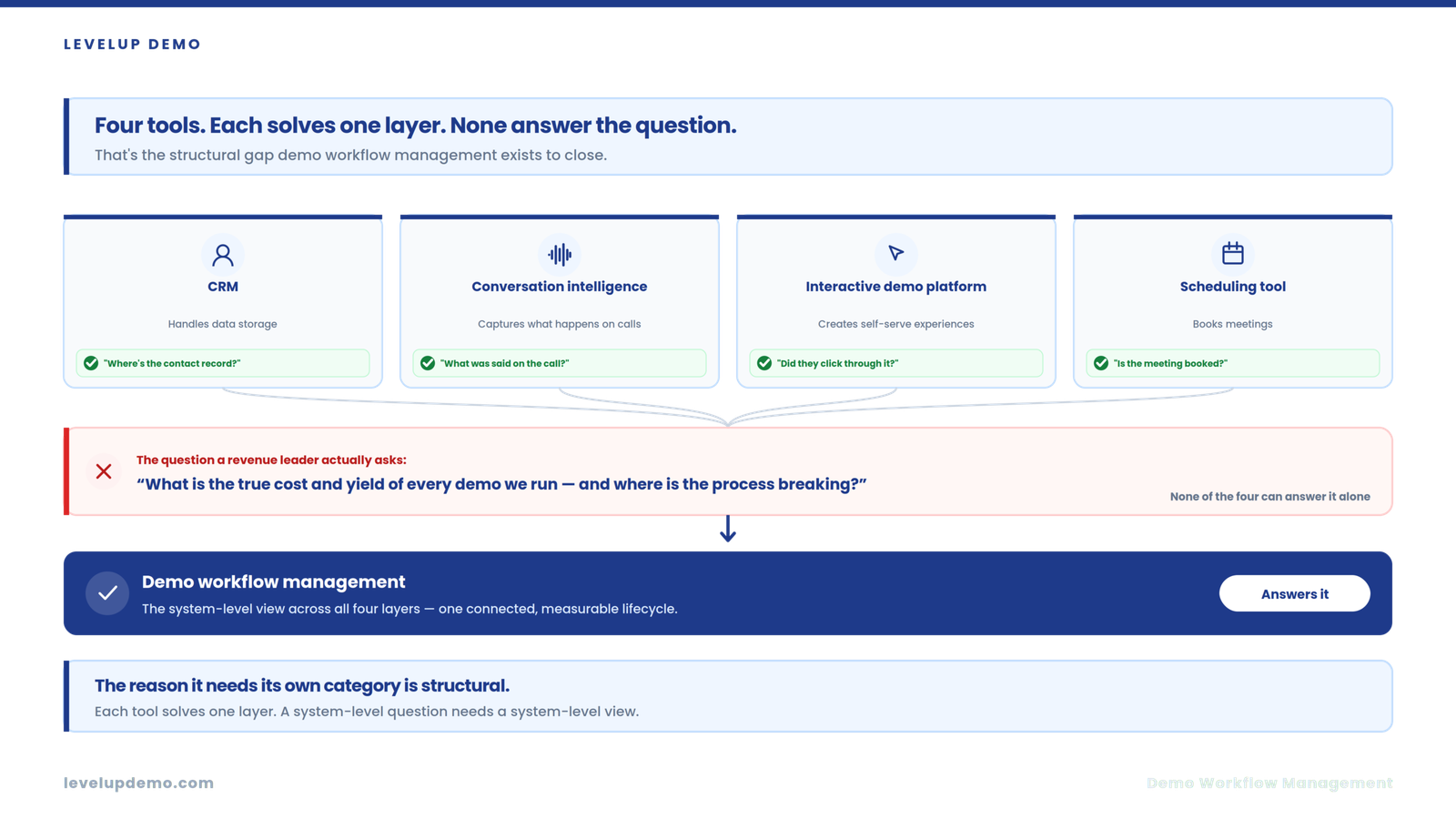
The reason this needs its own category is structural. CRM handles data storage. Conversation intelligence captures what happens during calls. Interactive demo platforms create self-serve product experiences. Scheduling tools book meetings. Each solves one layer. None of them answer the question that actually matters to a revenue leader: “What is the true cost and yield of every demo we run, and where is the process breaking?”
That question requires a system-level view. Demo workflow management provides it.
Why it works this way
The constraint that produced this discipline is fragmentation. As SaaS sales stacks grew more specialized, the demo process got split across more tools and more owners. A Monday.com workflow guide recommends phased rollouts across Weeks 1 through 4 for foundation-building and Weeks 5 through 12 for automation. Supademo’s implementation guidance emphasizes 90-day milestones with assigned ownership. Ngram recommends evaluating after 30 days and expanding after 90 days based on actual usage. All of them are solving the same root problem: nobody owns the full picture.
Where published advice diverges from practice
The standard playbook says: audit workflows, pick a narrow use case, define ownership, automate the highest-friction steps, connect to CRM, validate, iterate. That’s correct and also incomplete.
What practitioner sources stress (and most guides skip) is that the first week of any demo workflow project is almost always a CRM cleanup exercise, not a workflow design exercise. I’ve seen teams spend the majority of their initial sprint discovering that their contact records are duplicated, their lifecycle stages don’t match their actual sales process, and their custom fields were set up by someone who left eighteen months ago. The workflow can look automated on paper while producing garbage data underneath. Five random demo records inspected manually, three missing key fields: that’s the diagnostic that tells you your data model is dirty before you automate anything on top of it.
The decision this creates
You have to choose: do you fix the foundation first (CRM hygiene, field mapping, ownership rules) or do you start building the workflow and clean as you go? Most teams that start building first end up rebuilding within 90 days. The slower path is usually faster.
The Demo Workflow Framework
This is the ten-stage framework for mapping and managing the complete demo lifecycle.
| Stage | What happens | Who owns it | What breaks without it |
|---|---|---|---|
| 1. Capture | Demo request submitted and logged | Marketing / Website | Leads lost in form submissions or email |
| 2. Qualify | Request scored against ICP criteria | RevOps / SDR | Reps waste time on unqualified prospects |
| 3. Route | Qualified request assigned to the right rep | RevOps / Routing rules | Hot leads sit in a generic queue |
| 4. Schedule | Demo booked with calendar sync | Sales / Automation | Back-and-forth emails, no-shows |
| 5. Prepare | Rep reviews account context and demo plan | Sales / Presales | Generic demos that don’t connect |
| 6. Deliver | Live or interactive demo executed | Sales / SE | Poor experience, low engagement |
| 7. Capture intelligence | Meeting notes, engagement signals, buying intent recorded | AI / Meeting intelligence | Insights trapped in one person’s memory |
| 8. Follow-up | Next steps sent, tasks created, pipeline updated | Sales / RevOps | Deals stall silently |
| 9. Measure | Demo-level analytics reviewed | RevOps / Leadership | No visibility into what’s working |
| 10. Optimize | Process refined based on data | RevOps | Same mistakes repeated quarterly |
The framework isn’t theoretical. Submit one test demo request from start to finish. If the follow-up task doesn’t fire automatically, your trigger chain is broken somewhere between stages 7 and 8. That single test is worth more than a week of planning.
The Demo Workflow Maturity Model
| Level | Name | Characteristics | Typical KPI visibility |
|---|---|---|---|
| 1 | Ad hoc | No defined process. Demos happen on request with no tracking. | None |
| 2 | Defined | Basic workflow exists. Scheduling is standardized. CRM updated manually. | Demo count |
| 3 | Connected | Demo platform integrated with CRM. Routing rules active. Follow-up partially automated. | Demo-to-opportunity rate |
| 4 | Measured | Demo analytics tracked. Revenue per demo calculated. Engagement scoring active. | Revenue per demo, follow-up rate |
| 5 | Optimized | Full lifecycle managed as one system. AI-assisted intelligence capture. Continuous improvement loop. | Pipeline velocity, win rate by demo type |
Most teams reading this are at Level 1 or 2. That’s normal. The jump from Level 2 to Level 3 is where the operational pain is highest, because it requires CRM integration work that exposes every data hygiene problem you’ve been ignoring.
The ghost errors nobody warns you about
These are the problems that show up after you’ve built the workflow, not before.
| Symptom | Root cause | The fix that actually works |
|---|---|---|
| Demo completed, no follow-up task appears | Workflow trigger mapped to wrong lifecycle stage | Create five test contacts and trace the exact trigger-to-task path before rollout |
| Reps say the data “looks wrong” | Stale or duplicate CRM records | Clean the CRM first. Test with sample contacts before expanding |
| Engagement data exists but reports are useless | Demo events tracked but not normalized into usable CRM fields | Store demo sessions in a custom object instead of overloading the contact record |
| Hot leads missed after demo | Routing rules too broad or missing for high-intent signals | Set explicit routing for CTA clicks and completion behavior, verify with a small batch |
| Team stops using the process within weeks | Workflow adds friction or ownership is unclear | Roll out in phases. One initiative, one owner |
| Vendor demo looked great, production failed | Demo scenario hid error paths and real volume | Build a real workflow with at least one error path and test failure handling, as AyAutomate recommends |
That last row deserves emphasis. I’ve watched teams select a workflow platform based on a polished vendor demo, then discover in production that the tool hides broken-run behavior until something fails at volume. Always build a test workflow that includes an error path. If the platform can’t show you what happens when something breaks, it’s not ready for production.
Where practitioners disagree
There’s an active debate about whether demo workflow management should be owned by RevOps or Sales. The RevOps camp argues that because the workflow spans multiple tools and teams, it needs a systems-level owner who thinks in processes rather than deals. The Sales camp argues that reps closest to the buyer should control their own demo preparation and follow-up cadence.
I land on RevOps owning the system design and measurement, with Sales owning execution within that system. But this isn’t settled, and at companies with fewer than ten people, the distinction is academic anyway.
How demo workflow management differs from adjacent categories
| Capability | CRM | Conversation intelligence | Interactive demo platform | Demo workflow management |
|---|---|---|---|---|
| Stores contact and deal data | ✓ | — | — | Connects to CRM |
| Records and analyzes calls | — | ✓ | — | Ingests call intelligence |
| Creates self-serve product experiences | — | — | ✓ | Incorporates as a stage |
| Manages the full demo lifecycle end-to-end | — | — | — | ✓ |
| Measures revenue per demo | — | — | — | ✓ |
Tools like Gong and Fireflies own conversation intelligence. Storylane and Navattic own interactive demos. Chili Piper owns scheduling. Each is strong in its layer. Demo workflow management connects those layers into one auditable process so you can answer: which demos produce revenue, and why?
The Demo Workflow Health Score
Score each dimension from 1 (broken) to 5 (optimized). A total below 25 means your workflow has structural gaps.
| Dimension | What you’re measuring |
|---|---|
| Request quality | Are demo requests qualified before they reach a rep? |
| Routing efficiency | Do qualified leads reach the right owner within your SLA? |
| Scheduling efficiency | What’s the time-to-book from request to confirmed meeting? |
| Preparation readiness | Does the rep have account context before the call? |
| Stakeholder participation | Are the right buying committee members attending? |
| Demo execution | Is engagement tracked during the session? |
| Follow-up quality | Are next steps sent within 24 hours with relevant materials? |
| CRM hygiene | Does the demo record match reality? Compare one CRM record against source analytics. If values diverge, mapping is failing. |
| Revenue attribution | Can you tie a closed deal back to a specific demo? |
| Overall workflow health | Is there one owner accountable for the end-to-end process? |
Run the Health Score, then connect the gaps
Once you know which dimensions are leaking pipeline, LevelUp Demo connects request capture, qualification, scheduling, preparation, intelligence, follow-up, and analytics into one measurable workflow — so the fixes actually hold.
Frequently asked questions
Is demo workflow management worth it if we run fewer than 20 demos a month?
Yes, but the implementation looks different. At low volume, the goal isn’t automation. It’s visibility. You need to know which demos convert and why, even if you’re routing them manually. Start with the Health Score above and fix the two lowest-scoring dimensions first. Automation comes later.
What does demo workflow management replace?
It doesn’t replace your CRM, your calendar tool, or your conversation intelligence platform. It sits above them as an orchestration layer. Think of it as the connective tissue between tools that otherwise don’t talk to each other. If you’re evaluating demo workflow software, look for platforms that integrate with your existing stack rather than replacing it.
How is this different from DemoOps?
DemoOps typically refers to the operational team or function responsible for demo environments, data, and infrastructure. Demo workflow management is broader: it encompasses the entire lifecycle from request to revenue, including the human processes and measurement systems that DemoOps supports. One is a team function. The other is a business discipline.
Who should own the demo workflow?
RevOps is the natural owner for system design and measurement. Sales owns execution. In teams under ten people, the founder or head of sales typically owns both, which works until it doesn’t. The signal that you need to split ownership: when demo follow-up quality drops because the person designing the workflow is also the person running every demo.
What KPIs should we track first?
Start with three: demo-to-opportunity conversion rate, average time from request to completed demo, and revenue per demo. These give you a baseline for pipeline velocity, operational efficiency, and revenue attribution without requiring a complex analytics setup. Once those are stable, layer in demo quality score and stakeholder participation rate.
Where to go from here
If you’ve read this far, you probably recognize your team somewhere in the maturity model. The next step isn’t buying software. It’s running the Health Score assessment above and identifying the two dimensions where you’re leaking the most pipeline value.
For teams ready to connect their demo lifecycle into one system, from request capture through AI-powered meeting intelligence and revenue attribution, LevelUp Demo was built specifically for this workflow.
The next problem you’ll hit after getting the workflow defined is measurement. Specifically: how do you calculate the true revenue impact of each demo when attribution models are messy and buying committees span multiple contacts? That’s the demo analytics problem, and it’s where most teams stall after getting the process right.
Key takeaways
Conclusion
Demo workflow management isn’t another tool to add to an already crowded stack. It’s the discipline of treating your entire demo lifecycle, from the first request through revenue attribution, as one connected system that you can measure and improve. The teams that win aren’t the ones with the flashiest demo software. They’re the ones who own the full picture: clean data underneath, clear ownership at every handoff, and a feedback loop that turns each demo into a signal about what to fix next.
Wherever you land in the maturity model, the path forward is the same. Start with visibility, not automation. Fix the foundation before you build on top of it. Measure what actually ties back to revenue. Do that consistently, and the demo stops being a calendar event you hope goes well and becomes a repeatable, measurable engine for pipeline.
Turn your demo lifecycle into one measurable system
LevelUp Demo connects capture, qualification, routing, scheduling, preparation, intelligence, follow-up, and analytics into one workflow built for revenue teams. Start free, or see it on a live walkthrough.