Two sales reps sell the same SaaS product. One researches the prospect, confirms the objective for the call, asks discovery questions, demonstrates only the workflows that matter to this buyer, handles the questions that come up, and ends with an agreed next step. The other shares their screen within ninety seconds, walks through every feature, runs the same demo they run for everyone, skips discovery, and finishes with no clear next action.
Both technically delivered a demo. The buyer’s experience could not be more different. And the gap is not product knowledge; both reps know the platform cold. The gap is that one followed a repeatable standard and the other followed a personal habit.
As a SaaS sales team grows, demo quality quietly becomes dependent on individual rep habits. You can have a great product, a CRM, a documented sales process, polished demo assets, and real sales training, and still have no shared definition of what a good demo actually looks like. That is the problem demo standardization solves. And the objection it immediately raises is worth answering up front: standardization does not mean handing every rep a word-for-word script.
The goal is to standardize the structure, the critical steps, the quality bar, and the process requirements, while letting reps own the conversation, the examples, the depth, the sequence, and the buyer-specific messaging. In other words, standardize the experience without standardizing the personality.
The goal of saas demo standardization is a consistent quality bar across reps, not identical demos. Standardize what should happen; let each rep decide how to make it happen.
- Standardization defines structure, critical steps, and a quality bar. Scripting defines exact wording. They are not the same thing.
- Standardize preparation, discovery, demo structure, objection handling, and the next step. Let reps own persona, use case, depth, sequence, and conversation.
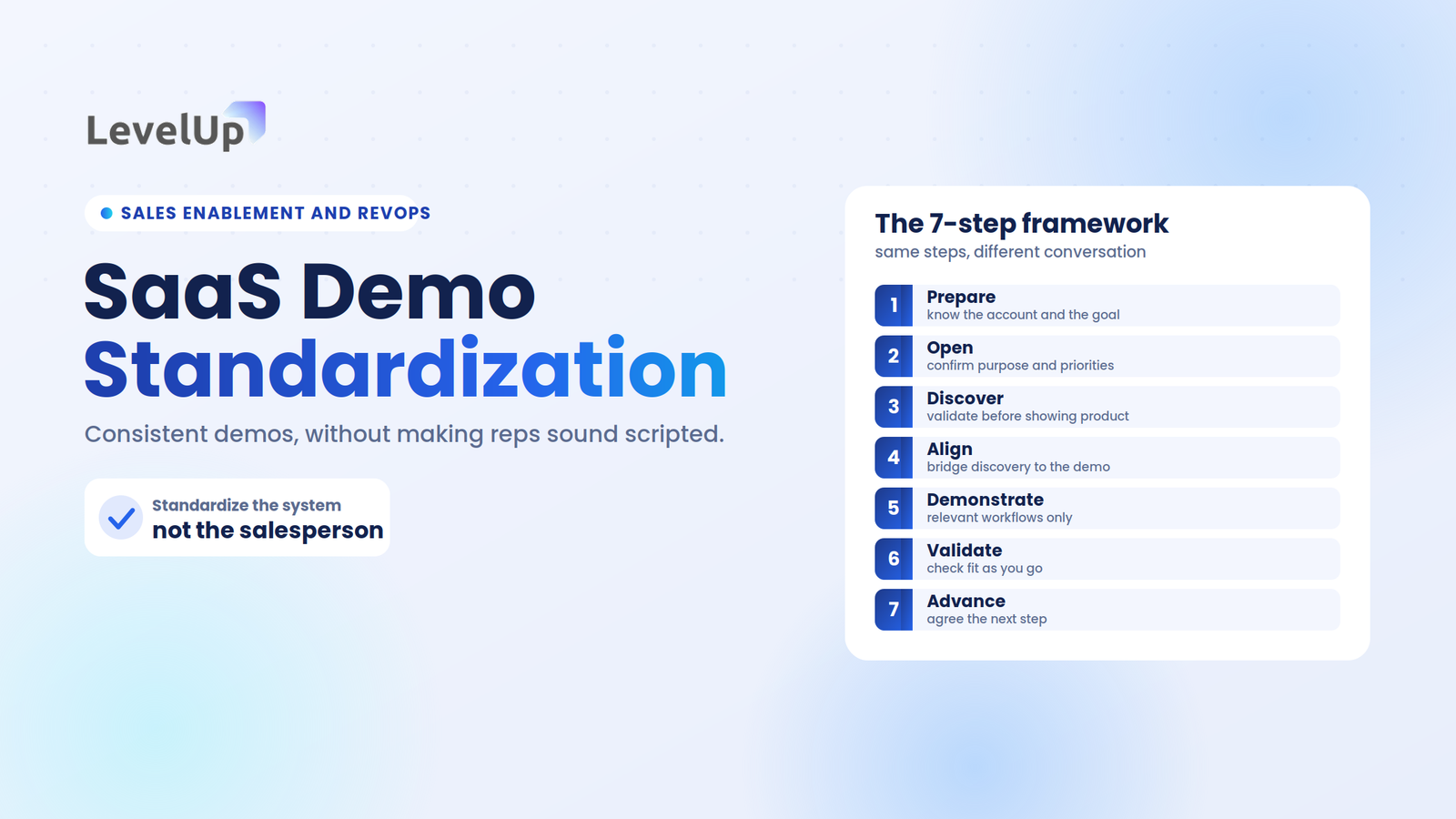
- Use a seven-step framework: Prepare, Open, Discover, Align, Demonstrate, Validate, Advance.
- Measure consistency and rep-to-rep variance, not just conversion, so you fix avoidable execution gaps without flattening good reps.
What is SaaS demo standardization?
SaaS demo standardization is the process of creating a repeatable framework, quality standard, and set of operating requirements for product demos, so different reps can consistently deliver a strong buyer experience while still adapting the conversation to each prospect.
Standardization can cover any part of the demo lifecycle that benefits from a shared definition of done:
- Pre-demo preparation
- Demo objectives
- Opening
- Discovery
- Demo structure
- Product storytelling
- Feature selection
- Objection handling
- Technical escalation
- Next steps
- Post-demo documentation
Standardization is not scripting
The distinction that makes this topic useful is the one most teams get wrong. Standardization is a consistent process. Scripting is predetermined language. A standardized demo might require discovery before the product walkthrough; a scripted demo requires every rep to say the same opening paragraph. One sets guardrails for behavior. The other dictates words. For complex SaaS sales, the first wins every time.
Why SaaS teams need to standardize their demos
The case for standardization is an operational one. These are the problems that show up as a team scales, before anyone decides to fix the demo itself.
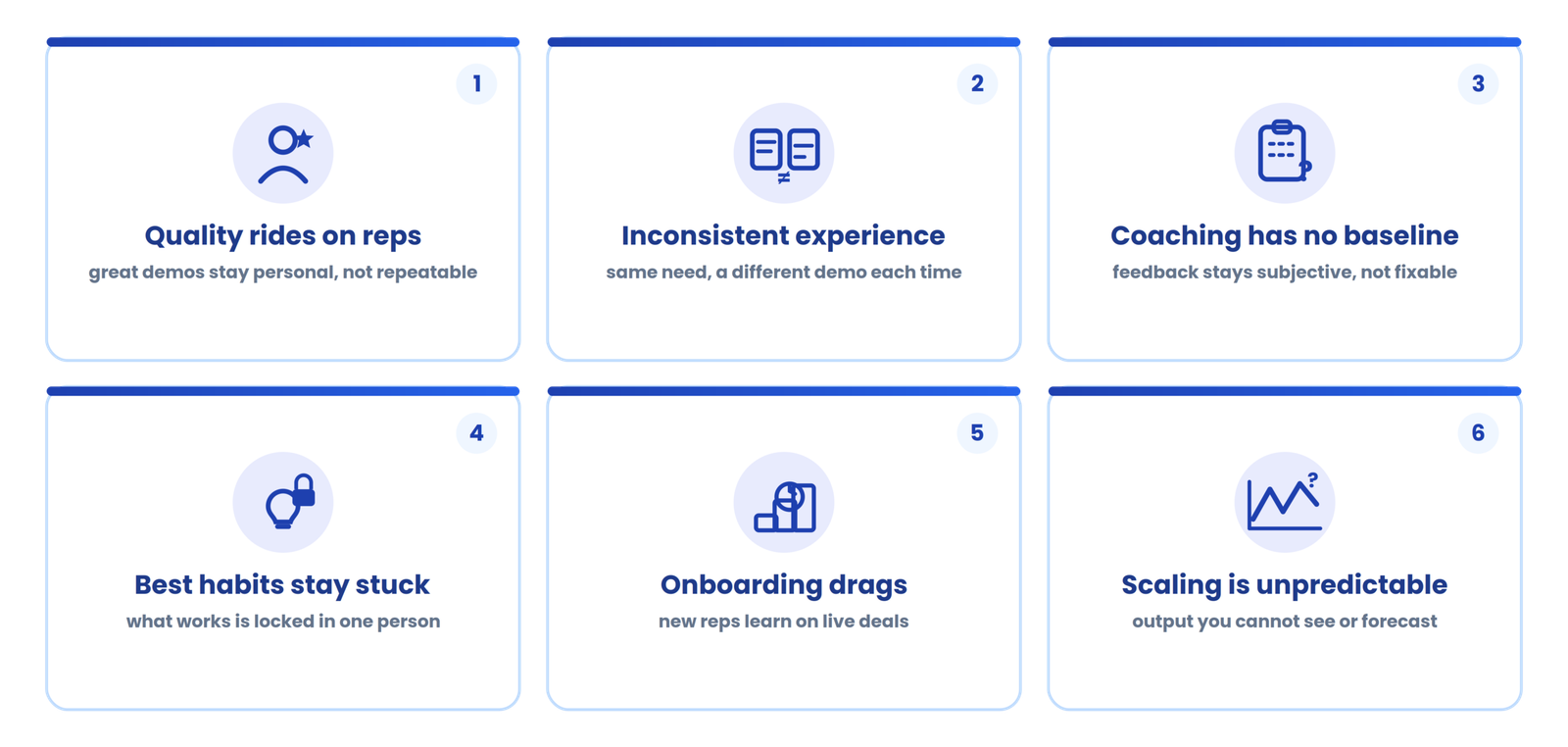
Demo quality becomes dependent on individual reps
Experienced reps develop their own approaches, and those approaches often work. The problem is that they only work for that rep. When demo quality lives in individual habits, it cannot be taught, copied, or relied on, and it does not survive the next ten hires.
Buyers get inconsistent experiences
Two prospects with nearly identical needs can receive completely different demos: one a tight, relevant, discovery-led session, the other a feature tour with no context. The buyer has no idea that what they got was a coin flip, but their evaluation of your product rides on it.
Managers struggle to coach effectively
Without an agreed standard, feedback becomes subjective. Bad coaching: “You need to make your demo more engaging.” Better coaching: “You moved into the product before confirming the prospect’s primary use case.” The second is only possible when there is a standard to measure against.
High-performing rep habits stay isolated
One rep discovers that leading with the reporting dashboard converts better for a particular segment. Without a standard and a way to fold improvements into it, the rest of the team never benefits. The insight stays locked in one person’s head.
Onboarding becomes harder
New reps have to reverse-engineer the demo process through trial and error on live deals. Every ramp is slower than it needs to be, and every early demo is a prospect spent learning rather than selling.
Scaling becomes unpredictable
A process that works with five reps who talk to each other every day may fall apart at thirty. Five slightly different habits is manageable. Thirty is variance you cannot see, cannot coach, and cannot forecast against.
Standardization vs. scripting: what’s the difference?
This is the distinction that gives the whole topic a point of view, so it is worth making concrete.
| Standardization | Scripting |
|---|---|
| Defines structure | Defines exact wording |
| Establishes minimum standards | Controls the conversation |
| Allows personalization | Often limits personalization |
| Provides guardrails | Can create rigidity |
| Supports coaching | Encourages memorization |
| Focuses on behavior | Focuses on language |
What standardization looks like
A standard describes a behavior that should happen. For example: “Every demo should confirm the buyer’s priorities before the product walkthrough.” How the rep confirms those priorities is up to them.
What scripting looks like
A script describes language that must be used. For example: “Every rep must say the same opening paragraph.” The moment a demo is read rather than had, the buyer feels it, and in complex SaaS sales that costs you the room.
Standardize what should happen. Let reps decide how to make it happen.
What should you standardize in a SaaS demo?
Not every part of a demo needs the same level of standardization. Fix the parts where consistency protects the buyer experience, and leave the rest to the rep. Here is where the line usually sits.
1. Pre-demo preparation
Require the inputs, not the method. Standardize that account research happened, CRM fields are populated, the demo objective is defined, the prospect’s role is known, the use case is identified, and discovery questions are prepared. You can use AI prompts for SaaS demo preparation to speed that up. Do not dictate exactly how each rep does the research; standardize that it happened and what it produced.
A useful stop-go test from teams that have done this well: pull five random demo records. If three lack a next step, owner, or outcome, your CRM is too dirty to trust any automation built on top of it.
2. Demo objective
Every demo should have a clear purpose beyond “show the product.” Standardize that an objective is chosen from a known set, such as: validate the use case, demonstrate product fit, confirm technical requirements, build the business case, advance to evaluation, or agree on a next step. The rep picks the objective that fits the deal; the requirement is that one exists.
3. Opening
Set a minimum opening structure and let reps phrase it naturally:
4. Discovery
Define the required discovery areas and the minimum that must be understood before the product appears: current workflow, the problem, its impact, the desired outcome, the existing solution, and the buying context. Do not mandate a twenty-question interrogation. The point is a discovery-first demo whose narrative changes by use case, not by rep preference.
5. Product demonstration
Standardize one principle: demonstrate the relevant workflows, not the entire product. The specific workflow depends on the buyer. The data backs this up. An analysis of sales demos by Kickscale found that demos showing one to three features closed at around 64 percent, while demos showing more than ten features closed at roughly 20 percent. Relevance beats coverage, so standardize relevance and let the rep choose which workflows qualify.
6. Objection handling
Standardize the process, not the words. A common frame keeps responses measured without forcing identical answers:
7. Technical escalation
Define when an AE should answer directly, when to verify before answering, when to bring in a sales engineer, and when to follow up after the call. A shared escalation rule stops reps from guessing on technical questions, which is where credibility is most often lost.
8. Next step
Every demo ends with an agreed outcome, an owner, a next action, and a timeline. This is a process requirement, not a nicety. When a deal hits “Demo Done” in your CRM, stage-based automation should create the follow-up task automatically. If it does not, the SaaS demo workflow is incomplete.
What should reps be allowed to customize?
Standardization without flexibility produces robots. These are the parts of the demo that should stay the rep’s to shape.
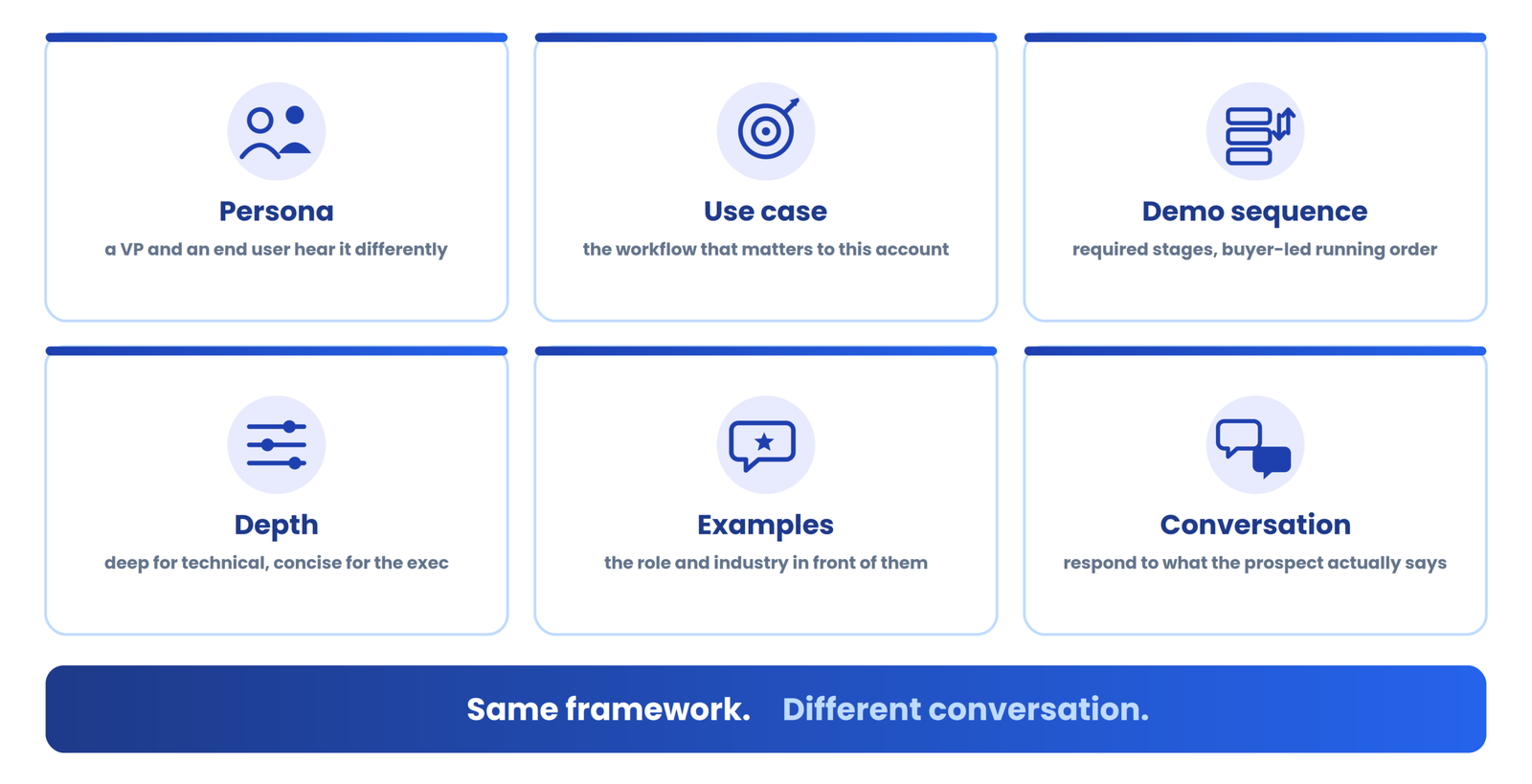
Persona
A VP and an end user should not receive identical messaging. The same workflow means different things to the person who runs it and the person who reports on it.
Use case
The relevant workflow changes by account. What matters to one buyer is noise to another, so the chosen use case belongs to the rep who ran discovery.
Demo sequence
The order can change depending on what the buyer most wants to see. A standard defines the required stages, not a fixed running order.
Depth
Technical stakeholders may need deeper detail; executives may need a concise business view. The rep reads the room and sets the depth accordingly.
Examples
Industry and role-specific examples make a demo land. Reps should pull the examples that match the buyer in front of them.
Conversation
Most of all, reps should respond to what the prospect actually says. A standard cannot anticipate the conversation; it can only make sure the important things happen inside it.
Same framework. Different conversation.
The 7-step SaaS demo standardization framework
This is the backbone of the whole system: a sequence every rep follows, at every experience level, regardless of the buyer.
Step 1: Prepare
Before the meeting, confirm who is attending, what you already know, what you do not know, the likely use case, and what this specific demo should accomplish.
Step 2: Open
Start with alignment. Confirm the purpose, the priorities, the agenda, and the expected outcome, so the buyer knows the call is built around them.
Step 3: Discover
Validate your assumptions. Explore the current process, the pain, its impact, the desired outcome, and any constraints, before the product appears.
Step 4: Align
Connect discovery to the planned demo out loud. Something like: “Based on what you have described, I would like to focus on how your team currently handles X and show you how that workflow changes with the platform.” This builds the bridge between discovery and demonstration so the walkthrough feels earned, not generic.
Step 5: Demonstrate
Show only the relevant workflows, and run each one through the same arc so the product always appears as the resolution to a problem:
Step 6: Validate
Do not wait until the end to check for fit. Ask as you go: does this match the workflow you described? How would your team use this? What would you need to change? Is anything missing?
Step 7: Advance
End with a defined next step, and capture the decision, the owner, the timeline, and any open questions, so the deal moves rather than stalls.
Turn the framework into a standard your team actually follows
A framework on a slide is not a standard. LevelUp Demo connects demo preparation, execution, and follow-up so the seven steps show up on real deals, not just in training.
How to build a SaaS demo playbook
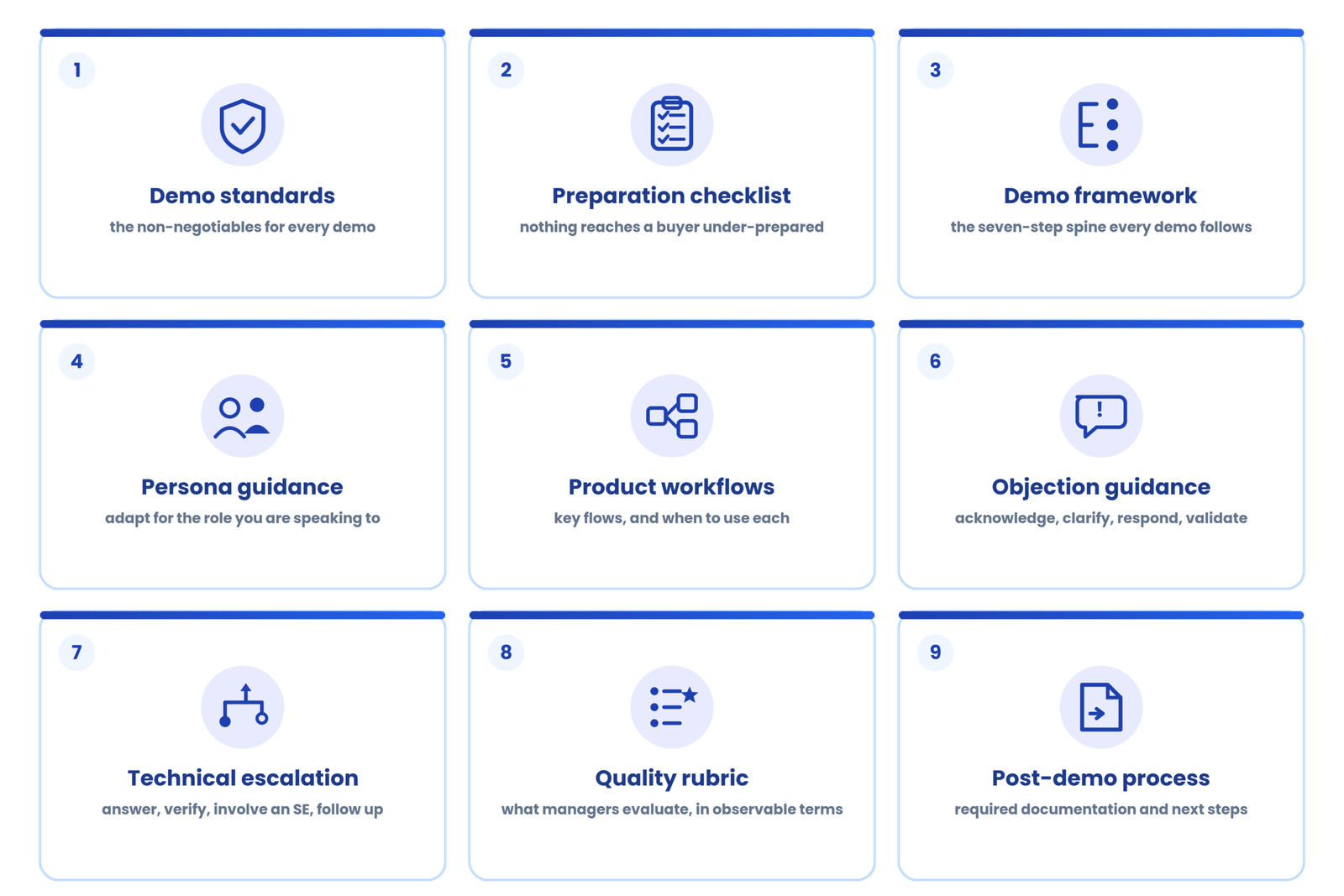
The framework only matters once it becomes usable documentation. A demo playbook turns the standard into something a rep can actually open before a call. Keep it to nine short sections.
Demo standards. Define what every demo should accomplish, the non-negotiables that apply regardless of deal.
Preparation checklist. List the required preparation, so nothing reaches a buyer under-prepared.
Demo framework. The seven-step process, written as the spine every demo follows.
Persona guidance. How to adapt messaging for practitioners, managers, executives, and technical stakeholders.
Product workflows. The key workflows, documented with when to use each one.
Objection guidance. Principles and examples, using the acknowledge-clarify-respond-validate frame, not canned rebuttals.
Technical escalation. When to answer, verify, involve a sales engineer, or follow up.
Quality rubric. What managers should evaluate, in observable terms.
Post-demo process. The required documentation and next steps once the call ends.
Do not build an enormous document nobody will use. The playbook should be short enough to use and detailed enough to guide.
Create a minimum demo quality standard
Before you can standardize demos, you have to define what good means. A minimum quality standard turns a vague aspiration into something managers can actually assess.
| Area | Standard |
|---|---|
| Preparation | Rep understands the account and the objective |
| Discovery | Buyer priorities are validated |
| Relevance | Demo reflects the buyer’s needs |
| Demonstration | Relevant workflows are shown |
| Interaction | Buyer participates |
| Accuracy | Claims and capabilities are verified |
| Objections | Concerns are handled appropriately |
| Next step | A clear action is agreed |
Avoid vague standards like “be engaging.” Make quality observable and coachable instead: “the rep checks for a buyer reaction after demonstrating a relevant workflow.” For a deeper evaluation model, pair this with your demo performance metrics so the standard connects to real outcomes.
How to standardize demos across different rep experience levels
The framework stays the same for everyone. What changes is the amount of support around it.
New reps
Need more structure: guided preparation, role-play, shadowing, and stronger checklists, so the standard carries them while the judgment develops.
Experienced reps
Need targeted coaching, performance feedback, advanced scenarios, and more autonomy, with the framework as a backstop rather than a crutch.
Senior reps
Need outcome-based standards, peer coaching, a hand in optimizing the framework, and coaching responsibilities of their own.
Standardization should provide more freedom as reps demonstrate competence, not less.
How to measure SaaS demo standardization
Do not measure standardization through revenue alone. Revenue is an outcome of many things; these metrics reveal consistency and variance, which is what a standard is meant to control.
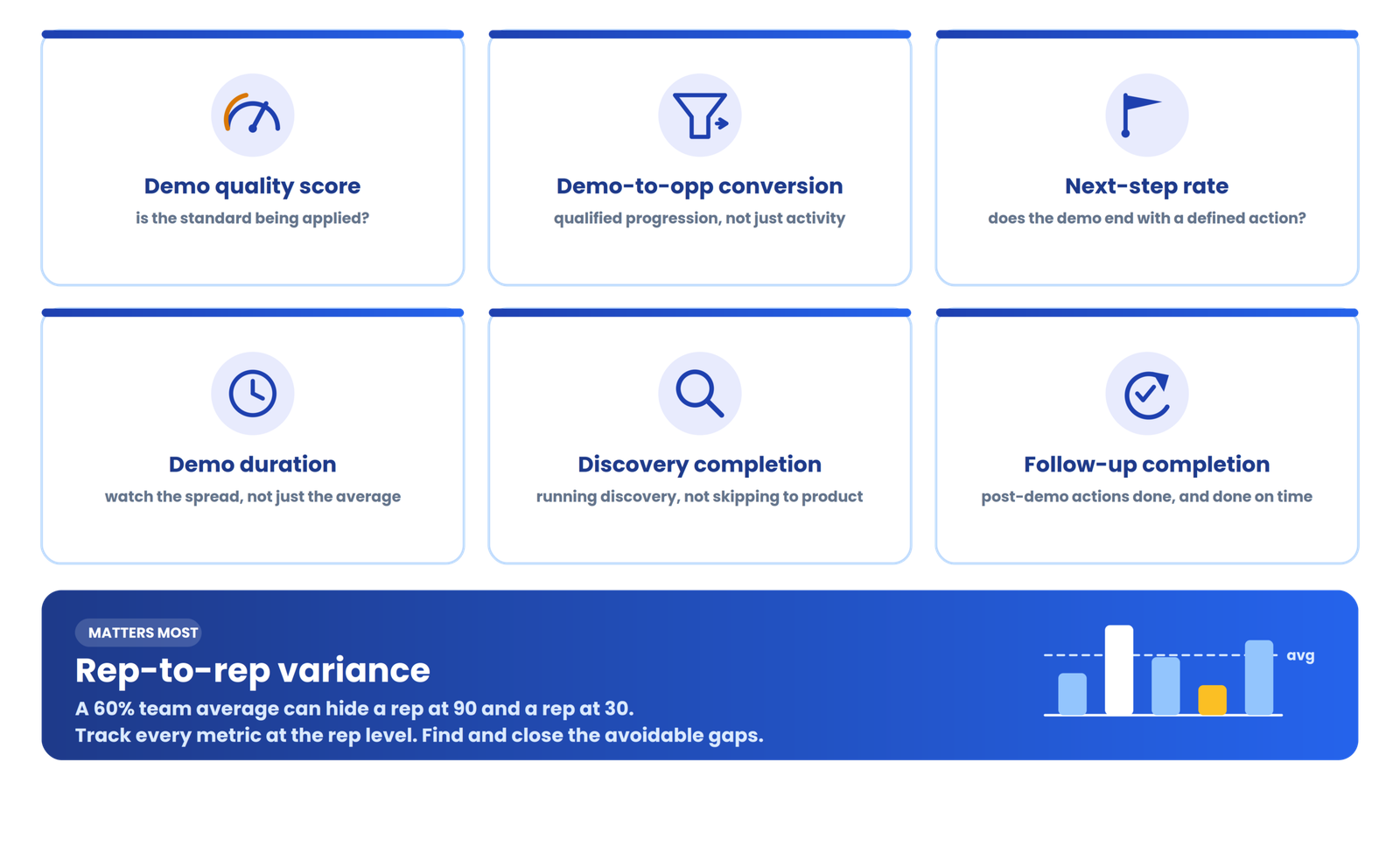
Demo quality score
How well are reps following the quality standard? This is the most direct read on whether the standard is being applied.
Demo-to-opportunity conversion
Are standardized demos producing qualified progression, or just activity?
Next-step rate
How often does a demo end with a defined next action? A standard that requires a next step should move this number.
Demo duration
Are demos drifting longer or becoming inconsistent? Longer is not automatically worse; HubSpot’s demo data finds successful demos tend to run noticeably longer than unsuccessful ones, because of real two-way conversation rather than longer feature tours. Watch the spread, not just the average.
Discovery completion
Are reps actually running discovery, or skipping to the product? A discovery-first standard is only real if this holds up.
Follow-up completion
Are post-demo actions happening? Follow-up timing varies widely from rep to rep when done is not defined, and speed matters, so a standard should close that gap.
Rep-to-rep variance
This is the one most teams skip, and it matters most. If the team averages a 60 percent next-step rate but one rep is at 90 and another at 30, the average hides the real story. The objective is not to make every rep identical; it is to find and close avoidable execution gaps. Track your metrics at the rep level, not just the team level.
Common SaaS demo standardization mistakes
Turning the demo into a word-for-word script. The fastest way to make a standard fail. A read demo sounds rehearsed, and buyers disengage the moment they feel it.
Standardizing every feature. Feature coverage is not demo quality. Mandating that every feature gets shown recreates the feature-tour problem the standard was meant to fix.
Removing personalization. Standardized does not mean identical. Strip out persona, use case, and examples and you have scripted the demo by accident.
Creating too many rules. A complex process is not a better process. Every extra rule is a thing reps ignore under pressure.
Measuring only conversion. Conversion tells you what happened, not why. Without quality and variance data, you cannot diagnose the cause.
Training once. A standard that is taught once and never reinforced quietly reverts to individual habits within a quarter.
Never updating the framework. Products and buyer expectations change. A frozen framework slowly stops matching reality.
Treating senior reps like new reps. Experienced reps need guardrails, not micromanagement. Over-controlling your best people is how you lose them.
SaaS demo standardization checklist
A practical checklist you can copy into your playbook or CRM.
Before the demo
During the demo
After the demo
How LevelUp Demo supports a more consistent demo process
Creating a standardized demo framework is only the first step. The harder part is making sure that framework is actually followed across real opportunities, every rep, every demo.
That is where the operational problem lives: multiple reps, multiple demos, different preparation, different execution, different follow-up, and therefore different outcomes. A document cannot enforce itself. The standard has to show up in the workflow where the work happens.
LevelUp Demo supports the relevant demo workflow by keeping preparation, execution context, and post-demo follow-up connected to the deal, so the quality bar is visible and the next step is captured rather than forgotten. If you want the standard you build to survive contact with a growing team, request a LevelUp Demo and see how it fits your process.
Frequently asked questions
What is SaaS demo standardization?
SaaS demo standardization is the process of defining a repeatable framework, quality standard, and set of process requirements for product demos, so different reps consistently deliver a strong buyer experience while still adapting the conversation to each prospect. It standardizes the process, not the words.
Should every sales rep use the same SaaS demo script?
No. Standardize the framework, the quality bar, and the critical process steps, not the exact language. A script controls wording and produces rehearsed-sounding demos; a standard sets behavior and lets reps have a natural conversation inside it.
What should be standardized in a SaaS demo?
Preparation requirements, the demo objective, the opening structure, discovery areas, the demo narrative arc, feature relevance, objection handling, technical escalation, and the required next step. These protect the buyer experience regardless of who runs the demo.
What should reps be allowed to customize?
Persona-specific messaging, the chosen use case, the demo sequence, the depth of detail, the examples used, and the conversation itself. Reps respond to the buyer in front of them within the shared framework.
How do you standardize demos without making them robotic?
Define behavioral standards instead of word-for-word scripts. “Confirm priorities before the walkthrough” is a standard; “say this exact sentence” is a script. Standards create consistency; scripts create memorization and the robotic feel buyers dislike.
What should a SaaS demo playbook include?
Demo standards, a preparation checklist, the demo framework, persona guidance, documented product workflows, objection guidance, technical escalation rules, a quality rubric, and the post-demo process. Keep it short enough to use and detailed enough to guide.
How do you measure demo consistency?
Compare rep-to-rep variance on demo quality scores, next-step rates, discovery completion, demo duration, and follow-up completion, alongside demo-to-opportunity conversion. Averages can hide inconsistency, so the variance across reps is the number that reveals avoidable execution gaps.
Final takeaway
The goal of demo standardization is not to make every rep sound the same. It is to make sure every prospect gets the same baseline of preparation, relevance, clarity, and professionalism, whichever rep they happen to meet.
Standardize the process. Standardize the quality bar. Keep the conversation human.
Standardize the system, not the salesperson. Build the framework, define what good looks like, and then give your reps the room to be the reason a buyer chooses you. If you want help making the standard stick across a growing team, see how LevelUp Demo fits your demo workflow.
Standardize the system, not the salesperson
Give every prospect the same baseline of preparation, relevance, and clarity, without flattening what makes your reps effective. LevelUp Demo keeps your demo standard visible and followed across the whole team.