
Your marketing team is celebrating a record quarter. Demo requests are up 40%. Sales confirms pipeline is growing. Then your CEO opens the board deck and asks a question that shouldn’t be hard:
Which of those demos actually contributed to the revenue we closed?
And suddenly, three people are pulling numbers from three systems, and none of them agree.
That moment, the one where demo volume and revenue exist in the same company but not in the same story, is where most SaaS teams realize they have an attribution problem they haven’t named yet. This article unpacks what that problem actually is, why traditional attribution models miss it, and how to think about connecting demo activity to business outcomes without drowning in dashboards that report everything and explain nothing.
By the end, you’ll have a clear framework for understanding where demo data breaks down and what to connect so your revenue story includes the demo chapter.
Who should keep reading (and who shouldn’t)
This is relevant if you’re running a SaaS company or sales team where demos are a meaningful part of how deals move forward. Founders juggling sales and product. Heads of sales watching demo-to-opportunity conversion. RevOps teams trying to make CRM data actually trustworthy. Demand gen leaders who need to know whether high demo volume means high-quality pipeline.
If you’re looking for a step-by-step CRM setup tutorial, this isn’t that. If you’re pre-revenue and haven’t run 50 demos yet, the operational complexity here will feel premature. Start with getting your demo workflow consistent first, then come back when you’re ready to measure what it produces.
What demo attribution actually is
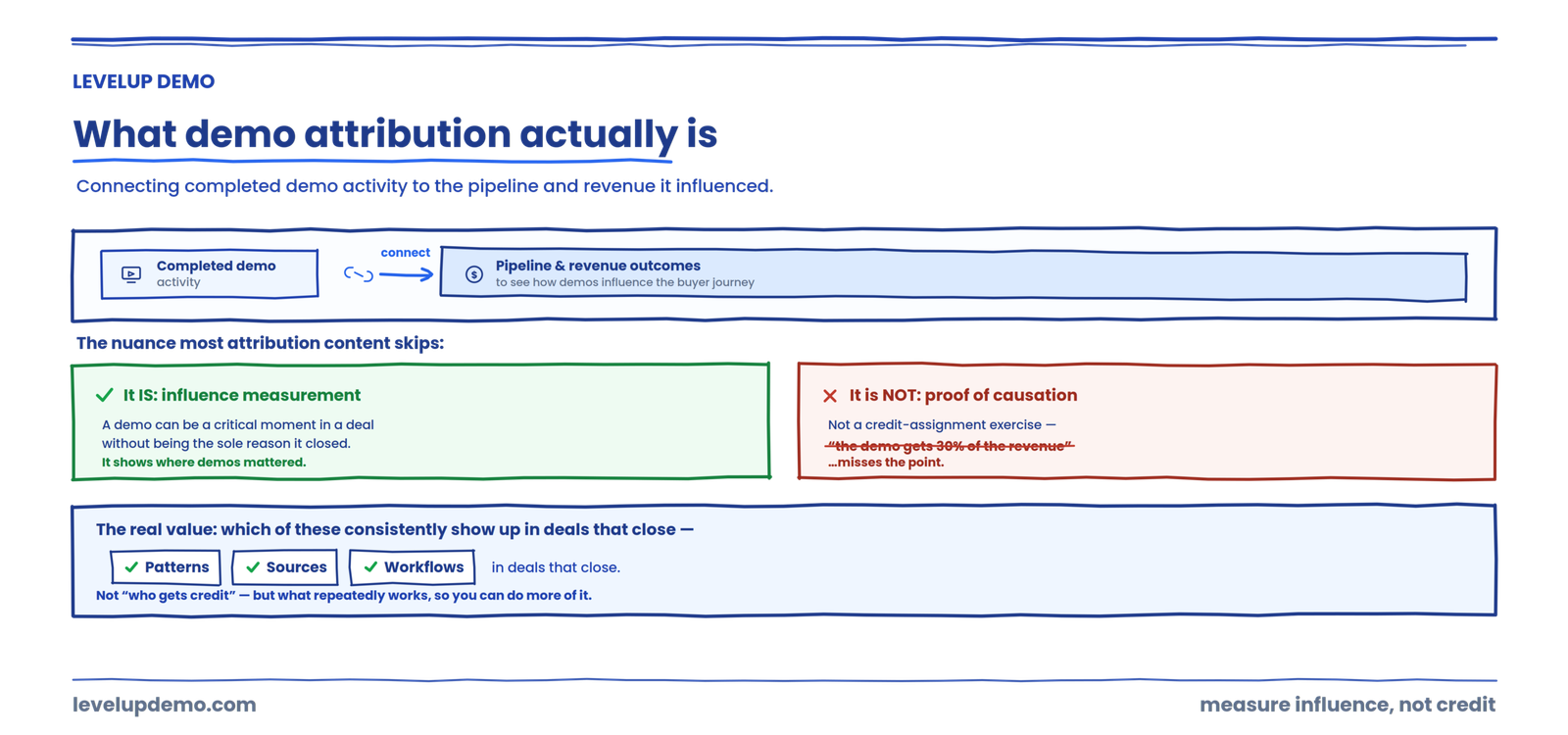
Demo attribution is the practice of connecting completed demo activity with downstream pipeline and revenue outcomes to understand how demos influence the buyer journey. That’s the core of it.
Attribution is not the same as causation
But there’s a nuance most attribution content skips. Attribution is influence measurement, not proof of causation. A demo may be a critical moment in a deal without being the sole reason the deal closed. Treating attribution as a credit-assignment exercise (“the demo gets 30% of the revenue”) misses the point. The real value is understanding which demo patterns, sources, and workflows consistently appear in deals that close.
The fragmented measurement problem
Most SaaS teams already track the raw ingredients. Demo requests. Demos completed. No-show rates. Opportunities created. Pipeline value. Closed revenue.
The problem isn’t missing data. The problem is disconnected data.
Marketing sees acquisition sources. Sales sees calendar events and opportunities. Finance sees closed revenue. The CRM has records for all of it, theoretically, but the connective tissue between “a prospect from this campaign requested a demo on this date, attended with these stakeholders, received follow-up within this window, and became this opportunity that closed for this amount” rarely survives intact.
A dashboard can show you every number you need and still fail to tell you what happened. That’s the gap.
The Demo Attribution Gap
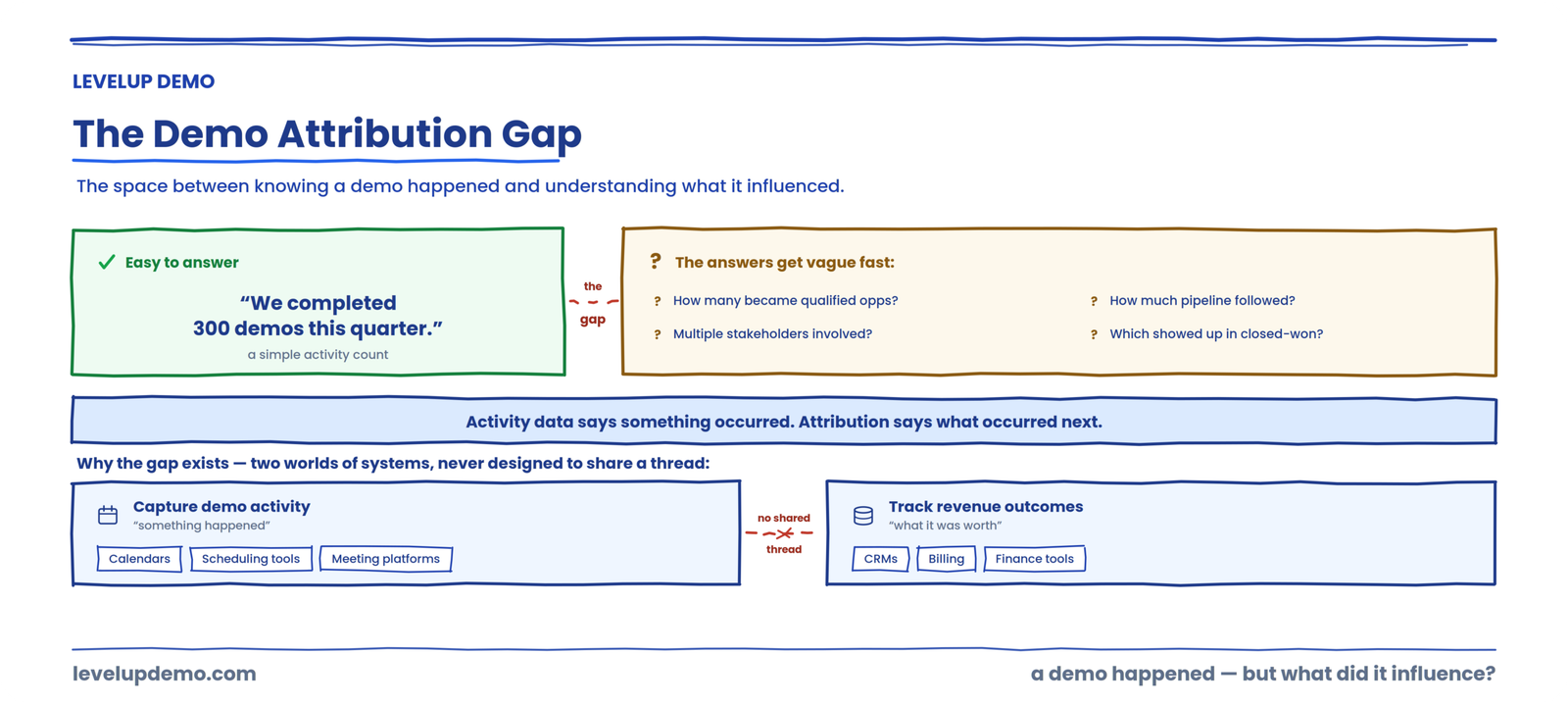
Here’s what it looks like in practice. A company says: “We completed 300 demos this quarter.” Reasonable thing to measure. Now ask the follow-up questions. How many of those 300 created qualified opportunities? How much pipeline followed? Which ones involved multiple stakeholders from the buying committee? Which demo experiences showed up in accounts that became closed-won revenue?
The answers get vague fast.
At LevelUp Demo, we call this disconnect the Demo Attribution Gap: the space between knowing a demo happened and understanding what business outcome that demo influenced.
Activity data tells you something occurred. Attribution helps you understand what occurred next. The gap exists because the systems that capture demo activity (calendars, scheduling tools, meeting platforms) and the systems that track revenue outcomes (CRMs, billing, finance tools) weren’t designed to maintain a shared thread.
The Demo Revenue Chain
To see where attribution breaks, it helps to map the full journey a demo sits inside.
→
Demo request
→
Qualification
→
Routing
→
Scheduling
→
Completed demo
→
Follow-up
→
Opportunity
→
Pipeline
→
Revenue
Revenue visibility breaks whenever one link in this chain loses its connection to the next. Marketing knows the source. Sales knows the meeting happened. The CRM knows an opportunity exists. Finance knows the deal closed. But the complete journey from source to revenue, passing through the demo, is rarely visible to any single person or system.
This is why “how many demos did we do?” and “how much revenue did we close?” can both be answered confidently while “which demos drove that revenue?” draws blank stares.
What should SaaS teams actually attribute to a demo?
Before you can connect demos to revenue, it helps to be precise about what “attribute” even means here. There are five distinct things worth tying back to a demo, and most teams stop at the first one.
The first four tell you what a demo produced. The fifth tells you why, which is the difference between a report and something you can act on.
Why traditional attribution models miss the demo story
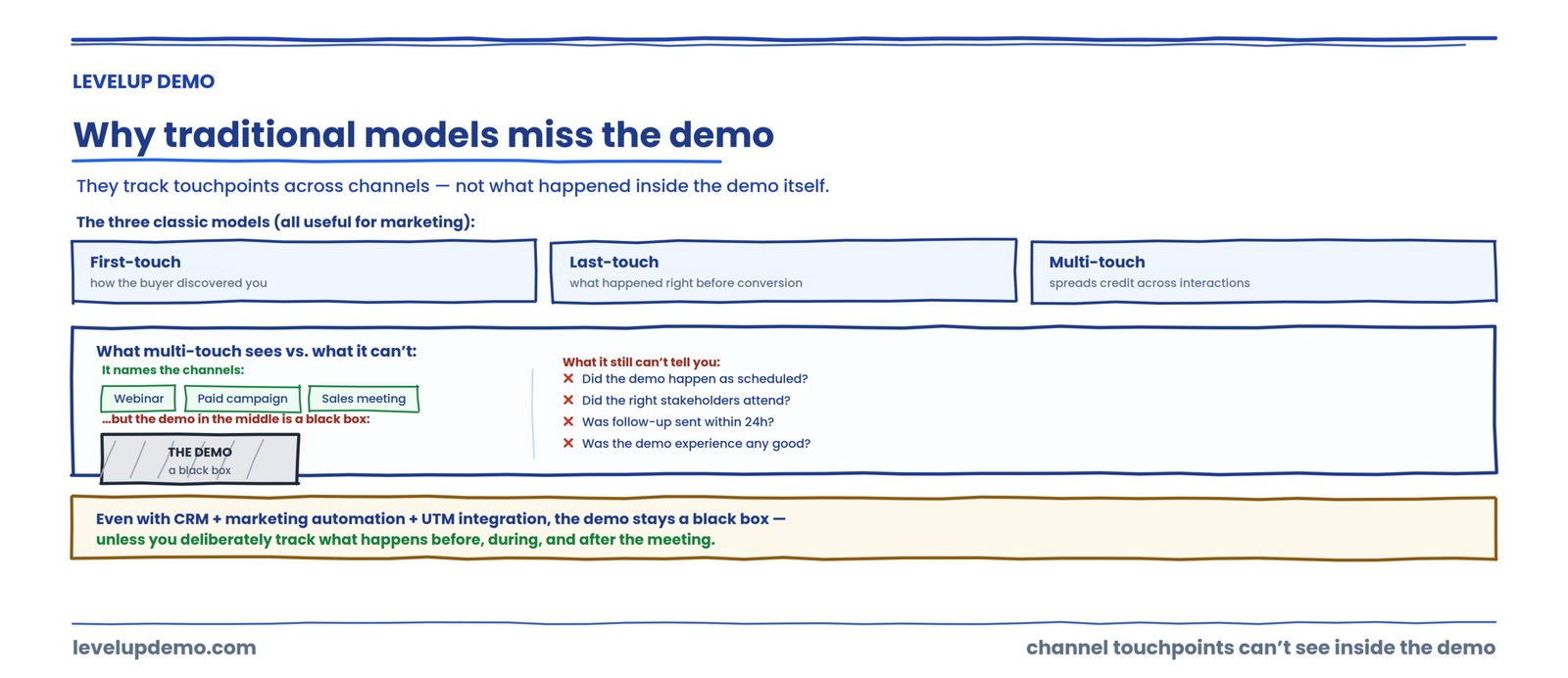
First-touch attribution tells you how a buyer discovered you. Last-touch tells you what happened right before conversion. Multi-touch distributes credit across interactions. All useful for marketing analysis.
But these models were built to track touchpoints across channels, not to explain what happened inside the demo journey itself.
A multi-touch model might tell you that a webinar, a paid campaign, and a sales meeting all influenced a deal. It won’t tell you whether the demo actually happened as scheduled, whether the right stakeholders attended, whether follow-up was sent within 24 hours, or whether the demo experience itself was any good.
Dreamdata and Factors.ai both describe multi-touch attribution as requiring integration of CRM, marketing automation, and UTM data to connect touches to revenue. That integration matters. But even with it, the demo itself remains a black box unless you’re deliberately tracking what happens before, during, and after the meeting.
The Demo Attribution Model
To make the problem easier to analyze, the LevelUp Demo team uses a four-layer model.
Layer 1 · Acquisition
Where did the buyer come from? Which channel, campaign, or referral generated the request? This answers whether your demand sources produce demo requests that become customers, or just demo requests.
Layer 2 · Demo journey
What happened between the request and the post-demo moment? Qualified? How routed? Did scheduling drag? Did the right people attend? Timely follow-up? Least visibility, most operational leverage.
Layer 3 · Pipeline influence
Did an opportunity get created? How quickly? Did the deal progress or stall? This connects the demo to sales outcomes.
Layer 4 · Revenue outcome
Did the account close? What was the deal value? How does that compare to accounts where the demo journey looked different?
This isn’t first-touch versus last-touch. It’s a way to see the full story instead of fragments.
The Five Demo Attribution Breakpoints
Five breakpoints consistently show up in SaaS demo operations. Each is a place where one link in the revenue chain loses its connection to the next.
The ghost errors nobody warns you about
| Problem | The weird fix |
|---|---|
| Demos show in CRM but revenue isn’t tied back to source | Reconcile closed-won deals weekly; manually map a sample back to source fields |
| Every high-performing channel shows as “Direct” | Add a hidden URL field plus a self-reported attribution question on the demo request form |
| SDR activity and demos are invisible in reporting | Require a specific activity type for demos in CRM; audit 10 recent opportunities for completeness |
| Attribution numbers differ across CRM, ad platform, and analytics | Pick one revenue source of truth and document the lookback window by sales motion |
| “Unknown” source keeps growing quarter over quarter | Capture landing page URL and referrer at form submission; compare against CRM fill rate |
Where practitioners disagree
There’s a live debate about lookback windows. One camp, mostly teams running sales-led motions with 90-plus-day cycles, argues for 90 to 180 day attribution windows. The other, typically PLG-oriented teams, insists anything beyond 30 to 90 days introduces noise that makes attribution less useful, not more. I land on the longer window for sales-led SaaS because shortening it systematically erases the influence of early-stage touches like demos that happen months before close, but this is genuinely unsettled and depends on your sales cycle length.
The metrics that actually connect demos to revenue
Demo-to-opportunity rate measures how effectively completed demos become qualified opportunities. Demo-to-close rate tracks how often completed demos appear in closed-won accounts. Pipeline per demo shows pipeline value relative to demo volume. Revenue per demo does the same for closed revenue.
Time from demo to opportunity matters because it reveals momentum. Stakeholder coverage, whether the relevant buying group participated, correlates with deal quality in ways that single-attendee demos rarely match. Follow-up speed, how quickly the conversation continues after the demo, is one of the most controllable variables in the entire chain.
Implementation guidance from Dreamdata suggests a 2 to 4 week standard setup for attribution if CRM hygiene and UTM discipline are already in place. If your duplicate contact rate is above 10%, that’s the bottleneck to fix before any attribution model will produce trustworthy results.
Keep the demo journey connected end to end
LevelUp Demo keeps request, qualification, scheduling, follow-up, and outcome in one thread, so the attribution story doesn’t break at every handoff between systems.
How to build a demo attribution system
You don’t fix attribution with a dashboard. You fix it by building a system that keeps the journey connected. Six steps, in order.
How to use demo attribution data to improve the demo operation
Attribution shouldn’t end with reporting. The only question that matters after you can see the patterns is: what should we change now? The data points at specific fixes:
Sources produce poor-quality demos
Improve acquisition targeting or tighten qualification before the demo is booked.
Certain demos rarely progress
Investigate preparation and delivery: were the right people there, was the use case right?
Opportunities stall after demos
Review next steps and follow-up speed. The gap after the meeting is usually the culprit.
Some reps or workflows outperform
Understand what they do differently, then make it the standard the rest of the team runs.
That’s the sequence that matters: measurement leads to insight, and insight leads to operational improvement. Reporting that stops at “here’s what happened” leaves the most valuable step on the table.
Demo attribution vs marketing attribution vs demo analytics
These terms get used interchangeably, and they shouldn’t be. Each answers a different question.
| Area | The main question it answers |
|---|---|
| Marketing attribution | Where did demand come from? |
| Demo analytics | What happened across demo performance? |
| Demo attribution | How did demo activity connect to pipeline and revenue? |
| Demo operations | What should the team improve in the workflow? |
Marketing attribution explains how a buyer entered the journey. Demo analytics describes how demos performed. Demo attribution connects that activity to pipeline and revenue. And demo operations turns the answer into a change in how the workflow runs. Together they form a chain, not a set of competing tools.
When does a SaaS team need demo attribution?
Not every team needs this on day one. But a few signals mean it’s time to stop counting demos and start connecting them:
From demo activity to demo operations
Attribution reveals patterns. Some sources consistently produce demo requests that become customers. Some routing workflows correlate with faster deal progression. Some follow-up delays correlate with lost momentum. Some demos with weak stakeholder participation rarely convert.
Once you can see those patterns, the question shifts from “what happened?” to “how should we improve the system?” That’s where attribution connects to Demo Operations: the practice of treating the entire demo workflow as an optimizable system rather than a collection of isolated calendar events.
From demo attribution to demo intelligence
Attribution is one stage in a longer progression. Each step builds on the one before it:
→
Measurement
→
Attribution
→
Insight
→
Optimization
Attribution tells you what happened across the journey. Demo Intelligence is the next step: understanding the patterns behind those outcomes and using them to make better decisions, not just better reports. The teams that get there stop asking “did the demo happen?” and start asking “what does the demo data tell us to change?”
Frequently asked questions
What is demo attribution?
Demo attribution is the practice of connecting demo activity, including the request, scheduling, completion, and follow-up, with downstream outcomes like qualified opportunities, pipeline, and closed revenue. The goal is understanding how demos influence the buyer journey rather than simply counting that demos occurred. Attribution measures influence, which is different from claiming a demo single-handedly caused a deal to close.
How do you measure whether demos generate revenue?
Connect completed demo records in your CRM to the opportunities and closed-won deals associated with those same accounts. Track demo-to-opportunity rate and demo-to-close rate over time. If those connections don’t exist in your data, that’s the first problem to solve.
What’s the difference between demo attribution and marketing attribution?
Marketing attribution explains how a buyer entered the journey. Demo attribution explains what happened once the buyer entered the demo journey. Both are useful. Together they tell a more complete story than either one alone. You can read more about how demo workflows connect to revenue outcomes on the LevelUp Demo blog.
Which demo metrics matter most?
Demo-to-opportunity rate and demo-to-close rate answer the most important revenue questions. Pipeline per demo and revenue per demo give you efficiency context. Follow-up speed is the metric most teams undervalue and the one most directly within their control.
Can a demo influence a deal without directly causing the sale?
Yes. Complex B2B buying journeys involve multiple stakeholders and interactions over weeks or months. A demo might be the moment a technical evaluator gets convinced, even if the economic buyer’s final decision happens after a separate negotiation. Attribution should capture that influence without overstating it.
How is demo attribution different from demo analytics?
Demo analytics describes how your demos performed (volume, no-show rates, conversion rates across the funnel). Demo attribution connects that activity to specific pipeline and revenue outcomes, answering which demos and demo patterns influenced deals that closed. Analytics tells you how demos did; attribution tells you what they were worth.
How do you connect demos to pipeline in a CRM?
Ensure the demo record (contact, account, date, attendees, outcome) is linked to the opportunity record. This sounds obvious, but the connection breaks constantly when scheduling tools, meeting platforms, and CRM records aren’t integrated.
Teams don’t need another dashboard confirming that demos happened. They need a way to understand what happened because those demos happened, and what to change as a result. Measure the journey. Understand where it breaks. Then improve the operation that produces it. That’s the sequence. And if your next step is figuring out which parts of your demo workflow need the most attention, start with the five breakpoints above and audit ten recent opportunities against them. The gaps will be obvious fast.
Stop measuring demos as isolated events
If your team is connecting demo activity to revenue by hand, LevelUp Demo keeps the whole journey, from request through follow-up and outcome tracking, connected in one place, so the attribution story doesn’t break at every handoff.