
Most demo automation tools focus on delivering demos — not converting them. Here’s the breakdown that actually matters.
I spent six weeks last quarter helping a 4-person SaaS sales team untangle their demo process. They were running 40+ demos a month using one of the “top-rated” interactive demo platforms. Engagement metrics looked great. Click-through rates, solid. Conversion to paid? Flat. The problem wasn’t the demo experience — it was everything that happened after someone watched the demo.
No lead capture. No qualification. No follow-up system. Just a beautiful interactive walkthrough floating in the void.
That experience rewired how I evaluate this entire category.
TL;DR: Key Insights
- Demo automation reduces manual effort and scales demos: Fewer repetitive live calls; more pipeline coverage
- Interactive demos improve engagement and shorten sales cycles: Buyers self-educate faster, arrive warmer
- Most tools focus on demo experience, not conversion: Great demos don’t automatically produce revenue
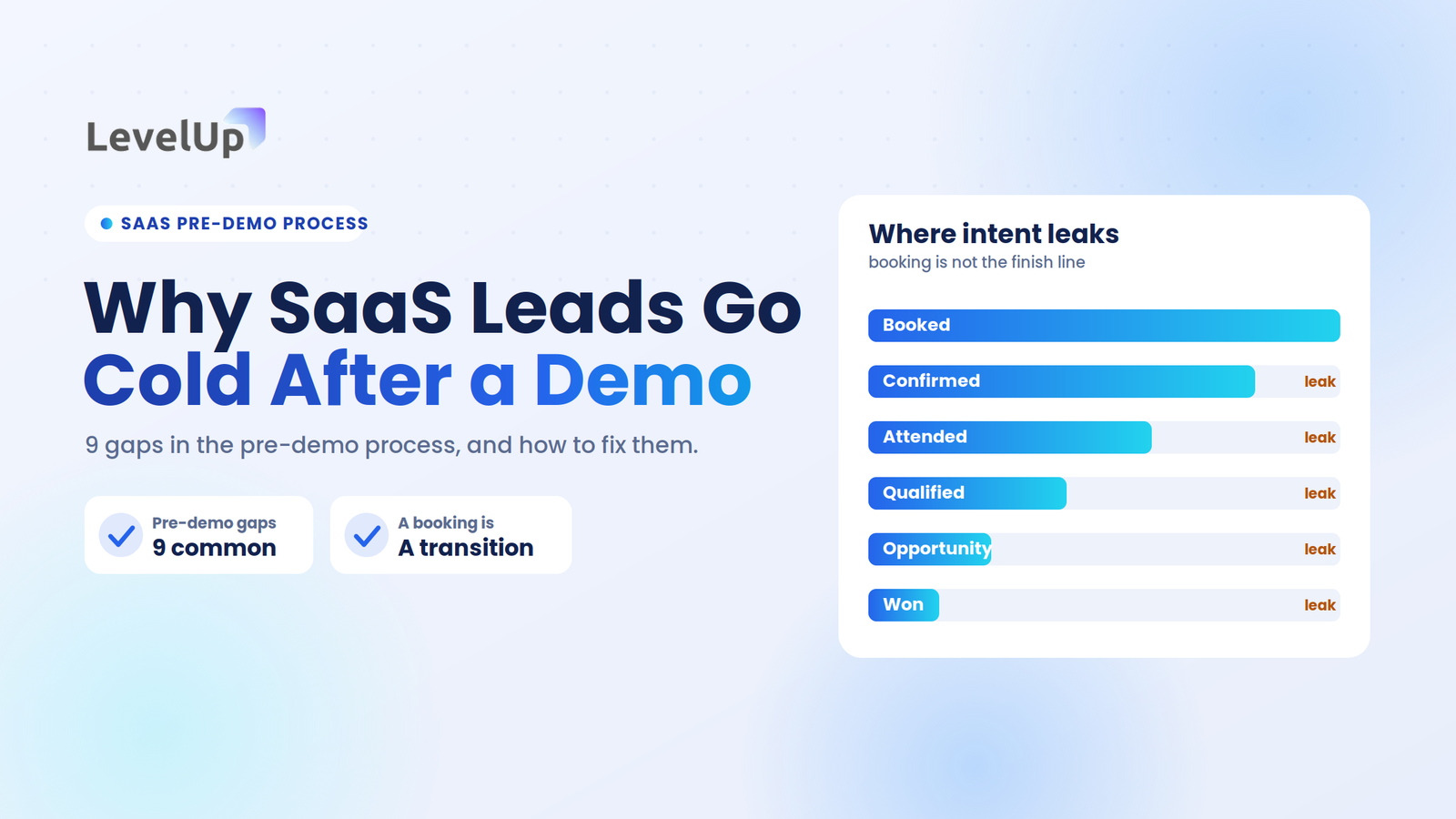
- SaaS teams lose deals after demos due to poor follow-up and tracking: The post-demo gap is where pipeline leaks
- The best tools connect demo delivery with conversion workflows: Systems beat standalone tools every time
What Is Demo Automation Software?
Demo automation software helps SaaS teams create, deliver, and scale product demos using interactive walkthroughs, videos, or simulations — without needing a live sales call.
These tools range from HTML cloning platforms that replicate your product’s UI to video-based demo builders that let prospects explore at their own pace.
The category has exploded because of one simple shift: SaaS buyers don’t always want to talk to sales first.
They want to explore the product on their own — quickly, on their own time, without scheduling a 30-minute call just to see if the thing works.
That’s where demo automation comes in.
Why Demo Automation Is Growing Fast
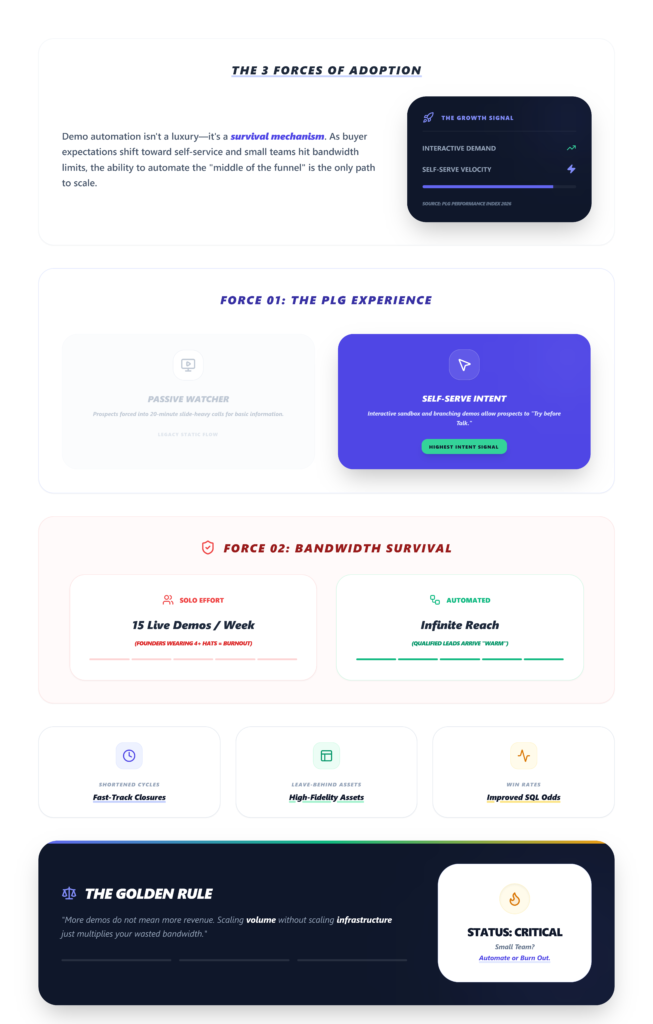
Three forces are driving adoption hard right now.
First, product-led growth changed buyer expectations. People want to try before they talk. Interactive branching demos, sandbox environments, and leave-behind assets give prospects that self-serve experience without engineering effort.
Second, small SaaS teams can’t afford to run 15 live demos a week. A founder wearing four hats doesn’t have the bandwidth. Presales automation isn’t a luxury anymore — it’s survival.
Third (and this is the one most roundups skip), the post-demo workflow is where deals actually close or die. Automated demos can shorten sales cycles and improve win rates — but only when used correctly.
More demos don’t mean more revenue. Not even close.
How Demo Automation Impacts Sales
Here’s what actually changes when you automate demos well:
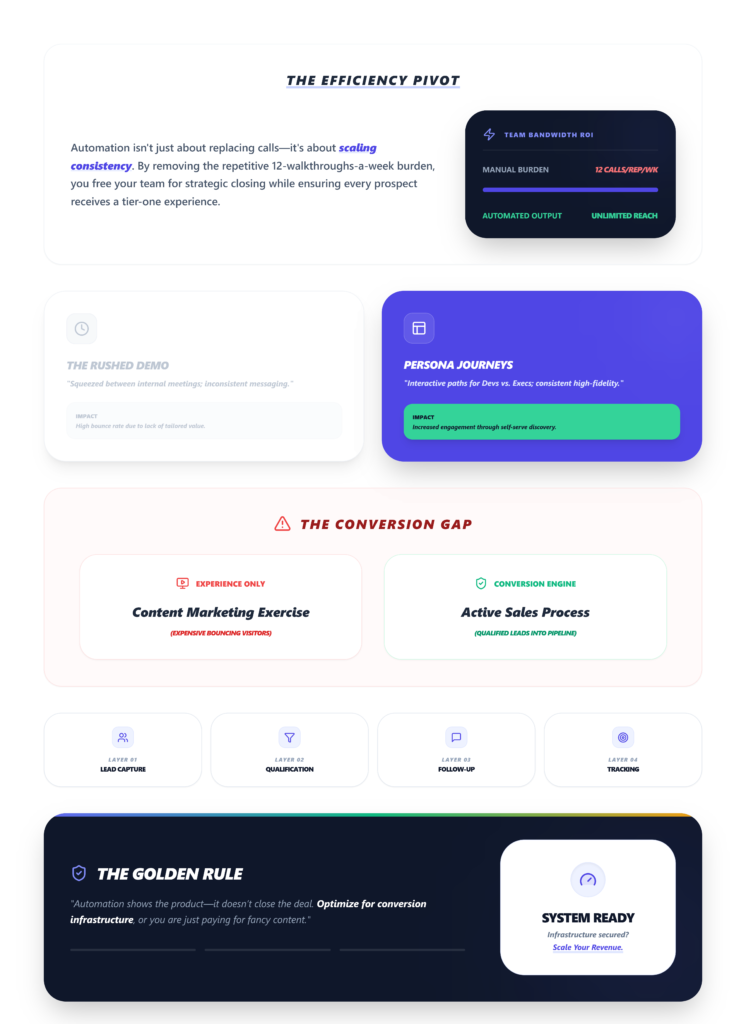
- Manual demo effort drops. Your team stops repeating the same walkthrough 12 times a week.
- Product experience scales. Every prospect gets a consistent, high-quality demo — not a rushed one squeezed between meetings.
- Engagement improves. Interactive demos with persona-based journeys keep prospects clicking instead of bouncing.
But here’s the part that matters: demo automation shows your product — it doesn’t close deals.
If there’s no lead capture, no qualification layer, no follow-up system, and no conversion tracking, you’re just running a content marketing exercise disguised as a sales process.
Most tools optimize for experience, not conversion. And that gap is expensive.
The Quick Verdict Matrix
- End-to-End Demo Conversion
Top Pick: LevelUp Demo
One Reason Why: Only platform connecting demo delivery to follow-up, qualification, and outcome tracking - Interactive Product Demos
Top Pick: Navattic
One Reason Why: Best HTML cloning with account-level analytics for PLG teams - Personalized Demo Storytelling
Top Pick: Walnut
One Reason Why: Deep per-prospect customization with deal rooms and CRM sync - Technical Presales Demos
Top Pick: Reprise
One Reason Why: Full sandbox environments for complex product simulations - Lightweight Interactive Demos
Top Pick: Storylane
One Reason Why: No-code setup, transparent pricing, fast time-to-value - Video-Based Automated Demos
Top Pick: Consensus
One Reason Why: Asynchronous video demos built for multi-stakeholder buying committees
The Selection Framework: How I Evaluated These Tools
I used four weighted factors, calibrated specifically for SaaS founders and small sales teams (not enterprise procurement committees):
- Time-to-Value (TTV) — 30% weight.
How fast can you go from signup to a live, publishable demo? Founders can’t afford a 2-week onboarding cycle. If the first demo isn’t live within 48 hours, the tool is already fighting uphill. - Pricing Transparency & Scaling Friction — 25%.
Per-creator billing traps are real. A tool that costs $38/month for one person can quietly become $350/month when your GTM team grows to five. I looked at 3-year TCO projections, not just sticker prices. - CRM Integration Depth — 25%.
CRM sync isn’t optional. If demo engagement data doesn’t flow into HubSpot or Salesforce in real time, your sales team is flying blind. Manual CSV exports aren’t a “workaround” — they’re a liability. - No-Code Customization — 20%.
If the marketing or sales team can’t personalize demos without filing an engineering ticket, adoption will stall. Interactive branching, dynamic variables, and white-label URLs need to be accessible to non-technical users.
Demo Automation Tools Comparison
- LevelUp Demo
✅ Supported: Demo delivery, Lead capture, Qualification, Follow-up automation, Conversion tracking, End-to-end workflow
⚠️ Partial: Interactive demos - Navattic
✅ Supported: Demo delivery, Interactive demos
⚠️ Partial: Lead capture
❌ Missing: Qualification, Follow-up automation, Conversion tracking, End-to-end workflow - Walnut, Reprise & Storylane
✅ Supported: Demo delivery, Interactive demos
❌ Missing: Lead capture, Qualification, Follow-up automation, Conversion tracking, End-to-end workflow - Consensus
✅ Supported: Demo delivery
⚠️ Partial: Interactive demos
❌ Missing: Lead capture, Qualification, Follow-up automation, Conversion tracking, End-to-end workflow
This breakdown tells a story. Every tool in this list can deliver a demo. Only one connects demo delivery with the conversion workflow that actually produces revenue.
Best Demo Automation Software for SaaS Teams
1. LevelUp Demo — Best for End-to-End Demo Conversion
Here’s the uncomfortable truth about most demo automation platforms: they end where the real work begins. The demo plays. The prospect watches. And then… nothing. No captured lead. No qualification. No scheduled follow-up. No outcome tracking.
LevelUp Demo approaches the problem differently. It’s not just a demo tool — it’s a demo workflow system.
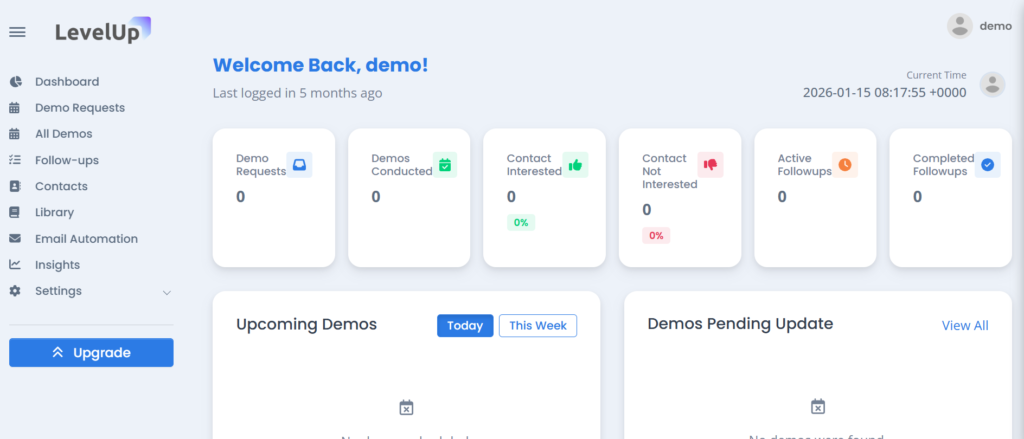
It captures leads through a smart demo form that replaces your standard “Request a Demo” page, auto-logs them into a dashboard, qualifies them instantly, schedules demos with the right team member via Google Calendar integration, manages follow-ups with dedicated views and reminders, and tracks outcomes (Won, Lost, In Follow-up, Pending) in a lightweight CRM.
The “Sticker” vs. “Reality” check: LevelUp doesn’t build interactive HTML demos or sandbox environments. That’s not its game. If you need pixel-perfect product simulations, you’ll pair it with a tool like Navattic or Storylane.
But if your bottleneck is conversion — not demo experience — this is the missing layer.
Scaling behavior: Because it’s built as a lightweight system (not an enterprise CRM), the cost and complexity don’t balloon when you go from 2 users to 10. There’s no per-creator billing trap.
Visual checkpoint: The analytics dashboard shows demo requests, outcomes, follow-up rates, and conversion metrics in one clean view. When the “Follow-ups” tab shows zero pending items, you know your pipeline is clean. When it doesn’t, you know exactly where to look.
Unlike most demo automation tools, LevelUp connects demo delivery with conversion workflows. That’s the gap I see SaaS teams fall into repeatedly — and it’s the reason I keep recommending it.
Ready to close the post-demo gap?
LevelUp Demo connects your demo workflow to actual conversion outcomes — lead capture, qualification, follow-up, and tracking in one system.
2. Navattic — Best for Interactive Product Demos
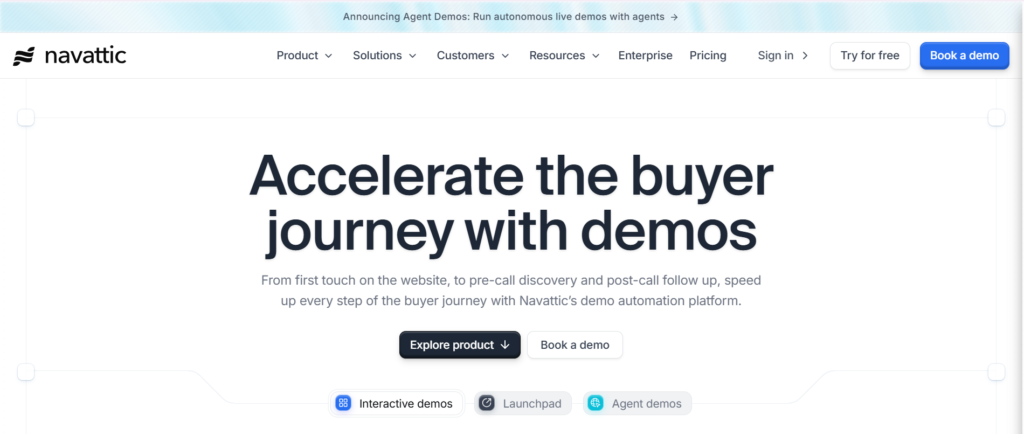
Navattic is the tool most PLG-focused SaaS teams reach for first, and for good reason. It uses HTML cloning to create click-through demo experiences that look and feel like your actual product — without exposing production data or requiring backend engineering.
Best for: Product-led growth teams that want prospects to self-serve through interactive demos before ever talking to sales. ABM-oriented analytics tied to account-level data make it strong for enterprise GTM motions too.
The “Sticker” vs. “Reality” gap: Navattic markets itself as accessible, but the sophisticated interactive branching and persona-based journeys require upfront mapping and design work. Non-technical marketers report 2–3 weeks of setup before the first demo goes live — which contradicts the “quick launch” expectation.
The dashboard shows a “Launchpad” free tier with 1 builder license, but the Base tier jumps to $500/month for 5 seats. That UI jump signals clearly: this tool is built for scaling teams, not solo founders.
Scaling penalties: 3-year TCO for a small team runs $18,000–$36,000+ at the Base tier minimum. That’s a real number for a seed-stage startup.
Ghost error & workaround: CRM sync occasionally drops demo engagement data during high-volume periods (500+ demos/day). The community workaround? Export analytics as CSV and re-import into HubSpot using Zapier as a buffer layer. Not elegant, but it works.
Who should skip it: Solo founders or budget-conscious startups. The $500/month entry point and enterprise-focused feature set don’t match early-stage economics.
3. Walnut — Best for Personalized Demo Storytelling
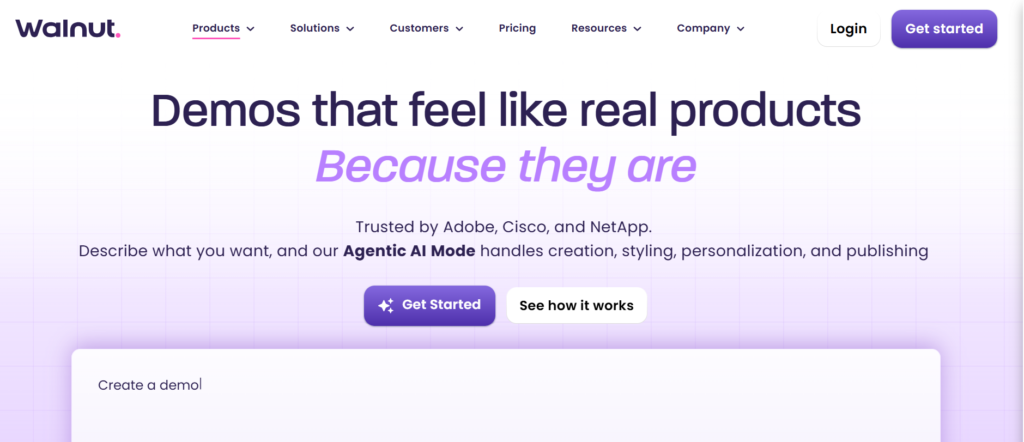
Walnut built its reputation on per-prospect personalization for complex B2B sales cycles. If your sales process involves multi-stakeholder deal rooms with CRM sync, Walnut gives your reps the tools to build custom demo narratives for each account.
Best for: Mid-market and enterprise B2B SaaS teams running 30+ day sales cycles where each prospect needs a tailored story.
The “Sticker” vs. “Reality” gap: Deal room customization sounds great in the marketing copy. In practice, founders report 3–5 day turnaround per prospect customization, which limits scalability for high-volume pipelines.
The pricing page shows $750/month as the entry point — but that’s a minimum for a single user. Seat-based scaling isn’t clearly displayed, creating pricing opacity that frustrates budget-conscious buyers.
Scaling penalties: Custom pricing starts at $750/month with no transparent tier visibility. For a 3-person team, expect $2,000+/month. 3-year TCO easily exceeds $70,000 for even small deployments.
Visual checkpoint: Walnut’s editor uses a green “Published” badge when a demo is live and prospect-facing. But the customization interface stays in a grey “Draft” state until all dynamic variables are populated — which means your reps need to complete every personalization field before anything goes live. That’s a feature and a friction point, depending on your workflow discipline.
Who should skip it: Startups with fewer than 5 users or teams running high-velocity, low-touch sales motions. The per-prospect effort doesn’t scale for PLG.
4. Reprise — Best for Technical Presales Demos
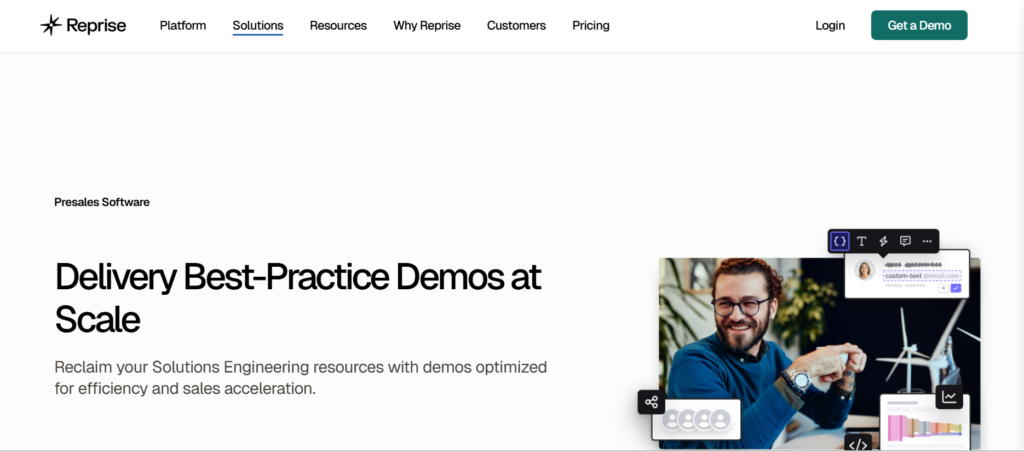
Reprise occupies a specific niche: full sandbox environments for technical presales teams that need to simulate complex product behavior without touching production.
If your demo involves API-level interactions, multi-step workflows, or synthetic demo data, Reprise is purpose-built for that.
Best for: Enterprise presales engineers running proof-of-concept demos for technical buyers.
The “Sticker” vs. “Reality” gap: Reprise’s sandbox environments are powerful — but they require technical presales expertise to configure. This isn’t a tool your marketing team will pick up and run with.
Setup timelines of 1–2 weeks per demo environment are common, and the learning curve is steep for non-engineers.
Scaling penalties: Enterprise pricing (custom quotes only) means there’s no self-serve path. Adding new demo environments or team members requires sales conversations, not dashboard clicks. For fast-moving startups, that friction is a dealbreaker.
Ghost error & workaround: Sandbox instances occasionally persist cached data from previous demo sessions, creating confusion when a prospect sees another company’s (fake) data. The workaround: manually flush the sandbox cache before each demo session using the admin panel’s “Reset Environment” button — a step that isn’t documented in the standard onboarding flow.
Who should skip it: Any team that doesn’t have dedicated presales engineering resources. If you’re a founder doing your own demos, Reprise will slow you down.
5. Storylane — Best for Lightweight Interactive Demos
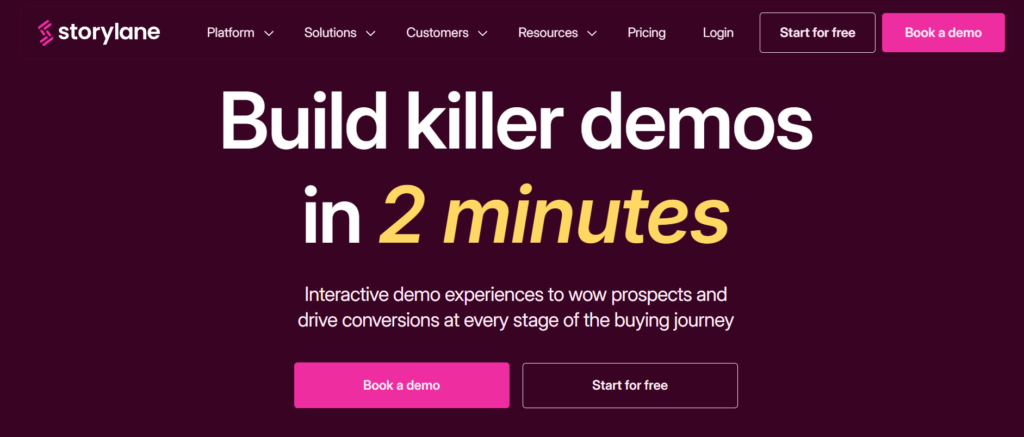
Storylane is the budget-friendly, no-code entry point into interactive demos. It uses screenshot-based demo capture (not full HTML cloning) to let teams publish click-through demos fast — sometimes within hours.
Best for: PLG companies and small GTM teams that need to publish interactive demos quickly without engineering support.
The “Sticker” vs. “Reality” gap: “No-code” is accurate for basic demos, but interactive branching logic still requires careful planning. The screenshot-based approach means your demos won’t update automatically when your product UI changes — you’ll need to re-capture screens manually.
At $40/user/month, pricing is transparent and predictable, which is refreshing in this category.
Scaling penalties: 3-year TCO for a 3-person team: roughly $4,320. Significantly cheaper than Navattic or Walnut, but you’re trading depth of interactivity for speed and cost.
Visual checkpoint: Storylane’s editor shows a blue “Live” indicator when a demo is published. The demo builder interface is clean — almost too clean. If you’re coming from a more complex tool, the limited customization options might feel restrictive. But for teams that need speed over sophistication, that’s the point.
Who should skip it: Teams running complex enterprise demos with multi-step branching or sandbox requirements. Storylane is built for lightweight, fast deployment — not deep product simulation.
6. Consensus — Best for Video-Based Automated Demos
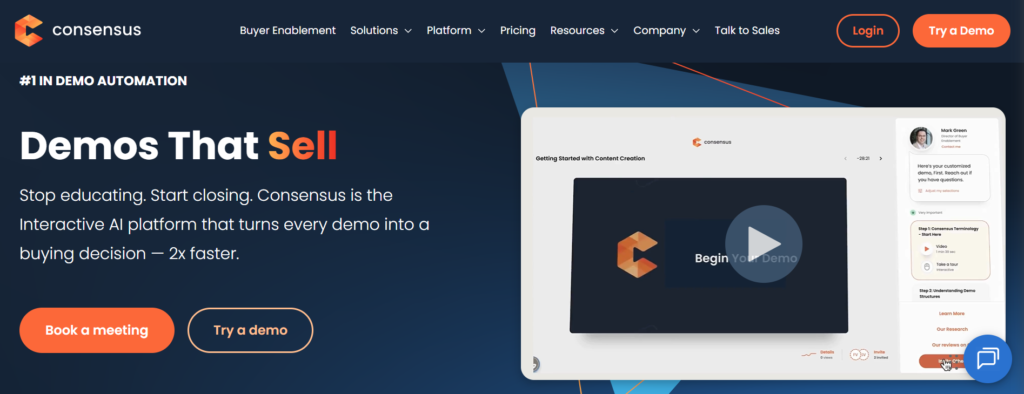
Consensus takes a different approach entirely: asynchronous video-based demos designed for multi-stakeholder buying committees. Instead of interactive click-throughs, prospects watch curated video segments and self-select the features most relevant to their role.
Best for: Enterprise SaaS teams selling to buying committees of 5+ stakeholders where each person needs a different angle on the product.
The “Sticker” vs. “Reality” gap: Video demos are great for top-of-funnel education, but they don’t replace the interactivity that technical buyers expect. Consensus works best as a complement to live demos — not a replacement.
The platform tracks which video segments each stakeholder watches, giving sales teams useful intent signals, but the data doesn’t always sync cleanly with CRM pipelines.
Scaling penalties: Enterprise pricing with custom quotes. Video production quality directly impacts demo effectiveness, which means ongoing content investment beyond the platform cost itself.
Why Most Demo Automation Tools Don’t Improve Conversion
This is the section most roundup posts skip, and it’s the one that matters most.
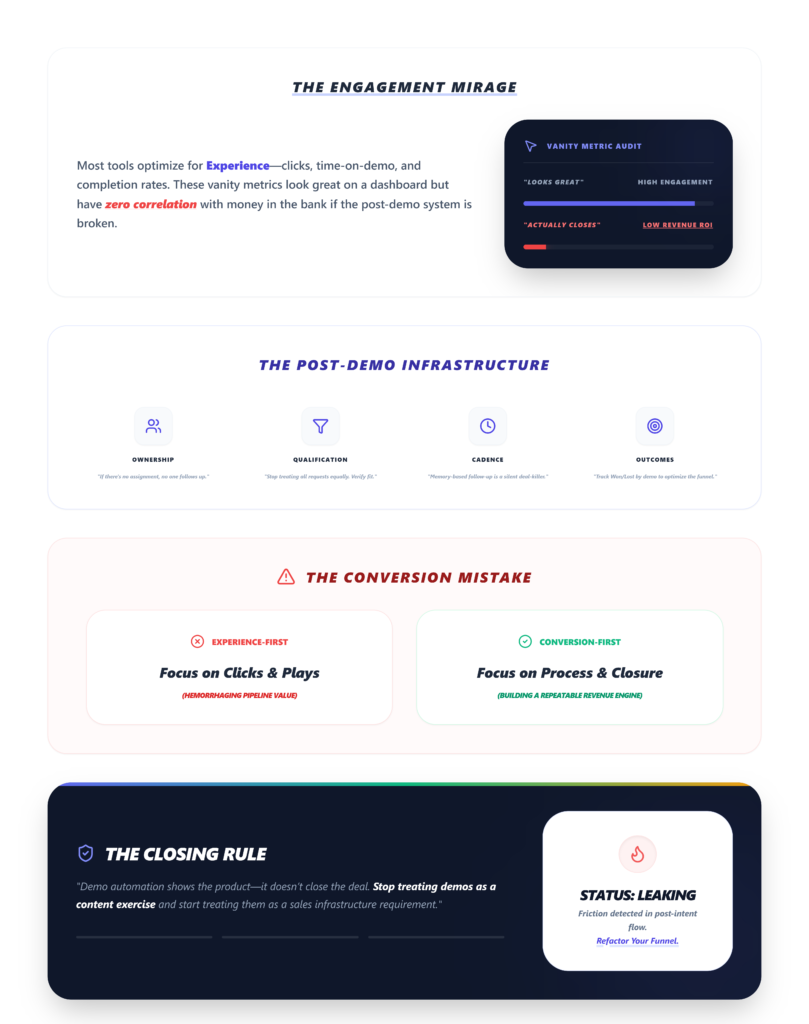
Most demo automation tools focus on showing the product. They optimize for engagement — clicks, time-on-demo, completion rates. Those metrics feel good. They look great in a dashboard.
But conversion depends on what happens after the demo.
Think about it:
- Who owns the lead after the demo? If there’s no assignment, no one follows up.
- Is the lead qualified? If every demo request gets the same treatment, your team wastes time on bad fits.
- What’s the follow-up cadence? If it’s manual and memory-based, leads slip through. Every time.
- Are outcomes tracked? If you can’t see Won/Lost/Pending by demo, you can’t optimize the funnel.
Most tools optimize for experience, not conversion. And the gap between “great demo engagement” and “closed deal” is where SaaS teams hemorrhage pipeline.
The Demo → Conversion System (Framework)
Here’s the framework I use when advising SaaS teams on demo workflow design:
- 1. Lead Capture
What Happens: Prospect submits interest; data is logged automatically
Where Most Tools Stop: ✅ Some tools do this - 2. Qualification
What Happens: Lead is scored or categorized by fit
Where Most Tools Stop: ❌ Most tools skip this - 3. Demo Delivery
What Happens: Prospect experiences the product (interactive, video, or live)
Where Most Tools Stop: ✅ All tools do this - 4. Follow-Up
What Happens: Assigned owner reaches out with context; reminders fire automatically
Where Most Tools Stop: ❌ Almost no tools do this - 5. Conversion Tracking
What Happens: Outcome is logged (Won, Lost, In Follow-up); metrics are visible
Where Most Tools Stop: ❌ Almost no tools do this
The tools in this roundup handle Stage 3 well. Some handle Stage 1. Almost none handle Stages 2, 4, and 5 — which is exactly where conversion actually happens.
A demo without follow-up is just content. A demo with qualification, assignment, follow-up automation, and outcome tracking is a system.
Systems outperform tools.
Which Demo Automation Tool Is Best?
There’s no universal answer. It depends on what’s actually broken in your demo process.
- For interactive product demos → Navattic or Walnut. Both deliver polished, click-through experiences. Navattic is stronger for PLG; Walnut is stronger for personalized enterprise storytelling.
- For technical presales teams → Reprise. If your demos require sandbox environments and synthetic demo data, nothing else comes close.
- For lightweight, fast demos → Storylane. Best time-to-value and most transparent pricing in the category.
- For video-based demos → Consensus. Purpose-built for multi-stakeholder buying committees.
- For conversion → LevelUp Demo. The only tool in this list that connects demo delivery with the full conversion workflow — lead capture, qualification, scheduling, follow-up, and outcome tracking.
What SaaS Teams Actually Need
Here’s where I’ll get slightly opinionated (and I think I’ve earned it after watching dozens of SaaS teams fumble this).
Tools solve pieces. They give you a better demo experience, or a faster setup, or prettier analytics. That’s valuable.
But pieces don’t produce outcomes.
Systems solve outcomes. A system connects the demo to the follow-up to the close. It assigns ownership. It tracks what happened. It tells you why deals are stalling — not just how many people clicked through your interactive walkthrough.
Most SaaS teams don’t need another demo tool. They need a demo workflow system that treats the demo as one step in a conversion process — not the whole process.
LevelUp Demo was built for exactly that gap. It’s not competing with Navattic on interactive demo quality or with Reprise on sandbox depth.
It’s solving the problem those tools don’t touch: what happens between “demo watched” and “deal closed.”
Still losing deals after demos?
Most teams don’t have a demo problem — they have a post-demo workflow problem. LevelUp Demo fixes that.
FAQ
What is demo automation software?
Demo automation software lets SaaS teams create, deliver, and scale product demos through interactive walkthroughs, video experiences, or product simulations — without requiring a live sales call for every prospect. It reduces manual effort and lets buyers explore products asynchronously.
Do automated demos replace live demos?
No. Automated demos complement live demos by handling top-of-funnel education and qualification. They let prospects self-serve early in the buying process, so live demos can focus on high-intent, qualified opportunities. The best teams use both strategically.
Which demo tool is best for SaaS startups?
It depends on your bottleneck. For interactive demos on a budget, Storylane offers the fastest time-to-value at $40/user/month. For teams where leads don’t convert despite strong demo engagement, LevelUp Demo addresses the post-demo workflow gap that most tools ignore.
Do demo automation tools actually improve conversion?
Demo tools improve engagement — not necessarily conversion. Conversion requires lead capture, qualification, follow-up automation, and outcome tracking. If your tool only handles demo delivery, you’re optimizing for the wrong metric. The demo checklist for SaaS teams should include post-demo workflow as a non-negotiable.
What’s the biggest mistake SaaS teams make with demo automation?
Treating the demo as the end of the funnel instead of the middle. Teams invest in beautiful interactive demos and then wonder why win rates don’t improve. The answer is almost always the same: no structured follow-up, no lead qualification, and no conversion tracking. The demo funnel needs to extend past the demo itself.
How much does demo automation software cost for small teams?
Ranges vary wildly. Storylane starts at ~$40/user/month ($4,320 3-year TCO for a 3-person team). Navattic starts at $500/month ($18,000+ 3-year TCO). Walnut starts at $750/month with opaque seat-based scaling. Per-creator billing escalation is the hidden cost trap — always calculate 3-year TCO before committing.
Final Takeaways
Demo automation is growing fast — and for good reason. SaaS buyers expect self-serve product experiences, and small teams can’t sustain 15 live demos a week.
But here’s what I keep coming back to after working with teams across this space:
Tools help scale demos. They make the experience better, faster, more interactive. That’s real value.
Conversion needs more than demos. It needs follow-ups, ownership, tracking, and accountability. The post-demo gap is where revenue lives or dies.
Systems outperform tools. A connected workflow — from lead capture through qualification, demo delivery, follow-up, and outcome tracking — produces results that no standalone demo platform can match.
If you’re evaluating demo automation software right now, don’t just ask “which tool makes the best demo?” Ask: “What happens to the lead after they watch it?”
That question will change your entire evaluation criteria. And probably your close rate.