TL;DR
AI becomes useful in a demo workflow when it connects the stages, not when it replaces the salesperson. This guide maps every step from inbound request to post-demo analysis, explains where AI removes repetitive work, where it improves decisions, and where human judgment stays essential. Four original frameworks give you a reusable methodology for evaluating what to automate.
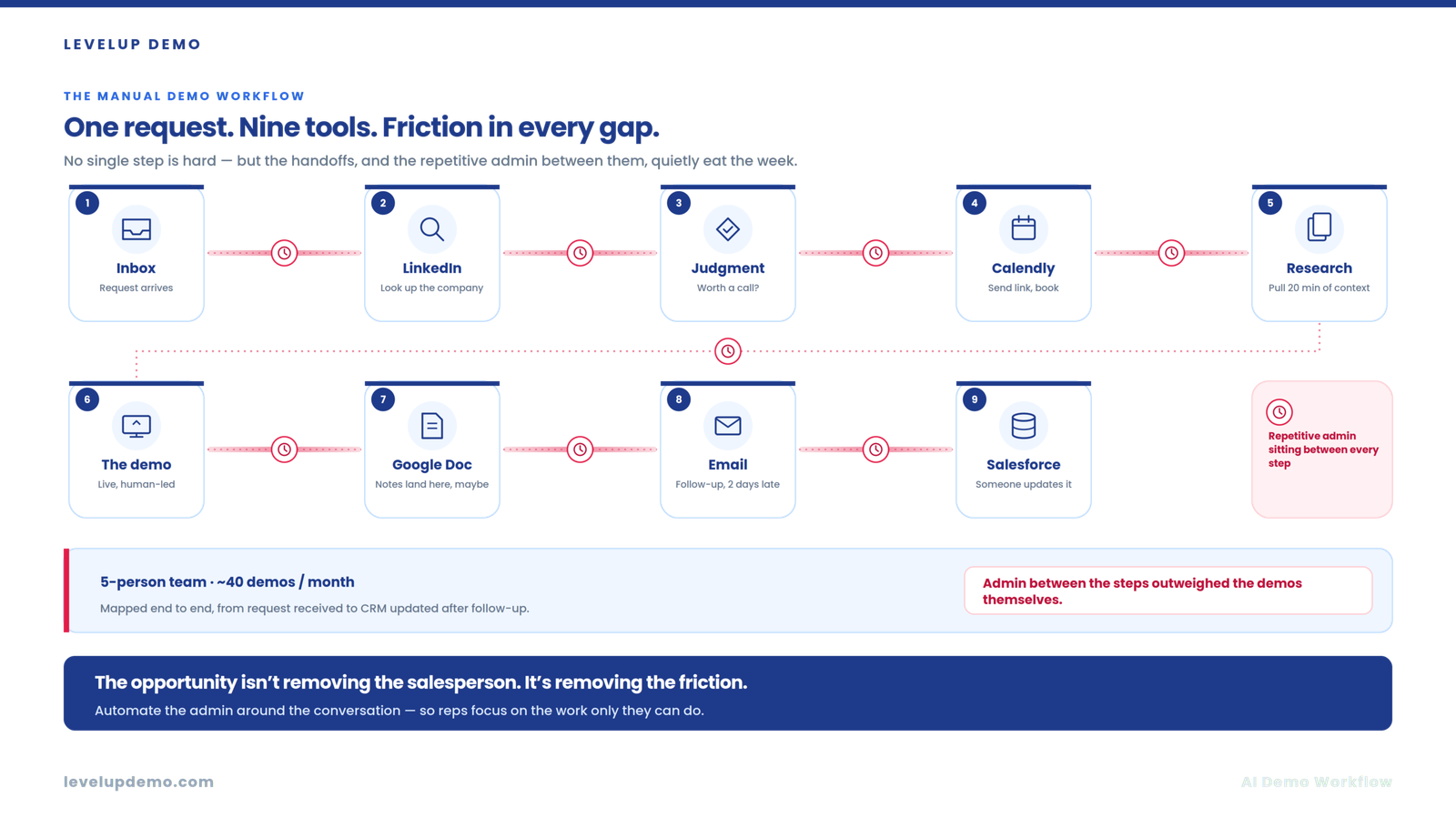
A demo request hits the inbox. Someone looks up the company on LinkedIn. Someone else decides whether the lead is worth a call. A third person sends a calendar link. The prospect books. The AE spends twenty minutes pulling together context. The demo happens. Notes land in a Google Doc, maybe. Follow-up goes out two days late because the rep got pulled into another deal. Then somebody updates Salesforce.
No single step here is hard. The problem is the number of handoffs, and the amount of repetitive admin work sitting between each one. When I mapped this out for a five-person sales team running about forty demos a month, the manual work between “request received” and “CRM updated after follow-up” consumed more rep time than the demos themselves.
AI can automate parts of this workflow. But the biggest opportunity isn’t removing the salesperson from the conversation. It’s removing the administrative friction around the conversation so the salesperson can focus on the work only they can do.
That’s what this article covers: a complete AI demo workflow, stage by stage, with honest guidance on what to automate, what to assist, and what to leave human.
What is an AI demo workflow?
An AI demo workflow is a connected sequence of automated and AI-assisted actions that helps SaaS teams manage demo requests, qualification, preparation, scheduling, follow-up, and analysis. Instead of treating each step as a separate manual task, it links them so data and context flow from one stage to the next.
This is different from adding a single AI feature inside an existing tool. A standalone AI lead scorer that doesn’t affect routing or preparation creates another number nobody checks. The value compounds when stages are connected.
Why AI demo automation differs from traditional demo automation
Traditional automation is deterministic. If a form is submitted, send an email. If the lead score is above 50, create a task. These rules work well for structured, predictable actions.
AI-enabled workflow automation adds a layer: understand the input, classify it, recommend or act, then learn from the outcome. When a demo request arrives from a 200-person fintech company, AI can enrich the record with company context, assess whether it fits your ICP, and surface that context for the rep preparing the call.
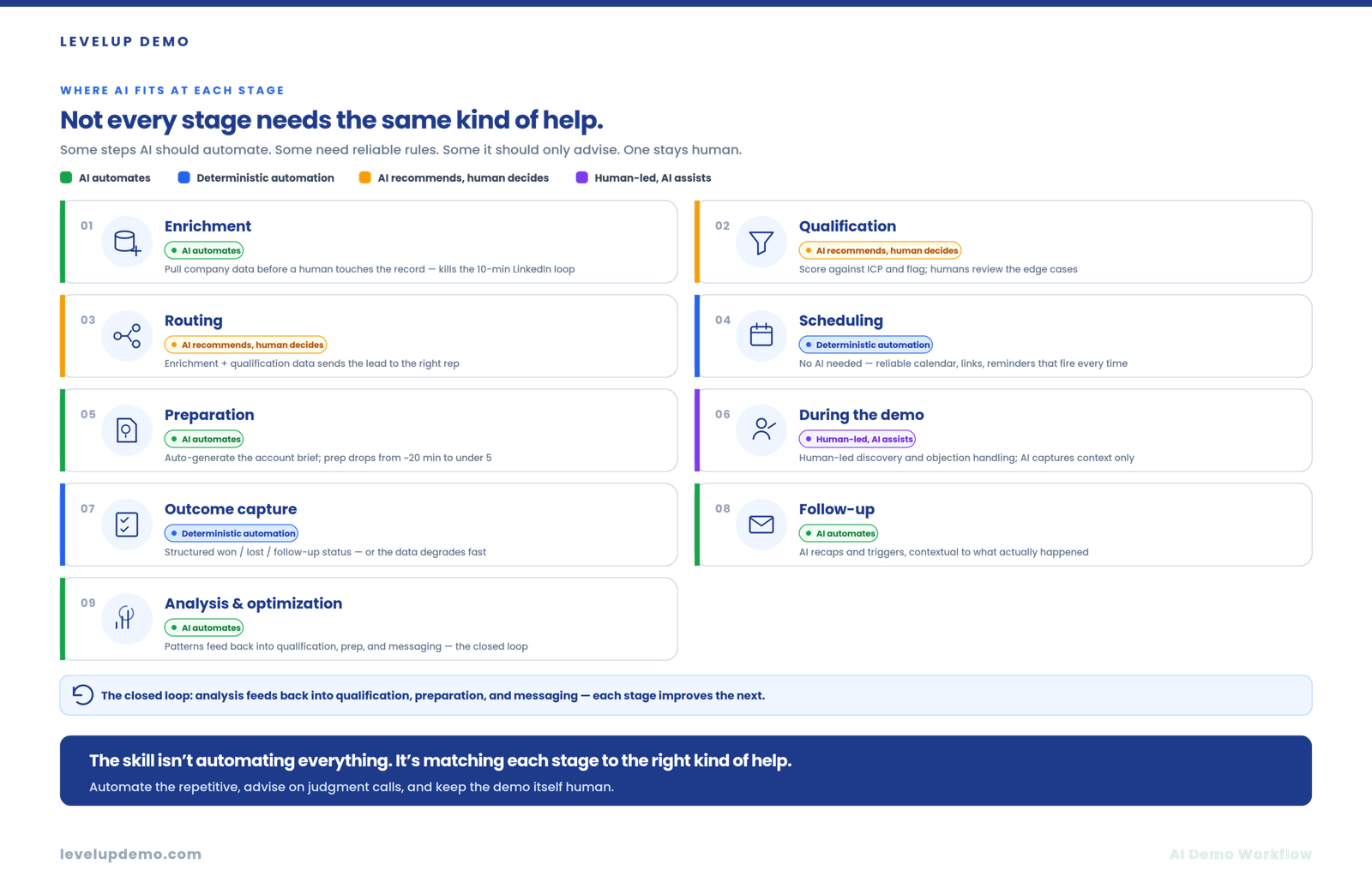
But here’s where teams get tripped up. Deterministic rules are still valuable for scheduling, reminders, and CRM field updates. Not every workflow step needs a language model. Some steps need a reliable if-then rule that fires every time without interpretation. The skill is knowing which type of automation fits which stage.
The AI Demo Workflow Automation Map
This is the full lifecycle. Each stage can be evaluated independently for AI fit. The eleven stages are: capture the request, enrich it with company data, qualify against fit, route to the right rep, schedule the meeting, prepare an account brief, run the demo, capture the outcome, follow up, analyze patterns, and optimize the next cycle.
When I first tried mapping these stages against the tools a team was actually using, the list looked like this: Typeform, Google Sheets, Calendly, a notetaking app, HubSpot, Gmail, and a Slack channel. Six tools, zero data flowing between them. That’s the real gap AI workflow design solves.
Where AI fits at each stage
Enrichment
When a request arrives, AI can pull company data (industry, employee count, recent funding, tech stack signals) and attach it to the record before a human touches it. This removes the ten-minute LinkedIn research loop that happens on every single request.
The friction warning from v100.ai’s implementation guide is worth noting: enrichment breaks when the input data is too thin. A request with only a Gmail address and no company name gives the AI almost nothing to work with. Your intake form needs to collect enough to make enrichment useful.
Qualification
AI can evaluate the enriched request against your ICP criteria, score the lead, and flag requests that are clearly outside your target. This helps teams prioritize the forty requests that arrive on a Monday morning without an SDR manually reviewing each one.
But qualification has edge cases. A two-person startup using a free email domain might be a terrible lead, or it might be a well-funded founder who hasn’t set up the company domain yet. AI should flag and recommend. Humans should review the edges. When I set up automated qualification without a human review step for borderline leads, about 15% of routed demos were misqualified, mostly false negatives that should have been booked.
Routing
Enrichment plus qualification data can inform routing. If the lead is enterprise, route to the senior AE. If it’s a specific vertical, route to the rep who knows that space. This is where connecting stages matters: routing without enrichment context is just round-robin with extra steps.
Scheduling
Scheduling doesn’t need AI. It needs reliable automation. Calendar availability checks, booking links, time zone handling, confirmation emails, reminders. A deterministic system that fires correctly every time is more valuable here than a probabilistic one. Storylane’s setup guidance suggests a first automated demo workflow can be built in 30 to 60 minutes when the scope is constrained, and scheduling is the stage where that speed matters most.
Preparation
This is where AI earns its keep for the rep. Before the call, AI can generate an account brief: what the company does, likely pain points based on industry and size, any previous interactions, and areas the prospect is most likely to ask about.
LevelUp Demo’s Demo Assist does this by creating preparation briefs and coaching blueprints before the meeting. The rep walks into the call with context instead of spending twenty minutes on manual research. I’ve seen prep time drop from fifteen to twenty minutes per demo down to under five when the brief is generated automatically and the rep just reviews it.
During the demo
The demo itself stays human-led. This is relationship building, strategic discovery, live objection handling. AI can assist with note capture and contextual information retrieval during the call, but it doesn’t run the conversation.
The industry is exploring real-time sales copilots that surface product information during live calls. That’s an emerging direction. For now, the practical value is in capturing what happens during the meeting so it feeds the next stages.
Outcome capture
After the demo, the outcome needs to be recorded in a structured way: won, lost, interested, not interested, follow-up required. This sounds simple, but when it’s optional or unstructured, outcome data degrades fast. Consistent outcome capture is what makes the analysis and optimization stages possible later.
Follow-up
AI can draft recap emails, identify next steps from meeting notes, and trigger follow-up workflows based on the recorded outcome. A “follow-up required” outcome can automatically queue a personalized email with relevant resources. A “won” outcome can trigger the handoff sequence.
LevelUp Demo supports automated follow-up triggered by demo lifecycle events, which means the follow-up isn’t just scheduled, it’s contextual. The content changes based on what happened.
The community fix from practitioners using Puppydog’s approach is relevant here: many teams stop at “demo delivered” and never define what follow-up should happen for different behavior patterns. That’s where conversion analytics collapse.
Analysis and optimization
AI can identify patterns across completed demos: which objections appear most, which pricing tiers win more often, which sources convert, what timing correlates with closed deals. This feeds back into qualification criteria, preparation briefs, and messaging.
This is the closed-loop: qualification data improves routing, which improves preparation, which improves demo context, which improves outcome capture, which improves follow-up, which improves analysis, which improves future qualification. Each stage feeds the next. Track these metrics alongside your demo operations KPIs to see where the loop breaks.
Human + AI Demo Workflow Responsibility Matrix
| Category | Examples | Who owns it |
|---|---|---|
| AI should automate | Enrichment, classification, reminders, recap drafting, routine follow-up triggers | Machine |
| AI should recommend | Lead prioritization, routing suggestions, preparation insights, objection patterns | Machine recommends, human decides |
| Humans should own | Complex qualification, strategic discovery, live demo delivery, negotiation, deal strategy | Human |
This distinction matters more than any feature list. If you automate a step that requires judgment, you’ll get bad outcomes at scale. If you keep a step manual that’s purely repetitive, you’re wasting rep time.
Demo AI Autonomy Ladder
Where does your team sit?
Most teams reading this are somewhere between levels one and two. The goal isn’t to race to level five. It’s to move deliberately, validating each stage before adding autonomy. Closed-loop means data and insights feed operational improvement. It does not mean AI independently runs your sales organization.
What can go wrong when AI runs demo workflows
AI enrichment can pull the wrong company. Lead scoring can misclassify a strong prospect. Routing can send an enterprise deal to the wrong rep. Summaries can hallucinate details the prospect never mentioned. Follow-up emails can reference features that weren’t discussed.
For any high-risk step, the pattern should be: AI output, then human validation, then action. Enrichment data should be reviewable. Qualification scores should be overridable. Follow-up drafts should be editable before sending.
I once watched an automated follow-up reference a competitor integration that the prospect had never mentioned. The AI had pulled it from enrichment data about the company’s tech stack and assumed it was discussed. That’s the kind of failure that erodes trust fast, and it’s preventable with a review step.
Where this fails
If your team runs fewer than ten demos a month, the overhead of setting up AI workflows may not justify the time saved. The ROI on automation scales with volume and repetition. A two-person team doing six demos a month might get more value from a clean spreadsheet and disciplined follow-up habits than from building an eleven-stage automated workflow. Start with the stages that hurt most (usually follow-up and preparation) and expand from there.
What this looks like in practice
If your demo process still relies on separate tools for requests, qualification, scheduling, follow-up, and reporting, LevelUp Demo brings those workflows into one place. It applies AI and automation at specific stages: enrichment, qualification, Demo Assist preparation, automated follow-up based on demo lifecycle events, and AI-powered analytics. Sales teams stay in control of the customer conversation. The tool handles the repetitive work around it.
You can see how the pricing works or request a demo to walk through the workflow with their team.
Connect every stage of your demo workflow
LevelUp Demo applies AI and automation where it helps — enrichment, qualification, Demo Assist prep, lifecycle-triggered follow-up, and analytics — while your reps stay in control of the conversation.
FAQ
What is an AI demo workflow?
An AI demo workflow is a connected sequence of automated and AI-assisted actions covering demo requests, qualification, enrichment, scheduling, preparation, follow-up, and analysis. It links stages so data flows between them, reducing manual handoffs and giving sales teams context at each step without requiring separate tools for each function.
Can AI qualify demo requests?
Yes, but with caveats. AI can evaluate enriched lead data against ICP criteria and score requests. It works well for clear-fit and clear-reject cases. Edge cases, like an unusual company structure or ambiguous intent, still need human review.
Should AI replace sales reps during demos?
No. The demo conversation involves relationship building, strategic discovery, and real-time objection handling. AI can assist with context and note capture, but the meeting itself should be human-led.
Can AI automate demo follow-up?
AI can draft recap emails, identify next steps, and trigger follow-up workflows based on demo outcomes. The key is connecting follow-up to what actually happened in the demo, not sending generic templates.
What should stay human in a demo workflow?
Complex qualification decisions, live demo delivery, negotiation, and deal strategy. Any step requiring high-context judgment, relationship awareness, or strategic thinking should remain human-owned.
What’s the first stage to automate?
For most teams, enrichment and follow-up offer the fastest return. Enrichment removes repetitive research. Automated follow-up prevents the most common conversion leak: delayed or missing post-demo communication.
How do you measure whether AI demo automation is working?
Track demo analytics across the funnel: request-to-scheduled rate, scheduled-to-attended, demo-to-opportunity, and demo-to-closed. Compare rep admin time before and after. If conversion rates improve and admin time drops, the automation is working. If not, check where the workflow is disconnected.
The next problem you’ll hit after setting up the workflow isn’t automation. It’s data quality. Every AI stage depends on the data feeding it, and the first thing that breaks in most implementations is the intake form collecting too little context for enrichment to do anything useful. Fix the input before you optimize the output.
Automate the admin, keep the conversation human
LevelUp Demo connects request, qualification, prep, follow-up, and analytics into one workflow — so your reps spend time on demos, not admin. Start free, or see it on a live walkthrough.