
A prospect asking a difficult question during a demo is often a good sign.
I know that sounds wrong. Most reps feel their stomach drop when a buyer says, “This seems expensive,” or “We’re already using something else.” But here’s what I’ve learned after coaching dozens of AEs and reviewing hundreds of lost deals: the demos where nobody asks anything are the ones that go nowhere.
No questions means no engagement. No concerns means no buying process. The prospects who push back? They’re the ones actively evaluating whether your product fits their world. That’s exactly where you want them.
The problem is, most sales teams treat objections like threats instead of what they actually are — requests for more confidence. And that misread kills deals.
This guide walks through the exact objections you’ll hear during SaaS product demos, what they really mean, and how to respond in a way that moves deals forward. If you’re looking for the ultimate guide to sales demos, consider this the objection-handling chapter you’ve been missing.
What is SaaS objection handling? SaaS objection handling is the process of addressing prospect concerns during a product demo or sales conversation. Common objections relate to pricing, timing, implementation, integrations, competitors, and internal buy-in. Effective objection handling helps buyers gain confidence and move forward in the buying process.
Why Objections Happen During SaaS Demos
Before we get into specific responses, it’s worth understanding why objections show up in the first place. Because if you misdiagnose the cause, you’ll solve the wrong problem every time.
Here’s what’s usually happening beneath the surface:
- Risk perception
The buyer is mentally calculating what could go wrong if they choose you — and they don’t have enough data yet to feel safe. - Budget anxiety
Not always “we can’t afford it.” More often, “I can’t justify this spend internally without a clearer ROI story.” - Implementation fear
They’ve been burned before. Migration projects that took three times longer than promised. Onboarding that was a disaster. - Change resistance
Their team is comfortable with the current workflow, even if it’s broken. New tools mean new habits. - Stakeholder concerns
The person on the call might love your product but knows their VP will ask questions they can’t answer yet.
Most objections are uncertainty problems, not product problems. When you internalize that, your entire approach changes. You stop defending and start investigating.
The SaaS Objection Handling Framework: LCURC
I’ve seen teams try a dozen different frameworks. The one that sticks — because it’s simple enough to use under pressure — follows five steps:
- 1. Listen
Let them finish. Don’t interrupt. Don’t start forming your rebuttal while they’re still talking. The 70/30 talk-time rule matters here: the buyer should be doing most of the talking. - 2. Clarify
Repeat what you heard and ask one open-ended question to make sure you understand the real concern. “When you say expensive, are you comparing us to your current tool, or is this about the overall budget?” - 3. Understand
Dig into the root cause. Many objections are smokescreen objections — the stated issue masks something deeper. - 4. Respond
Now — and only now — address the concern with evidence. Social proof, a customer story, a concrete timeline, an ROI frame. Not a feature dump. - 5. Confirm
Check that the concern is actually resolved before moving on. “Does that address what you were worried about, or is there another piece we should talk through?”
If you skip straight from Listen to Respond, you’ll answer the wrong question. I’ve watched it happen dozens of times. The rep gives a beautiful answer to a concern the buyer didn’t actually have.
The 10 Most Common SaaS Demo Objections (And How to Handle Them)
Objection #1: “This seems expensive.”
What they’re actually saying: I don’t see enough value yet to justify this cost internally.
We’ve seen prospects raise pricing objections when the real issue was unclear value. They’re not saying your product costs too much in absolute terms. They’re saying you haven’t connected the price to a business outcome they care about.
How to respond: Reframe around ROI. “What’s the cost of the problem you’re solving today? If your team spends 10 hours a week on manual reporting, that’s real money.” Then connect your pricing to the time, revenue, or risk they’d recover.
Understanding your demo-to-close rate helps you see where pricing objections actually stall deals versus where they’re just part of the conversation.
Objection #2: “We’re already using another solution.”
This is competitive displacement territory. The buyer isn’t saying “no.” They’re saying, “Convince me the switching cost is worth it.”
How to respond: Don’t trash the competitor. Instead, ask what’s working and what isn’t. “What made you take this demo if your current tool is handling things?” That question usually opens up the real pain. Focus on outcomes and workflow differences, not feature checklists.
Many teams struggle here because the real reasons SaaS leads don’t convert have more to do with unclear differentiation than product quality.
Objection #3: “We need to think about it.”
This one stings because it feels polite but final. In reality, it usually means one of three things: the value wasn’t clear enough, a decision-maker is missing from the conversation, or there’s no urgency.
How to respond: “Totally fair. Can I ask — what specifically do you want to think through? I want to make sure I’ve given you everything you need.” Then offer a leave-behind or a summary they can share with their team. Watch for buying signals that tell you whether this is genuine consideration or a soft no.
Objection #4: “We need approval from leadership.”
Multi-stakeholder buying is the norm in B2B SaaS. This objection isn’t a dead end — it’s a signal that you need to equip your champion.
How to respond: “That makes sense. What questions do you think they’ll have? I can put together a one-pager that addresses those directly.” The goal is decision-maker alignment. Build materials tailored to different buyer personas so your champion walks into that internal meeting armed.
Objection #5: “Will this integrate with our tools?”
Technical objections are often implementation risk in disguise. The real fear: “Will this be a nightmare to set up?”
How to respond: Share a concrete onboarding timeline and name a similar customer who integrated the same stack. “We onboarded a team using Salesforce and Slack last month — took about two weeks.” Specificity kills anxiety. Showing this inside interactive product demos can make the integration feel tangible rather than theoretical.
Objection #6: “Our team probably won’t use it.”
Adoption fear. This is a change management concern, and it’s legitimate. Buyers have purchased tools before that collected dust.
How to respond: Acknowledge it directly. “That’s a real concern — adoption is where most tools fail. Here’s how our onboarding works, and here’s what [customer X] did to get their team using it in the first two weeks.” Understanding why SaaS user adoption fails early helps you address this with credibility.
Objection #7: “We don’t have time right now.”
A priority objection. They’re not saying your product is bad. They’re saying the pain isn’t urgent enough to act on today.
How to respond: Quantify the cost of waiting. “I hear you. Just so we’re on the same page — if the current process costs your team [X hours/week], that’s [Y] over the next quarter. Does it make sense to revisit in two weeks with a concrete timeline?” Speed matters, and lead response time data shows that delayed follow-up kills momentum fast.
Objection #8: “Your competitor does this too.”
They want differentiation, and they want you to earn it.
How to respond: Don’t get into a feature war. Shift to outcomes. “You’re right — [Competitor] does offer that. Where we differ is in [specific workflow or result]. Our customers typically see [specific outcome] because of [specific reason].” For context on how to position against alternatives, check out our software comparisons.
Objection #9: “We need more information.”
This is often hidden uncertainty. They don’t know what they need — they just don’t feel confident enough to move forward.
How to respond: “Happy to share more. Can you help me understand which area feels unclear — pricing, implementation, or how it fits your workflow?” That question forces specificity. Once you know the gap, fill it. Our guide on how to give a product demo covers how to structure information delivery so buyers don’t leave with unanswered questions.
Objection #10: “I’m not sure this solves our problem.”
This one points backward. If the buyer doesn’t see the fit, either discovery was incomplete, the demo wasn’t personalized, or you’re talking to the wrong use case.
How to respond: “Let’s back up. Tell me more about the specific problem you’re trying to solve.” Then re-map your product to their workflow in real time. This is exactly why a strong discovery call before the demo changes everything.
Mistakes Reps Make When Handling Objections
I’ve reviewed enough call recordings to see the same patterns:
- Talking too much. The rep launches into a two-minute monologue instead of asking one clarifying question.
- Getting defensive. Treating the objection like a personal attack rather than a data point.
- Responding too fast. Answering before they understand the real concern. This is the most common mistake, and it’s the most expensive.
- Ignoring the root cause. Addressing the surface objection while the real blocker stays hidden.
If you want to tighten this up, review your product demo best practices, revisit your sales demo scripts, and run through a SaaS demo checklist before every call.
How Discovery Calls Reduce Objections Later
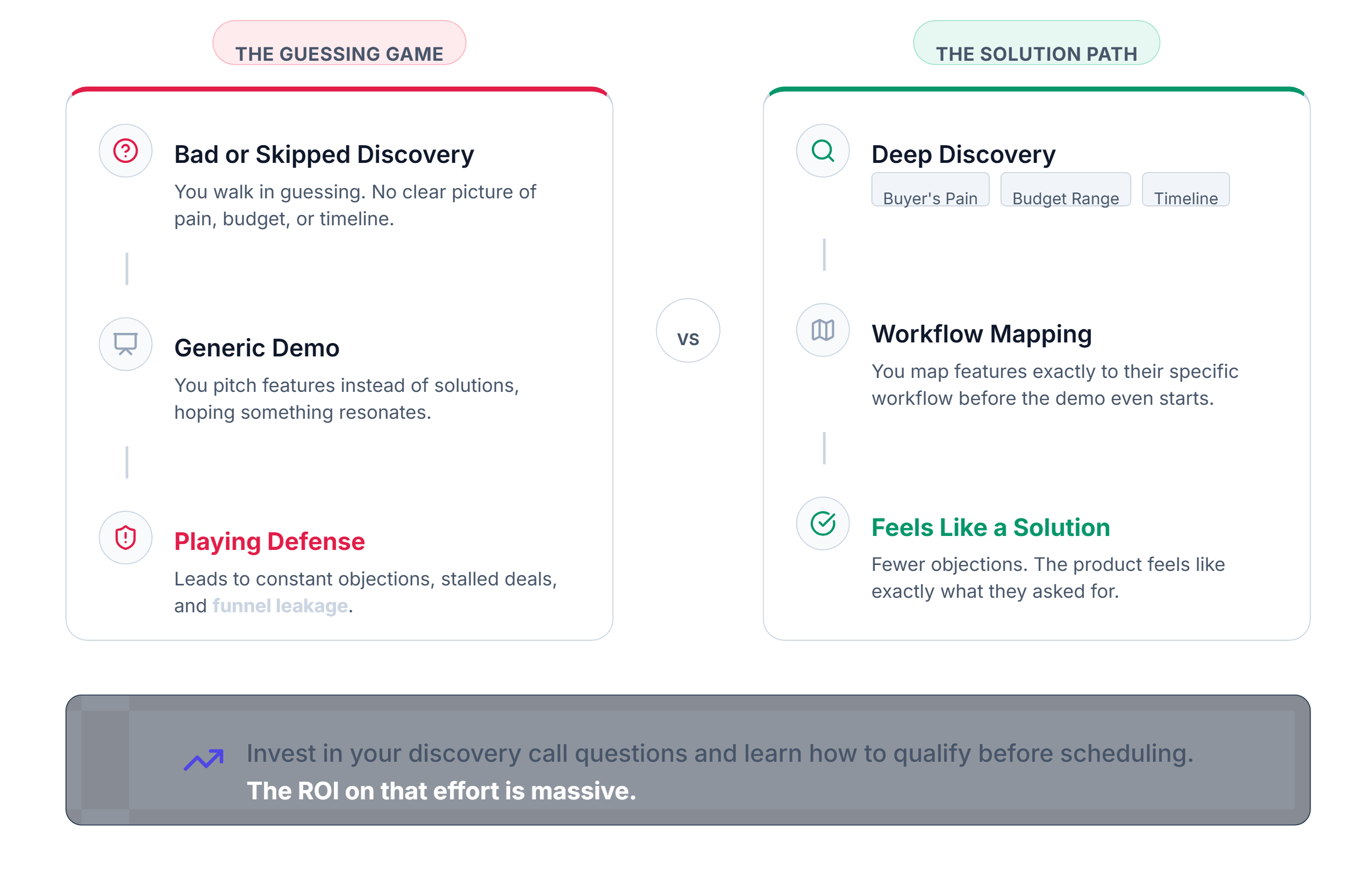
Here’s the pattern: teams with strong qualification hygiene hear fewer objections during demos. Teams that skip discovery — or rush through it — spend the entire demo playing defense.
Good discovery means you already know the buyer’s pain, their budget range, their decision process, and their timeline. You’ve done the feature-to-workflow mapping before the demo even starts. So when you show the product, it feels like a solution, not a pitch.
Bad discovery means you’re guessing. And guessing leads to generic demos, which lead to objections, which lead to stalled deals and funnel leakage.
Invest in your discovery call questions and learn how to qualify demo requests before scheduling. The ROI on that effort is massive.
How Top SaaS Teams Handle Objections Differently
Before the Demo
Average teams: Minimal prep. Generic deck.
Top teams: Review discovery notes. Customize the demo to the buyer’s workflow. Prepare proof-of-resolution stories.
During the Demo
Average teams: React to objections defensively.
Top teams: Investigate objections with open-ended questions. Use the LCURC framework. Keep talk-time ratio in check.
After the Demo
Average teams: Send a generic follow-up email.
Top teams: Assign follow-up to a named owner. Recap the objection and resolution. Confirm the next step before ending the call.
The strongest SaaS reps investigate objections instead of immediately answering them. Objection handling is often more about listening than persuading.
How LevelUp Demo Helps Teams Manage Demo Conversations
One thing I’ve noticed with small sales teams: the demo itself might go well, but deals leak because nobody tracked the objection, the follow-up ownership was unclear, or the next step wasn’t logged anywhere.
Streamline Your Demo Workflow
LevelUp Demo gives you qualification visibility, stakeholder context, and follow-up management in one place — so objections get tracked and nothing slips.
It’s not about replacing your CRM. It’s about having a clean view of what happened in the demo, what the buyer’s concerns were, and who owns the next step. That’s where deals are won or lost.
FAQ
What is SaaS objection handling?
SaaS objection handling is the process of addressing buyer concerns during demos or sales calls. It involves listening, clarifying the real issue, responding with evidence, and confirming the concern is resolved before advancing the conversation.
Why do prospects raise objections during demos?
Buyers object because they’re evaluating risk — budget, implementation, adoption, or internal approval. Objections signal active evaluation, not disinterest. They’re requests for confidence.
How should reps handle pricing objections?
Reframe around value and ROI. Ask what they’re comparing the price to, quantify the cost of their current problem, and connect your pricing to measurable business outcomes rather than defending the number.
What are the most common SaaS sales objections?
The most frequent objections relate to pricing, competitor comparison, timing, team adoption, integration concerns, leadership approval, and unclear problem-solution fit.
How can discovery calls reduce objections?
Strong discovery uncovers the buyer’s pain, budget, timeline, and decision process before the demo. This lets reps personalize the presentation and address concerns proactively, reducing surprise objections during the demo itself.
The Bottom Line
Objections aren’t the moment a deal starts slipping away — they’re the moment a buyer starts taking you seriously. The reps who win treat every concern as a request for confidence, slow down enough to find the real issue, and confirm it’s resolved before moving on.
LevelUp Demo
Ready to tighten your demo process?
Explore LevelUp Demo and see how teams track objections, manage follow-ups, and close more deals from every demo.