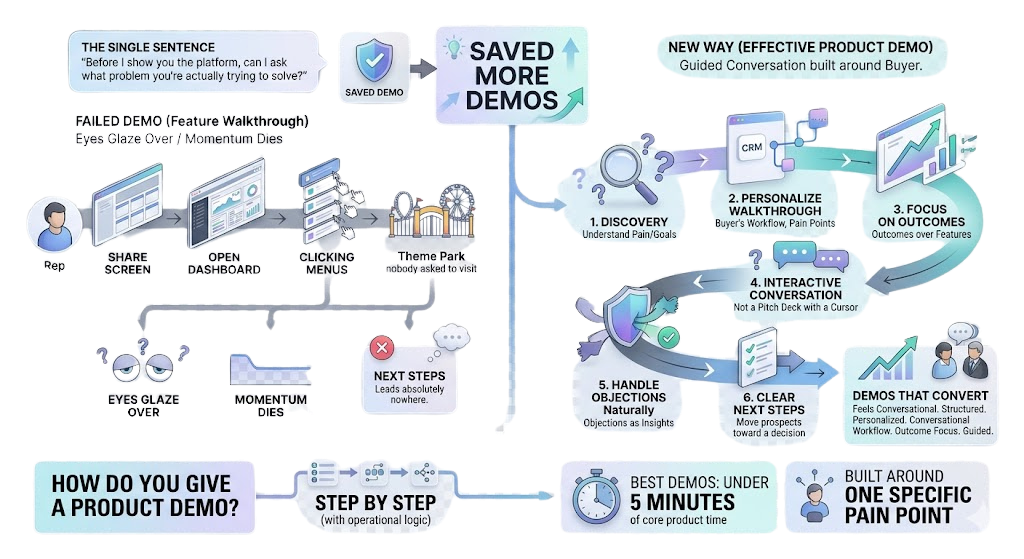
“Before I show you the platform, can I ask what problem you’re actually trying to solve?”
That single sentence has saved more demos than any feature walkthrough I’ve ever built. And yet, most SaaS reps never say it. They share their screen, open the dashboard, and start clicking through menus like a product tour guide at a theme park nobody asked to visit.
I’ve watched hundreds of SaaS demos over the years—some brilliant, most forgettable. The pattern behind the forgettable ones is almost always the same: the rep rushes into features, the buyer’s eyes glaze over, momentum dies somewhere around minute seven, and the “next steps” slide gets a polite nod that leads absolutely nowhere.
The teams that understand how to give a product demo effectively approach demos differently. They don’t treat the call like a presentation. They treat it like a guided conversation built around the buyer’s workflow, pain points, and goals.
The demos that convert? They feel conversational. Structured, yes. Personalized, always. But never like a pitch deck with a cursor.
This article breaks down exactly how to give a product demo that actually converts — step by step, with the operational logic behind each phase.
To give a product demo that converts, SaaS teams should start with discovery, personalize the walkthrough around the buyer’s workflow, focus on outcomes instead of features, keep the conversation interactive, handle objections naturally, and end with clear next steps. The best demos are under 5 minutes of core product time and built around one specific pain point.
Why Most Product Demos Fail
Here’s something that took me a while to accept: most failed demos are communication problems, not product problems. The product works fine. The features are solid. But the rep dumps fifteen capabilities onto a buyer who came in with one question, and the whole thing collapses under its own weight.
The usual suspects:
- Feature dumping. Showing everything instead of the three things that matter to this buyer.
- Weak discovery. Jumping into the demo without understanding the prospect’s actual workflow or pain.
- Generic walkthroughs. Running the same script for a VP of Sales and a CS manager—two completely different jobs.
- Poor pacing. Spending eight minutes on setup screens before reaching the value.
- Weak next steps. Ending with “let me know if you have questions” instead of a concrete action.
The data backs this up. Interactive demos that stay under 10 steps see significantly higher completion rates than sprawling product tours. And demos under 5 minutes consistently hold attention better than longer sessions. Buyers aren’t patient. They’re evaluating you while twelve other tabs compete for their focus.
What Makes a Great Product Demo?
A great demo isn’t comprehensive. It’s relevant. Buyers remember workflows and outcomes more than feature lists. They remember the moment you showed them how their specific problem gets solved—not the moment you explained your notification settings.
If you want to understand how to give a product demo that actually converts, this is the mindset shift most SaaS teams miss. Great demos are not about showing everything. They are about showing the right things in the right context.
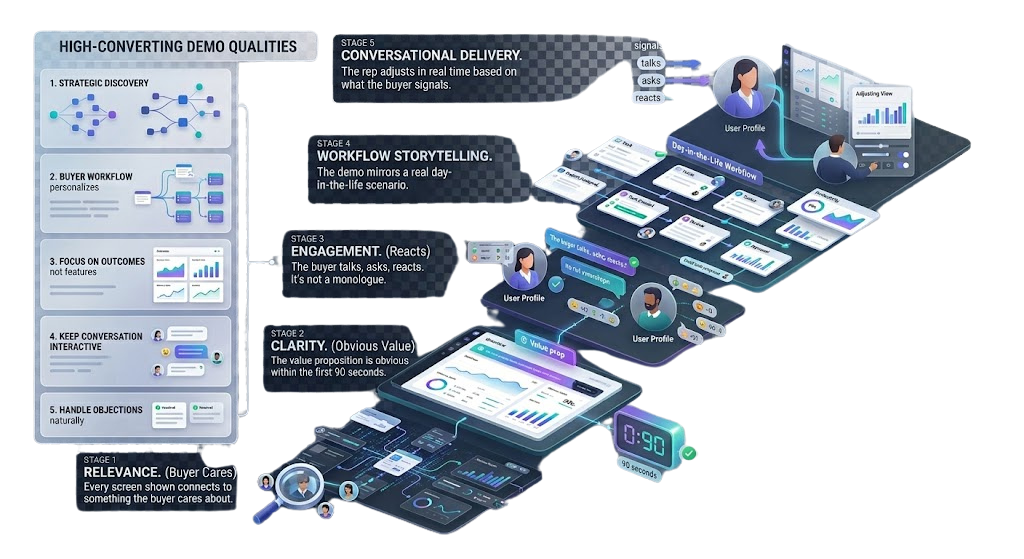
The qualities that separate high-converting demos:
Relevance
Every screen shown connects to something the buyer cares about.
Clarity
The value proposition is obvious within the first 90 seconds.
Engagement
The buyer talks, asks, reacts. It’s not a monologue.
Workflow storytelling
The demo mirrors a real day-in-the-life scenario.
Conversational delivery
The rep adjusts in real time based on what the buyer signals.
The best teams understand that how to give a product demo successfully has less to do with presentation skills and more to do with relevance, personalization, and buyer alignment.
If you want a deeper framework, our product demo best practices guide lays out the strategic layer behind these principles.
Step-by-Step: How to Give a Product Demo
This is the core. Eight phases, each with a clear purpose and a verification point so you know it’s working.
1. Prepare Before the Demo
Preparation is where most conversion gains hide. Before you open your demo environment, you need discovery notes reviewed, a stakeholder map sketched out, a demo goal defined, and top objections anticipated with updated answers. Verification check: You’re ready when you can articulate the buyer’s primary problem in one sentence without referencing your product. Use a SaaS demo checklist to standardize this across your team.
2. Start With Context, Not Features
Open with alignment, not a screen share. “Before we jump into the platform, I’d love to confirm—what’s the biggest challenge your team is trying to solve right now?” Why does this work? Because it reframes the demo from a presentation into a problem-solving session. The buyer leans in because you’re talking about their world, not yours.
3. Personalize the Walkthrough
Generic demos are conversion killers. If your buyer runs a 4-person CS team at a B2B SaaS company, show them a workflow that looks like a 4-person CS team at a B2B SaaS company. Use their terminology and reference their industry’s version of the problem. This is where strong discovery call questions pay off—they give you the raw material to customize every walkthrough without building a new demo from scratch.
4. Focus on Outcomes Instead of Features
Stop narrating what the product does and start showing what the buyer gets. Instead of “This is our reporting dashboard,” try “This is where your team lead sees exactly which follow-ups are overdue—without asking anyone.” Buyers care more about results than functionality lists.
5. Keep the Demo Interactive
A demo where only the rep talks is a demo that’s dying. Build in engagement moments: “Does this match how your team currently handles this?” “Who on your side would be using this view day-to-day?” If you’re the only voice for five straight minutes, course-correct.
6. Watch for Buying Signals
This is where demos shift from education to conversion. When a prospect asks implementation or pricing questions, they’re mentally projecting themselves into using the product. Learn to recognize buying signals and respond accordingly. Shift from “showing” to “closing” mode.
7. Handle Objections Naturally
Don’t dodge objections around pricing, implementation, or features. Acknowledge, answer concisely, and connect back to the workflow you’ve been showing. Balanced, practical responses build trust faster than polished deflections.
8. End With Clear Next Steps
This is where deals die quietly. End every demo with one defined next action and a clear owner. “I’ll send a recap with the three workflows we covered, and let’s schedule a call with your Head of Ops for Thursday. Does that work?” A date, an action, and an owner.
Common Product Demo Mistakes
- Feature overload
Prospect can’t tell what matters to them - No discovery before the demo
Demo targets the wrong pain - Generic walkthrough
Feels impersonal; prospect disengages - Ignoring buying signals
Missed closing opportunity
Final Thoughts
Great product demos are conversations, not presentations. The best SaaS product demos are structured conversations designed to help buyers clearly understand how the product fits into their workflow and solves their real business problems. Get the discovery right, keep the walkthrough relevant, and never leave a demo without a next step that has a name and a date attached to it.
Ready to stop losing deals after the demo?
LevelUp Demo helps SaaS teams manage scheduling, outcomes, and follow-ups in one place — so strong discovery calls turn into closed deals.
Frequently Asked Questions
What makes a good SaaS demo?
A good SaaS demo is relevant, concise, and conversational. It connects every feature shown to a specific buyer problem and ends with a clear next action.
How long should a product demo be?
Live SaaS demos should target under 5 minutes of core product walkthrough within a 15–25 minute meeting. Async demo videos should stay under 2 minutes. Interactive tours perform best under 10 steps.
What should a software demo include?
A context-setting opening, a discovery recap, a personalized workflow walkthrough covering 3–4 core features, engagement checkpoints, objection handling, and a concrete close with next steps.
How do you personalize a product demo?
Use discovery notes to tailor examples, language, and workflows to the buyer’s role, industry, and specific pain points. Show their version of the problem, not a generic one.
What are common demo mistakes?
Feature overload, skipping discovery, running generic walkthroughs, talking past the close, weak CTAs, and failing to follow up after the demo.