
What is lead response time?
Lead response time is the elapsed time between a new inbound lead showing interest—like requesting a demo or filling out a form—and your team’s first meaningful response. It is a critical revenue metric because buyer intent decays rapidly; responding within 5 minutes makes you 100x more likely to reach the lead and schedule the demo.
Key Insights (TL;DR)
- Lead response time directly impacts demo booking rates — not just “speed metrics” on a dashboard.
- Delays reduce buyer intent and create drop-offs before a demo is ever scheduled.
- Most SaaS teams lose revenue before the demo even happens. The pipeline bleeds early.
- Speed matters, but system matters more than speed. Random fast replies don’t convert.
- Faster response without structured routing and scheduling still fails at the conversion layer.
What Is Lead Response Time?
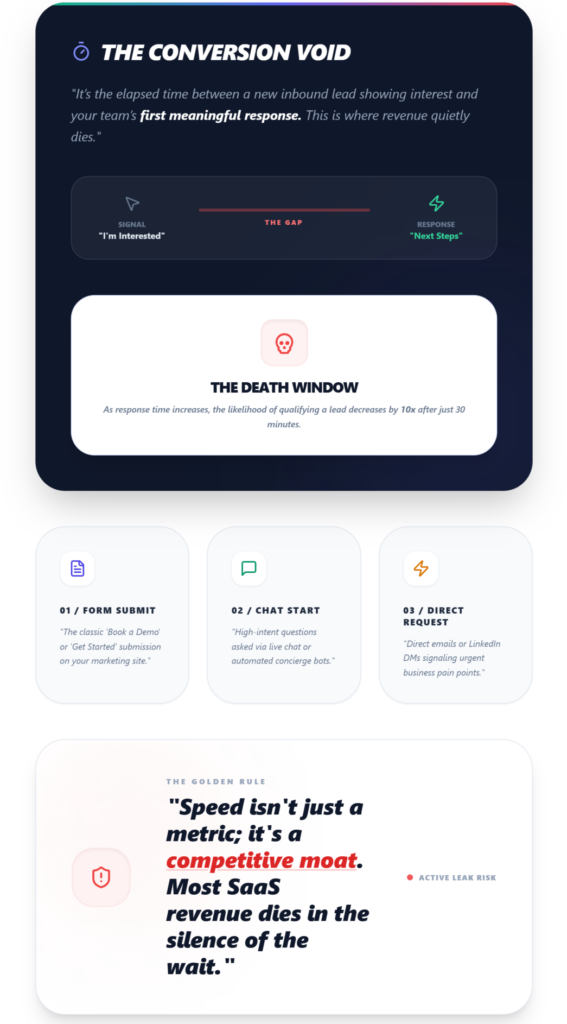
Lead response time (simple definition): Lead response time is the elapsed time between a new inbound lead showing interest — filling out a form, requesting a demo, starting a chat — and your team’s first meaningful response.
It’s the gap between “I’m interested” and “Here’s what happens next.”
And that gap is where most SaaS revenue quietly dies.
Why Lead Response Time Matters More Than You Think
Most SaaS teams think lead response time is just about speed. Reply fast, check the box, move on.
But in reality, it determines whether a demo ever happens.
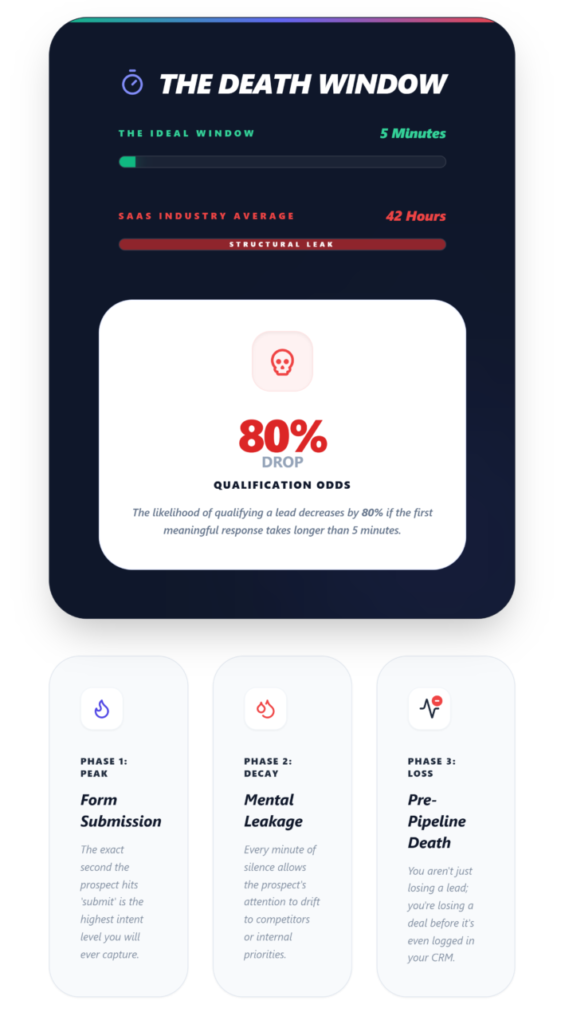
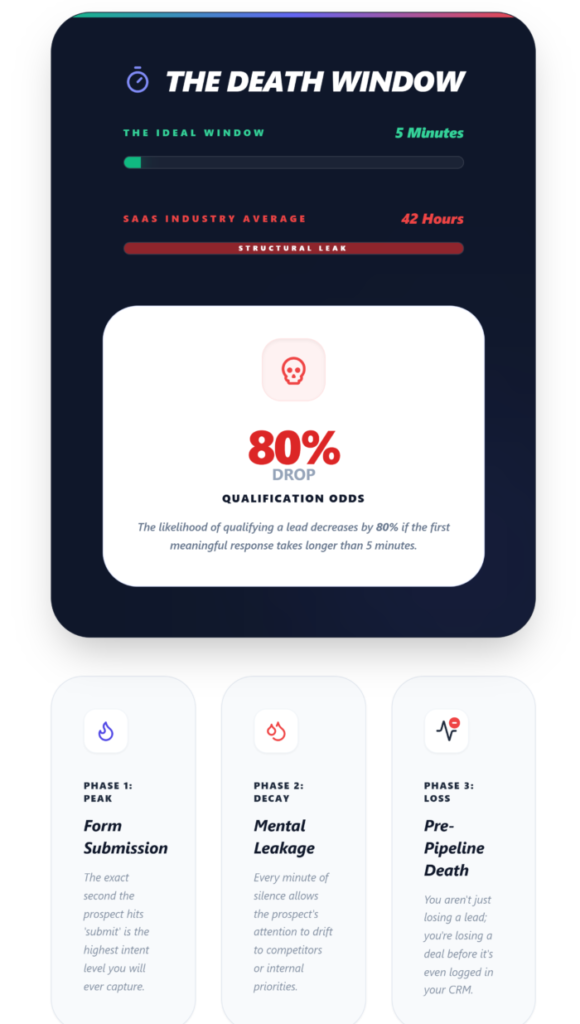
If you delay response, you don’t just lose a lead — you lose a potential deal before it even enters your pipeline. The form submission was the peak of intent. Everything after that is decay.
And the data backs this up in a way that’s honestly uncomfortable: the odds of qualifying a lead drop 80% after just five minutes. Five. Not five hours. Not five days.
I’ve watched teams obsess over ad spend, landing page copy, and funnel optimization — then let demo requests sit in a shared inbox for 35 hours.
The average SaaS response time is 42 hours. That’s not a minor inefficiency. That’s a structural revenue leak.
Here’s what this guide will help you do: understand exactly where money is lost between lead submission and demo execution, and build a system that stops the bleeding.
Pre-Flight Check: Are You Ready to Fix This?
Before you change anything, you need baseline visibility. What you need locked down:
- A CRM (HubSpot, Salesforce, or equivalent) logging inbound timestamps
- Access to your lead source data segmented by channel
- Clarity on who currently owns lead response (or if nobody does)
Stop/Go test: Pull your last 10 demo requests and check the first response time in your CRM logs. If more than 2 of them exceeded 30 minutes, you have a system problem — not a people problem. Go.
How Slow Lead Response Kills Your Revenue
Intent Decays Quickly
A prospect who fills out a demo request is at peak curiosity. They’ve done the research. They’re comparing options. They’re ready to talk.
Thirty minutes later? They’re back in Slack, in a meeting, answering emails. The urgency is gone.
Data from the original Harvard Business Review study still holds: you’re 7x more likely to qualify a lead contacted within the first hour versus the second.
And contacting within 5 minutes makes you 100x more likely to reach them compared to waiting 30 minutes. That hot lead window closes fast. And it doesn’t reopen with a follow-up email two days later.
The Demo Booking Never Happens
This is the part nobody talks about enough. Delay doesn’t just reduce conversion rates on paper — it means the demo scheduling step literally never occurs.
The lead cools off. They don’t respond to your belated outreach. Your rep marks them “unresponsive.”
In your CRM, it looks like a bad lead. It wasn’t. It was bad timing. Delay equals no scheduling. It’s that simple.
Competitors Respond First
Here’s a number that should keep you up at night: 30-50% of sales go to the vendor that responds first.
Not the best vendor. Not the cheapest. The first.
Your prospect submitted a demo request to you and two competitors within the same 15-minute window.
If you respond in 4 hours and your competitor responds in 4 minutes, you’re not even in the conversation anymore. First responder advantage is real, and it compounds.
Lead Quality Appears Worse Than It Is
This is the ghost error I see constantly in small SaaS teams.
The pipeline review happens. Conversion rates are low. The conclusion? “Our leads aren’t qualified enough. We need better targeting.”
But pull the bottleneck analytics. Look at the response timestamps. Those leads weren’t bad — the timing was.
When you’re averaging 35-hour response times, you’re measuring the quality of stale leads, not fresh ones. Your lead qualification rate is a lagging indicator of your speed, not your marketing.
Pipeline Leakage Starts Early
Most teams think pipeline leakage happens at the proposal stage or during negotiation. It doesn’t.
It starts at the top — between form submission and first response.
70%+ of leads go cold after 42 hours without contact. They churn before the demo.
Your sales pipeline velocity tanks not because your closers are weak, but because the top of the funnel is hemorrhaging before anyone picks up the phone.
Lead Response Time Is Actually a Demo Conversion Problem
Here’s the shift most teams miss: lead response time isn’t a standalone metric.
It’s the first domino in a chain that ends at revenue.
The chain looks like this:
Lead submits request → Response happens → Qualification → Demo scheduled → Demo executed → Deal closed.
Break any link, and the chain collapses. But the first break — slow response — is the most destructive because it prevents everything downstream.
No response means no qualification. No qualification means no demo. No demo means no pipeline.
Most SaaS teams lose deals before the demo even happens. They’re optimizing close rates on a pipeline that’s already been gutted by response delays.
Speed without system doesn’t improve conversion. You can respond in 90 seconds, but if there’s no routing logic, no qualification step, and no scheduling mechanism, that fast reply goes nowhere.
The Lead-to-Demo Conversion Flow
Here’s the framework that actually connects speed to revenue. I call it the Lead-to-Demo Conversion Flow:
- Lead Submits Request — Form fill, chat message, or demo request hits your system.
- Instant Response — Automated acknowledgment plus real human follow-up within 5 minutes. Not an autoresponder trap — actual context.
- Qualification — Quick scoring based on intent signals. Demo requesters get priority over content downloads. Use a lead prioritization framework, not gut feel.
- Demo Scheduling — Frictionless booking. Calendar link, rep assignment, confirmation. No back-and-forth email chains.
- Demo Execution — Prepared, on time, with context from the qualification step already loaded.
Each step has a verification point. If you can’t confirm that 80% of your leads move from Step 1 to Step 2 within 5 minutes, the rest of the flow is irrelevant. That’s your diagnostic starting point.
Visual checkpoint: In a healthy system, your CRM dashboard shows green “Responded <5min” badges on lead cards and your demo funnel shows minimal drop-off between submission and scheduling.
What Is a Good Lead Response Time?
You need to understand exactly what happens at every time interval after a lead submits a request.
- Under 5 minutes (Excellent)
Impact: 100x better contact rate. 391% conversion lift vs. 30+ minute responses. - Under 1 hour (Acceptable)
Impact: 7x more likely to qualify than waiting to hour two. Still competitive. - 1–24 hours (Risky)
Impact: Intent has decayed significantly. Competitors likely already engaged. - 24+ hours (Poor)
Impact: 60x worse qualification rate vs. sub-5-minute. Most leads are effectively dead.
The five-minute rule isn’t aspirational. It’s the baseline for competitive SaaS sales. Anything beyond that, and you’re handing revenue to whoever responds first.
Why Most SaaS Teams Struggle with Response Time
It’s rarely laziness. It’s broken infrastructure.
- Manual routing. Leads land in a shared inbox. Someone has to notice, claim it, and act. In a 1-5 person sales team, that someone is usually in a meeting.
- No ownership. If everyone is responsible, nobody is. The rep assignment queue has no rules, no round-robin, no accountability. Leads sit.
- Delayed follow-ups. The first response happens, but the scheduling step takes another 24 hours of email ping-pong. The channel-specific response times vary wildly — chat might hit 2 minutes, but form submissions lag at 45.
- Broken systems. CRM alerts aren’t configured. Off-hours submissions get no response until morning. Stale contact data causes bounced emails. The tools exist, but nobody wired them together.
How to Improve Lead Response Time (Without Chaos)
You don’t need a 50-person SDR team. You need a system.
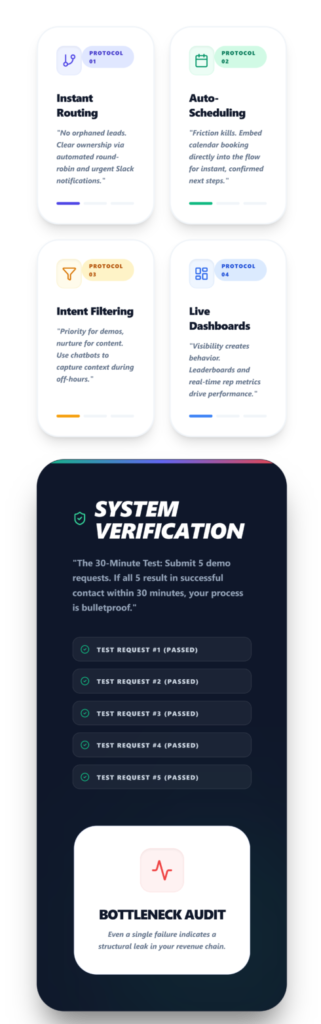
- Instant routing with clear ownership. Every inbound lead gets assigned to a specific rep automatically. Round-robin for small teams. Slack pings for urgency. No orphaned leads.
- Automated scheduling. Stop emailing “When works for you?” Embed calendar booking directly into your response flow. The lead picks a time. It’s confirmed. Done.
- Qualification filters. Not every lead needs a 5-minute response from your best closer. Score by intent — demo requests get priority, content downloads get nurtured. Apply a working hours adjustment for off-hours submissions, but make sure a chatbot captures context immediately.
- Real-time accountability. A shared dashboard showing response times by rep. Leaderboards work. Visibility creates behavior change faster than any training session.
Verification: Test 5 demo requests through your own system. If successful contact happens within 30 minutes on all 5, your process is solid. If even one fails, you’ve found your bottleneck.
Why Speed Alone Isn’t Enough
Responding fast without a structured demo system doesn’t fix conversion.
I’ve seen teams hit sub-2-minute response times and still bleed pipeline. Why?
Because the response was a generic autoresponder with no human context. Or the rep responded but had no way to schedule the demo without three more emails. Or the lead got qualified but nobody tracked the follow-up.
Speed is necessary. But speed plugged into routing, scheduling, and follow-up management is what actually moves conversion rates.
When Fast Response Meets a Broken Demo Workflow
If your team responds quickly but still struggles to convert demo requests into booked meetings, the problem isn’t speed — it’s the system after the speed.
LevelUp Demo connects lead capture directly to qualification, scheduling, and follow-up tracking so nothing falls through the gap between “interested” and “booked.” It’s built for small SaaS teams who don’t need a heavyweight CRM — just a clean path from request to demo.
FAQ
What is lead response time?
Lead response time is the duration between a prospect’s first inbound action — like a demo request or form fill — and your team’s first substantive response. It’s the most controllable variable in your demo funnel and directly predicts whether a conversation happens at all.
Why is speed to lead important?
Because intent is perishable. A lead contacted within 5 minutes is 100x more likely to be reached than one contacted at 30 minutes. Speed to lead determines whether your sales team gets a conversation or a voicemail. It’s the difference between pipeline and waste.
What is a good lead response time for SaaS?
Under 5 minutes is the benchmark for high-performing teams. Under 1 hour is acceptable. Anything beyond 24 hours means you’ve likely lost the lead to a competitor or to simple disinterest. The industry average of 42 hours is, bluntly, a demo conversion failure.
Does response time affect demo conversions?
Directly. Slow response breaks the chain between lead submission and demo scheduling. Teams that cut response times from hours to minutes see conversion lifts of 21-391%. The demo doesn’t happen if the response doesn’t happen — and reducing no-shows starts with reducing response delays.
Conclusion: Systematize Your Speed
Lead response time is a revenue metric, not a sales activity metric. The 42-hour industry average means most SaaS teams are losing deals before the first conversation even happens. Because intent decays within minutes, the five-minute rule is a minimum, not a stretch goal. Remember that bad lead quality is often just bad response timing in disguise. However, speed without routing, scheduling, and follow-up systems still fails. Build the complete Lead-to-Demo Conversion Flow (Submit → Respond → Qualify → Schedule → Execute). Fix the system first. Then measure the speed.
Ready to close the gap between lead and demo?
LevelUp Demo gives small SaaS teams the routing, scheduling, and follow-up infrastructure to convert demo requests — not just respond to them.
✅ Instant Lead Routing
✅ Frictionless Scheduling
✅ Stop Revenue Leaks