A 400-person fintech submits a demo request through your pricing page at 2:14 PM. Your CRM workflow fires, checks round robin, and assigns the lead to an SDR who handles the SMB segment. That SDR looks at the company, realizes it’s a mid-market account with an existing opportunity, and manually reassigns it. The territory AE is out sick. Nobody notices for nine hours.
By the time the right person reaches out, the prospect has already booked a call with a competitor.
The problem wasn’t volume. It wasn’t even speed, exactly. It was that the system answered the wrong question. Round robin asked “whose turn is it?” when the real question was “who should own this?”
That distinction, between distribution and ownership, is the core of demo request routing. And it’s the piece most SaaS teams get wrong first.
By the end of this article you’ll understand how ownership logic actually works inside a routing system, why the standard advice breaks down in practice, and what separates a routing workflow that assigns leads from one that assigns the right leads.
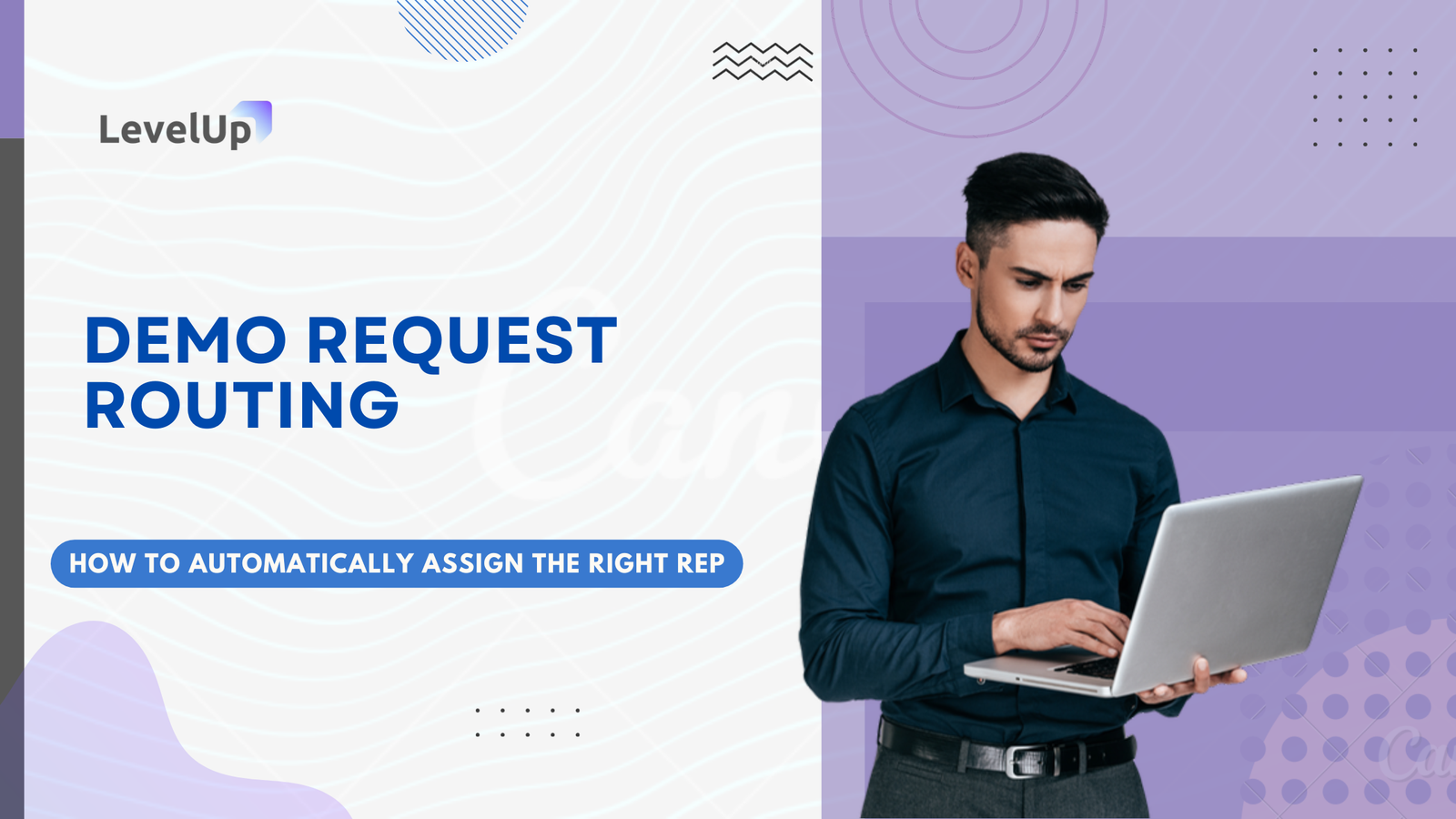
What is demo request routing?
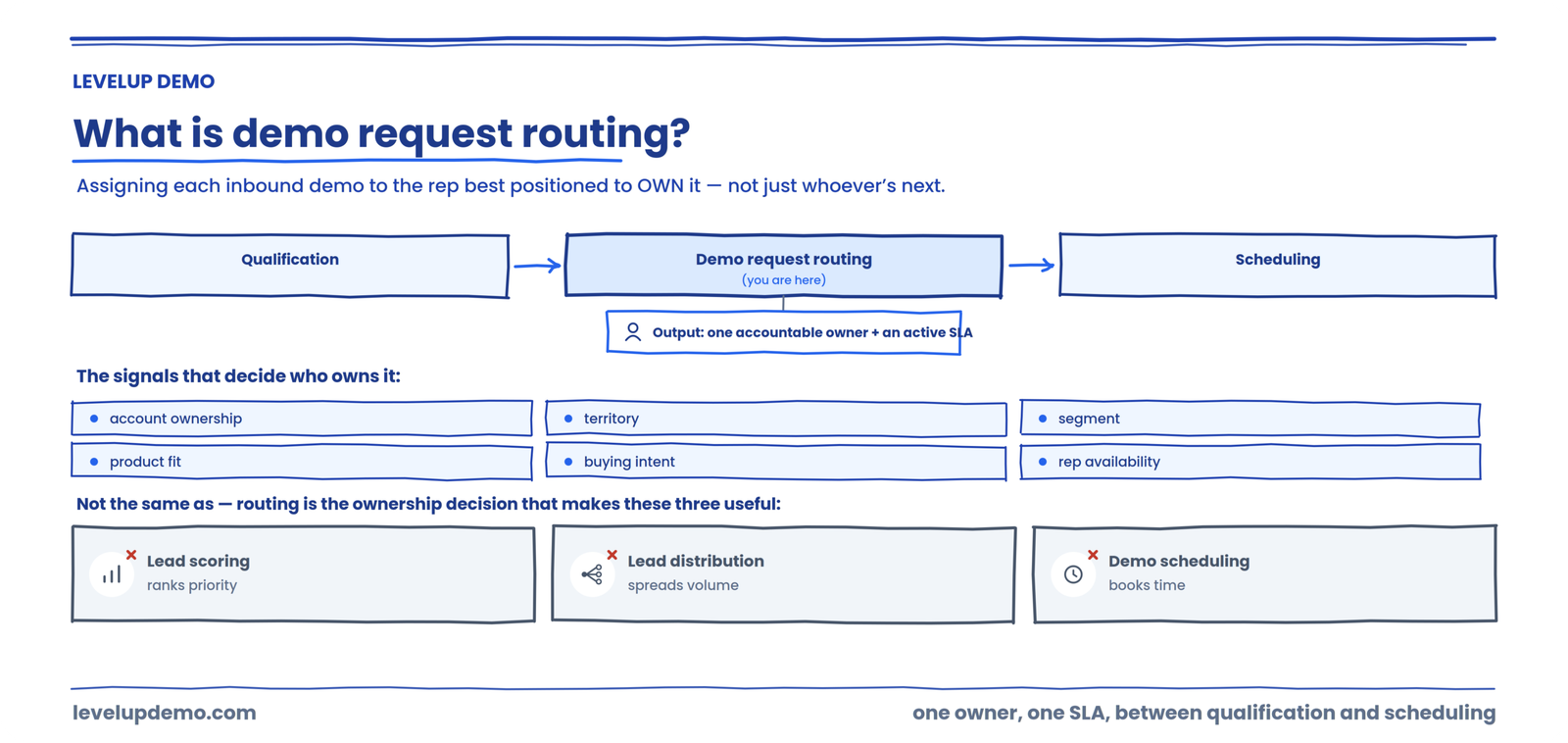
Demo request routing is the process of assigning an inbound product-demo request to the sales representative or team best positioned to own it, using signals like account ownership, territory, segment, product fit, buying intent, and rep availability. It sits between qualification and scheduling inside the broader SaaS demo workflow, and its output is a single accountable owner with an active SLA.
That’s different from lead scoring, which ranks priority. It’s different from lead distribution, which spreads volume. And it’s different from demo scheduling, which books time. Routing is the ownership decision that makes all three useful.
Why round-robin routing isn’t enough
Round robin is fair. Fair isn’t always effective.
If your reps are genuinely interchangeable (same segment, same territory, same product expertise), round robin works fine. Most SaaS teams outgrow that condition fast. The moment you have territory rules, named accounts, product specialists, or a mix of SDRs and AEs, round robin starts producing misroutes that look invisible in the CRM but show up in reassignment rates and slower response times.
A 1,200-person SaaS company requests an enterprise demo. Round robin sends it to an SDR who handles inbound for the SMB pool. The SDR can’t run the demo, doesn’t own the territory, and has no context on the account. Now you’ve added a handoff, a delay, and friction the prospect never needed to experience.
Round-robin routing distributes requests evenly, but it does not assign them to the most appropriate representative. That’s the gap routing logic is supposed to close.
What data should determine who gets a demo request?
The routing decision depends on what you know about the request and what you know about your team. Here’s what should feed the logic:
| Signal | Why it matters |
|---|---|
| Existing account owner | Prevents conflict and preserves relationship context |
| Existing opportunity | Avoids duplicate pipeline and rep confusion |
| Territory | Respects geographic or regional ownership |
| Company size / employee count | Determines segment (SMB, mid-market, enterprise) |
| Industry | Matches domain expertise where it exists |
| Product interest | Routes to the right specialist if you sell multiple products |
| Estimated deal value | Flags high-value requests for senior reps |
| Buying intent signals | Separates research from active evaluation |
| Lead source | Differentiates paid, organic, partner, event |
| Language / time zone | Matches availability and communication fit |
| Rep availability | Prevents assignment to reps who can’t respond |
| Rep workload | Balances capacity across the team |
Not every team needs all of these. But every team needs more than “whose turn is it.”
One thing that consistently breaks routing in practice is bad field hygiene. Country values entered as free text, company size left blank, domain not matched to an existing account. The routing logic can be perfect, but if the data going in is incomplete, the output is a coin flip. Enrichment before assignment matters more than most teams realize when they first build the workflow.
Should you qualify before routing?
This is where practitioners genuinely disagree.
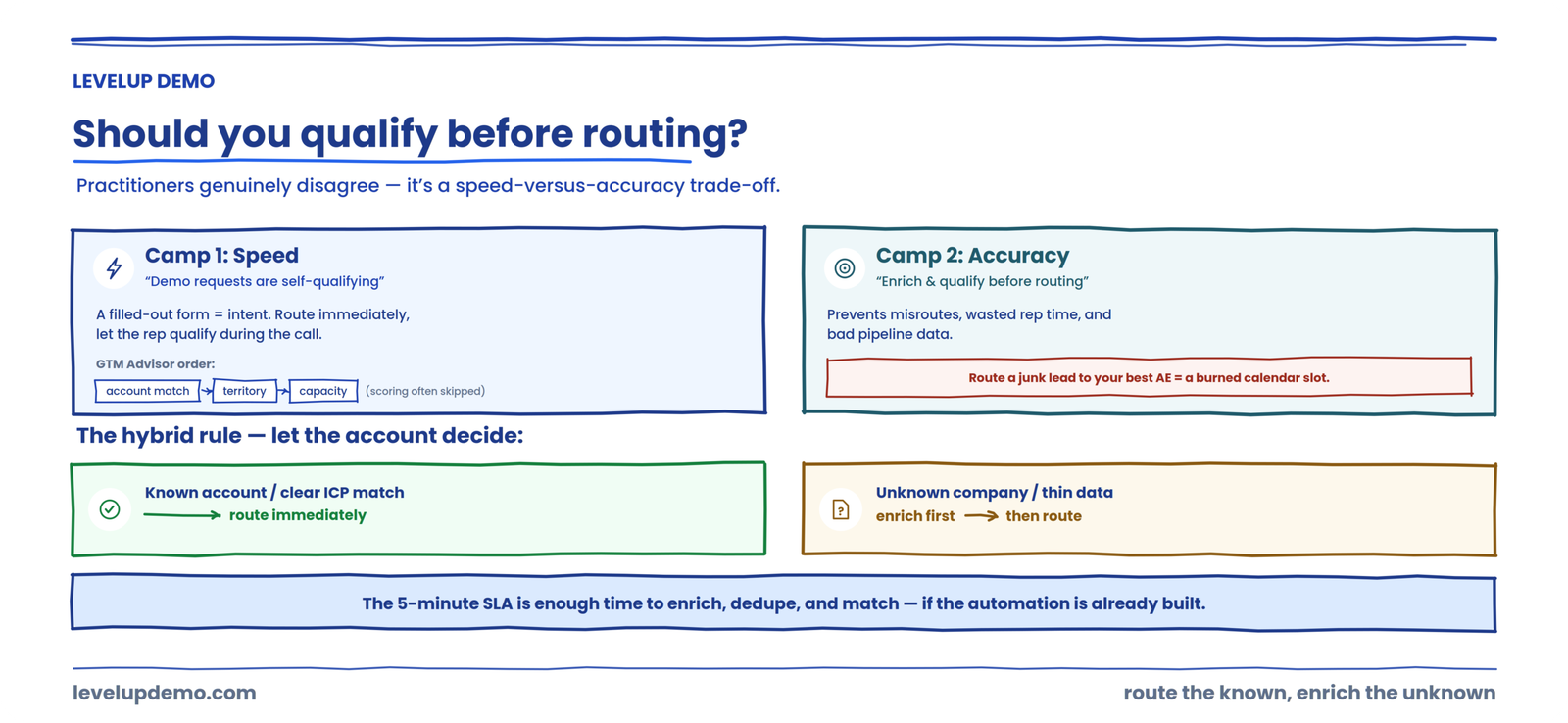
One camp says demo requests are self-qualifying. Someone filled out a form asking to see your product. That’s intent. Route immediately and let the rep qualify during the conversation. The argument is speed: GTM Advisor’s routing framework treats demo requests as inherently high-intent, recommending account matching first, then territory, then capacity, and explicitly noting that scoring can often be skipped.
The other camp says enrichment and basic qualification before routing prevents misroutes, wasted rep time, and bad pipeline data. The argument is accuracy: route a junk lead to your best AE and you’ve burned a slot in their calendar.
I land on a hybrid. For known accounts and clear ICP matches, route immediately. For unknown companies with incomplete form data, enrich first, then route. The five-minute SLA window that most inbound teams target gives you enough time to run enrichment, check for duplicates, and match the account, as long as the automation is already built.
If you want to go deeper on the qualification layer, there’s a full breakdown on how to qualify demo requests before they hit the pipeline.
The RIGHT framework for demo request routing
Instead of treating routing as a single rule, think of it as five sequential decisions. This is the framework LevelUp Demo recommends:
Build a routing hierarchy
Routing rules need precedence. If you have ten rules and they all evaluate independently, you’ll hit conflicts constantly. One lead can match a territory rule, a segment rule, and a product rule, each pointing to a different rep. Without a clear hierarchy, you don’t have routing logic. You have a race.
A recommended order of precedence, though the exact sequence depends on your sales model:
The principle is simple: known ownership beats inferred ownership, and inferred ownership beats rotation. Account matching runs before any new-business logic. Always.
Kubaru reported that teams implementing structured routing hierarchies saw routing accuracy rise from 72% to 96%, with demo-to-opportunity conversion moving from 38% to 51%. That’s a material difference, and it came from rule ordering, not from adding more rules.
How to handle routing exceptions
A complete demo routing workflow needs fallback logic for requests that don’t match a primary routing rule. Every routing system needs somewhere for ambiguous requests to land. Call it a fallback queue, a default owner, a routing exception queue. Just make sure it exists.
| Problem | The weird fix | Where practitioners found it |
|---|---|---|
| Demo booked but no rep ownership changes | Meeting tool and CRM both write the owner field, causing a conflict | Remove one source of truth; let only one system write ownership |
| Enterprise account routed to SDR pool | Account match runs after round robin instead of before | Move account ownership to the top of the waterfall |
| “Unassigned” demos pile up silently | No fallback rule for missing data or unavailable reps | Create a default queue or backup owner |
| Reps complain about unfair distribution | Rotation ignores meeting load and capacity | Add availability filters before rotation fires |
| Duplicate requests create double ownership | Duplicate detection is missing or runs too late | Check for existing contact and owner before any assignment |
| Routing works in testing, fails in production | Rules documented only inside the tool | Maintain an external routing spec and change log |
That last row is one I’ve seen repeatedly in demo workflows. Someone builds routing logic inside HubSpot or Salesforce, it works perfectly in the sandbox, and then a territory change three months later breaks it because nobody remembers which workflow contains the rule. Documenting routing logic outside the tool isn’t optional. It’s how you prevent silent drift.
Routing that assigns an owner but nothing else is only half a workflow
LevelUp Demo connects qualification, routing, scheduling, outcomes, and follow-up in one workflow, so the moment an owner is assigned, the notification, SLA timer, and scheduling flow fire automatically.
How AI improves demo request routing
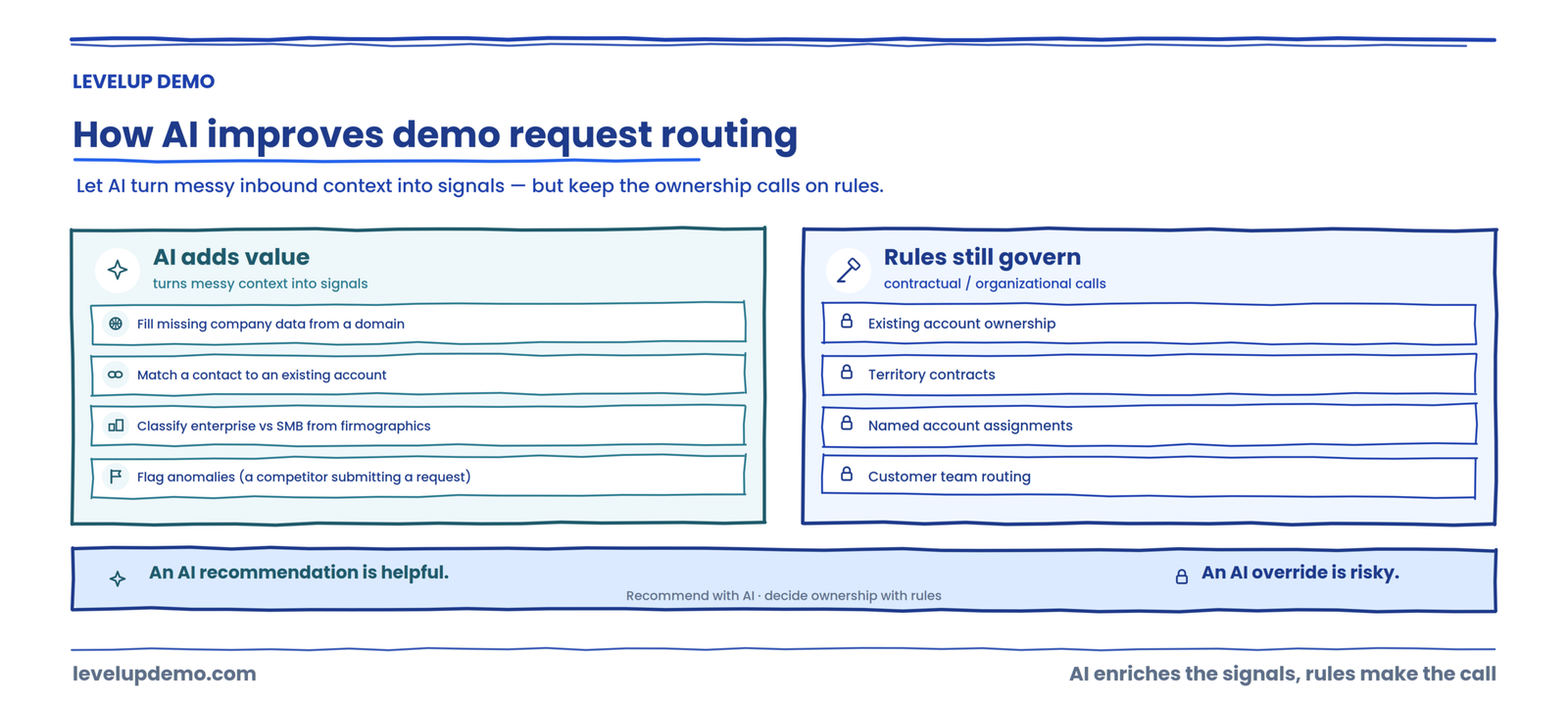
AI can improve demo request routing by enriching incomplete submissions, classifying accounts, detecting intent signals, and recommending an appropriate routing path. It’s most useful when it turns messy inbound context into structured routing signals.
Where AI adds real value: filling in missing company data from a domain, matching a contact to an existing account, classifying whether a request looks like enterprise or SMB based on firmographic signals, and flagging anomalies (like a known competitor submitting a request).
Where deterministic rules should still govern: existing account ownership, territory contracts, named account assignments, customer team routing. These are business decisions with contractual or organizational implications. An AI recommendation is helpful. An AI override is risky.
For a deeper look at how AI fits across the full demo lifecycle, there’s a complete guide on the AI-powered demo workflow.
How to measure routing quality
Most teams measure whether a lead got assigned. That’s necessary but insufficient. Routing quality has five dimensions:
Routing correctness asks whether the request reached the appropriate owner. Track this through reassignment rate. If reps are constantly reassigning leads they received, the routing logic is wrong.
Routing speed measures how quickly ownership was established. GTM Advisor recommends tracking P95 response time alongside match rate and fallback rate as core routing KPIs.
Routing continuity checks whether the prospect moved smoothly from assignment into scheduling and follow-up, or whether the handoff stalled.
Routing stability tracks whether the lead needed reassignment after initial routing.
Routing outcome connects the assigned route to downstream results. Did demos routed through the hierarchy convert better than demos that hit the fallback queue? Kubaru found that companies with a formal demo process converted demos to pipeline at 42.1%, compared with 29.5% for companies without one. Routing is a big part of what makes that process formal.
If you’re building out your measurement framework, the demo operations KPIs breakdown covers the full metric set.
Where practitioners disagree
There’s an active debate about whether routing should happen before or after scheduling. Some teams let the prospect book directly through a scheduling tool with round-robin logic, then adjust ownership in the CRM afterward. Others route first, then send a personalized scheduling link from the assigned rep.
Both approaches work. The scheduling-first model is faster but harder to correct when the wrong rep gets booked. The routing-first model is more accurate but adds a step before the prospect gets a calendar link. I lean toward routing first for any team with more than two reps or any form of territory or segment structure. The speed difference is negligible if your automation is tight, and the accuracy difference is significant.
Demo request routing audit
Pull up your last twenty demo requests and check:
If three or more of those answers are no, the routing system needs work before you add more rules on top of it.
When routing is only one piece of the problem
Most routing gaps aren’t really routing gaps. They’re workflow gaps: the request gets assigned, but scheduling stalls, follow-up doesn’t fire, or outcomes never get tracked. LevelUp Demo connects qualification, routing, scheduling, outcomes, and follow-up inside one demo operations workflow, so the ownership decision actually leads somewhere. See how it works.
FAQ
What is demo request routing?
Demo request routing is the process of automatically assigning an inbound product-demo request to the sales rep or team best positioned to own it, based on signals like account ownership, territory, company size, product fit, intent, and rep availability. It sits between qualification and scheduling inside the demo operations workflow, and its output is a single accountable owner.
Should demo requests be qualified before routing?
For known accounts and clear ICP matches, route immediately. For unknown companies with incomplete data, enrich and qualify first. The goal is accurate ownership within your SLA window, not perfection at the cost of speed.
Is round-robin routing good enough for demo requests?
Only if your reps are genuinely interchangeable across segment, territory, and product expertise. Most SaaS teams outgrow that quickly.
What happens when no rep is available for a demo request?
The request should land in a fallback queue or route to a backup owner. Silent unassignment is the single most common routing failure, and it’s entirely preventable with a default path.
How do you measure routing accuracy?
Track reassignment rate, fallback rate, distribution balance, and time to assignment. Then connect those to downstream demo outcomes. Routing accuracy without outcome data is just a process metric.
What’s the difference between lead routing and demo operations?
Lead routing is one step. Demo operations is the full workflow: request, enrichment, qualification, routing, scheduling, the demo itself, outcome tracking, and follow-up. Routing that stops at assignment misses most of the value.
Your next problem after routing isn’t going to be the rules themselves. It’s going to be what happens in the thirty minutes after assignment: whether the notification actually reaches the rep, whether the scheduling link goes out, and whether anyone is tracking what happens to the demo after it’s held. That’s where most pipelines quietly leak, and it’s worth auditing before you add another routing condition.
Make the ownership decision actually lead somewhere
LevelUp Demo connects qualification, routing, scheduling, outcomes, and follow-up in one demo operations workflow, so nothing stalls in the thirty minutes after assignment.