
A rep on our team spent three weeks working a mid-market account. Back-and-forth emails, a warm intro from a mutual connection, scheduling gymnastics across time zones. The demo finally happened. The product was solid. The conversation felt smooth. The prospect even said, “This looks great.”
Two weeks later, the deal went dark. No reply. No objection. Just silence.
We pulled the call recording and watched it back. The rep had opened with a 12-minute product walkthrough before asking a single question about the buyer’s workflow. The prospect was polite the entire time, but never engaged. They smiled, nodded, and left without understanding how the product fit their world.
Most SaaS demo failures are execution failures, not product failures. Not pricing. Not competition. Not a missing feature. The way the demo is run — what happens before, during, and after — is where deals are won or quietly lost.
By the end of this guide, you’ll know exactly which demo mistakes are costing you revenue and have a concrete framework for fixing each one.
What are the biggest SaaS demo mistakes?
The biggest SaaS demo mistakes include skipping discovery, showing too many features, delivering generic presentations, ignoring buying signals, failing to personalize the demo, and ending without clear next steps. These mistakes often reduce engagement and lower demo-to-close conversion rates.
Why Good Products Still Lose Deals During Demos
Great products lose deals every day because buyers never see their relevance.
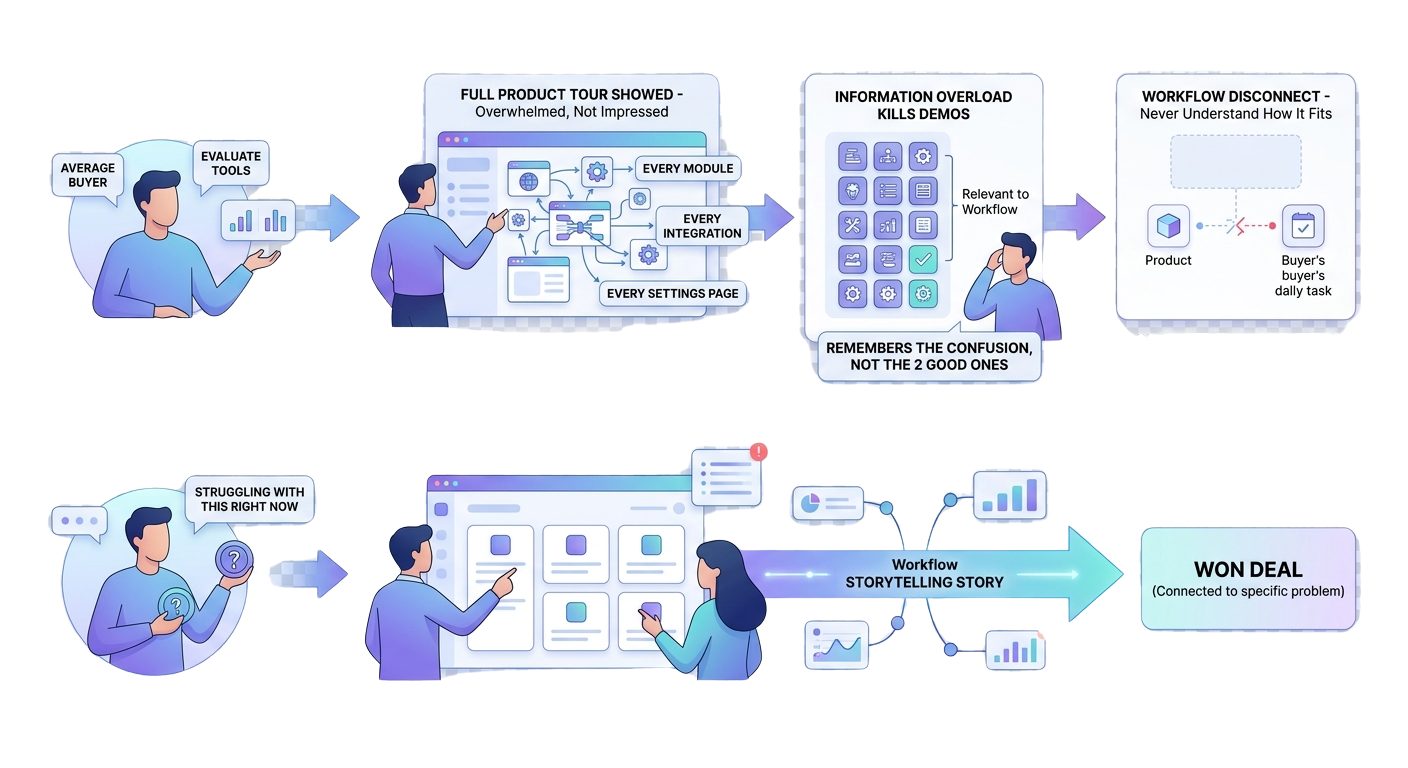
Here’s what’s actually happening. The average buyer is evaluating multiple tools. Their attention during a 30-minute demo starts declining around the 8-10 minute mark if nothing has connected to their specific problem. They’re not sitting there thinking, “Wow, what a feature set.” They’re thinking, “How does this help me with the thing I’m struggling with right now?”
We’ve seen strong products lose deals because the demo was generic. The rep showed the full product tour — every module, every integration, every settings page — and the buyer walked away overwhelmed, not impressed.
Information overload kills demos. When a buyer sees 15 features and only 2 are relevant to their workflow, they don’t filter for the 2. They remember the confusion.
And the workflow disconnect is the silent deal-killer. In many cases, buyers don’t reject the product. They simply never understand how it fits their workflow. That’s not a product problem. That’s a demo execution problem. If you’re looking for a deeper breakdown, our ultimate guide to sales demos covers the full picture.
The 10 SaaS Demo Mistakes That Cost Teams Revenue
This is where most of the damage happens. I’ve watched hundreds of demos — live, recorded, reviewed with reps afterward — and the same patterns keep showing up.
Mistake #1: Starting With Features Instead of Problems
The fastest way to lose a deal is to show everything and explain nothing. Reps get excited about the product. That’s natural. But when you open a demo by jumping straight into the interface without establishing the buyer’s context, you’re essentially presenting a solution before confirming the problem.
How to fix it: Start with a discovery call. Even 5 minutes of targeted questions before showing product changes the entire dynamic. Use a buy-in summary — recap the buyer’s pain, desired outcome, and urgency — and get them to confirm it before you touch the product. If the prospect can’t restate their own pain in one sentence, you’re not ready to demo.
Mistake #2: Running the Same Demo for Every Prospect
This is the “one-deck-fits-all” trap. A VP of Sales and an individual contributor care about completely different things. Showing them the same walkthrough is lazy, and buyers feel it. We’ve watched reps deliver identical demos to a 10-person startup and a 500-person enterprise in the same week. The startup prospect wanted speed and simplicity. The enterprise prospect wanted compliance and integrations. Both got the same tour. Neither converted.
How to fix it: Customize around role and workflow. Use strong discovery call questions to understand the buyer’s ICP, team size, and current tools before you build the demo flow. The best SaaS demos feel personalized because discovery happened first.
Mistake #3: Showing Too Many Features
Buyers don’t need every feature. They need the right features. Feature dumping is one of the most common demo habits, especially among founder-led sellers who built the product and want to show off everything. But cognitive overload is real. When you show 20 capabilities in 25 minutes, the buyer retains almost none of it.
How to fix it: Pick 2-3 features that directly map to the buyer’s stated pain points. Show the loop: pain → capability → short customer story → engagement question. That’s it. If you need a tighter structure, our guide on how to give a product demo walks through this step by step.
Mistake #4: Ignoring Buying Signals
When a prospect asks, “How does implementation work?” or “Can we get our team lead on the next call?” — that’s not a casual question. These signals often predict deal progression. Pricing curiosity, stakeholder involvement, timeline questions — these are all indicators that the buyer is mentally moving forward. Reps who miss them keep demoing features instead of advancing the conversation.
How to fix it: Train yourself to recognize buying signals in real time. When you hear one, pause the demo and address it directly. “It sounds like you’re thinking about rollout — let’s talk about that.”
Mistake #5: Talking Too Much
I pulled call recordings from a quarter’s worth of demos once. The reps who lost the most deals had one thing in common: they talked for 75%+ of the call. The ones closing? Closer to 50-50. Monologue demos kill engagement. When the buyer becomes a passive audience member, they mentally check out. They stop asking questions. They stop imagining themselves using the product.
How to fix it: Build in engagement checkpoints every 3-4 minutes. “Does this match how your team handles it today?” or “Where does this break down for you?” Our SaaS demo best practices guide has more on maintaining call control without being robotic.
Mistake #6: Reaching the Value Moment Too Late
The most expensive demo mistakes often happen before the product is even shown. But even once you’re in the product, timing matters. If your “wow moment” comes at minute 22 of a 30-minute call, most buyers have already decided this isn’t for them. Attention drop-off is steep. Demo fatigue is real.
How to fix it: Front-load value. Show the single most relevant capability within the first 5 minutes of screen sharing. Some teams use interactive product demos or self-guided experiences to let buyers hit the value moment on their own terms, which can be even more effective.
Mistake #7: Weak Next Steps
“I’ll send over some info and we can circle back next week” is not a next step. It’s a polite way to let a deal die. Vague endings create vague outcomes. No ownership, no timeline, no commitment. The prospect leaves the call without a reason to return.
How to fix it: Before the call ends, schedule the next meeting. Name the specific action items and who owns each one. “I’ll send the proposal by Thursday. Can we get 20 minutes with your team lead on Monday?” That’s a demo next step that actually protects the deal.
Mistake #8: No Follow-Up Process
Same-day follow-up is non-negotiable. Yet I’ve seen teams where the average follow-up time after a demo is 3-4 days. By then, the buyer has moved on emotionally, even if they were interested during the call. Delayed follow-up is where momentum dies. And when there’s no sales SLA governing response times, leads slip through every week.
How to fix it: Implement a same-day follow-up rule. Standardize what gets sent: a summary of what was discussed, the agreed next step, and any relevant resources. If your team struggles with this, AI follow-up tools can automate the heavy lifting without losing the personal touch.
Mistake #9: Not Tracking Demo Outcomes
If your CRM doesn’t clearly show what happened after each demo — won, lost, in follow-up, no-show — you’re flying blind. You can’t improve what you can’t see. Poor CRM hygiene means nobody knows whether a demo was promising or dead. Reps repeat the same mistakes because there’s no feedback loop. Leadership can’t tell if the problem is qualification, execution, or follow-up.
How to fix it: Standardize demo outcome tracking. Every demo gets a status update the same day. Use demo management software or a demo workflow tool to create visibility across the team without adding admin overhead.
Mistake #10: Treating Demos as Presentations Instead of Conversations
This is the one that ties everything together. Great demos feel like collaborative problem-solving sessions. The rep isn’t performing. They’re exploring the buyer’s situation alongside them, using the product as a shared canvas. Buyers disengage when demos become feature tours instead of problem-solving conversations. When a demo feels like a webinar, the buyer acts like a webinar attendee — they multitask, they half-listen, and they don’t buy.
How to fix it: Shift your mental model. You’re not presenting. You’re diagnosing and co-solving. Use a demo conversation framework instead of a rigid script. Ask questions mid-demo. React to what the buyer says. Let the conversation shape the product walkthrough, not the other way around.
Which SaaS Demo Mistakes Hurt Conversion Rates the Most?
Not all mistakes impact your bottom line equally. To help your team prioritize, we’ve categorized these flaws by their impact on your demo-to-close metrics.
Critical Blockers — Very High Impact
Skipping discovery and running generic, unpersonalized presentations are your primary conversion killers. When you fail to establish context or tailor the solution to the specific buyer persona, you create a “webinar effect” where the buyer stops engaging. These errors often lead to deals stalling immediately after the demo.
Momentum Killers — High Impact
Feature overload, ignoring buying signals, and weak next steps are momentum killers. These happen mid-call and post-call. Failing to capture a buying signal or letting a buyer leave without a committed next step turns a warm lead cold within hours.
Execution Gaps — Medium Impact
Talking too much, late value delivery, or inconsistent outcome tracking fall into the execution category. They don’t always kill a deal instantly, but they prevent the continuous improvement necessary for your team to scale its demo performance.
How High-Performing SaaS Teams Avoid These Mistakes
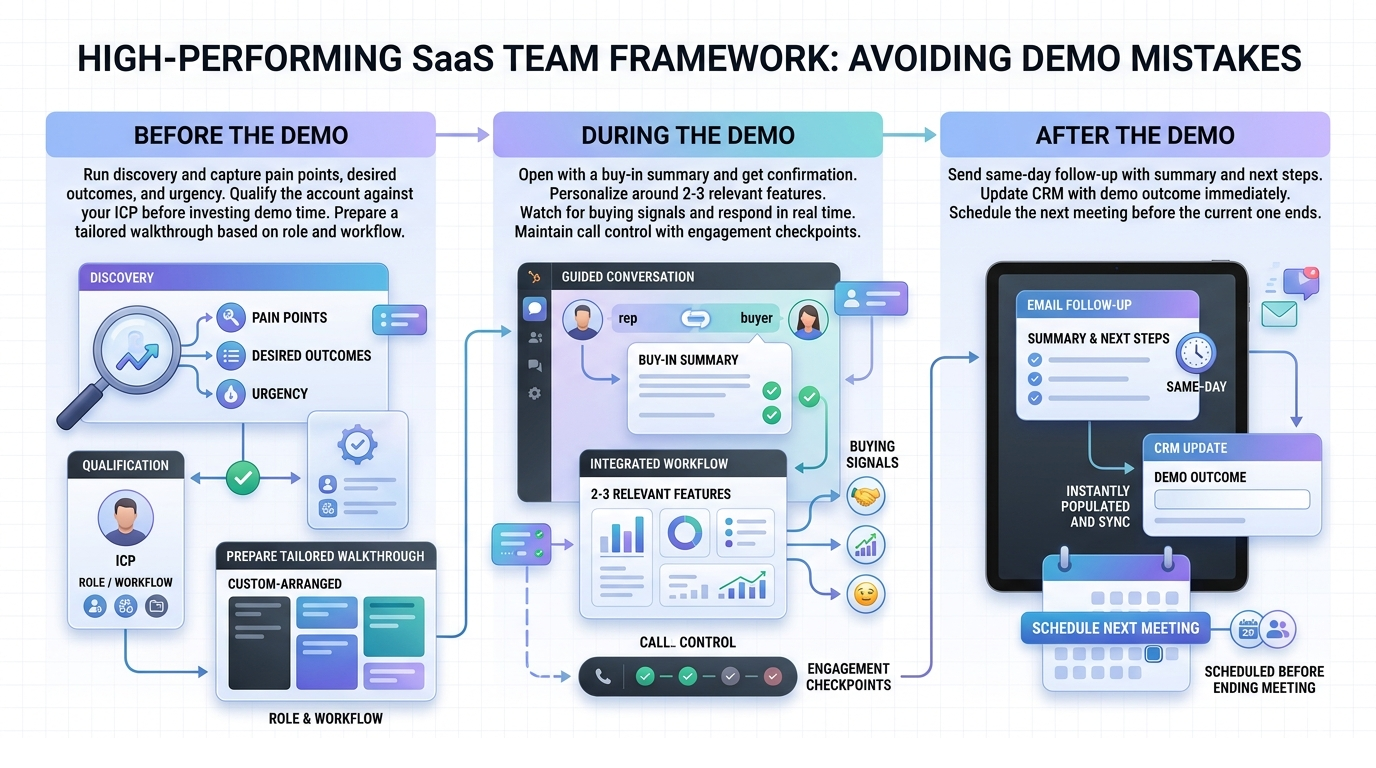
The teams that consistently convert demos into deals don’t rely on individual talent. They run a process. Here’s the framework:
Before the Demo: Run discovery and capture pain points, desired outcomes, and urgency. Qualify the account against your ICP before investing demo time. Prepare a tailored walkthrough based on role and workflow.
During the Demo: Open with a buy-in summary and get confirmation. Personalize around 2-3 relevant features. Watch for buying signals and respond in real time. Maintain call control with engagement checkpoints.
After the Demo: Send same-day follow-up with summary and next steps. Update CRM with demo outcome immediately. Schedule the next meeting before the current one ends.
How LevelUp Demo Helps Teams Avoid Demo Mistakes
One pattern we keep seeing: small teams lose deals not because they can’t demo well, but because the operational layer around demos is broken. Leads come in and nobody knows who owns them. Follow-ups get delayed because there’s no system. Demo outcomes aren’t tracked, so the same mistakes repeat quarter after quarter.
LevelUp Demo
Fix Your Demo Workflow Before Fixing Your Demo Skills
LevelUp Demo gives small sales teams and founders a lightweight system for lead qualification, demo scheduling, follow-up management, and outcome tracking — without the complexity of a full CRM migration. If your demo process has gaps, see how it works.
Frequently Asked Questions
What are common SaaS demo mistakes?
The most common SaaS demo mistakes include skipping discovery, running generic presentations, feature dumping, ignoring buying signals, talking too much, and ending without defined next steps. These errors reduce buyer engagement and lower demo-to-close conversion rates across teams of all sizes.
Why do SaaS demos fail?
SaaS demos fail primarily because of execution, not product quality. The buyer never sees how the product fits their specific workflow. Common causes include lack of personalization, poor call control, delayed follow-up, and treating the demo as a presentation instead of a conversation.
How can I improve demo conversion rates?
Improve demo conversion by running thorough discovery before showing product, personalizing every walkthrough to the buyer’s pain points, maintaining engagement with questions, ending with specific next steps, and following up the same day. Tracking demo outcomes also reveals patterns you can fix.
What should I avoid during a product demo?
Avoid opening with features before understanding the buyer’s problem. Don’t show every capability — focus on the 2-3 most relevant. Don’t monologue. Don’t end with vague follow-up promises. And don’t skip the post-demo process, because that’s where many deals quietly die.
How do successful SaaS teams run demos?
Successful teams run a structured process: qualify and prepare before the demo, personalize and engage during it, and follow up with tracking after it. They treat demos as collaborative problem-solving sessions, not product presentations, and they review call recordings to coach and improve continuously.