
SaaS Sales Benchmarks
SaaS sales benchmarks are standard performance ranges used to evaluate how effectively a sales team converts leads into customers. The most critical benchmarks include:
- Lead response time: within 5–15 minutes (best-performing teams)
- Demo conversion rate: 20%–40% (typical SaaS range)
- Demo no-show rate: 20%–50% (common issue)
- Demo-to-close rate: 15%–30% (healthy range)
These metrics help SaaS teams identify bottlenecks, improve conversion, and optimize revenue performance.
What Are SaaS Sales Benchmarks?
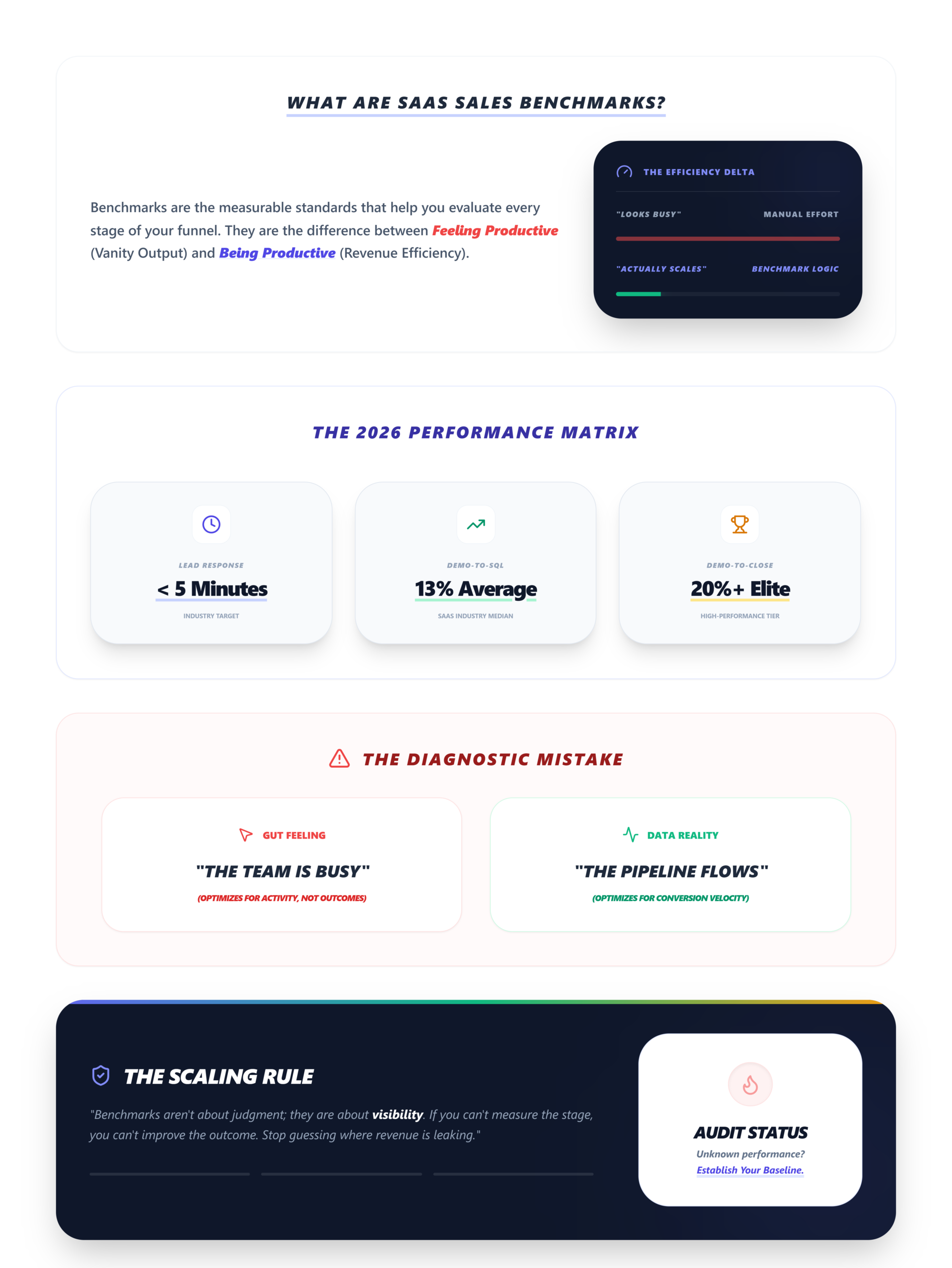
SaaS sales benchmarks are measurable performance standards that help teams evaluate key stages of their sales funnel — from lead response to demo conversion and final deal closure.
They’re the difference between feeling productive and being productive.
Why Most SaaS Teams Don’t Know They’re Underperforming
I was looking at data from a mid-stage SaaS company last quarter. Fifteen demos a week. Decent pipeline.
Founders felt good about things.
Then we pulled the numbers. Their MQL-to-SQL sat at 18%. Demo-to-close was hovering around 7%.
Reps were running 50+ demos a month just to stay near quota. The team wasn’t lazy — they were drowning in activity with no signal telling them the engine was broken.
Most teams track activity. Very few track performance against benchmarks.
You might be generating leads, running demos, and closing deals — but without benchmarks, you genuinely don’t know if your numbers are good, bad, or slowly bleeding you dry.
By the end of this guide, you’ll have the exact benchmark ranges for every critical stage of the SaaS sales funnel, a diagnostic framework to find where your revenue is leaking, and a system-level understanding of what actually moves these numbers.
The Pre-Flight Check: Are You Ready to Benchmark?
Before any of this is useful, you need two things locked down:
- 1. A CRM or pipeline tool that tracks demo outcomes. Doesn’t need to be Salesforce — a spreadsheet works if it’s honest. But you need data on demos booked, demos completed, and deals closed.
- 2. At least 30 days of sales activity to measure. Benchmarking against a week of data is noise, not signal.
Stop/Go test: Can you pull the number of demos booked, completed, and closed from last month in under 10 minutes? If yes, keep reading. If no, fix your tracking first.
Why Benchmarks Matter More Than Gut Feel
Four reasons. None of them are optional.
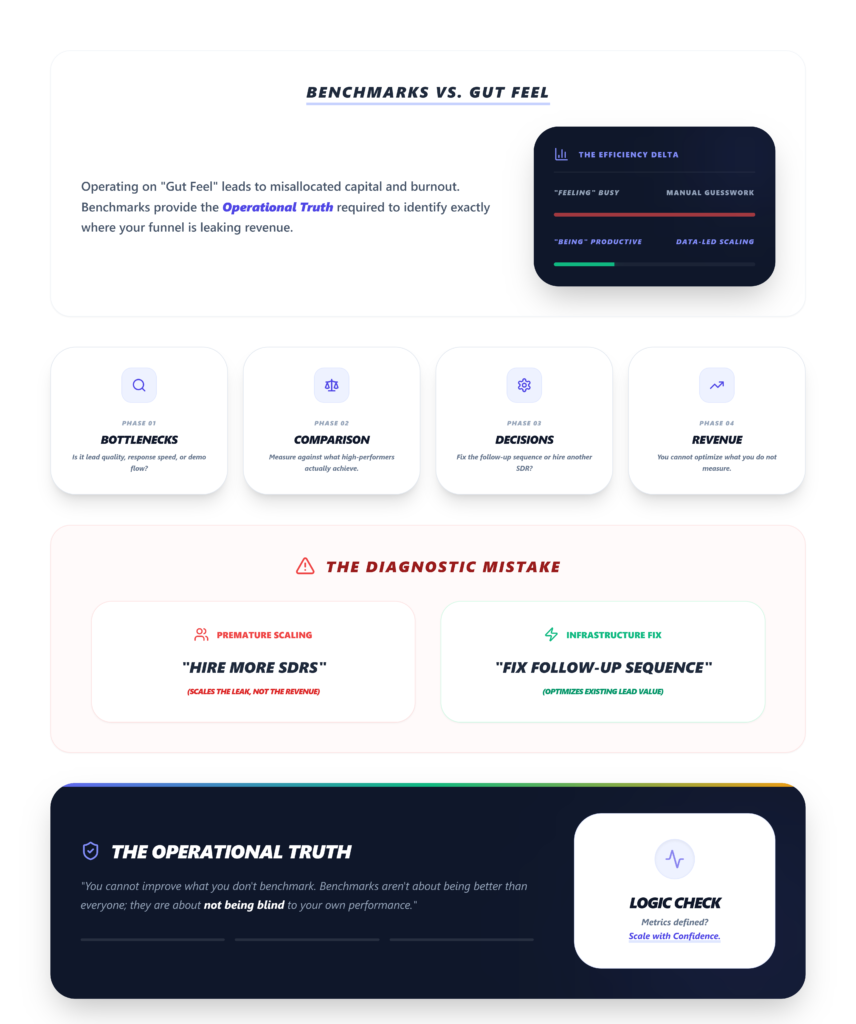
- Identify bottlenecks. Is the problem lead quality? Response speed? Demo quality? Benchmarks point to where the funnel breaks.
- Compare performance. Not against some theoretical ideal — against what good SaaS teams actually achieve.
- Improve decision-making. Should you hire another SDR or fix your follow-up sequence? Benchmarks answer that.
- Optimize revenue. You can’t improve what you don’t measure against a standard.
You can’t improve what you don’t benchmark. That’s not a motivational poster line — it’s an operational truth.
The Core SaaS Sales Benchmarks for 2026
This is the main section. Bookmark it. Screenshot it. Tape it to your sales dashboard.
1. Lead Response Time Benchmark
What it is: The time between a lead submitting a demo request (or filling out a form) and your team’s first meaningful response.
- Best: Under 5 minutes
- Good: 5–15 minutes
- Poor: 1+ hour
What you should see: A timestamp in your CRM showing first-touch within minutes, not hours. If your lead routing takes longer than your morning coffee, you have a problem.
The nuance here: Community consensus points to same-day for warm leads and under an hour for cold traffic as minimums. But the data is clear — teams responding in under 5 minutes see dramatically higher demo booking rates.
Lead response time is one of the strongest predictors of SaaS conversion. The intent window is small. Miss it, and you’re chasing someone who’s already talking to your competitor.
Verification: Pull your last 20 inbound leads. Check the time gap between form submission and first response. If more than half exceed 15 minutes, this is your bottleneck.
2. Demo Conversion Rate Benchmark
What it is: The percentage of leads that actually turn into booked (and ideally attended) demos.
- Good: 20%–40%
- High-performing: 40%+
- Concerning: Below 15%
What you should see: Your visitor-to-lead conversion sitting between 1.5–2.5% (top 10% hit 8–15%), and a healthy chunk of those leads converting into scheduled demos.
If you’re seeing high lead volume but low demo bookings, the friction is between capture and scheduling. Low conversion usually indicates one of two things: your ICP definition is too loose (attracting wrong-fit leads), or there’s too much friction in the booking process itself.
Interactive demos convert roughly 2x better than static screenshots — and leads from those close 20–25% faster.
Verification: Count demos booked last month. Divide by total qualified leads. If you’re under 20%, audit your booking flow and pre-demo qualification process.
3. Demo No-Show Rate
- Good: Under 20%
- Average: 20%–40%
- Poor: 50%+
This one stings because it’s invisible revenue loss. No-shows are often caused by weak follow-up, too much time between booking and the actual demo, or — and this is the ugly one — the lead wasn’t qualified enough to care.
What you should see: Confirmation emails sent immediately, a reminder 24 hours before, and another 1 hour before the demo.
If your “Demo Scheduled” status in the CRM doesn’t have a pre-demo qualification score attached (ICP match, use-case clarity, budget signal), you’re flying blind.
Verification: Pull no-show data for the last 30 days. If it’s above 30%, your follow-up sequence needs surgery.
4. Demo-to-Close Rate
- Good: 15%–30%
- High: 30%+
- Demo burnout threshold: Below 8–10%
Here’s where it gets real. SQL-to-close averages 20–25%, with top performers hitting 30%+.
But the demo-to-opportunity conversion — the step right before close — is where elite teams separate themselves. Best-in-class teams exceed 90% demo-to-opportunity. Average teams sit at 60–80%.
The friction warning: If your close rate is below 8–10%, your reps are burning out. At that rate, a rep needs 50+ demos a month just to hit a reasonable quota. That’s not a sales problem — it’s a positioning or ICP problem.
Verification: Pull your last 20 completed demos. How many moved to “Opportunity” stage? How many closed? If fewer than 12 out of 20 even became opportunities, invest in discovery training before anything else.
Some Insights:
- Lead response time is one of the strongest predictors of SaaS conversion. Teams that respond within 5 minutes are significantly more likely to book a demo than those responding after an hour.
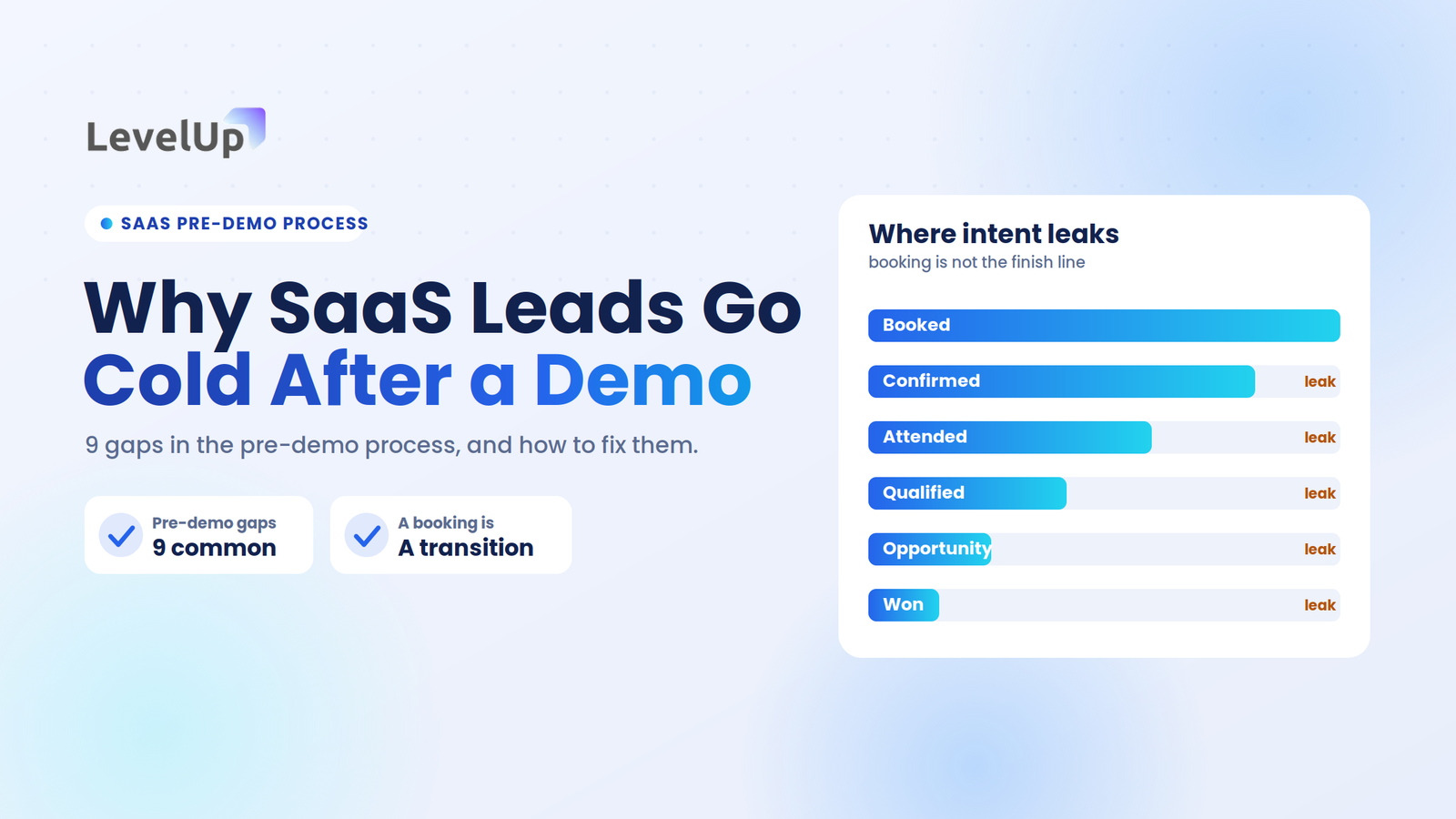
- Most SaaS revenue is lost not at the top of the funnel, but between lead capture and follow-up. The gap between “lead comes in” and “first meaningful contact” is where deals quietly die.
- Improving speed and follow-up often increases conversion more than increasing lead volume. Doubling your ad spend won’t help if your response time is two hours.
Why Teams Fall Below Benchmarks (The Ugly Truth)
I’ve seen this pattern dozens of times. The team isn’t incompetent. The system is broken.
- Problem: Demo conversion drops as you scale
Root Cause: Pipeline fills with weak-fit leads; reps waste time on “maybe” prospects
The Fix: Add pre-demo qualification questions; segment by ICP before scheduling - Problem: Sales team burnout
Root Cause: Reps doing 50+ demos/month when close rate is below 8–10%
The Fix: Reduce demo volume. If you can’t hit 8–10% close rate, your ICP or positioning is broken - Problem: Demo-to-opportunity plateaus
Root Cause: Poor sales discovery; reps not uncovering real pain points
The Fix: Invest in discovery training. Elite teams exceed 90% demo-to-opportunity - Problem: Response time kills conversion
Root Cause: No ownership over lead routing; manual handoffs create delays
The Fix: Automate lead capture and routing. Same-day minimum for warm leads - Problem: Enterprise deals stuck in limbo
Root Cause: Multi-stakeholder buying committees; long evaluation cycles
The Fix: Use different metrics entirely — focus on SQL-to-close (20–25%) and demo-to-opportunity (60–90%), not top-funnel volume
The common thread? Lack of ownership, no follow-up system, and poor lead routing. It’s not a people problem. It’s a process problem.
The SaaS Conversion Improvement Framework
Six phases. In order. Skip one, and the rest fall apart.
- Capture leads instantly. Your demo request form should auto-log into your pipeline. No manual entry. No delays.
- Respond within minutes. Under 5 is the target. Under 15 is acceptable. Over an hour and you’ve already lost.
- Qualify properly. ICP match, use-case clarity, budget signal. If a lead doesn’t pass, don’t waste a demo slot.
- Schedule demos fast. Reduce the gap between “yes, I want a demo” and the actual meeting. Every day of delay increases no-show risk.
- Follow up consistently. Post-demo follow-up within 24 hours. A structured sequence — not a single “just checking in” email.
- Track outcomes. Won, Lost, In Follow-up, Pending. If you can’t see your demo funnel metrics at a glance, you can’t improve them.
Real Scenario: What Benchmark Improvement Actually Looks Like
A SaaS company receives 100 demo requests per week.
Before optimization:
- Average response delay: 2 hours
- Demo conversion rate: 15%
- Demo-to-close rate: 10%
- Result: ~1.5 closed deals per week
After improving response time to under 10 minutes and adding pre-demo qualification:
- Demo conversion rate jumps to 30%
- Demo-to-close rate improves to 18% (better-fit demos)
- Result: ~5.4 closed deals per week
Revenue nearly quadrupled. Lead volume stayed exactly the same. The only change was speed and qualification.
AI-driven personalization in their outreach sequences added roughly a 10% conversion uplift on top of that. This is why optimization beats lead generation almost every time.
Why Benchmarks Alone Don’t Fix Performance
Knowing your demo-to-close rate is 9% is useful. But it doesn’t tell you what to do about it.
Manual processes fail at scale. Spreadsheets lose leads. Reps forget follow-ups. There’s no visibility into who’s doing what, and no automation catching the gaps.
Your benchmarks need a system behind them.
If you’re running demos and tracking outcomes manually, leads are slipping through.
LevelUp Demo was built for exactly this — lightweight demo workflow management that handles lead capture, qualification, scheduling, outcome tracking, and follow-up reminders without the bloat of a full CRM. We built it because we saw small sales teams losing deals to process gaps, not competition.
FAQ
What is a good SaaS demo conversion rate?
A good SaaS demo conversion rate falls between 20%–40%. High-performing teams with tight ICP definitions and low-friction booking processes regularly exceed 40%. If you’re below 15%, audit your lead qualification and scheduling workflow — the friction is likely between capture and booking, not in the demo itself.
What is an ideal lead response time for SaaS?
Best-performing SaaS teams respond to inbound leads within 5 minutes. Acceptable range is 5–15 minutes. Anything over an hour significantly reduces the probability of booking a demo. Speed is the single highest-leverage variable in early-funnel conversion.
What is a good SaaS close rate?
A healthy SaaS demo-to-close rate sits between 15%–30%. SQL-to-close averages 20–25% across the industry, with top performers reaching 30%+. If your close rate is below 8–10%, your reps are likely experiencing demo burnout — the issue is usually ICP fit or weak discovery, not effort.
How can SaaS teams improve these metrics without increasing lead volume?
Focus on three levers: reduce response time (under 5 minutes), tighten pre-demo qualification (ICP match and use-case clarity), and build a structured follow-up system with outcome tracking. These changes typically deliver more revenue impact than doubling ad spend.
What to Do With This
Benchmarks show you where you’re bleeding. Speed determines whether leads convert or disappear.
Systems — not willpower — improve outcomes over time.
And the hardest truth for most founders to accept: optimizing what you have almost always beats buying more leads.
Pull your numbers this week. Run them against the benchmarks above. Find the gap. Fix the system.
Ready to stop losing demos to process gaps?
Start with LevelUp Demo — built for small SaaS teams that need pipeline clarity without CRM complexity.