
Quick Answer :
Qualifying SaaS demo requests means evaluating a prospect’s company fit, role, use case, and buying timeline before scheduling a call. To stop wasting time on unqualified leads, use a structured 3-step framework: Capture data via smart forms, Score against your Ideal Customer Profile (ICP), and Route high-intent prospects to live demos while directing low-intent users to self-serve resources.
Last quarter, I ran 23 demos in two weeks. Felt productive. Looked productive on paper. But here’s what actually happened: four of those prospects were students writing research papers. Three were competitors poking around our feature set. Six had zero budget and openly admitted they were “just exploring.” That’s more than half my calendar—gone.
I didn’t have a qualification problem I could see. I had a qualification problem I could feel: exhaustion, a sinking close rate, and a growing suspicion that my demo pipeline was mostly noise.
That’s when I realized something most SaaS teams overlook: you don’t just book demos—you need a system to qualify demo requests before they ever reach your calendar. Without that filter, your pipeline fills with curiosity instead of buying intent.
Why Demo Qualification Matters
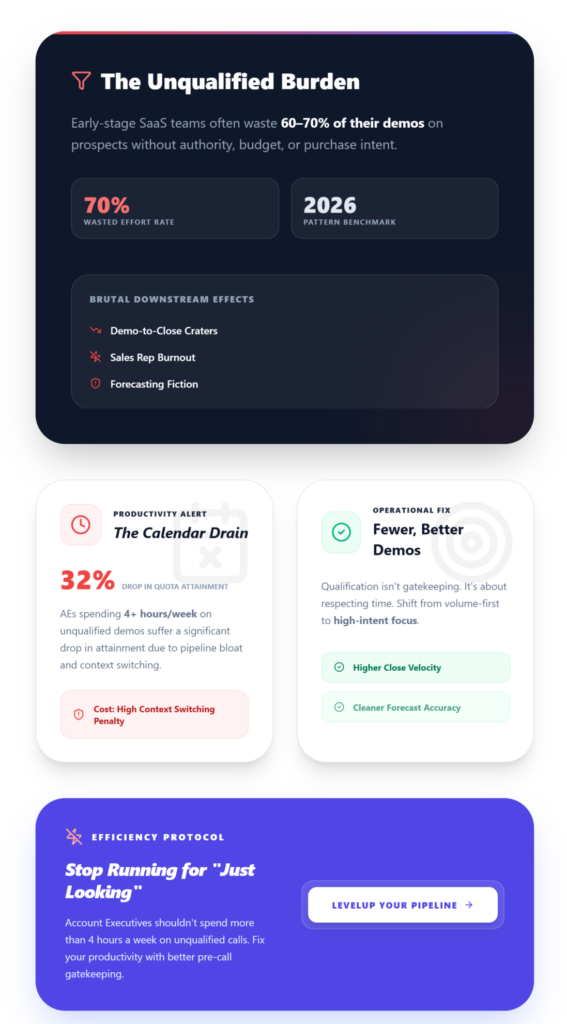
Here’s a number that should bother you: roughly 60–70% of demos are conducted with unqualified prospects who have no budget or authority to buy. That’s not a guess. That’s the pattern across early-stage SaaS teams that skip pre-qualification entirely.
And the downstream effect is brutal. Your demo-to-close rate craters. Your reps burn out. Your forecasting becomes fiction. Many SaaS companies lose sales productivity by running demos for unqualified prospects who are still researching solutions.
The fix isn’t doing more demos. It’s doing fewer, better ones.
SaaS demo qualification isn’t about gatekeeping. It’s about respecting your own time—and honestly, respecting the prospect’s time too. A student researching tools for a thesis doesn’t need a 45-minute walkthrough of your enterprise billing module.
📉 The Calendar Drain Penalty
Recent 2026 sales productivity data shows that Account Executives spending more than 4 hours a week on unqualified, “just looking” demos suffer a 32% drop in overall quota attainment. The hidden cost isn’t just the 30-minute call—it’s the prep time, the context switching, and the pipeline bloat that obscures real revenue opportunities.
What Does It Mean to Qualify Demo Requests?
Qualifying demo requests means evaluating whether a prospect is a good fit for your product before scheduling a demo call. SaaS teams typically assess company fit, role, use case, and buying timeline to determine whether a request represents a serious sales opportunity.
That’s it. No complicated scoring matrix required at the start. You’re asking one simple question: Is this person likely to become a customer in the near future?
If the answer is “probably not,” you don’t ignore them. You route them differently. More on that later.
Common Problems With Unqualified Demo Requests
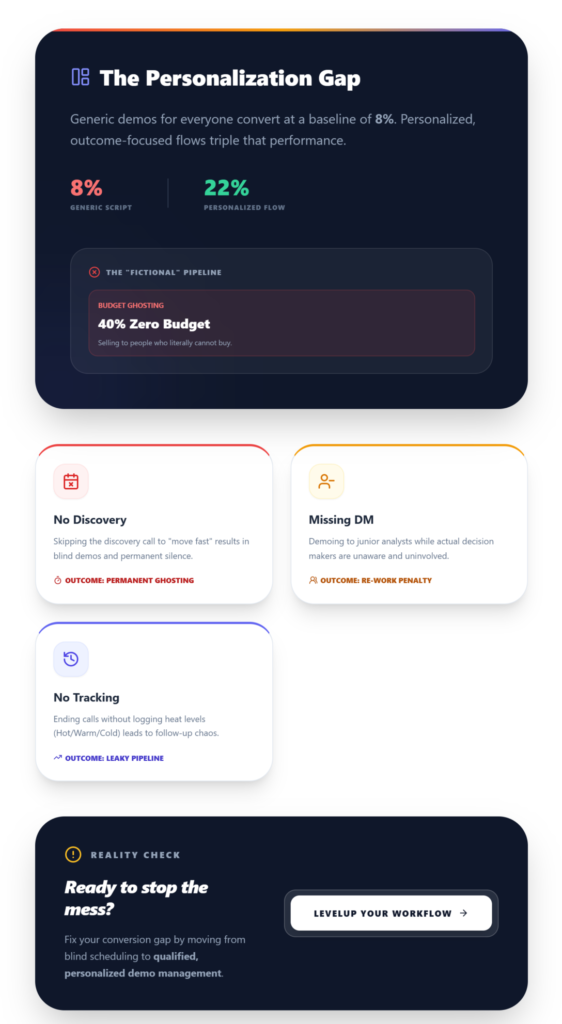
Before we build anything, let’s name the mess. These are the patterns I see over and over—and the ones I’ve lived through.
- No discovery, just scheduling. Teams skip the discovery call to “move fast.” The rep shows up, demos blind, and the prospect says “looks great, let me think about it.” Then silence. Forever.
- The buying committee is missing. You demo to a junior analyst. They love it. But the actual decision-maker? Never heard of you. Now you’re re-doing the demo two weeks later—if you’re lucky enough to get a second shot.
- Generic demos for everyone. Same script, same flow, whether it’s a 10-person startup or a 500-person operations team. Generic demos convert at roughly 8%. Personalized ones? Closer to 22%. That gap is enormous.
- Budget is never discussed. Reps avoid the money question like it’s radioactive. Meanwhile, 40% of demos are with prospects who have zero budget allocated. You’ve just spent an hour selling to someone who literally cannot buy.
- No post-demo tracking. The demo ends, and nobody logs whether the prospect was hot, warm, or ice-cold. Follow-up becomes “whoever remembers.” Deals slip through. Same mistakes repeat. No data, no optimization.
Sound familiar? Good. That means you’re ready to fix it.
Pre-Flight Check: Are You Ready to Qualify?
Before building a qualification workflow, make sure you can answer these:
- Do you have a documented ICP? Not a vague idea—an actual list of firmographic criteria (industry, company size, use case).
- Do you know who your buyer is? Title, role, and where they sit on the buying committee.
- Can you describe your ideal demo outcome in one sentence?
Stop/Go test: If you can’t articulate your ICP in two sentences, pause here. Define it first. Everything downstream depends on it.
7 Ways SaaS Teams Can Qualify Demo Requests
Here’s a practical SaaS demo qualification framework you can implement this week. No enterprise tooling required.
1. Analyze the Company Profile
Start with firmographics. Does the company match your ICP? Check company size, industry, and whether their product use case aligns with what you actually solve.
What you should see: A quick LinkedIn or Crunchbase lookup confirms they’re in your target segment. If they’re a 3-person agency and you sell enterprise workflow software, that’s a signal—not a match.
Verification: Can you confirm at least two ICP criteria (industry + company size) from public data?
2. Identify the Requester’s Role
Is this person a founder, product manager, or operations leader? Or a marketing intern collecting screenshots for a comparison blog post?
Stakeholder mapping matters even at the request stage. A demo request from a VP of Operations carries different weight than one from a “Student Researcher” with a Gmail address.
What you should see: The requester’s title and role are visible in the form submission or on LinkedIn.
3. Review the Use Case Provided
Did the prospect explain how they plan to use your product? Clear use cases—”We need to manage inbound demo requests across three sales reps”—indicate real buying intent. Vague responses like “just want to see what it does” are a different category entirely.
Verification: Does the stated use case map to at least one core feature of your product?
4. Ask About the Implementation Timeline
This is the question that separates researchers from buyers: “When are you planning to implement a new solution?”
A prospect evaluating tools for next quarter is fundamentally different from someone “just keeping tabs on the market.” Both are valid. But only one deserves a live demo slot this week.
5. Evaluate Company Size and Scale
A 200-person SaaS company evaluating your tool for their entire sales org represents a different opportunity than a solo consultant. Scale signals deal size, complexity, and urgency.
6. Identify Stakeholder Involvement
Ask early: “Who else will be involved in this decision?” Getting the buying committee on the demo is critical. Only 15% of demo attendees become SQLs—and a solo attendee with no authority rarely converts.
If the decision-maker isn’t on the call, consider rescheduling.
7. Prioritize High-Intent Signals
Look for behavioral cues: Did they visit your pricing page? Did they submit a detailed form? Did they reference a competitor by name? These pain-point mapping signals tell you more about intent than any single form field.
A Simple Framework for Qualifying Demo Leads
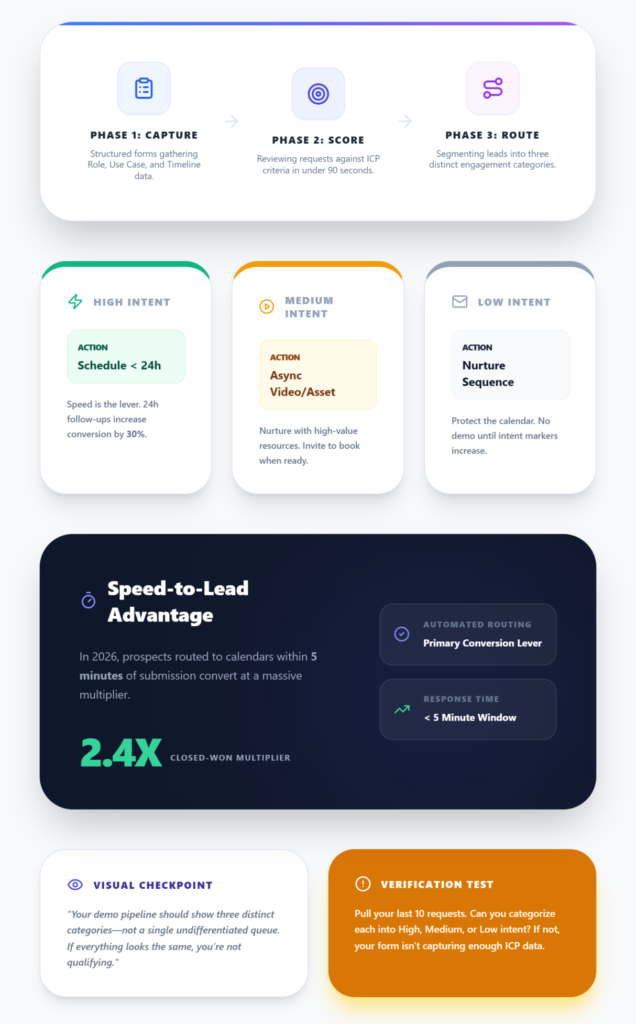
Here’s what I use. It’s not fancy. It works.
- Phase 1: Capture. Every demo request comes through a structured form—not a bare Calendly link. The form asks for company name, role, use case, team size, and timeline.
- Phase 2: Score. I review each request against ICP criteria. Takes 90 seconds. I’m looking for: right industry, right role, clear problem, near-term timeline.
- Phase 3: Route.
- High-intent: Schedule the demo within 24 hours. A follow-up within 24 hours increases conversion by 30%; after 48 hours, momentum dies.
- Medium-intent: Send a short async video or resource. Invite them to book when ready.
- Low-intent: Add to a nurture sequence. No demo.
Visual checkpoint: Your demo pipeline should show three distinct categories—not a single undifferentiated queue. If everything looks the same, you’re not qualifying.
Verification: Pull your last 10 demo requests. Can you categorize each one into high, medium, or low intent using this framework? If not, your form isn’t capturing enough data. To how to qualify sales leads properly, you need this kind of structure. Winging it doesn’t scale.
⚡ The Speed-to-Lead Advantage
B2B buyer expectations have accelerated rapidly. In 2026, high-intent prospects that are qualified and routed directly to calendar scheduling within 5 minutes of form submission convert to closed-won deals at 2.4x the rate of those forced to wait for manual SDR outreach. Automated routing isn’t just a time-saver; it is your primary conversion lever.
How SaaS Teams Should Respond to Low-Intent Requests
This is where most teams get it wrong. They either ignore low-intent requests completely (burning potential future pipeline) or they demo everyone equally (burning current resources). Neither works.
For low-intent requests—students, researchers, early-stage explorers—offer self-serve resources. A recorded product walkthrough. A detailed feature page. A comparison guide. You’re not rejecting them. You’re routing them to the right experience.
This protects your team’s time and actually improves the prospect’s experience. Nobody wants a 40-minute live demo when a 5-minute video would answer their question.
The Ugly Truth: What Actually Breaks Down
Demo attendee is silent—no questions
The Weird Fix: Before the call, ask: “Who will attend and what’s their role?” Reschedule if it’s not a decision-maker.
Why It Works: You stop demoing to the wrong person.
“Looks great, let me think about it” → ghost
The Weird Fix: During the demo, ask: “If you love this, what happens next?” Lock a follow-up date before ending.
Why It Works: Explicit next steps kill the ghost.
High completion rate, low SQL conversion
The Weird Fix: Add a 15-minute discovery call before every demo. Review pain-point documentation.
Why It Works: You stop demoing blind.
Prospect asks “How much?” mid-demo
The Weird Fix: Add budget qualification to your intake form. If they won’t answer, they’re not qualified.
Why It Works: Price-shoppers self-select out.
Demo runs 90 minutes, prospect drops at 45
The Weird Fix: Use “Tell, Show, Tell”: state what you’ll show (2 min), demo 2–4 features tied to their pain (15–20 min), define next steps (2 min).
Why It Works: Shorter demos with higher engagement.
How Structured Demo Workflows Improve Qualification
Here’s what changed everything for me: I stopped sending demo requests straight to a calendar. Instead, requests flow into a structured workflow where each one gets reviewed, scored, and routed.
The difference is night and day. You can actually see the SaaS demo funnel most teams don’t track when you build it this way.
Streamline Your Demo Qualification Workflow
If you’re managing demo requests across spreadsheets and calendar links, platforms like LevelUp Demo let SaaS teams capture, qualify, and manage demo requests in one place—before anything hits a sales calendar. It’s built for small teams that need structure without CRM bloat. See how it works →
The core idea is simple: evaluate requests first, prioritize high-intent prospects, and schedule demos only when qualification criteria are met. Teams with structured qualification see roughly 40% faster conversion velocity compared to teams running open-calendar scheduling.
When you improve your demo conversion rates, it’s almost never because you ran more demos. It’s because you ran the right ones.
FAQ
How long does it take to qualify a demo request?
With a structured intake form and clear ICP criteria, qualification takes 60–90 seconds per request. The time investment is minimal compared to running a 30-minute demo for an unqualified prospect. Most teams reclaim several hours per week by filtering requests before scheduling.
What if we’re a small team without an SDR?
Founders and solo reps can still qualify effectively. Use a smart demo form that captures role, company size, use case, and timeline. Review submissions daily and batch-route them. You don’t need a dedicated SDR—you need a process.
Should we qualify demo requests even with low inbound volume?
Yes. Even with 10 requests per month, running five unqualified demos costs real time. Qualification isn’t about volume—it’s about conversion. Low-volume teams actually benefit more because every demo slot carries higher opportunity cost.
What’s the difference between a demo request and a qualified lead?
A demo request is an inbound signal. A qualified lead (SQL) is a request that’s been verified against your ICP, has a confirmed decision-maker, and shows a near-term buying timeline. The gap between the two is where most SaaS teams lose productivity.
The Real Takeaway
Qualifying demo requests allows sales teams to focus on prospects who are most likely to convert. That’s not a theory—it’s the operational difference between teams that close 8% of demos and teams that close 22%.
Stop treating your demo calendar like an open door. Build a filter. Score your requests. Route intelligently. Your close rate—and your sanity—will thank you.
Conclusion: Scaling Your Demo Pipeline in 2026
Optimizing your demo pipeline for modern Answer Engines and zero-click search behavior starts with having the right operational foundation. By strategically capturing, scoring, and routing your inbound demo requests, you ensure that your sales team’s energy is spent solely on qualified buyers actively seeking your solution.
Don’t let an open calendar drain your sales velocity. Implement a strict qualification framework, leverage automation to route low-intent users to self-serve assets, and watch your demo-to-close metrics radically transform.
Ready to build a smarter demo workflow?
Stop treating your calendar like an open door. Filter the noise and prioritize high-intent buyers effortlessly.
✅ Pre-Qualify Automatically
✅ Route by Intent
✅ No CRM Bloat