Quick Answer :
Buying signals during a SaaS demo are questions or behaviors from prospects that indicate real purchase intent. The most common signals include inquiries about implementation timelines, pricing, integration capabilities, security, and internal stakeholder involvement. When prospects shift from politely watching to asking workflow-specific questions, sales reps should stop presenting features and pivot immediately to qualification and ROI discussions.
“That was a great demo—we’ll circle back next week.”
I’ve heard that sentence maybe 200 times. And for the first year of running demos, I believed it. Every single time. I’d hang up, update the CRM to “promising,” and wait. The callback never came for about 70% of those “great demos.”
Here’s what I eventually figured out: the actual buying signal happened 22 minutes earlier, when the prospect asked “Does this integrate with our CRM?”—and I blew right past it to show them another feature they didn’t ask about.
Sales teams miss buying signals during demos because they’re too focused on presenting features instead of listening to prospect questions. This post breaks down exactly which signals matter, which ones are noise, and how to respond when they show up.
What Are Buying Signals During a SaaS Demo?
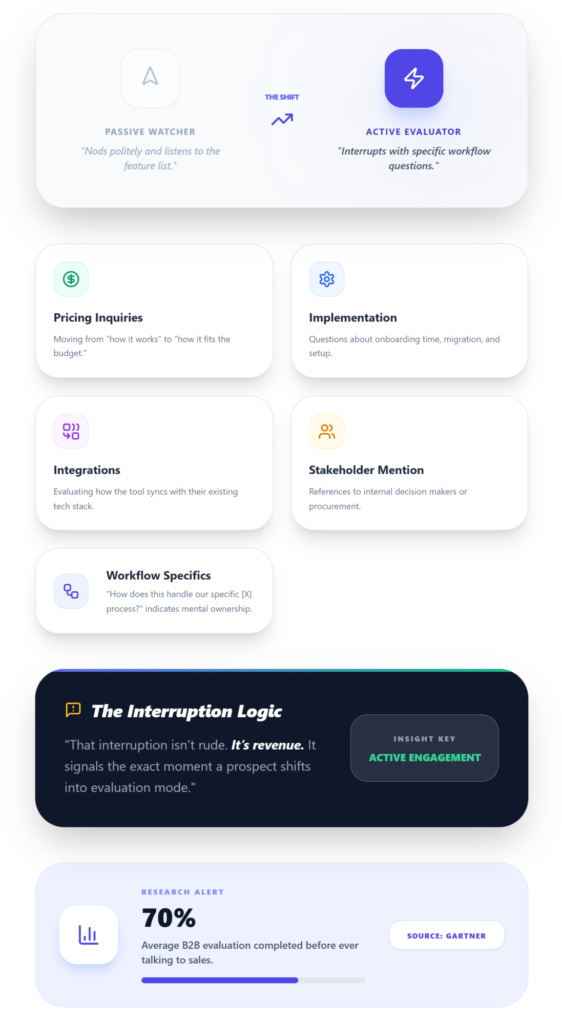
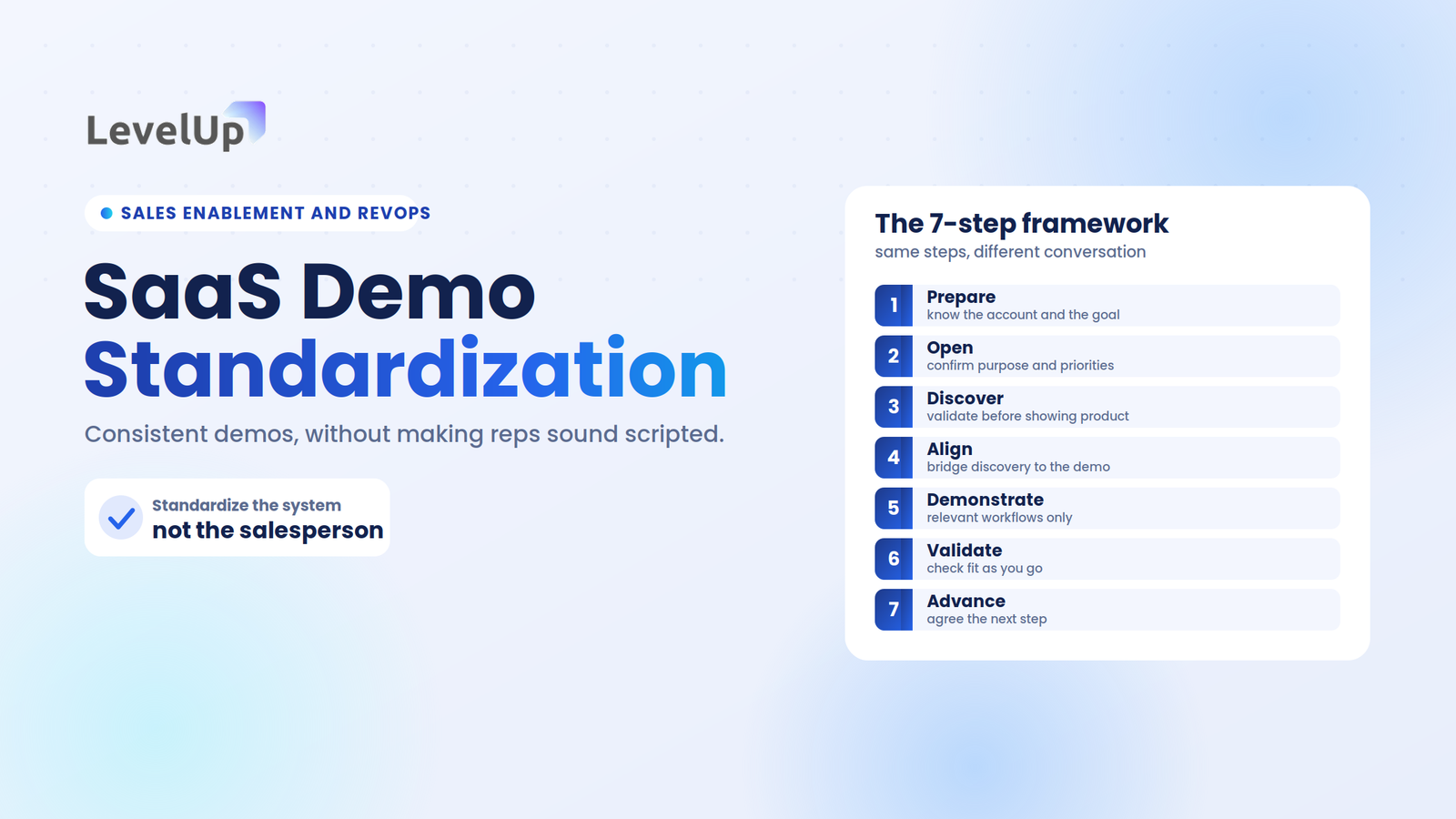
Buying signals during a SaaS demo are questions or behaviors from prospects that indicate real purchase intent. These signals include pricing inquiries, implementation concerns, integration discussions, stakeholder mentions, and workflow-specific questions. They appear when a prospect mentally shifts from “watching a presentation” to “evaluating whether this fits my team.”
That shift is everything. And it’s subtle.
A prospect who’s just watching will nod politely. A prospect who’s buying will interrupt you. They’ll ask something specific about their world—their stack, their team, their timeline. That interruption isn’t rude. It’s revenue.
According to Gartner’s B2B buying research, today’s buyers complete roughly 70% of their evaluation before ever talking to sales. So by the time they’re on your demo, many have already narrowed the field. The signals they drop during the call tell you where they are in that remaining 30%.
Why Are Buying Signals Important in SaaS Sales?
Because demos that convert don’t follow a script—they follow the buyer.
I lost a $50k deal once by starting at the login screen. The prospect literally said, “This looks just like our current tool.” I spent the first five minutes walking through a dashboard they’d already seen a version of. The deal died right there. Next time, I opened with the outcome report—the specific thing their team couldn’t build internally—and closed the following week.
That experience rewired how I think about demos. The presentation isn’t the point. Reading the room is. When you learn to how to qualify sales leads through their behavior during the demo itself, you stop wasting cycles on prospects who were never going to buy—and start doubling down on the ones who are ready.
📉 The Feature-Pitch Penalty
According to 2026 B2B sales analytics, Account Executives who spend more than 60% of a demo talking about features rather than asking discovery questions experience a 45% drop in close rates. Modern prospects are researching heavily before the call; they don’t want a feature tour, they want to know if the product survives their specific workflow edge cases.
The 7 Most Common Buying Signals During a SaaS Demo
1. Implementation Questions
What it sounds like: “How long does it take to set this up?” or “What does onboarding look like?”
When a prospect asks about implementation, they’re already past “Is this interesting?” They’ve moved to “Can we actually do this?” That’s a fundamentally different mental space. They’re imagining your product inside their workflow.
Visual checkpoint: Watch for forward-leaning body language here. On video calls, you’ll notice them reach for a pen or start typing—they’re taking notes for an internal conversation that hasn’t happened yet.
2. Pricing Curiosity
What it sounds like: “What pricing tier includes this feature?” or “Is there a cost difference between annual and monthly?”
Pricing questions during a demo are one of the strongest indicators of real purchase intent. People don’t ask about cost for products they’re not considering. Period.
(I’ll be honest—I used to dodge pricing questions mid-demo because I thought it would “derail the flow.” Terrible instinct. Now I answer directly and pivot to ROI. The conversion difference was night and day.)
3. Integration Concerns
What it sounds like: “Does this connect to Salesforce?” or “Can we push this data into our existing stack?”
This is the buyer evaluating technical fit. They’re running a mental compatibility check. If you’ve done your pre-demo research using something like BuiltWith for a quick tech stack scan, you can answer this with specifics—not generalities.
4. Stakeholder Mentions
What it sounds like: “I’d need to show this to our VP of Ops” or “My CTO would want to see the API docs.”
The deal just expanded. This isn’t a single-threaded conversation anymore.
According to HubSpot’s sales statistics, the average B2B purchase involves 6-10 decision-makers. A stakeholder mention means you’ve cleared one gate and the prospect is mentally preparing to champion you internally.
5. Workflow-Specific Questions
What it sounds like: “Can we automate this step?” or “What happens when a lead comes in after hours?”
This is the prospect mapping your product onto their daily reality. They’re not evaluating features anymore—they’re stress-testing real usage. When someone asks about edge cases in their workflow, they’ve already decided the core product works.
6. Timeline Discussions
What it sounds like: “Could we have this running before Q3?” or “What’s the fastest you’ve gotten a team live?”
Timeline questions signal urgency. There’s a budget cycle, a board meeting, or a competitor breathing down their neck. Either way, they’re not browsing. They’re buying with a deadline.
7. Security or Compliance Questions
What it sounds like: “Are you SOC 2 compliant?” or “Where’s the data hosted?”
This is procurement-level thinking. Legal and security teams don’t review tools the company isn’t planning to buy. If this question comes up mid-demo, the internal evaluation has already started behind the scenes.
Signals That Show a Deal Might Close
Not all signals carry equal weight. Here’s what I watch for when I’m trying to gauge whether a deal is tracking toward close:
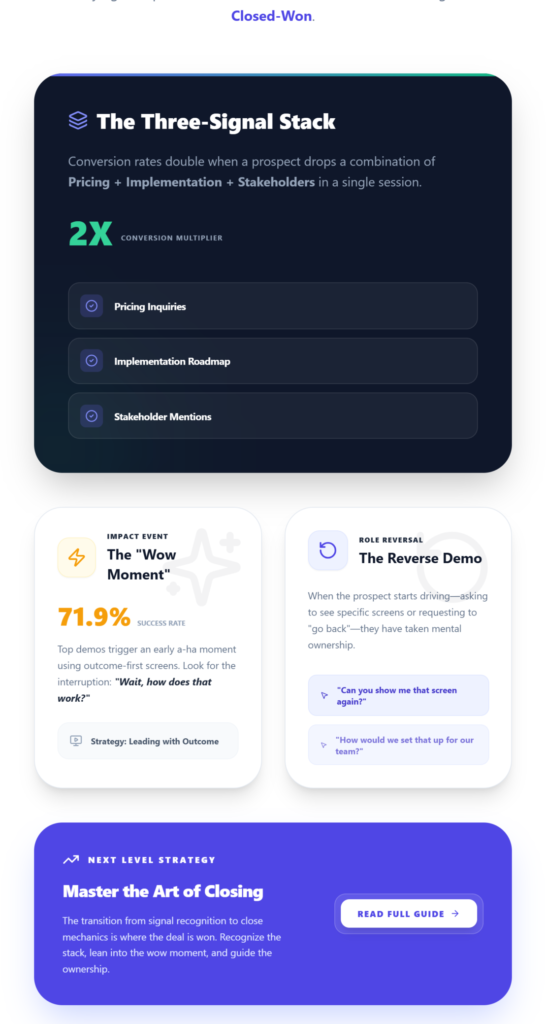
- Multiple signal types in one call. A prospect who asks about pricing AND implementation AND mentions a stakeholder? That’s a three-signal stack. In my experience, stacked signals convert at roughly 2x the rate of single signals.
- The “wow moment” reaction. Top-performing demos—71.9% of them, according to recent interactive demo benchmarks—open with modals or outcome-first screens that trigger this. When the prospect interrupts with “Wait, how does that work?”—that’s the a-ha moment you’re looking for.
- Prospect drives the demo. When they start asking to see specific screens or say “Can you go back to that?”—you’ve entered a reverse demo. They’re selling themselves. Let them.
If you want to go deeper on this, I’d recommend reading how to master the art of closing a sales demo. It covers the transition from signal recognition to close mechanics.
Signals That Show the Prospect Is Still Exploring
Here’s the uncomfortable part. Some “positive” signals are actually neutral—or even negative.
- “Sounds good” with no follow-up question. This is the polite exit. Real interest generates more questions, not fewer.
- Camera off, no engagement for 3+ minutes. Screen-sharing lag causes fidgeting and disengagement. If you’re presenting for five minutes straight and getting silence, you’ve lost them.
- Only generic questions. “How many customers do you have?” isn’t a buying signal. It’s small talk.
- Short demos with no depth. I A/B tested 7-10 minute demos against 15-20 minute persona-driven ones. The shorter demos booked fine—but closed at a noticeably lower rate. Bookings aren’t conversions.
The hard truth: a demo where nobody pushes back or asks hard questions is usually a demo that’s going nowhere. Friction is a feature.
How SaaS Teams Should Respond to Buying Signals
Recognizing signals is half the job. Responding correctly is the other half.
When you hear an implementation question: Don’t just answer it—expand it. “Great question. Most teams in your space are live in about two weeks. Want me to walk through what that first week looks like?” You’re pulling them further into the buying vision.
When pricing comes up: Answer directly. Then pivot. “That feature’s included in our Growth tier. Based on what you’ve told me about your team size, here’s roughly what the ROI looks like.” I keep a Google Sheet ROI calculator open during every demo. Fill it live with their inputs. The specificity kills objections.
When stakeholders get mentioned: Immediately offer to help. “Happy to put together a 2-minute summary for your CTO—what matters most to them?” Generic recaps get roughly 50% lower reply rates compared to role-specific follow-ups. A CEO wants ROI numbers. A tech lead wants integration docs. Send the right one.
When workflow questions surface: Stop presenting. Let them drive. Give sandbox access mid-call if you can. The moment a prospect is clicking through your product themselves, you’ve shifted from pitch to experience—and that’s where deals close.
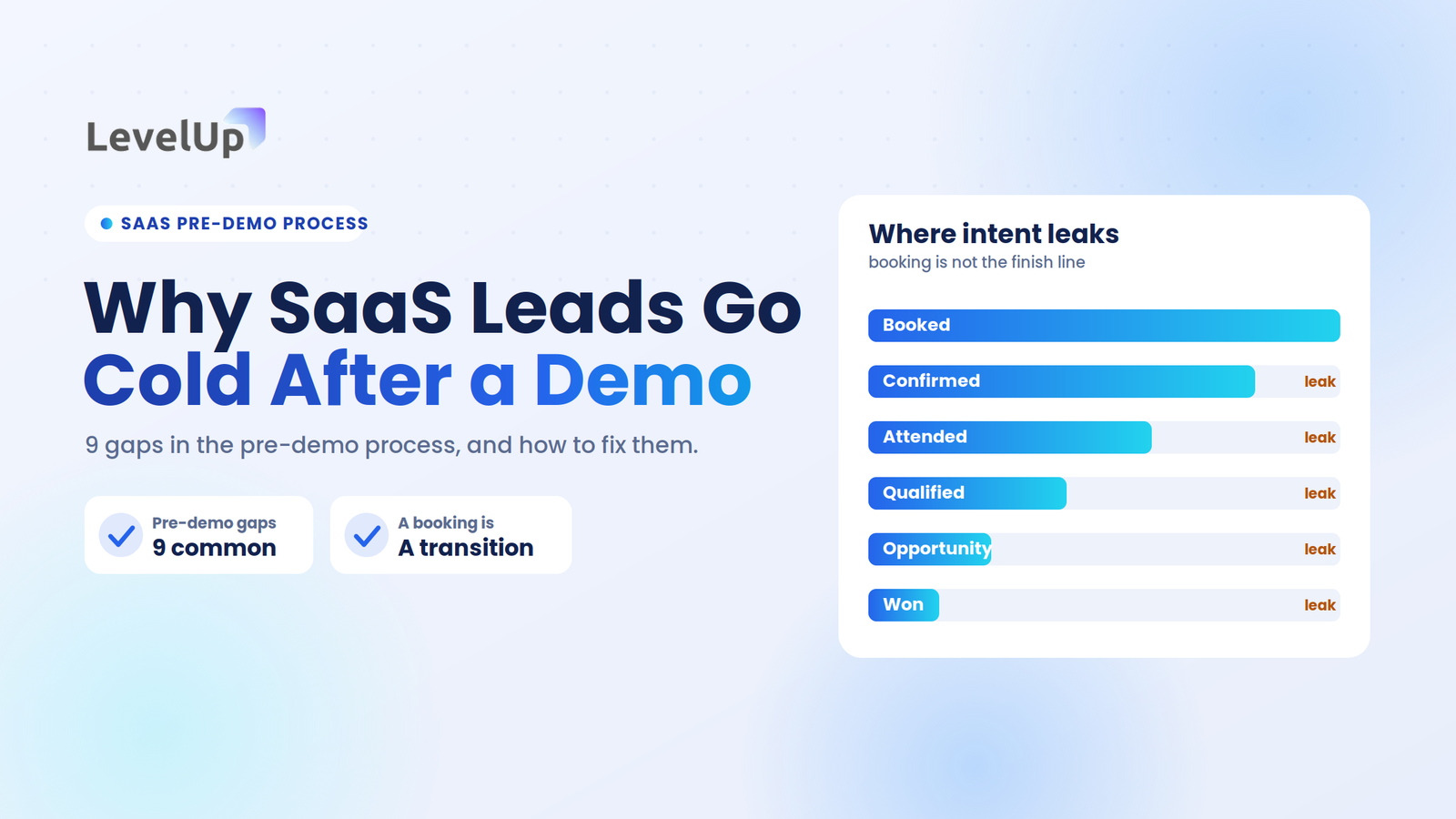
Understanding what happens to SaaS demos after the call is critical here, because the follow-up window after a strong-signal demo is brutally short.
⚡ The 60-Minute Follow-Up Window
If a prospect displays stacked buying signals (e.g., asking about pricing and implementation), sending a hyper-personalized recap within 60 minutes of the call ending increases the likelihood of a next-step meeting by over 58%. Speed signals competence and keeps momentum alive while the demo is still fresh in their mind.
How Tracking Demo Outcomes Improves Sales Decisions
Here’s something I didn’t figure out until embarrassingly late: you can’t improve signal recognition if you’re not tracking outcomes.
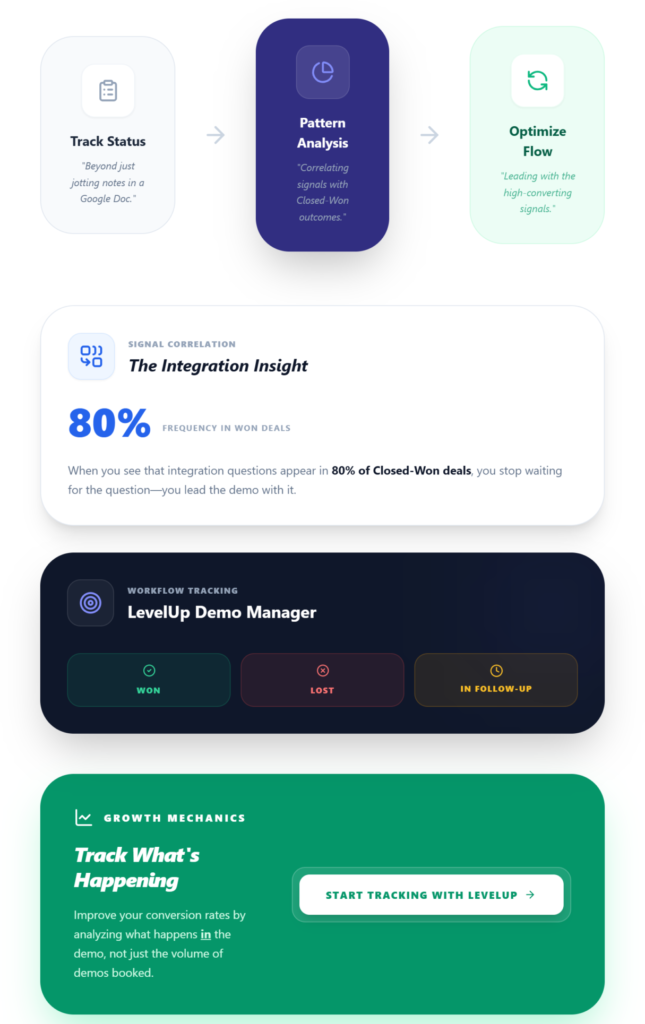
I used to run demos, jot notes in a Google Doc, and move on. No pattern analysis. No way to correlate which signals actually led to closed deals versus which ones just felt promising.
Tracking demo conversations and outcomes helps teams understand which demos show strong buying signals and which ones need further qualification. When you can look back at 50 demos and see that integration questions appeared in 80% of your closed-won deals, you start structuring demos differently. You lead with integration. You prepare for it.
This is where tools like LevelUp Demo fit naturally. It lets SaaS teams manage demo workflows, track outcomes with simple status updates—Won, Lost, In Follow-up—and keep follow-ups from falling through the cracks. The analytics dashboard shows you which demos convert and why, so your signal recognition improves with every call.
If you want to improve your demo conversion rates, start by tracking what’s actually happening in your demos—not just how many you’re booking.
FAQ
What are buying signals in SaaS sales?
Buying signals are verbal or behavioral cues from prospects that indicate genuine purchase intent. During SaaS demos, these signals typically appear as questions about implementation timelines, pricing tiers, integrations with existing tools, internal stakeholder involvement, and workflow-specific use cases. They reveal that a prospect has moved beyond curiosity into active evaluation.
How can you tell if a prospect is interested during a demo?
Engaged prospects interrupt, ask specific questions tied to their workflow, and reference other team members who’d need to see the product. Disengaged prospects stay silent, keep cameras off, and respond with vague affirmations like “looks good.” The quality and specificity of questions is a more reliable indicator than politeness.
What questions indicate buying intent during a product demo?
Questions like “How long does implementation take?”, “What pricing tier includes this?”, “Does it integrate with [specific tool]?”, and “Can I show this to my team?” all indicate buying intent. These questions show the prospect is mentally placing your product inside their organization.
Why do SaaS demos fail to convert?
Most demos fail because they’re structured as feature walkthroughs instead of qualification conversations. Starting chronologically—login screen, dashboard, settings—kills relevance within the first two minutes. Demos that open with the prospect’s specific pain point and desired outcome convert at significantly higher rates. According to Wyzowl’s product demo research, outcome-led demos generate up to 2x more next-step completions than feature-led ones.
How should sales teams follow up after spotting buying signals?
Send a role-specific follow-up within one hour. Not a generic recap—a targeted message addressing exactly what that prospect cared about. Include a next step link or calendar invite. Speed and specificity are what separate closed deals from ghosted threads.
Conclusion: Mastering Demo Qualification in 2026
Stop treating your demo like a slideshow. The best demos I’ve ever run were the ones where I talked less than the prospect. Every question they ask is a breadcrumb leading you toward—or away from—a deal. Your job isn’t to present. It’s to listen, recognize, and respond.
The signals are already there. By identifying implementation questions, stakeholder mentions, and workflow friction, you shift from simply showing a product to actively qualifying a buyer. You just have to stop talking long enough to hear them.
Track the Signals That Actually Close Deals
LevelUp Demo helps SaaS sales teams manage their demo workflows, track buying signals, and analyze exactly which outcomes lead to revenue. Stop guessing—start tracking.
✅ Track Demo Outcomes
✅ Improve Conversion
✅ Manage Follow-Ups