
Why do B2B SaaS leads not convert?
B2B SaaS leads typically fail to convert due to slow response times, poor qualification, friction in demo booking, and weak post-demo follow-up — not just poor lead quality.
Key Insights (TL;DR)
- Most SaaS lead conversion problems are not caused by poor lead quality — the system after capture is where revenue dies.
- The biggest drop-off happens after intent, not before — leads show interest, then vanish in a broken process.
- Slow response times and poor demo systems kill conversion — responding after 5 minutes can cut your SQL-to-close rate in half.
- Leads don’t convert when there’s no structured demo-to-close process — hope is not a conversion strategy.
- Fixing conversion systems often delivers more revenue than generating more leads — a 1% conversion rate increase can boost revenue 30–50%.
What Does “Lead Conversion” Mean in SaaS?
Lead conversion in SaaS refers to turning an interested prospect into a paying customer, typically through stages like qualification, demo, and structured follow-up.
It’s not a single event — it’s a system of handoffs, and each handoff is a potential failure point.
Why Your Leads Aren’t Converting — Even When Demand Is High
Many SaaS teams have a steady flow of leads. Marketing is running. Demo requests come in. The pipeline looks alive on paper.
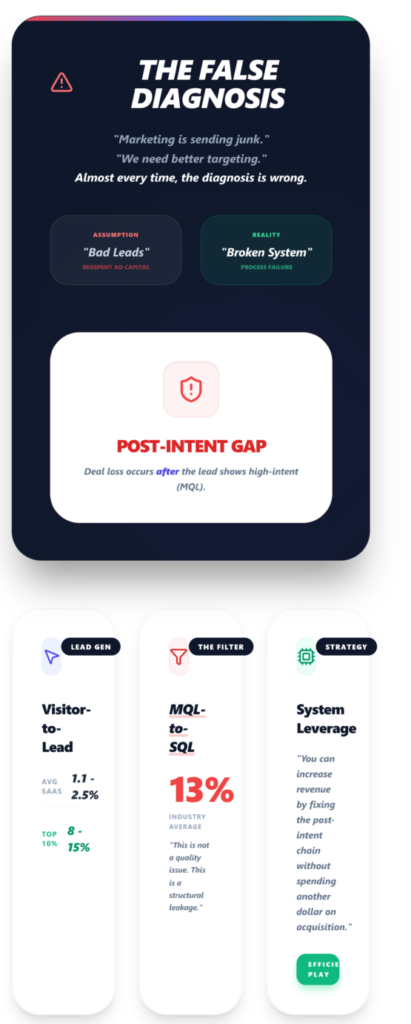
Most SaaS teams don’t lose leads at the top — they lose them after intent.
But conversion rates stay frustratingly low. The assumption is usually that the leads are bad. “We need better targeting.” “Marketing is sending us junk.”
I’ve heard this from dozens of founders and sales leads, and almost every time, the diagnosis is wrong. In reality, the problem starts after the lead shows intent.
Here’s what I mean: average B2B SaaS visitor-to-lead rates sit between 1.1–2.5%. The top 10% hit 8–15%. That gap is massive — but it’s not always a top-of-funnel problem.
When I’ve audited funnels where leads were flowing but deals weren’t closing, the breakdown was almost always between the demo request and the signed contract.
MQL-to-SQL conversion averages just 13%. That’s not a lead quality issue. That’s a system issue.
By the end of this guide, you’ll be able to identify exactly where your conversion system is breaking and have a practical framework to fix it — without spending more money on lead gen.
More leads don’t fix conversion. They just scale the leak.
Pre-Flight Check: Are You Ready to Diagnose This?
Before we go further, here’s what you need in front of you:
- Access to your CRM’s pipeline data (demo requests, outcomes, response times)
- Your last 30 days of demo-to-close metrics
- Clarity on who owns conversion on your team (if nobody does, that’s your first finding)
Stop/Go test:
Can you tell me, right now, what percentage of your demo requests turned into closed deals last month?
If you can’t, you have a measurement problem before you have a conversion problem. Fix that first.
7 Reasons Your SaaS Leads Don’t Convert
1. Slow Lead Response Time
The data here is brutal. SQL-to-close rates for teams responding under 5 minutes exceed 30%.
Most teams respond in hours — sometimes days.
Why it happens: No alert system. No ownership. The lead sits in a shared inbox while your prospect evaluates three competitors.
Impact: Slow follow-up means high-intent leads never reach a demo — so deals never even enter your pipeline.
You’ve turned a hot lead into a cold one through pure inertia.
2. No Clear Qualification Process
Every demo request gets treated the same. A mid-market CTO with 150 engineers gets the same generic scheduling link as a student exploring tools for a class project.
Why it happens: Teams skip ICP filtering because they’re afraid of losing volume. But when MQL-to-SQL sits at 13%, you’re already losing — you’re just losing slower.
Impact: Sales reps burn hours on unqualified demos. Morale drops.
Because there is no structured qualification, actual high-intent buyers can’t book a meeting fast enough, and deals die before the demo begins.
3. Friction in Demo Booking
I’ve seen SaaS companies with 6-field demo forms, no calendar integration, and a “we’ll get back to you within 48 hours” confirmation message. That’s not a funnel. That’s a wall.
Why it happens: Nobody’s tested the booking flow from the prospect’s side. The form was built once and forgotten.
Impact: Demo request-to-close rates range from 20–30% for SMB and drop to 10–15% for enterprise. Adding friction pushes you toward the bottom of that range fast.
(And if you’re seeing high no-show rates on demos, booking friction is almost always a contributing factor.)
4. Generic Demos
Here’s where most revenue actually dies. The prospect shows up, and the AE runs the same 30-minute walkthrough they’ve given 200 times.
No personalization. No connection to the prospect’s specific pain. No proof of value.
Why it happens: No pre-demo research process. No intake form capturing use case. No time allocated for prep.
Impact: Personalization lifts conversions by 200%+. Generic demos do the opposite — they actively convince prospects that you don’t understand their problem.
That’s worse than no demo at all.
5. No Defined Next Step
The demo ends. The AE says, “I’ll send over some resources.” The prospect says, “Sounds great, let me discuss with my team.”
Both parties know nothing will happen next.
Why it happens: No post-demo playbook. No structured close process. The “next step” is left to vibes and mutual optimism.
Impact: Deals stall in “Pending” status for weeks. Pipeline reports look inflated. Forecasts become fiction.
6. Weak or Delayed Follow-Up
This one’s almost too common to mention, except that it keeps destroying conversion rates everywhere I look.
The follow-up email goes out 3 days late, says nothing specific, and links to a generic case study.
Why it happens: No follow-up system. No reminders. No accountability. The AE is already focused on the next demo, not closing the last one.
Impact: Without a structured post-demo stage, momentum dies instantly.
Multichannel follow-up (email + calls + LinkedIn) boosts conversions 2–4x over single-channel outreach. This is exactly why a proper follow-up process is mandatory to convert deals.
7. No Ownership of Conversion
Ask most SaaS teams: “Who owns conversion?” Marketing says sales. Sales says marketing.
Nobody owns the gap between MQL and closed deal.
Why it happens: Organizational silos. Misaligned incentives. Marketing is measured on leads. Sales is measured on revenue.
The middle — where conversion actually happens — belongs to no one.
Impact: Without ownership, there’s no iteration. No one’s running A/B CRO tests on the demo flow.
The system stays broken because nobody’s job is to fix it.
It’s Not a Lead Problem — It’s a Conversion System Problem
Here’s the critical shift most teams miss:
Leads enter the system with intent. They’ve visited your site, read your content, maybe even clicked “Request a Demo.” That’s real signal.
Then the system fails them. Slow response. Friction. Generic experience. No follow-up. No clear path forward.
Conversion drops — not because the leads were bad, but because the infrastructure between “interested” and “paying” is held together with duct tape and good intentions.
Most SaaS teams lose deals after intent, not before.
The instinct is to go buy more leads. Run more ads.
Increase PPC spend (which converts at a painful 0.7% visitor-to-lead, by the way — roughly half of what SEO delivers).
But pouring more water into a leaky bucket doesn’t fill the bucket. It just makes a bigger puddle.
The SaaS Lead-to-Revenue Conversion System
Here’s the framework. Six stages. Each one is a potential leak — or a potential multiplier.
- 1. Lead capture
How prospects enter your system. Smart forms, frictionless opt-ins, clear value exchange. - 2. Response
Speed is everything. Under 5 minutes is the benchmark. Automated alerts, instant confirmation. - 3. Qualification
Filter against your ICP before the demo, not after. Score by intent signals. - 4. Demo
Personalized, structured, outcome-focused. Time-to-value visible instantly. - 5. Post-demo follow-up
Same day. Specific. Includes a clear, time-bound next step. Multichannel. - 6. Conversion
Defined close process. Pricing transparency and decision-maker alignment.
Each stage feeds the next. Break one, and everything downstream suffers. Building a strong SaaS demo funnel relies on this exact sequence.
Where SaaS Leads Actually Drop Off
Most SaaS teams don’t lose leads at the top — they lose them after intent. Here is exactly where the leaks happen:
Before demo → slow response
- Leads wait days for a response
- No qualification — every request treated equally
- Booking process creates friction (long forms, no calendar, slow confirmation)
During demo → weak execution
- Generic walkthrough with no personalization
- No discovery — AE talks features, not problems
- No proof of ROI or time-to-value demonstration
After demo → no follow-up (BIGGEST LOSS)
Leads fail most often here because the journey after the demo is almost nonexistent. Hope is not a strategy.
- No follow-up for 48–72 hours
- No defined next step communicated
- No ownership of the deal’s progression
- Lead enters CRM purgatory — “Pending” forever
The demo stage is where the most revenue is won or lost. It’s the hinge.
Everything before it builds to this moment. Everything after it depends on what happened here.
And yet, it’s the stage most teams invest the least in systematizing.
How to Fix SaaS Lead Conversion (Practical Steps)
Respond instantly. Set up automated routing and alerts. If a lead requests a demo, they should hear from you in under 5 minutes. Not an auto-reply — a real, human touchpoint.
Qualify properly. Build ICP filters into your capture forms. Ask 2–3 qualifying questions upfront. Route high-fit leads to senior reps. Nurture the rest automatically.
Remove demo friction. One-click booking. Embedded calendar. Minimal form fields. Confirmation with prep materials, not just “we’ll be in touch.”
Structure your demos. Pre-demo intake. Personalized agenda. Specific pain-point mapping. Clear ROI framing. End every demo with a concrete next step and a date.
Enforce follow-up. Same-day recap email. Specific to the conversation. Include pricing if discussed. Set a follow-up sequence — don’t rely on memory. Track everything.
Your demo workflow shouldn’t depend on heroic individual effort.
If you’re running demos without a system for capture, scheduling, qualification, and follow-up, you’re leaving revenue on the table every single day.
LevelUp Demo was built to handle exactly this — giving small SaaS teams a structured demo-to-close workflow without the bloat of a full CRM.
Why Most SaaS Teams Need a Conversion System, Not More Leads
More leads don’t fix broken conversion systems.
I keep coming back to this because it’s the most expensive mistake I see SaaS teams make.
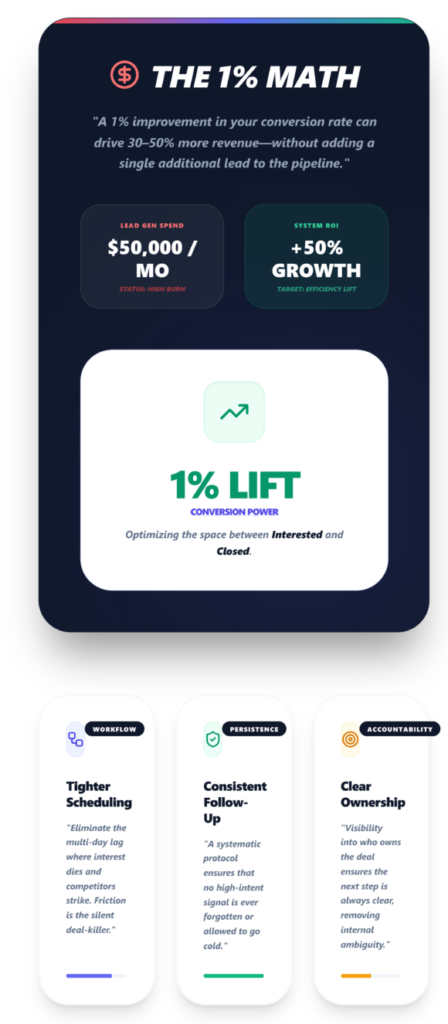
They’ll spend 50K/month on paid acquisition while their demo-to-close rate sits at 12%.
A 1% improvement in conversion rate can drive 30–50% more revenue — without a single additional lead.
The fix isn’t more demand. It’s better demo workflows. Tighter scheduling. Consistent follow-ups. Clear ownership.
A system that treats the space between “interested” and “closed” as the high-value real estate it actually is.
That’s what a purpose-built demo management tool gives you — not more leads, but more revenue from the leads you already have.
FAQ
Why do SaaS leads fail to convert?
Most SaaS leads fail to convert due to broken post-intent processes — slow response times, poor demo experiences, and inconsistent follow-up. The leads themselves are often fine; the system handling them isn’t.
What is a good SaaS conversion rate?
Average B2B SaaS visitor-to-lead is 1.1–2.5%, with top performers hitting 8–15%. SQL-to-close averages 20–25%, and elite teams push past 30% with structured demo processes and rapid response.
How can I improve SaaS conversion rates?
Respond to demo requests in under 5 minutes, qualify leads against your ICP before scheduling, personalize every demo, and enforce structured same-day follow-up with clear next steps. System changes beat volume every time.
Are leads the problem or the process?
Almost always the process. If leads are showing intent — visiting your site, requesting demos — the issue is what happens next. Audit your response time, demo quality, and follow-up cadence before blaming lead quality.
Final Takeaways
- Your leads probably aren’t the problem. Your conversion system is.
- The biggest revenue leak happens between demo request and close — not at the top of funnel.
- Responding in under 5 minutes, qualifying before the demo, and personalizing the experience are table stakes, not nice-to-haves.
- A structured demo-to-close process beats more ad spend every time.
- More leads don’t fix conversion problems. Fix the system first. The revenue is already sitting in your pipeline.
Ready to stop losing deals after intent?
Explore LevelUp Demo and build a conversion system your leads actually deserve.
✅ Instant Lead Routing
✅ Better Conversions
✅ Stop Revenue Leaks