
What is funnel leakage in SaaS?
Funnel leakage in SaaS refers to the loss of potential customers at different stages of the sales process before they become paying customers. In B2B SaaS, the most severe and expensive leakage occurs after a prospect shows intent—specifically during the demo scheduling, execution, and post-demo follow-up stages.
Key Insights (TL;DR)
- Funnel leakage refers to prospects dropping off at different stages of the sales funnel before becoming paying customers.
- Most SaaS teams obsess over top-of-funnel leaks but completely ignore conversion-stage losses.
- The biggest leakage often happens between demo booking and deal closure — where intent is highest.
- Poor follow-up, disjointed handoffs, and lack of demo structure increase leakage significantly.
- Fixing conversion-stage leakage can increase revenue without generating a single additional lead.
What Is Funnel Leakage?
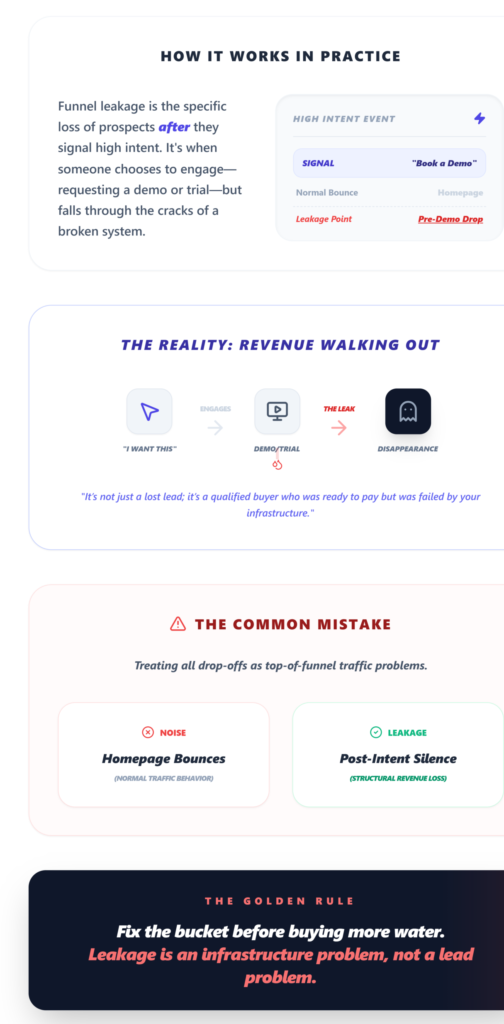
Funnel leakage in SaaS refers to the loss of potential customers at different stages of the sales funnel, especially between intent, demo, and conversion stages, where prospects drop off before becoming paying customers.
It’s not about visitors bouncing from your homepage. That’s normal traffic behavior.
Funnel leakage is what happens when someone wants your product — requests a demo, starts a trial, engages with sales — and still disappears.
That’s revenue walking out the door.
Why Funnel Leakage Is a Hidden Revenue Problem
Most SaaS teams focus on generating more leads. But very few analyze where those leads are actually lost.
Here’s the uncomfortable part: the biggest revenue losses don’t happen at the top of the funnel — they happen after intent.
A prospect who books a demo and never hears back. A trial user who hits onboarding friction on day two. A qualified lead sitting in a CRM queue assigned to a rep who’s on vacation.
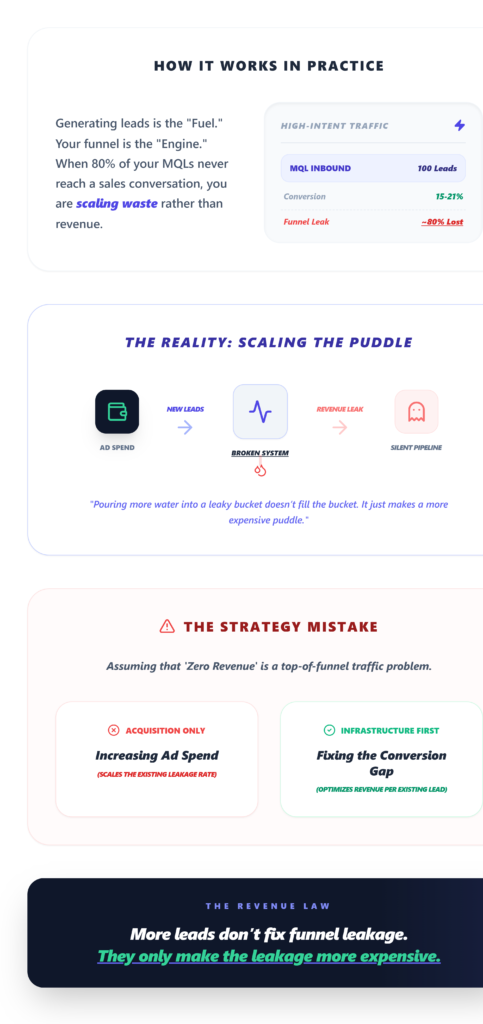
Only 15–21% of marketing-qualified leads convert to sales-qualified leads. That means 70–80% of your pipeline leaks before it ever reaches a serious sales conversation.
And most teams respond by pouring more leads into the same broken system.
More leads don’t fix funnel leakage — they scale it.
By the end of this guide, you’ll know exactly where your SaaS funnel is leaking, why demo-stage losses are likely your biggest problem, and how to fix them systematically.
Where Funnel Leakage Happens in SaaS
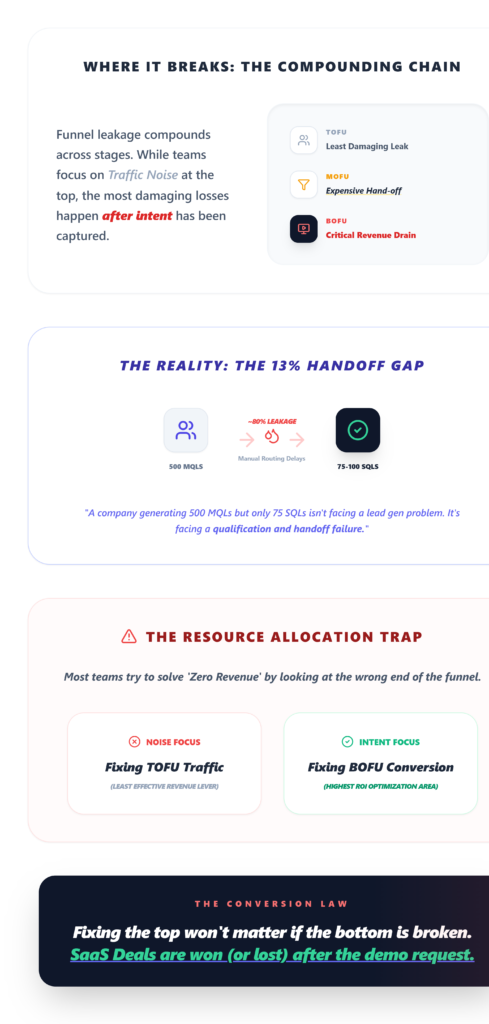
Sales funnel leakage doesn’t occur at a single point. It compounds across stages. But not all stages leak equally.
Top-of-Funnel Leakage
This is where most teams look first — and it’s usually the least damaging.
TOFU leakage comes from:
- Low-quality traffic that was never going to convert
- Weak lead magnets attracting the wrong audience
- Forms that capture volume, not intent
Yes, it matters. But fixing TOFU leakage alone won’t move revenue if everything below it is broken.
Mid-Funnel Leakage
This is where things start getting expensive.
Mid-funnel leakage happens when:
- MQL-to-SQL conversion fails due to poor qualification criteria
- Leads sit in queues because manual routing workflows delay assignment
- Marketing and sales aren’t aligned on what “qualified” actually means
- Data silos between your product database and CRM create blind spots
A SaaS company generating 500 MQLs per month but converting only 75–100 to SQLs isn’t facing a lead gen problem. It’s facing a qualification and handoff problem.
Bottom-of-Funnel Leakage
This is where the real damage happens. And most teams barely track it.
BOFU leakage includes:
- Demo requests that never get scheduled
- Demos that happen but have no structured follow-up
- Prospects who go dark after a “great call”
- Deals stuck in “pending” status for weeks with no next step
- Leads assigned to reps outside their territory or expertise
Most SaaS teams don’t lose leads at the top — they lose them after intent.
A prospect who fills out your demo form has already done their research. They’ve compared options. They’re ready to talk.
And if your response takes 48 hours, or your demo is a generic product walkthrough, or nobody follows up within a week — that deal is gone. This is conversion leakage at its most painful.
The Biggest Funnel Leakage Happens at the Demo Stage
Here’s where I need you to pay close attention, because this is the section that changes how you think about pipeline leakage.
The demo stage is where intent peaks — and where most SaaS revenue quietly dies.
Think about what it takes for a prospect to request a demo. They’ve found you, evaluated your positioning, read your pricing page, and decided you’re worth 30 minutes of their time. That’s a high-intent signal.
Now here’s what typically happens next:
Before the demo
- The form submission triggers a generic “Thanks, we’ll be in touch” email
- Lead routing assigns the request to whoever’s next in the queue — regardless of fit
- 24–72 hours pass before anyone reaches out
- By then, the prospect has booked demos with two competitors who responded in under an hour
During the demo
- The rep runs through a standard slide deck instead of addressing the prospect’s specific pain
- No discovery questions are asked
- The demo feels like a product tour, not a conversation
After the demo
- No structured follow-up sequence exists
- The rep sends a “Great chatting with you!” email and waits
- No next step is defined
- The deal enters CRM purgatory — tagged “In Follow-up” with no actual follow-up happening
A SaaS company generating 100 demo requests per month may lose 40–60% due to poor follow-up — not because of lead quality, but because of system gaps.
That’s not a marketing problem. That’s a revenue execution problem.
The SaaS Funnel Leakage Framework
To diagnose and fix pipeline leakage, you need a structured model. Here’s the framework:
- 1. Lead Capture Leakage
Where it happens: Forms, landing pages, CTAs.
The problem: You’re either capturing too many unqualified leads (noise) or losing qualified ones to friction (bad forms, slow page loads, unclear value props). - 2. Response Leakage
Where it happens: Between form submission and first human contact.
The problem: Slow lead response time kills deals. If your average response time exceeds one hour, you’re already losing to competitors who respond in minutes. (If you’re unsure about your response benchmarks, improving your lead response time is the single highest-ROI fix you can make.) - 3. Qualification Leakage
Where it happens: MQL-to-SQL handoff.
The problem: Marketing passes leads that sales doesn’t want. Sales ignores leads that marketing worked hard to generate. Nobody agrees on what “qualified” means. With 70–80% of MQLs never converting to SQLs, this stage is a massive, silent leak. - 4. Demo Leakage
Where it happens: Demo scheduling, demo execution, demo no-shows.
The problem: Demo scheduling delays, no-show rates with no re-engagement, and unstructured demos that don’t connect product value to buyer pain. This is where the highest-intent prospects are lost. (For a deeper look at structuring your demo process, check out how to build a demo funnel that converts.) - 5. Post-Demo Leakage
Where it happens: Follow-up sequences, proposal delivery, deal closure.
The problem: No defined next steps after the demo. Follow-ups are manual and inconsistent. Proposals take days. Deals sit in “pending” for weeks. The follow-up gap — the delay between prospect intent and sales response — is the single most damaging leak in the entire funnel.
Why Most SaaS Teams Don’t Notice Funnel Leakage
Funnel leakage persists because it’s invisible to teams that aren’t looking for it.
No stage-by-stage tracking. Most teams track top-line metrics — total leads, total demos, total deals.
But they don’t measure conversion rates between each stage. If you can’t see that 60% of demo requests never become scheduled demos, you can’t fix it.
No ownership. Marketing owns leads. Sales owns deals. Nobody owns the gaps between them.
The handoff zones — lead routing, demo scheduling, post-demo follow-up — are organizational no-man’s land.
Fragmented systems. Your product database doesn’t sync with your CRM. Your CRM doesn’t sync with your marketing automation.
Session replays show user behavior but nobody connects that data to pipeline outcomes. Data sync failures create blind spots that hide leakage.
How to Reduce Funnel Leakage in SaaS
Funnel leakage isn’t fixed with a single tactic. It requires systematic changes at each stage.
Improve response time. Set a one-hour response SLA for demo requests.
Use automated alerts — Slack, SMS, whatever gets attention — so leads don’t sit in queues. This alone can shift conversion rates dramatically.
Qualify leads earlier. Add 2–3 qualification fields to your demo form.
Not enough to create friction — just enough to route leads intelligently. Company size, use case, and timeline are usually sufficient.
Remove demo scheduling friction. Let prospects self-schedule. Embed calendar links in your confirmation emails.
Every hour of delay between “request submitted” and “demo booked” increases the chance of losing that prospect.
Structure your demos. Stop running generic product tours. Start every demo with discovery.
Understand the prospect’s specific pain before showing features. A 20-minute demo tailored to the buyer’s problem beats a 45-minute feature walkthrough every time.
Enforce follow-ups. Define the next step during the demo, not after.
Send a follow-up within 2 hours — not 2 days. Create a sequence: follow-up email, value-add resource, check-in call. Track completion. (Understanding why leads don’t convert often reveals that follow-up failure — not lead quality — is the root cause.)
Why Fixing Funnel Leakage Requires a System
Funnel leakage is not a single problem — it’s a system failure.
You can’t fix it with a better email template. You can’t fix it by hiring another SDR.
You need connected workflows: lead capture that feeds into qualification, qualification that triggers routing, routing that enables scheduling, scheduling that drives structured demos, and demos that flow into tracked follow-ups.
Most SaaS teams cobble this together across 4–5 disconnected tools. Leads leak through the gaps between them.
Built for this exact problem
LevelUp Demo connects your entire demo workflow — from lead capture and qualification to scheduling, outcome tracking, and follow-up management — in one lightweight system.
FAQ
What causes funnel leakage?
Funnel leakage is caused by slow response times, poor lead qualification, disjointed handoffs between marketing and sales, unstructured demos, and inconsistent follow-up processes. It’s rarely a single failure — it’s compounding friction across multiple stages.
How do you identify funnel leakage?
Measure conversion rates between each funnel stage — not just top-line totals. Run cohort analysis by traffic source and lead segment. Audit 10 random leads from the past month and trace their journey. Where they stalled is where you’re leaking.
Where does most funnel leakage happen in SaaS?
Most SaaS funnel leakage happens at the demo and post-demo stages. While 70–80% of MQLs fail to convert to SQLs, the highest-value leakage occurs when high-intent prospects — those who’ve requested demos — are lost to slow response, weak execution, or missing follow-up.
How do you fix funnel leakage?
Set response time SLAs. Qualify leads at capture. Remove demo scheduling friction. Structure every demo around buyer pain. Enforce follow-up sequences with defined next steps and tracking. Treat it as a system problem, not a single-fix issue.
Final Takeaways
- Funnel leakage is the silent revenue killer in SaaS — it compounds at every stage.
- TOFU leakage gets all the attention, but conversion-stage leakage costs more.
- The demo stage is where intent is highest and losses are most expensive.
- 70–80% of MQLs never become SQLs — that’s a qualification and handoff problem, not a lead gen problem.
- Response time, demo structure, and follow-up discipline are the three highest-leverage fixes.
- More leads don’t fix funnel leakage — they scale it.
- You don’t need more pipeline. You need less leakage.
Stop scaling a leaky funnel.
LevelUp Demo helps SaaS teams capture, qualify, schedule, and follow up on every demo request — so revenue stops slipping through the cracks.
✅ Capture & Qualify
✅ Automate Scheduling
✅ Stop Revenue Leaks