

The demo went well. The prospect nodded along, asked sharp questions about integrations, even said “this looks like exactly what we need.”
Your rep hung up feeling good. Logged “Demo Completed” in the CRM. Moved on to the next call.
Three weeks later, that prospect hasn’t responded to a single follow-up. No meeting booked. No deal created.
The lead sits in a spreadsheet somewhere between “interested” and “forgotten.” Nobody notices because nobody is looking.
We’ve watched this happen dozens of times across small SaaS teams. Not because the demo was bad.
Not because the product didn’t fit. But because everything that was supposed to happen after the call simply didn’t.
By the end of this post, you’ll understand exactly where demos go to die, why your CRM isn’t catching it, and what a functional post-demo workflow actually looks like.
Why Do SaaS Demos Go Cold After the Call?
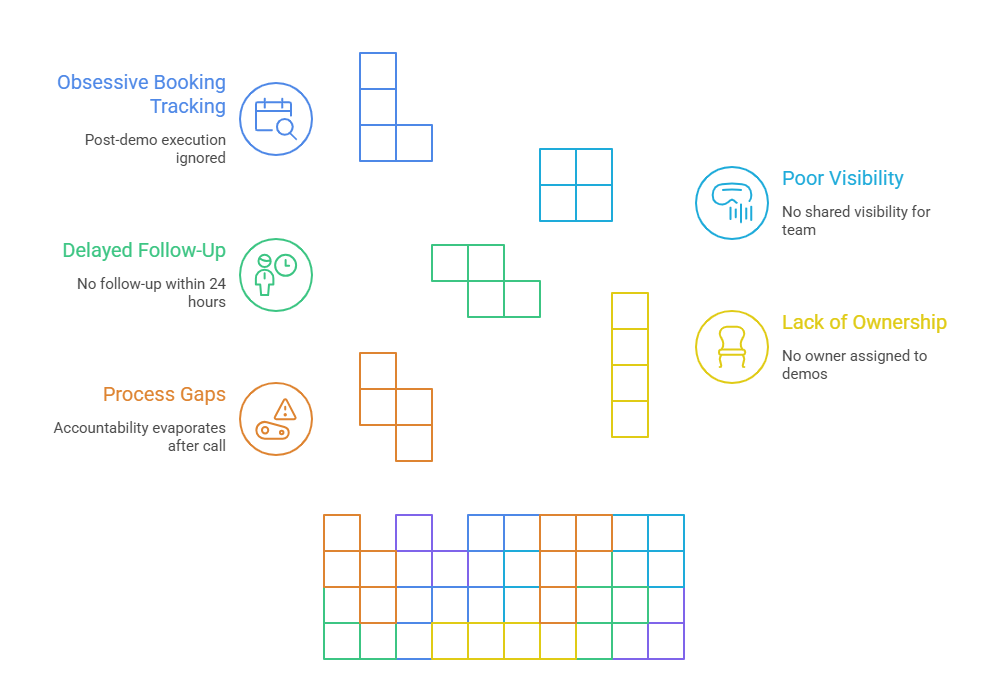
The short answer: process gaps, not prospect disinterest.
Across many SaaS teams we’ve observed, the demo itself gets all the attention.
Teams obsess over the pitch deck, the product walkthrough, the objection handling. But the moment the call ends, accountability evaporates.
Based on common demo funnel benchmarks, 40–50% of qualified demos fail to progress to a next meeting.
When you include demos that were loosely qualified or came through inbound forms without proper scoring, that number climbs closer to 60%.
These aren’t demos that got a hard “no.” They’re demos that got… nothing.
No outcome logged. No owner assigned. No follow-up within 24 hours. No shared visibility for the founder or team lead.
The biggest revenue loss in most early-stage SaaS companies happens after the demo, not during it.
And the reason it persists is that most teams track demo bookings obsessively but treat post-demo execution as something that’ll just sort itself out.
It doesn’t.
If you’re building or refining your demo process from scratch, this foundational guide to sales demos covers the full lifecycle worth understanding first.
📉 The “Platinum Minute” Reality
According to 2025 data on lead response times, the window for effective follow-up is brutal. Responding within the first minute can boost conversion by 391%. Wait just 5 minutes, and your odds of qualifying that lead drop by 80%. If your post-demo follow-up takes 24 hours, you aren’t just late—you’re invisible.
What Teams Think Happens After a Demo
Here’s the story most teams tell themselves:
“We’ll follow up.” Someone on the team will send a recap email. Probably today. Maybe tomorrow. It’s understood.
“It’s in the CRM.” The demo was logged. The contact exists. So the system is working, right?
“The rep remembers.” They were on the call. They know what was discussed. They’ll handle next steps.
This feels reasonable. It also falls apart almost immediately.
What Actually Happens
In most small SaaS teams, here’s the real post-demo sequence:
The rep finishes the call and jumps into the next one. The “recap email” gets pushed to end-of-day.
End-of-day becomes tomorrow. Tomorrow has its own fires.
The CRM record says “Demo Completed” but has no outcome, no next step, no follow-up date.
It’s a status, not a workflow.
The founder checks the pipeline on Friday and sees a bunch of “open” deals with no activity. Asks the rep.
Rep says “oh yeah, I need to follow up with them.” By now it’s been five days.
The prospect, meanwhile, has moved on. They’re evaluating two other tools. Your window closed on Day 2.
This is cadence decay in action. And it kills roughly 60% of demos not through malice or incompetence, but through the quiet accumulation of small gaps.
The 4 Most Common Post-Demo Black Holes
1. No Outcome Captured
A three-person sales team runs eight demos a week. After each call, the rep updates the CRM status to “Demo Done.”
But there’s no field for what happened. Was the prospect interested? Lukewarm? Completely wrong fit?
Nobody records it because the system doesn’t force it. Two weeks later, the founder asks which demos are worth pursuing.
Nobody can say with confidence.
2. Vague “Follow Up Later” Next Steps
The rep ends the demo with “I’ll send you some info and we can reconnect next week.” No specific date.
No calendar invite. No defined action item. “Follow up later” is the most dangerous phrase in SaaS sales because it feels like progress but creates zero commitment.
The demo-to-meeting conversion rate craters when next steps are left ambiguous.
For a deeper look at what actually moves demos toward closed deals, this breakdown of demo-to-deal conversion is worth reading.
3. Calendar and CRM Mismatch
The demo was scheduled through Calendly. The CRM has a contact record. But the two aren’t synced.
So the demo happened, but the CRM doesn’t reflect it properly.
The follow-up reminder lives in the rep’s personal calendar, not in any shared system.
If that rep is out sick or leaves the company, the lead vanishes.
4. No Follow-Up Accountability
There’s no dashboard showing which demos had a follow-up sent within one hour.
No alert when a demo sits untouched for 48 hours.
No team-level view of who is following up and who isn’t.
The founder finds out about pipeline leakage weeks later, usually when a prospect signs with a competitor.
Each of these is a visibility problem. Not a talent problem.
Why CRMs Don’t Solve This Alone
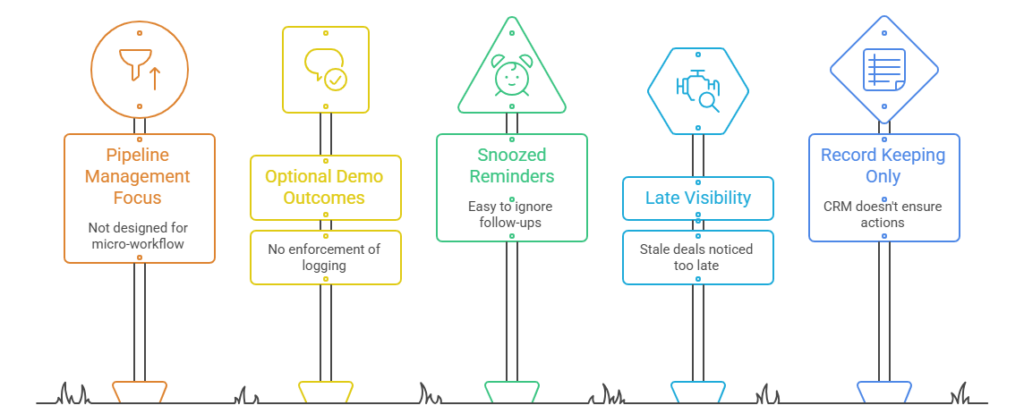
This is where teams get stuck. They assume that because they have HubSpot or Salesforce, the post-demo process is covered.
It isn’t. And here’s why.
CRMs are built for pipeline management. They track deals across stages, store contact information, and generate revenue reports.
They’re not designed to manage the micro-workflow between “demo happened” and “deal entered pipeline.”
Demo outcomes are typically optional fields. Nobody enforces them. Follow-up reminders exist, but they’re easy to snooze or ignore.
And the visibility a CRM provides comes too late. By the time a founder looks at the pipeline report and notices a stale deal, the prospect has already gone cold.
In most small SaaS teams, the CRM becomes a record of what happened, not a system that ensures things happen.
There’s a meaningful difference.
This is the gap that causes funnel drop-off to cluster right after the demo stage.
The demo itself might qualify the lead beautifully. But without a system that forces outcome logging, assigns follow-up ownership, and surfaces at-risk demos in real time, the qualified lead just… sits there.
We’ve written more about why demos fail even when the product is strong. The pattern is almost always structural, not personal.
💡 The Persistence Payoff
2025 sales data reveals that 80% of deals require 5+ follow-up touchpoints to close, yet nearly 50% of reps give up after just one attempt. This gap is where your revenue lives. It’s not about being annoying; it’s about being present when the prospect is ready to buy.
What Should Happen Immediately After a Demo?
Within 30 minutes of every demo, four things need to be true:
- The outcome is logged. Not “demo done.” An actual outcome: interested and scheduling next call, needs internal buy-in, not a fit, requested proposal. Something specific.
- A next step is defined. With a date. On a calendar. Visible to the team.
- Follow-up ownership is clear. One person owns the next touch. Not “the team.” One name.
- The founder or team lead can see it. Without asking anyone. Without digging through Slack. On a dashboard, in a shared view, somewhere with zero friction.
If any of those four things are missing, the demo is at risk.
Based on what we’ve seen, demos without a logged outcome and a defined next step within the first hour have a dramatically higher chance of going dark.
This is where a framework purpose-built for demo workflows changes things. Not a CRM add-on. Not a calendar plugin.
A system that treats the demo-to-follow-up-to-pipeline gap as its own distinct workflow.
Built for Exactly This Gap
LevelUp Demo forces outcome logging after every demo, makes follow-ups visible across your team, and removes reliance on memory. It’s not a CRM replacement. It’s the bridge between your demo and your pipeline that most teams are missing.
How Long Should Demo Follow-Ups Take?
The data here is consistent: Day 1 follow-ups outperform everything else.
Email open rates above 50% on same-day recaps are common.
Wait 48 hours and you’re fighting for attention against every other vendor in the prospect’s inbox.
A practical cadence for small teams:
- Within 1 hour: Recap email with specific pain points discussed and a calendar link for the next meeting.
- Day 2–3: A short check-in referencing something specific from the demo. Not a generic “just following up.”
- Day 5–7: A value-add touch. A relevant case study, a benchmark, something that advances the conversation.
Most teams we’ve worked with don’t get past step one consistently. Not because they don’t want to.
Because nothing in their workflow makes them do it.
For a more detailed follow-up framework, these follow-up strategies lay out what a complete post-demo cadence looks like.
The Troubleshooting Reality
Here’s what actually shows up when you audit post-demo workflows in small SaaS teams:
| Problem | Root Cause | What Actually Fixes It |
|---|---|---|
| 40% of follow-up meetings are no-shows | No calendar link in recap; no urgency created | Embed one-click scheduling in every recap email sent within 1 hour |
| Demos sit with no outcome for 5+ days | CRM doesn’t enforce outcome fields | Use a system that blocks progression without outcome entry |
| Prospects say “sounds good” then disappear | No defined next step; no commitment mechanism | End every demo with a specific date and action, not a vague agreement |
| Founder has no visibility into demo health | Data lives in rep’s head or personal notes | Shared dashboard with “days since last activity” flags |
| Follow-ups are duplicated or contradictory | Multiple team members touching the same lead without coordination | Single owner assignment with team-visible status |
None of these are exotic problems. They’re mundane. That’s why they persist.
Nobody builds a process around them because each one feels too small to matter.
But collectively, they account for the majority of post-demo revenue leakage.
How to Audit Your Own Post-Demo Process
Before changing anything, run this check. Pull your last 20 demos and answer honestly:
- How many have a logged outcome beyond “demo completed”?
- How many had a follow-up sent within 24 hours?
- How many have a defined next step with a date?
- How many can you see the status of right now, without asking anyone?
If fewer than 12 out of 20 pass all four checks, your post-demo process has structural gaps.
That’s not a judgment call. It’s arithmetic.
We put together a Post-Demo Reality Checklist that covers exactly what should happen in the first 24–72 hours after every demo: outcome logging, follow-up ownership, timeline visibility, and risk flags.
It’s a self-check tool you can use with your team this week. No form to fill out, no gating.
Just a practical reference.
For more on tracking and improving these numbers over time, this guide on demo conversion rates walks through the metrics that matter.
FAQ
Why do 60% of SaaS demos stall after the call?
Most demos stall because of workflow gaps, not prospect disinterest. No outcome gets logged, follow-ups are delayed, next steps are vague, and no one has visibility into which demos are at risk. The process between “demo done” and “deal in pipeline” is where revenue quietly leaks out.
What’s the difference between a demo outcome and a CRM deal stage?
A demo outcome captures what happened on the call: interested, not a fit, needs follow-up, requested proposal. A CRM deal stage tracks where a deal sits in the pipeline. Most CRMs handle stages well but don’t enforce demo-level outcome tracking, which is why demos fall through.
How quickly should you follow up after a SaaS demo?
Within one hour is the target. Same-day follow-ups see significantly higher engagement. Waiting beyond 48 hours drops response rates sharply. The follow-up should include specific references to the demo conversation and a direct calendar link for the next step.
Can a small SaaS team fix post-demo drop-off without hiring?
Yes. The fix is structural, not headcount-based. Outcome logging, follow-up ownership, and shared visibility can be implemented with the right workflow system. Most small teams lose demos to process gaps, not capacity constraints.
Where This Leaves You
If your team runs demos consistently but deals keep going quiet afterward, the problem is almost certainly in the gap between the demo and the pipeline.
Not in the pitch. Not in the product. In the workflow that’s supposed to carry the lead from “interested” to “next step” to “closed.”
If follow-ups rely on memory, if outcomes live in people’s heads, if you can’t see which demos are at risk without asking around, that gap is costing you revenue every week.
Stop Leaking Revenue After the Demo
LevelUp Demo was built to close exactly this gap. It forces outcome logging, makes follow-ups visible, assigns ownership, and gives founders a real-time view of post-demo health.
✅ Enforce Outcomes
✅ Visible Follow-Ups
✅ Real-Time Health