
Last quarter, we ran what I’d call a near-perfect demo. The prospect was nodding. They asked smart questions. Our product fit their pain points like a glove. I walked out of that call thinking, this one’s closed.
Two weeks later? Silence. No reply to our follow-up email. No internal champion pushing it forward. The deal just… evaporated.
And when I went back to figure out what happened, the answer wasn’t in the demo itself. The demo was great. The problem was everything around it. We had no structured follow-up. No defined next step. No way to track what happened after the call ended.
The SaaS demo process broke down in the stages we never bothered to build.
That experience forced me to rethink the entire demo funnel—not just the 30 minutes on screen, but the full lifecycle from first request to closed deal.
Here’s what I’ll walk you through: the 5 stages every SaaS demo should actually go through, why most teams unknowingly skip two of them, and how fixing that gap can be the difference between a 20% close rate and a 50%+ one.
Before You Read: The Stop/Go Check
This guide assumes you’re already running demos—even if they’re messy.
If your team has done at least 10 demos in the last 90 days and you can’t tell me exactly how many converted to a next step, keep reading. That’s your signal.
You should also have some form of lead capture in place (even a basic form), a calendar tool, and at least one person responsible for running demos.
If you’re pre-launch and haven’t done a single demo yet, bookmark this and come back. You’ll need it soon.
Why Most SaaS Demo Processes Are Actually 3 Stages Pretending to Be 5
Here’s the pattern I see constantly across early-stage SaaS teams:
- Someone fills out a form.
- A demo gets booked.
- The demo happens.
That’s it. That’s the whole “process.”
There’s no qualification layer. No structured post-demo sequence. No outcome tracking. The rep finishes the call, maybe sends a “thanks for your time” email, and moves on to the next one.
And then everyone wonders why demo conversion rates stay low.
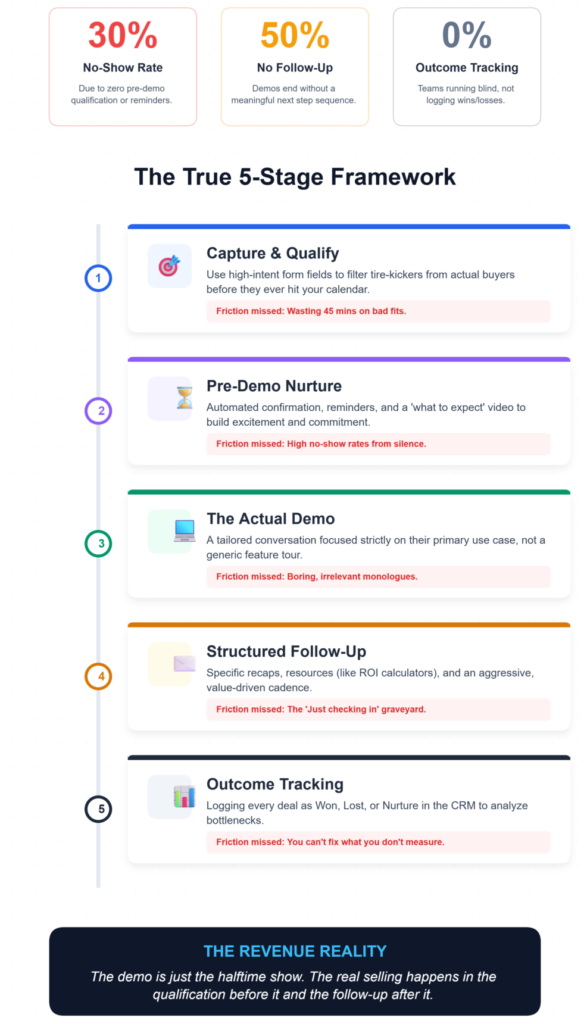
The data backs this up. Roughly 50% of SaaS demos never receive a meaningful follow-up. Around 30% of booked demos end in no-shows because there’s no pre-qualification or confirmation sequence.
And most small teams don’t track demo outcomes at all—they’re running blind.
So let’s fix that. Here are the 5 stages, in order, with the friction points most teams miss.
Stage 1: Demo Request Capture
This is where your funnel starts—and where a surprising number of teams already leak leads.
What should happen: A prospect lands on your site, fills out a demo request form, and that request gets logged somewhere trackable. Not in someone’s inbox. Not in a Slack message. Somewhere with structure.
What actually happens: Most teams use a generic contact form, collect a name and email, and route it to whoever checks their inbox first. There’s no intent signal. No way to prioritize. No context for the person running the demo.
The fix starts with your form. If you’re still using a basic “Request a Demo” form with just name and email, you’re capturing volume without signal.
You need high-intent fields that tell you why this person wants a demo—company size, use case, timeline. That context changes everything downstream.
And here’s something most teams don’t realize: poorly designed demo forms actually hurt conversions. Too many fields and people bounce. Too few and you’re flying blind on the call.
Visual checkpoint: Every demo request should land in a centralized dashboard—not scattered across email threads. You should see the prospect’s name, company, stated pain point, and submission timestamp in one view.
Verification: Pull up your last 10 demo requests. Can you tell me, right now, which ones had a clear use case stated? If not, this stage needs work.
Stage 2: Qualification Before the Demo
This is the first stage most teams skip entirely.
Here’s the uncomfortable truth: not every demo request deserves a demo.
I know that sounds harsh when you’re early-stage and hungry for pipeline. But spending 30 minutes with someone who has no budget, no authority, or no real problem to solve is worse than spending 15 minutes qualifying them out.
What should happen: Before a demo gets scheduled, someone reviews the request against your ICP. Is this the right company size? Right industry? Do they have a pain point your product actually solves?
If yes, schedule. If maybe, send a pre-demo questionnaire or a quick async video. If no, route them to self-serve resources.
What actually happens: The demo gets booked immediately with zero filtering. The rep shows up, does a feature dump for 25 minutes, and the prospect ghosts because the product was never a fit.
Qualified demos close at dramatically higher rates. Teams that implement even a basic qualification step—a 5-minute screening call or a structured intake form—see their demo-to-close rates climb toward that 40–60% benchmark. Without it, you’re stuck below 20%.
💡 The Cost of Unqualified Demos
According to 2026 B2B sales benchmarks, account executives spend an average of 14 hours per month running demos for prospects who lack the budget or authority to buy. Implementing a simple pre-demo qualification gate increases the overall pipeline win rate by 31% because reps reallocate that time to high-intent buyers.
Visual checkpoint: Your scheduling flow should show a “Qualified” or “Pending Review” status before any calendar invite goes out.
Verification: Look at your last 5 lost deals. How many of them should never have gotten a demo in the first place?
This is also where reducing demo no-shows starts. When prospects are qualified and expecting a tailored conversation, they actually show up.
Stage 3: Demo Execution
This is the stage everyone obsesses over—and honestly, it’s the one most teams are least bad at.
I won’t rehash the full playbook here (we’ve written a complete guide to running sales demos that goes deep).
But the core principle is simple: demo in the customer’s context, not yours.
That means:
- Lead with their pain points, not your feature list. If you’re showing 8 features, you’re showing 6 too many.
- Use the Tell-Show-Tell structure. Set the agenda, show the product solving their problem, then recap what they just saw.
- Keep it under 20 minutes of active demo. Attention drops hard after that. Cap your feature walkthrough at 2–4 differentiators tied to their stated goals.
- Watch for engagement signals. If the prospect hasn’t asked a question in 5 minutes, something’s wrong. Inject a check-in: “Does this match what you’re dealing with?”
Use a sandbox environment when possible. Let them click around. Interactive demos see roughly 2x the engagement of passive screen shares.
And rehearse. I know it sounds obvious, but 70%+ of teams skip pre-demo dry runs, and it shows. Cursor wandering around the screen, loading the wrong account, fumbling through transitions—these small friction points kill credibility.
Visual checkpoint: Your shared screen should show the prospect’s company name or data mocked in. No generic “Acme Corp” placeholders. No stray browser tabs.
Verification: Did the prospect ask at least 3 questions during the demo? If they sat silent the whole time, you likely delivered a feature tour, not a conversation.
For closing tactics that actually work in this stage, here’s our breakdown on closing demos.
Stage 4: Post-Demo Follow-Up
This is the second stage most teams skip. And it’s where the majority of revenue gets left on the table.
Here’s what I mean by “skip.” Teams technically send a follow-up email. But it’s a generic “Thanks for your time, let me know if you have questions” message sent 2 days later.
That’s not follow-up. That’s a formality.
Real post-demo follow-up looks like this:
- Within 1 hour of the demo: Send a personalized recap. Reference the specific pain points discussed. Attach any relevant docs, case studies, or a sandbox replay link. Include a clear next step with a date.
- Within 24 hours: If there’s a decision-maker who wasn’t on the call, send a short async summary video they can watch on their own time.
- Within 48 hours: If no response, follow up with a specific question—not “just checking in” but “Did the integration piece address your concern about [X]?”
Speed matters here. Fast follow-up—within the first hour—correlates directly with higher conversion. Every day you wait, the prospect’s memory of your demo fades and their inbox fills up with competitor pitches.
The reason this stage breaks down is simple: there’s no system for it. Reps finish a demo, jump to the next call, and forget to send the recap. The Q&A parking lot items never get answered. The promised case study never gets shared. And the deal stalls.
⚡ The “Golden Hour” Rule
2025 engagement data reveals that post-demo follow-ups sent within 1 hour of the call ending receive a 65% higher response rate than those sent the next day. The memory of your product’s “wow” moment decays rapidly—speed and relevance are your best conversion levers.
Visual checkpoint: Every completed demo should have a follow-up status visible in your pipeline—”Recap Sent,” “Docs Shared,” “Next Step Scheduled,” or “Awaiting Response.”
Verification: Check your last 10 completed demos. How many had a follow-up sent within 1 hour? How many had a defined next step? If you can’t answer that, you’re in the 50% of teams losing deals to silence.
Your demo workflow shouldn’t depend on memory
If follow-ups are falling through because there’s no system tracking them, that’s a workflow problem, not a people problem. Tools like LevelUp Demo give you a follow-up dashboard with reminders and status tracking—so every demo has a clear next action attached to it. No spreadsheets. No guessing.
Stage 5: Outcome Tracking & Next Steps
If Stage 4 is skipped often, Stage 5 barely exists for most teams.
Outcome tracking means logging what happened after every demo: Did it convert? Is it in follow-up? Was it lost? Why was it lost? What’s the next step and when?
Without this, you have zero visibility into your demo pipeline. You can’t tell which reps close better, which lead sources produce qualified demos, or where deals get stuck. You’re running demos into a void.
Here’s what outcome tracking should include:
- Demo status: Won, Lost, In Follow-up, Pending Decision
- Loss reason (if applicable): No budget, wrong timing, went with competitor, no response
- Next step + date: Trial started, proposal sent, second demo with decision-maker, etc.
- Follow-up owner: Who’s responsible for the next action?
Most teams track none of this. They might remember the big deals, but the mid-funnel prospects—the ones that need one more nudge—slip away completely. And those are often the ones with the highest close potential.
Teams that track demo outcomes and iterate on their process see a 20–30% conversion improvement within 4–6 weeks. That’s not theory. That’s the compounding effect of knowing what’s working and fixing what isn’t.
Visual checkpoint: You should be able to pull up a single view showing every demo from the last 30 days with its current status, outcome, and next step.
Verification: Can you tell me, right now, your demo-to-close rate for last month? If the answer is “I’d have to check a few places,” this stage isn’t built yet.
This is exactly where converting demos into actual deals either happens or doesn’t.
The Ugly Truth: Where Demos Actually Die
Problem 1: Deals go silent after great demos
Root Cause: No follow-up within 1 hour; no recap sent.
The Fix: Auto-send a sandbox replay and a pain-point recap immediately post-call.
Problem 2: Reps forget to share promised docs
Root Cause: No task system in place; relying entirely on memory.
The Fix: Log action items live during the demo and use automated follow-up reminders.
Problem 3: Prospects ghost after “Let me think about it”
Root Cause: No defined next step established on the call.
The Fix: Always end with a specific date and action micro-commitment before hanging up.
Problem 4: No idea which demos actually convert
Root Cause: No outcome tracking; data is scattered across 4 different places.
The Fix: Centralize your demo status and outcomes into one single pipeline view.
Problem 5: Unqualified leads waste demo slots
Root Cause: No pre-demo screening process.
The Fix: Add an ICP (Ideal Customer Profile) checklist before scheduling; route mismatches to self-serve videos.
Problem 6: Same demo mistakes repeated monthly
Root Cause: No iteration loop; no analytics review taking place.
The Fix: Review your demo drop-off patterns every 2 weeks and constantly adjust the crucial first 5 minutes of your pitch.
Checklist: Is Your Demo Process Complete?
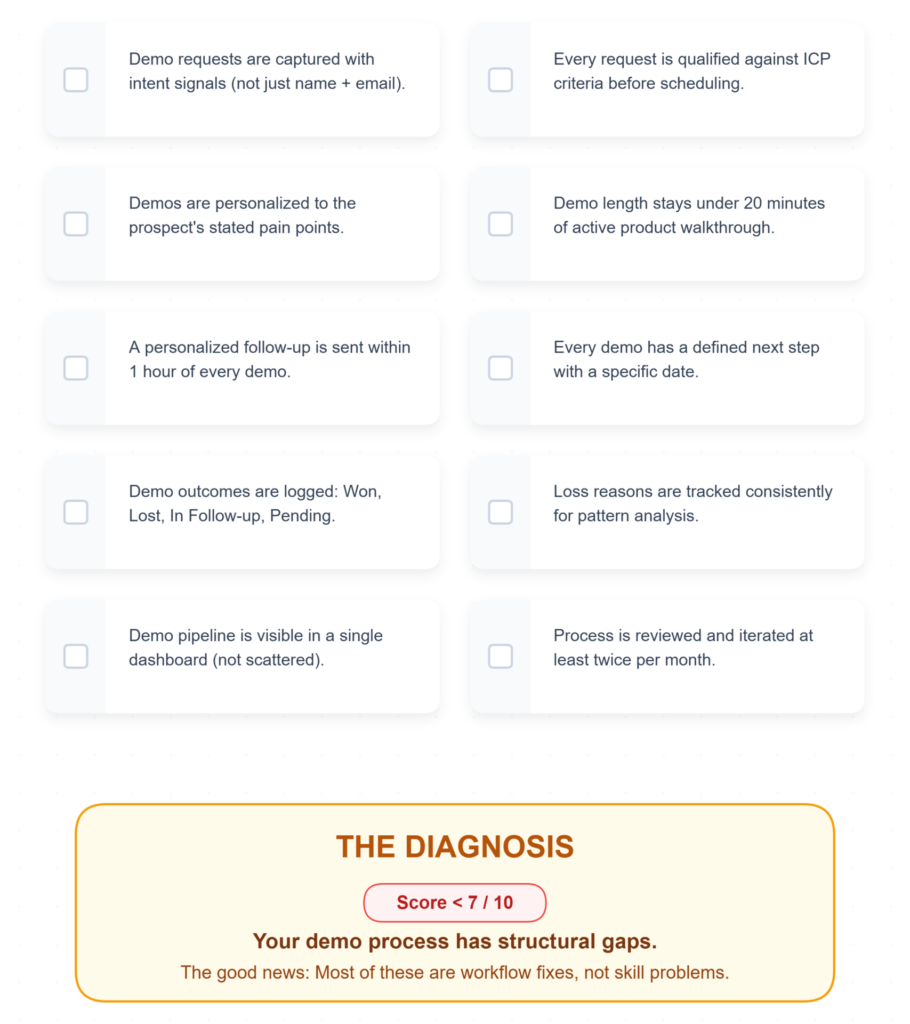
- [ ] Demo requests are captured with intent signals (not just name + email)
- [ ] Every request is qualified against ICP criteria before scheduling
- [ ] Demos are personalized to the prospect’s stated pain points
- [ ] Demo length stays under 20 minutes of active product walkthrough
- [ ] A personalized follow-up is sent within 1 hour of every demo
- [ ] Every demo has a defined next step with a date
- [ ] Demo outcomes are logged: Won, Lost, In Follow-up, Pending
- [ ] Loss reasons are tracked for pattern analysis
- [ ] Demo pipeline is visible in a single dashboard (not scattered across tools)
- [ ] Process is reviewed and iterated at least twice per month
If you checked fewer than 7, your demo process has structural gaps. The good news: most of these are workflow fixes, not skill problems.
FAQ
What are the 5 stages of a SaaS demo process?
The five stages are demo request capture, pre-demo qualification, demo execution, post-demo follow-up, and outcome tracking with defined next steps. Most teams only execute the middle three—and even then, qualification is often rushed or skipped entirely.
Why do SaaS demos not close even when the product fits?
The demo itself is rarely the problem. Deals stall because there’s no structured follow-up, no defined next step, and no system to track outcomes. When 50% of demos never get a meaningful follow-up, the issue is workflow—not product-market fit.
How do you track a SaaS demo pipeline effectively?
Log every demo with its current status (Won, Lost, In Follow-up, Pending), the assigned follow-up owner, and the next action date. Use a centralized dashboard rather than spreadsheets or CRM notes. LevelUp Demo is built specifically for this—tracking the full journey from lead capture through outcome.
How can small SaaS teams improve demo conversion rates?
Start by qualifying leads before booking demos—this alone filters out low-fit prospects. Then build a follow-up sequence that fires within 1 hour of every demo. Teams that add qualification and structured follow-up typically see close rates move from under 20% toward the 40–60% range within 4–6 weeks.
If your team runs demos regularly but deals still stall or disappear, the problem probably isn’t your pitch. It’s the stages you haven’t built around it.
Most demo pipelines break in the stages nobody tracks.
LevelUp Demo connects every stage—from request capture to outcome—so nothing falls through the cracks. Build a process that actually converts.
✅ Qualify Leads Automatically
✅ Enforce Follow-Ups
✅ Track True Outcomes