What is the difference between a SaaS demo funnel and a sales funnel?
A sales funnel covers the entire customer journey from awareness to purchase, while a SaaS demo funnel focuses specifically on converting high-intent prospects after they request a demo. While the sales funnel generates volume, the demo-to-close funnel is what actually secures the revenue.
Most SaaS revenue problems aren’t lead problems. They’re demo problems.
I’ve watched teams pour six figures into top-of-funnel campaigns while their demo-to-close rate bleeds out quietly in the background.
Nobody notices because everyone’s celebrating the MQL numbers. Meanwhile, the actual deals? They’re dying somewhere between “great demo, let’s circle back” and radio silence.
Here’s the hard verdict: If your demo conversion rate is below 25%, no amount of lead generation will save your quarter.
The sales funnel gets the budget. The demo pipeline gets ignored. And that’s exactly where the money disappears.
Key Insights
- Most SaaS teams optimize lead generation but completely ignore demo-to-close conversion — the highest-leverage stage in the pipeline.
- The biggest revenue drop happens after a demo is booked, not before.
- A demo funnel isn’t a subset of a sales funnel — it’s a separate system that demands its own metrics, ownership, and tooling.
- Sales funnels generate volume; demo conversion funnels convert intent. Confusing the two kills deal velocity.
- Fixing demo conversion often delivers 2–3x more revenue impact than adding more leads at the top.
What Is a Sales Funnel?
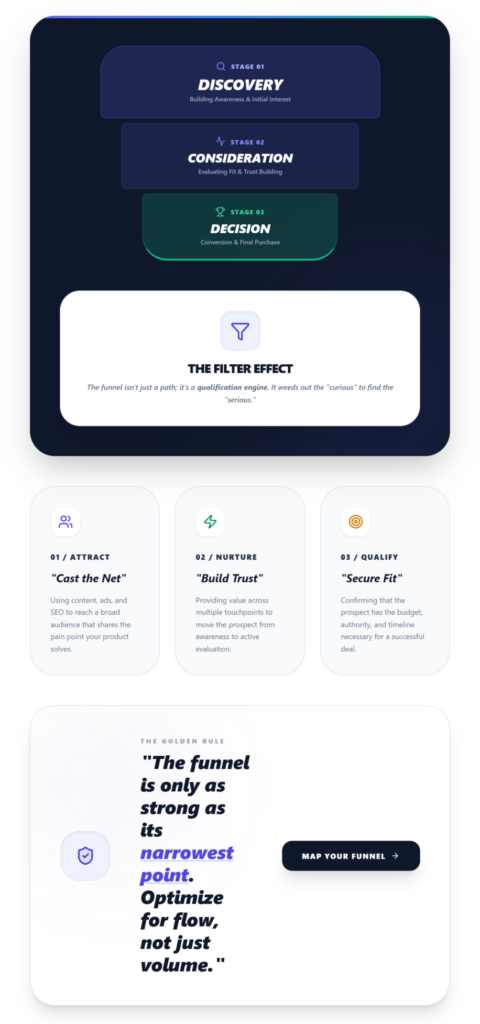
Sales funnel (simple definition): A sales funnel is the step-by-step process that takes a prospect from awareness to purchase through stages like discovery, consideration, and decision.
It maps the full buyer journey. It’s designed to attract, nurture, and qualify a broad audience into potential buyers across multiple touchpoints and stages.
What Is a SaaS Demo Funnel?
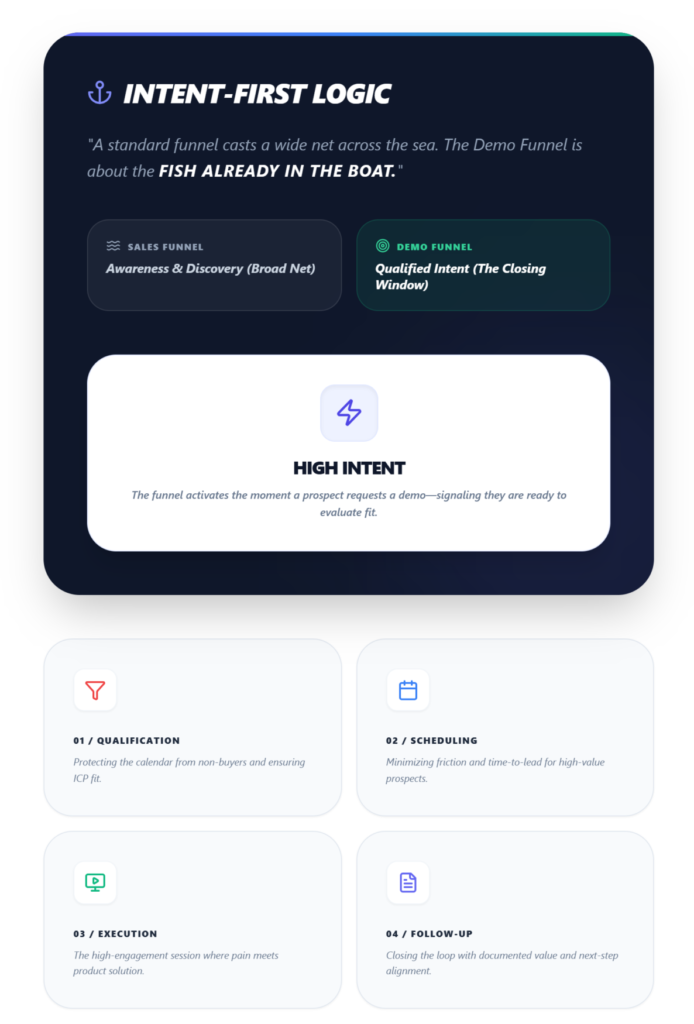
A SaaS demo conversion funnel is a focused conversion system that starts when a prospect signals high intent (requesting or booking a demo) and ends when that prospect either closes or drops off.
It governs qualification, scheduling, demo execution, and post-demo follow-through.
The difference matters: one casts a wide net, the other closes the fish already in the boat.
Key Differences Between SaaS Demo Funnel and Sales Funnel
To build a high-performing SaaS demo process, you must understand the explicit differences between these two systems.
- The Sales Funnel
Scope: Full journey (awareness → purchase).
Driver: Volume-driven. Marketing-led nurturing combined with sales outreach.
Focus: Marketing-heavy. - The Demo Funnel
Scope: Conversion stage (demo → deal).
Driver: Conversion-driven. Turns high-intent demo requests into closed deals.
Focus: Execution-heavy.
Why Demo Funnels Matter More Than Ever in SaaS
The SaaS landscape is evolving rapidly, and treating a demo as just another “meeting” is a critical failure.
- Rising CAC: Customer acquisition costs are at an all-time high. Wasting expensive leads on a leaky, unstructured demo process destroys your margins.
- Need for Better Conversion: You cannot out-market a terrible closing rate. Optimizing your demo stage yields the highest direct ROI in your entire pipeline.
- Demo as the Decision Stage: Buyers do their own research today. By the time they request a demo, they aren’t looking for a brochure—they are making a buying decision.
Most SaaS Teams Optimize the Wrong Funnel
Here’s what I see over and over: a SaaS team hits a revenue plateau. The knee-jerk reaction? “We need more leads.”
So they increase ad spend, launch new content campaigns, hire another SDR.
Nobody asks the uncomfortable question: What’s happening to the leads we already have?
The biggest revenue leaks don’t happen at the top of the funnel — they happen after the demo. A prospect books a call. They show up (maybe). The AE runs a generic walkthrough.
The prospect says, “Looks great, send me some info.” Then nothing. No structured next step. No urgency mechanism.
More leads don’t fix conversion problems. They just make the leaky bucket bigger.
What Most Teams Get Wrong About Funnels
1. Treating Demos as Just Another Funnel Step
Most teams slot “demo” into their CRM pipeline like it’s a checkbox between “qualified” and “proposal sent.”
It’s not a step — it’s the highest-stakes moment in the entire buyer journey. When you treat it as administrative, you lose the emotional momentum that drives deals forward.
Impact: demo-to-close rates drop below 15%, and nobody can explain why.
2. No Demo-to-Close System
There’s a lead scoring system. A nurture sequence. An outbound cadence. But what happens between “demo completed” and “deal closed”?
Usually: improvisation. No standardized follow-up timeline. No mutual action plan. No defined ownership of next steps.
The result is a post-demo drop-off that silently kills 40–60% of qualified opportunities.
3. Focusing Only on Lead Volume
This is the most expensive mistake in SaaS. Teams celebrate hitting MQL targets while win rates quietly erode.
Volume feels productive. But if your demo conversion rate is 12% and you double your leads, you’ve doubled your cost to acquire the same underwhelming number of deals.
The math doesn’t lie — conversion leverage beats volume leverage every time.
4. Ignoring Post-Demo Drop-Offs
Here’s a stat that should concern every revenue leader: 35–50% of demos that “go well” never convert.
Not because the product failed. Because the follow-up did. No recap email within the hour. No clear next step locked in before the call ended.
The prospect walks away impressed — and then gets busy with everything else.
5. No Clear Ownership After the Demo
In many SaaS orgs, the handoff between “demo delivered” and “deal managed” is a black hole. The AE assumes the SDR is following up.
Marketing thinks their job ended at the booking. Nobody owns the post-demo conversion window.
This is the exact 24–72 hour window where deal momentum either compounds or collapses entirely.
The 5-Stage SaaS Demo Funnel Framework
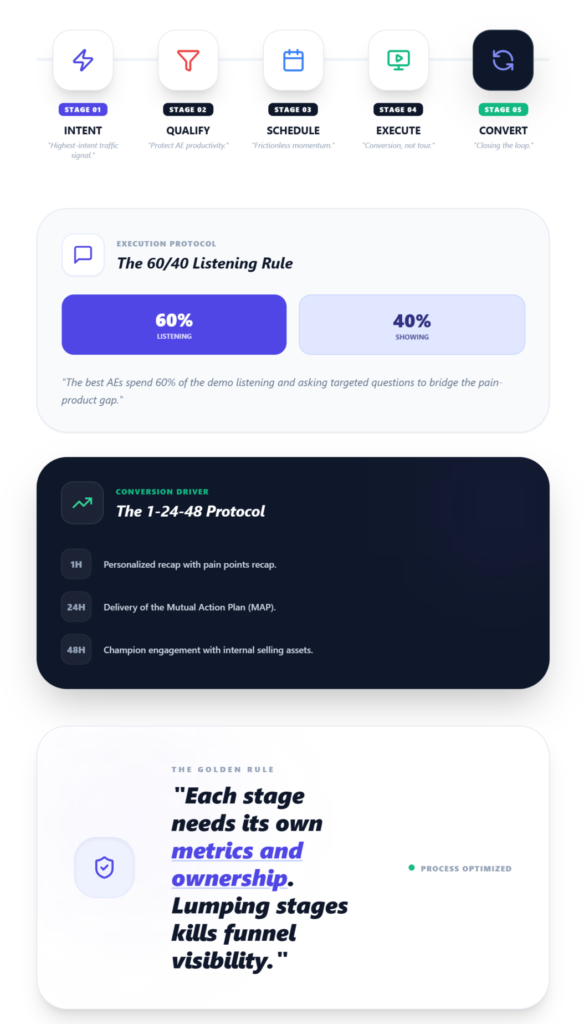
This is the system that separates teams closing at 30%+ from teams stuck at 12%. Understanding your demo funnel stages is critical. Each stage needs its own metrics, ownership, and tooling.
Stage 1: Demo Intent
The moment a prospect signals they want to see the product — through a CTA click, a “book a demo” form, or a direct request.
This is your highest-intent traffic. Measure it separately from general leads. If you’re lumping demo requests with ebook downloads, you’ve already lost clarity.
Stage 2: Qualification
Not every demo request deserves a live walkthrough. Pre-qualify based on ICP fit, company size, use case, and urgency.
This protects your AEs’ time and ensures the prospects who do get demos are genuinely closable. A 5-question intake form or a short discovery call works here.
Stage 3: Scheduling
Friction kills momentum. If a qualified prospect has to wait 4 days and exchange 6 emails to book a demo, you’ve handed them to a competitor.
Use instant scheduling, reduce time-to-demo below 48 hours, and send confirmation sequences that reduce no-shows with value-driven reminders.
Stage 4: Demo Execution
This isn’t a product tour. It’s a conversion event. Structure demos around the prospect’s stated pain points, not your feature list.
The best AEs spend 60% of the demo listening and asking questions, 40% showing targeted functionality. End every demo with a locked-in next step — not “I’ll send you some info.”
Stage 5: Post-Demo Conversion
The most neglected stage and the most valuable. Within 1 hour: send a personalized recap. Within 24 hours: deliver a mutual action plan.
This is where a structured demo follow-up separates your pipeline from actual revenue.
How the Demo Funnel Fits Inside the Sales Funnel
Think of it this way:
The sales funnel is the full highway — awareness campaigns, content marketing, outbound prospecting, lead nurturing. It brings people to the door.
The demo conversion funnel is the room where the deal actually happens. It starts at the door and ends at the close.
The sales funnel feeds the demo pipeline. But the demo funnel has its own rules, its own metrics, and its own failure modes.
Most teams build the highway and forget to build the room. They wonder why traffic comes in and revenue doesn’t come out.
Where SaaS Teams Lose Conversions
Before the demo:
- Poor qualification lets unfit prospects consume AE time
- Slow scheduling creates a 3–5 day gap where intent decays
- No pre-demo engagement means prospects show up cold
During the demo:
- Generic, feature-dump presentations that don’t address specific pain
- No discovery questions — just a monologue with screen sharing
- Ending without a concrete, time-bound next step
After the demo:
- No follow-up within the first hour (48% of teams wait over 24 hours)
- No champion enablement — the prospect can’t sell internally
- No system to track post-demo engagement or re-engage ghosted prospects
The Core Issue: Most of these issues exist because demo workflows are manual, unstructured, and not built for conversion.
When Should You Focus on Your Demo Funnel?
It’s time to shift your attention from top-of-funnel lead generation to your demo pipeline if:
- Your demo-to-close rate is consistently below 20%.
- Demos are happening frequently, but deals aren’t closing.
- Post-demo follow-ups are inconsistent or entirely manual.
If you’re seeing these signs, more leads won’t fix the problem. You need to identify your demo funnel gaps and optimize the SaaS demo process.
Diagnose Your Pipeline: Demo Funnel Decision Flow
Use this step-by-step decision tree to identify exactly where your revenue is leaking and how to fix it:
Step 1: Identify the Drop-Off Stage
Where are prospects stalling: Before, During, or After the demo?
Step 2: If Before the Demo (Pre-Demo)
Are no-show rates above 20% or is scheduling taking days?
👉 Implement instant booking and value-driven email reminders.
Step 3: If During the Demo (Execution)
Are prospects disengaging or giving generic “looks good” feedback?
👉 Stop feature-dumping; switch to pain-point discovery and lock in next steps on the call.
Step 4: If After the Demo (Post-Demo)
Are deals going cold despite positive verbal feedback?
👉 Send a recap within 1 hour and a mutual action plan within 24 hours.
Step 5: Final Action
👉 Based on the diagnosis:
- Automate the broken stage
- Track demo-to-close metrics, not just MQLs
How to Fix Your SaaS Demo Funnel
1. Define qualification criteria before anyone books a demo.
Use ICP scoring and a short intake form. Protect your AEs’ calendars for prospects who can actually buy.
2. Reduce scheduling friction to near-zero.
Embed calendar links directly in CTAs. Target less than 48 hours from request to live demo.
3. Structure every demo around the prospect’s pain, not your features.
Build 3–4 demo templates mapped to common use cases. Train AEs to diagnose before they prescribe.
4. Enforce a locked-in next step before the demo ends.
No demo should end with “let’s circle back.” Book the follow-up call on the demo call.
5. Automate the first 48 hours of post-demo follow-up.
Recap email within 60 minutes. Mutual action plan within 24 hours. Champion deck within 48 hours. This sequence should be systematized, not left to individual AE discipline.
Why Tools Built for Demo Funnels Matter
Most CRMs are pipeline management tools. They track where a deal is. They don’t optimize how that deal moves through the demo stage.
You can log a “demo completed” status in your CRM. But it won’t tell you if the prospect engaged, what questions they asked, or how fast the follow-up went out.
If your team runs more than 20 demos per month and your close rate is below 25%, the gap isn’t in your pipeline tool. It’s in your demo system.
Frequently Asked Questions
What is a SaaS demo funnel?
A SaaS demo funnel is a conversion-focused system that manages every stage from demo intent through post-demo follow-up. It’s designed to convert high-intent prospects into closed deals, not just track them.
What is the difference between a demo funnel and a sales funnel?
A sales funnel covers the full buyer journey from awareness to purchase. A demo funnel focuses specifically on converting prospects who’ve already requested a demo — a narrower, higher-intent, higher-leverage segment.
Why do SaaS demos fail to convert?
Most SaaS demos fail because of poor qualification, generic presentations, and weak post-demo follow-up — not because of the product. The conversion system around the demo matters more than the demo itself.
What is a good demo conversion rate?
A healthy SaaS demo-to-close rate ranges from 20–35%, depending on deal size and sales cycle. If you’re below 20%, the issue is almost always in demo execution or post-demo systems, not lead quality.
How do I reduce demo no-shows?
Send value-driven confirmation sequences, reduce time between booking and demo, and include a short pre-demo questionnaire that creates commitment. Teams that implement these see no-show rates drop by 30–50%.
Conclusion: Stop Ignoring the Middle of the Funnel
The sales funnel brings leads. The demo funnel converts them. Both matter — but only one is consistently ignored.
Most SaaS teams focus on the wrong metric. MQLs feel productive, but demo conversion rates tell the absolute truth. More leads don’t fix conversion problems. A better SaaS demo process does.
The real issue starts after the demo — and that’s exactly where most teams stop paying attention. Fix the demo funnel first. Then scale the top. That order matters more than most revenue teams realize.
Start Converting the Leads You Already Have
LevelUp Demo builds the missing structure around your demo workflow. Qualify leads automatically, enforce airtight post-demo follow-ups, and stop losing deals to internal chaos.
✅ Increase Deal Velocity
✅ Track Post-Demo Drop-Offs
✅ Automate Follow-Ups