
I still remember the Tuesday morning when I realized I’d been doing sales completely backwards.
I was working with a small SaaS startup—just me and two other people juggling everything from product development to customer calls. We’d just gotten 47 demo requests in a single week after a product launch, and I was thrilled. Finally, some traction! I spent the next three weeks running myself ragged, scheduling calls at all hours, customizing presentations, following up religiously.
The result? Two closed deals. Two.
The painful truth hit me during a particularly awkward demo with someone who didn’t have budget, didn’t have authority to buy, and honestly didn’t even have a problem our product solved. They just thought our landing page looked cool and wanted to “explore options.” I’d spent four hours preparing for that call.
That’s when I learned what every successful sales team already knows: not all sales leads are created equal, and treating them like they are will burn you out faster than you can say “conversion rate.”
If you’re a SaaS founder juggling a million things, or running a small sales team where every hour counts, this guide is for you. I’m going to walk you through everything I wish someone had told me about lead qualification—the frameworks that actually work, the mistakes that waste time, and the practical systems that help you focus on leads who are ready to buy.
By the end, you’ll know exactly how to separate tire-kickers from serious buyers, build a qualification process that fits your startup’s reality, and stop losing deals because of messy follow-ups or poor prioritization.
Let’s dig in.
So, What Exactly Is Lead Qualification?
Lead qualification is the process of figuring out which potential customers are actually worth your time—meaning they have a real need for what you’re selling, the ability to buy it, and the authority to make it happen.
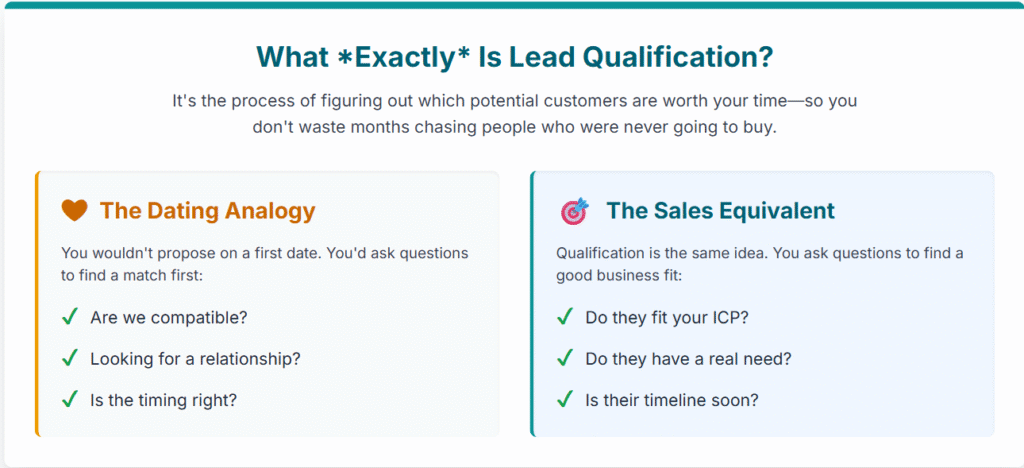
Think of it like dating. You wouldn’t propose marriage to everyone you meet at a coffee shop, right? You’d probably want to know if you’re compatible first, if they’re looking for a relationship, if the timing makes sense. Lead qualification is the same idea applied to sales—it’s about identifying which leads are genuinely interested and capable of becoming customers, so you don’t waste months chasing people who were never going to buy.
Here’s the thing that surprised me: good lead qualification actually makes your sales process faster, not slower. It feels counterintuitive—like you’re adding extra steps—but what you’re really doing is cutting out all the dead-end conversations that go nowhere. According to Salesforce research, companies with strong lead qualification processes reduce their sales cycle length by up to 30%.
How to qualify sales leads?
In real life, lead qualification happens in layers. It’s not a single yes-or-no checkpoint.
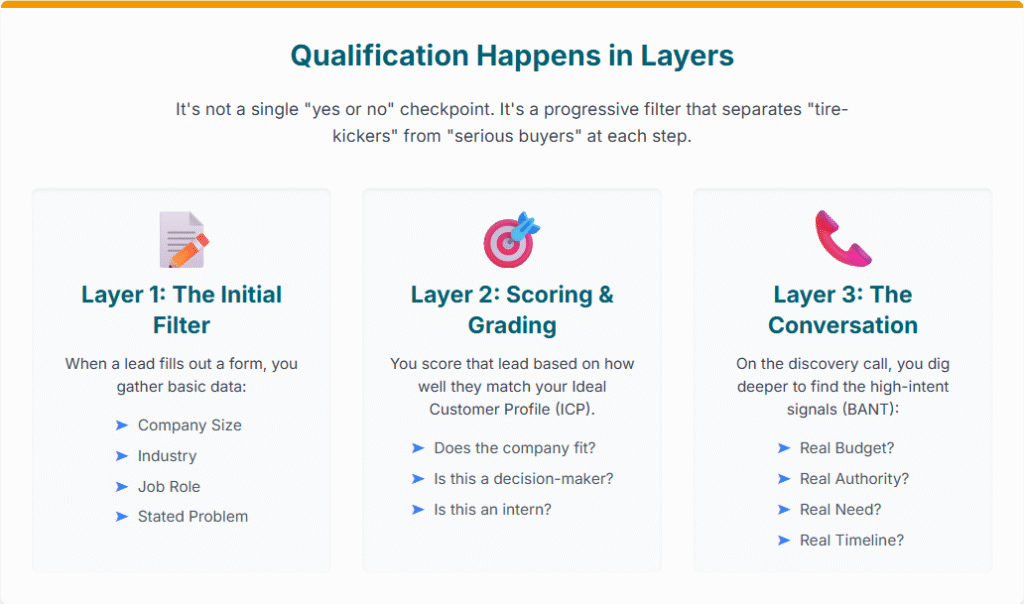
First layer: Someone fills out a form on your website or reaches out through LinkedIn. Right away, you’re gathering basic data—company size, industry, their role, what problem they’re trying to solve. This is your initial filter.
Second layer: You score or grade that lead based on how well they match your ideal customer profile (ICP). Does their company size fit? Are they in an industry you serve well? Is the person reaching out a decision-maker or an intern doing research for a class project? (Yes, that’s happened to me.)
Third layer: You have an actual conversation—maybe a discovery call or initial demo—where you dig deeper. Do they have budget? What’s their timeline? Who else needs to be involved in the decision? This is where you move from “this might be a fit” to “this is definitely worth pursuing” or “let’s deprioritize this.”
The key is having a system. When I was winging it, I’d get excited about any lead who seemed enthusiastic and end up chasing people who were three years away from buying. Once I built a simple scoring framework (more on that in a minute), I could look at my pipeline and immediately know where to focus my energy.
What Are the Main Benefits and Drawbacks of Lead Qualification?
Benefits:
- You stop wasting time on bad-fit leads. Seriously, this alone changed everything for me. Instead of spending 20 hours a week on demos that went nowhere, I spent 10 hours on demos that actually converted.
- Your conversion rates go up. When you’re only pursuing qualified leads, a much higher percentage of them close. My team went from a 4% demo-to-close rate to over 18% in six months just by getting better at qualification.
- Your sales team stays motivated. Nothing kills morale like endless rejection. When your team knows they’re talking to real prospects, wins come more often and everyone stays energized.
- You can forecast revenue more accurately. If you know that 20% of qualified leads close within 60 days, you can actually plan your business instead of guessing.
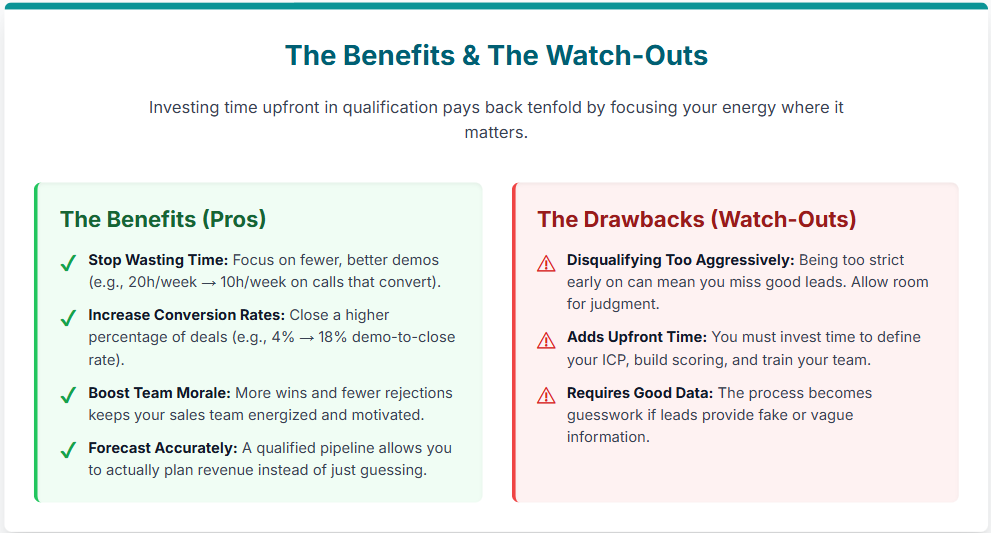
Drawbacks (or rather, things to watch out for):
- You might disqualify too aggressively early on. I’ve made this mistake—being so strict about criteria that we passed on leads who turned out to be great customers. Your qualification framework needs room for judgment calls.
- It adds time upfront. Yes, you need to invest energy in defining your ICP, building scoring systems, and training your team. But trust me, it pays back tenfold.
- You need good data. If leads are filling out forms with fake emails or vague information, qualification becomes guesswork. You need clean, accurate data to make this work.
The bottom line? The benefits massively outweigh the drawbacks, especially for small teams where every hour counts.
When Should You Start Using a Lead Qualification Process?
Honestly? As soon as you start getting inbound leads.
I know some founders think, “I’m too early-stage for this” or “I need to talk to everyone to learn about my market.” And look, there’s truth to that when you’re in discovery mode, validating your product-market fit. But once you know who your ideal customer is—even roughly—you should be qualifying.
Here’s when lead qualification becomes non-negotiable:
- You’re getting more demo requests than you can handle. If you’re turning down calls or scheduling them three weeks out, you need to prioritize better.
- Your close rate is below 10%. That’s a sign you’re spending time on the wrong leads.
- You have multiple people handling sales. Without qualification, everyone develops their own criteria and your pipeline becomes chaos.
- You’re losing track of follow-ups. If leads are slipping through the cracks because you can’t remember who’s hot and who’s lukewarm, you need a system.
Even if you’re a solo founder, a simple qualification checklist takes 10 minutes to create and will save you hours every week.
Why Lead Qualification Matters More Than You Think
Let me paint you a picture of what happens without lead qualification.
Your marketing team (or your late-night content creation efforts) starts working. Traffic goes up. Form submissions roll in. You’re excited—finally, some momentum! So you start reaching out to everyone. You schedule demos with anyone who’ll take a call.
But here’s what actually happens: You spend an hour prepping for a demo with a company that has 10 employees when your product is built for 100+. You have a great conversation with someone who loves your solution but has zero budget for the next 18 months. You do three follow-up calls with a VP who seems interested but can never seem to get their CEO on a call to actually make a decision.
Meanwhile, that perfect-fit customer who submitted a form two weeks ago? The one with budget, authority, and an urgent need? They got tired of waiting and went with a competitor.
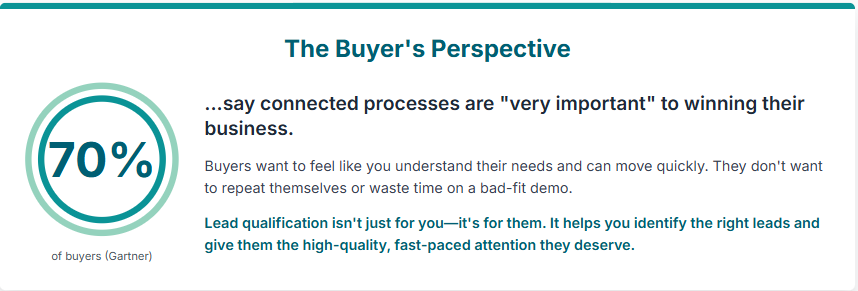
This is why 70% of buyers say connected processes are very important to winning their business, according to Gartner research. They want to feel like you understand their needs and can move quickly. Lead qualification lets you do exactly that—it helps you identify the right leads and give them the attention they deserve, while politely deprioritizing the ones who aren’t ready.
The Real Cost of Poor Lead Qualification
Let’s talk numbers for a second. According to HubSpot, sales reps spend only 35% of their time actually selling. The rest? Administrative tasks, research, scheduling, and follow-up. For a small sales team, that’s brutal.
Now imagine if half the leads you’re spending time on are never going to close. You’re not just wasting that time—you’re also missing out on the revenue you could have generated by focusing on better-fit prospects.
I saw this firsthand. Before implementing qualification, my team was running about 30 demos a month and closing 1-2 deals. After we got serious about qualification, we dropped to 18 demos a month but closed 4-5 deals. Same team, same product, better focus.
Understanding the Core Lead Qualification Criteria
Alright, let’s get into the frameworks. There are a bunch of acronyms floating around—BANT, CHAMP, MEDDIC, GPCT—and honestly, they all cover similar ground. Don’t get hung up on which one is “best.” What matters is understanding the core questions you need to answer about every lead.
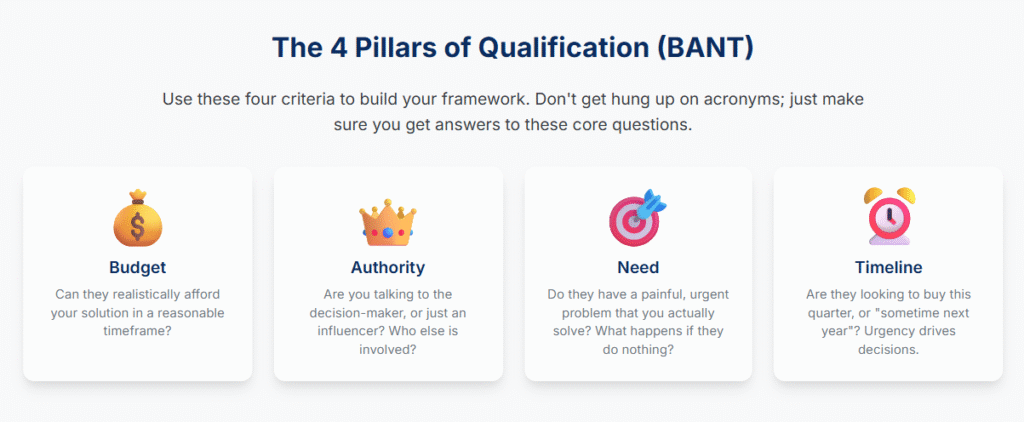
Budget: Can They Actually Afford You?
This one seems obvious, but you’d be surprised how many founders avoid asking about budget because it feels awkward. Get over it. You’re not being pushy—you’re being respectful of everyone’s time.
What to ask:
- “What budget have you set aside for solving this problem?”
- “What are you currently spending on [related solution]?”
- “Have you gotten approval to invest in a new tool, or is that something you’d need to secure?”
Here’s the thing: if someone says they have no budget, that doesn’t automatically disqualify them. Maybe they have budget but don’t want to share specifics yet (fair). Maybe they need to build a business case first, and your demo will help them do that.
What you’re really listening for is whether budget is a realistic possibility in a reasonable timeframe. If someone says, “We might have budget next fiscal year, which starts in 11 months,” that’s a signal to nurture, not actively pursue.
Authority: Can This Person Actually Say Yes?
This is where I got burned repeatedly in my early days. I’d have amazing conversations with enthusiastic users or junior managers who absolutely loved our product. We’d get to the end of the demo and they’d say, “Great! Let me run this by my boss.” Then… crickets.
Key questions:
- “Who else will be involved in this decision?”
- “What does your decision-making process typically look like for new software?”
- “Have you purchased similar tools before? How did that go?”
Don’t just ask who the decision-maker is and call it a day. You need to understand the entire buying committee. In B2B SaaS, there’s often a user who champions the product, a manager who needs to approve it, a finance person who controls budget, and sometimes IT or security who have veto power.
The best approach I’ve found: try to get the actual decision-maker on the call, even if it’s just for 15 minutes. If the person you’re talking to says, “My VP would need to approve this,” respond with, “Great! Can we get them on a quick call this week so I can address any questions they might have?”
Need: Do They Have a Problem You Can Solve?
This sounds basic, but it’s where a lot of qualification falls apart. Someone might think they need your product because it sounds cool, but that’s different from having a genuine, painful problem that your solution addresses.
What you’re digging for:
- What’s the current impact of this problem? (Time wasted, revenue lost, customer churn, etc.)
- What happens if they don’t solve it?
- What have they tried already?
- How urgent is this for them?
I love asking, “What happens if you don’t solve this in the next six months?” If they shrug and say, “Eh, we’ll keep doing what we’re doing,” that’s not a real need. If they say, “We’ll probably lose two more team members to burnout and miss our Q3 targets,” now we’re talking.
Real need creates urgency. Urgency drives decisions.
Timeline: When Are They Actually Going to Buy?
Someone can have budget, authority, and need, but if they’re not planning to make a decision for a year, they’re not a qualified lead right now. They’re a future opportunity.
Questions to ask:
- “When are you hoping to have a solution in place?”
- “What’s driving that timeline?”
- “Is there anything that would cause you to move faster or slower?”
Pay attention to external drivers. If they say, “Our current contract ends in 60 days and we’re evaluating alternatives,” that’s a strong timeline signal. If they say, “We’re just exploring options for now,” that’s code for “I’m not buying anytime soon.”
Here’s a pro tip: create different tracks in your CRM for different timeline segments. “Active” for people buying in the next 30-60 days, “Nurture” for 60-180 days, “Long-term” for beyond that. This helps you prioritize follow-ups appropriately.
Lead Source: Where Did They Come From?
Not all lead sources are created equal. In my experience, leads from referrals or existing customer introductions close at 3-4x the rate of cold inbound form fills. Leads who attended a webinar or downloaded a detailed resource tend to be more educated and closer to buying than someone who just stumbled on your site.
Track this stuff:
- Referral source (highest intent)
- Direct outreach to you or your team (high intent)
- Content download or webinar attendance (medium-high intent)
- Organic search or social media (medium intent)
- Paid ads (varies widely)
Use lead source as a scoring factor. A referral from an existing customer should get immediate attention. A random website visitor who filled out a form with a personal Gmail address? Lower priority until you validate fit.
Building Your Ideal Customer Profile (ICP)
Before you can qualify leads, you need to know what “qualified” looks like. That’s where your Ideal Customer Profile comes in.
Your ICP is not the same as a buyer persona. A persona describes who makes buying decisions (their role, goals, challenges). An ICP describes the characteristics of companies that are the best fit for your product.
How to Define Your ICP as a Startup
If you’re early-stage and don’t have a ton of customers yet, start with your hypotheses and refine as you go. But if you have even 10-20 customers, look for patterns.
Firmographic data to consider:
- Company size (number of employees)
- Industry or vertical
- Revenue range
- Geographic location
- Funding stage (for selling to other startups)
- Technology stack (what tools are they already using?)
Behavioral signals:
- How do they typically buy software? (Bottom-up adoption vs. top-down procurement)
- How long is their sales cycle usually?
- What problems are they actively trying to solve right now?
I remember doing this exercise with a client who sold project management software. They assumed their ICP was “any company with remote teams.” But when we dug into their best customers, we found a pattern: mid-sized creative agencies (20-100 people) with multiple client projects running simultaneously. That specificity changed everything about how they qualified leads.
Using Product Usage Data for SaaS
If you have a free trial or freemium model, you’re sitting on a goldmine of qualification data. This is called Product-Qualified Lead (PQL) scoring, and it’s incredibly powerful.
Track things like:
- Did they complete onboarding?
- How many times have they logged in?
- What features are they using?
- Have they invited team members?
- Did they hit any “aha moments” in your product?
For example, if you know that customers who invite three or more team members during their trial convert at 40%, but those who don’t convert at only 5%, that’s a huge qualification signal. A lead who invites their whole team is way more qualified than one who logged in once and disappeared.
At Levelup Demo, we see this all the time—when a founder sets up their demo form and immediately logs three demo requests, we know they’re serious. They’re not kicking tires; they have an active pipeline and need help managing it.
Lead Scoring and Grading: Making Qualification Scalable
Once you know your ICP and qualification criteria, you need a system to score leads consistently. Otherwise, every salesperson (or your sleep-deprived founder brain at 11 PM) will make up their own criteria.
How Lead Scoring Works
Lead scoring assigns point values to different attributes and behaviors. It sounds complicated, but it’s actually pretty straightforward.
Example scoring model:
Fit criteria (max 50 points):
- Company size matches ICP: +20 points
- Industry matches ICP: +15 points
- Geographic location in target market: +10 points
- Job title is decision-maker level: +15 points
- Using tech stack we integrate with: +10 points
Behavioral signals (max 50 points):
- Attended a webinar: +10 points
- Downloaded multiple resources: +10 points
- Visited pricing page: +15 points
- Requested a demo: +20 points
- Engaged with email sequence: +5 points
A lead with 70+ points is “hot” and gets immediate attention. 40-69 is “warm” and gets scheduled within a week. Below 40 goes into nurture campaigns.
Lead Grading: The Letter-Grade Approach
Some teams prefer letter grades (A/B/C/D) instead of numbers. Same concept, different visualization.
- A leads: Perfect fit, high intent, ready to buy soon
- B leads: Good fit, some interest, might need nurturing
- C leads: Partial fit or low intent, long-term nurture
- D leads: Poor fit, disqualify or archive
The beauty of grading is it forces prioritization. Your A leads get white-glove treatment. Your C and D leads get automated nurture emails or get archived entirely.
I’m a fan of combining both—score for granularity, grade for quick decision-making. Your CRM can auto-assign grades based on score ranges.
Don’t Overcomplicate It
Here’s where a lot of startups go wrong: they build incredibly complex scoring models with 47 different factors and weighted algorithms. Then nobody uses it because it’s too confusing.
Start simple. Pick 5-7 factors that actually matter for your business. Test for a month. Refine. Add complexity only when you need it.
The Lead Qualification Process: Step by Step
Alright, let’s walk through what this looks like in practice, from the moment a lead enters your world to the moment you decide to pursue or pass.
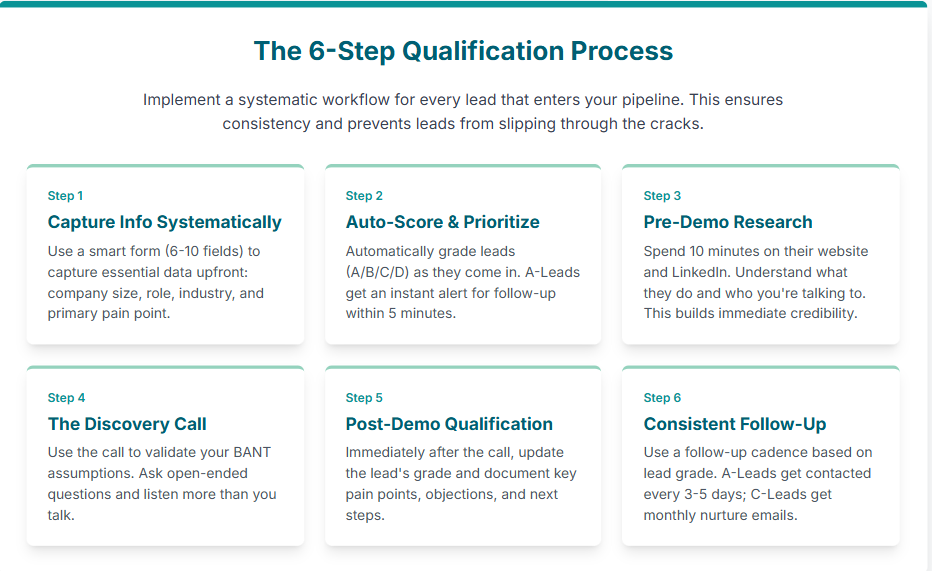
Step 1: Capture Lead Information Systematically
This starts with your demo request form or contact form. Don’t just ask for name and email—that tells you nothing about fit.
Essential fields to include:
- Full name
- Work email (not personal)
- Company name
- Company size
- Industry
- Job title/role
- What problem are they trying to solve?
- Timeline (when do they need a solution?)
Yes, longer forms reduce conversion rates slightly. But would you rather have 100 unqualified leads or 60 qualified ones? Quality over quantity, always.
If you’re using Levelup Demo’s smart demo form, it automatically captures this info and logs it directly into your dashboard—no manual data entry, no leads slipping through the cracks.
Step 2: Auto-Score and Prioritize
As soon as that form comes in, your system should be scoring it automatically based on the criteria you’ve defined. This happens in seconds and gives you an instant read on priority.
High-score lead? Get an immediate notification. Follow up within 5 minutes if possible. Research shows leads contacted within 5 minutes are 9x more likely to convert than those contacted after 30 minutes.
Medium-score lead? Schedule follow-up within 24 hours.
Low-score lead? Add to nurture campaign; revisit in 30-60 days.
This is where having a lightweight tool makes a huge difference. You don’t need Salesforce’s enterprise edition for this—you just need something that can capture, score, and alert you appropriately.
Step 3: Pre-Demo Research
Before you hop on a call, spend 10 minutes doing research. Look at:
- Their company website (what do they do?)
- Their LinkedIn (who are the key people?)
- Recent news (funding, product launches, expansions?)
- Any content they’ve engaged with (what are they interested in?)
This isn’t stalking—it’s preparation. And it makes a massive difference on the call. When you can say, “I saw you just raised a Series A—congrats! I imagine that’s creating some growing pains around [relevant problem],” you immediately establish credibility.
Step 4: The Discovery Call or Demo
This is where qualification gets real. You’ve got someone on the phone; now you need to validate (or invalidate) your initial scoring.
Structure I recommend:
- Intro and agenda (2 minutes)
-
- “Thanks for taking the time. I want to make sure this is valuable for you, so I’d love to start by understanding your situation, then I’ll show you how we might help, and we’ll leave time for questions. Sound good?”
- Discovery questions (10-15 minutes)
-
- Walk through your BANT criteria conversationally
- Ask open-ended questions and really listen
- Take notes on pain points and priorities
- Tailored demo (15-20 minutes)
-
- Show only the features relevant to their needs
- Connect each feature back to their specific pain points
- Use their language and examples when possible
- Next steps discussion (5-10 minutes)
-
- “Based on what we’ve talked about, does this feel like a fit?”
- “What questions do you still have?”
- “What would need to happen for you to move forward?”
- Schedule a specific follow-up or next meeting before you hang up
Red flags to watch for:
- Vague answers about budget or timeline
- Inability to articulate the problem clearly
- Decision-maker not willing to join calls
- Constantly rescheduling or going silent after initial enthusiasm
Step 5: Post-Demo Qualification and Scoring
After the call, update your lead score based on what you learned. Maybe they seemed like an A lead on paper but revealed they have no budget for 18 months—downgrade to C. Or maybe they were a B lead but you discovered an urgent need and the CEO wants to meet next week—upgrade to A.
Document everything:
- Key pain points discussed
- Objections or concerns raised
- Decision-makers identified
- Next steps agreed upon
- Your gut feel on likelihood to close
This is where tools like Levelup Demo shine—you can log demo outcomes (Won, Lost, In Follow-up, Pending) and track everything in one place instead of scattered across email, calendar, and spreadsheets.
Step 6: Ongoing Follow-Up and Re-Qualification
Here’s the part most teams drop the ball on: consistent follow-up. A lead who wasn’t ready to buy three months ago might be ready now. But if you’re not staying in touch, you’ll never know.
Create a follow-up cadence based on lead grade:
- A leads: Touch base every 3-5 days until closed or disqualified
- B leads: Weekly check-ins for a month, then bi-weekly
- C leads: Monthly nurture emails with valuable content
- D leads: Quarterly “just checking in” or remove from active pipeline
Use a system to track this. Set reminders. Use automated sequences where appropriate. But don’t let qualified leads go cold because you got busy.
Common Lead Qualification Mistakes (And How to Avoid Them)
I’ve made every mistake in the book, so let me save you some pain.
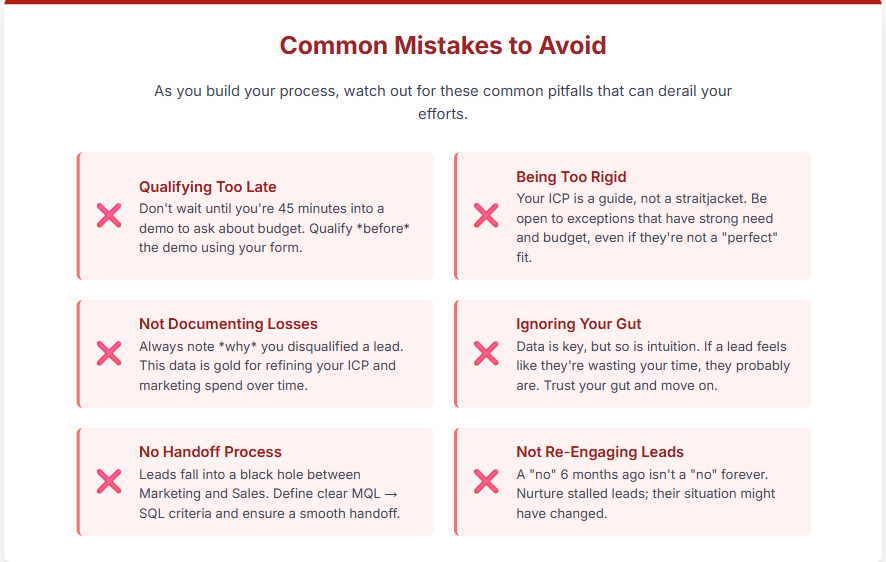
Mistake #1: Qualifying Too Late in the Process
I used to let anyone book a demo, then try to qualify them on the call. This meant I’d spend 45 minutes with someone before realizing they were a terrible fit.
Fix: Qualify before the demo. Use your form to filter. If someone doesn’t meet basic criteria, offer a resource instead of a live demo, or route them to a recorded demo.
Mistake #2: Being Too Rigid with Criteria
Early on, I’d disqualify anyone who didn’t check every box perfectly. I missed some great customers who didn’t fit my narrow definition but had real need and budget.
Fix: Use qualification as a guide, not a straitjacket. If someone’s company is smaller than your ICP but they’re willing to pay your full price and are a design partner for a new feature, that might be worth it.
Mistake #3: Not Documenting Why You Disqualified
I’d mark leads as “not a fit” and move on. Six months later, I’d have no idea why I passed on them, and I couldn’t learn from patterns.
Fix: Always note the disqualification reason. “No budget,” “wrong industry,” “not the decision-maker and can’t access them,” whatever. This data helps you refine your ICP and scoring over time.
Mistake #4: Ignoring Gut Feel
Data and frameworks are great, but sometimes you just know a deal isn’t going to happen. Maybe the person’s body language is off, or they keep deflecting questions, or something just feels wrong.
Fix: Trust your instincts, especially after you’ve done this for a while. If your gut says “this isn’t going anywhere,” it’s probably right. Document why you feel that way and move on.
Mistake #5: No Handoff Process Between Marketing and Sales
This is huge for teams with multiple people. Marketing generates leads, sales qualifies them, but there’s no clear process for the handoff. Leads fall into a black hole.
Fix: Define clear lead stages (MQL → SQL → Opportunity → Customer) and what criteria move a lead from one stage to the next. Have a weekly sync between marketing and sales to review lead quality and adjust campaigns.
Mistake #6: Not Re-Engaging Lost or Stalled Leads
Just because someone wasn’t ready six months ago doesn’t mean they’re not ready now. I used to just let leads go cold and never circle back.
Fix: Build a re-engagement campaign. Every 90 days, reach out to stalled leads with something valuable—a new feature announcement, a case study, an industry report. You’d be surprised how many come back to life.
Tools and Systems to Make Qualification Easier
You don’t need a massive tech stack to qualify leads well, but the right tools make a huge difference.
CRM Basics
At minimum, you need a system to:
- Capture lead information
- Score and tag leads
- Track interactions and notes
- Set follow-up reminders
- Report on pipeline status
For early-stage startups, even a well-organized spreadsheet can work temporarily. But as soon as you have more than one person touching leads, you need a real CRM.
Demo Scheduling and Management
This is where a lot of SaaS teams struggle. You’re juggling calendar links, follow-up emails, demo notes, and outcome tracking across multiple tools.
Levelup Demo was literally built to solve this problem. It’s a lightweight tool that:
- Replaces your “Request a Demo” form and auto-logs leads
- Lets you qualify and prioritize instantly
- Handles demo scheduling with calendar integration
- Tracks demo outcomes (Won/Lost/Follow-up/Pending)
- Gives you a clean follow-up view so nothing slips through
- Shows analytics on your demo funnel in one dashboard
it works alongside whatever you’re using. But it fills the gap that most CRMs don’t: managing your entire demo workflow from request to close.
Automation and Sequences
Tools like Zapier or LevelUp Demo let you connect your form to your CRM, trigger notifications, and automate lead routing. Email sequence tools (Mailchimp, Customer.io, Outreach) help with nurture campaigns.
Start simple: one Zap that sends you a Slack notification when a high-score lead comes in. Build from there.
Lead Qualification for Small Teams and Solo Founders
Everything I’ve talked about so far applies regardless of team size, but let’s address the unique challenges when you’re doing this alone or with just 1-2 other people.
Prioritization is Everything
When you’re wearing 15 hats, you literally cannot afford to waste time on bad leads. Your qualification bar might need to be higher than a team with dedicated SDRs.
My rule when I was solo: I only took calls with A-grade leads. Everyone else got routed to a recorded demo or a nurture email sequence. It felt harsh at first, but it meant I could actually close deals instead of being stuck in endless unproductive calls.
Automate Ruthlessly
Every manual step is a place where leads can fall through the cracks when you’re juggling too much.
Automate:
- Lead capture and scoring
- Demo scheduling (calendar links, not back-and-forth emails)
- Follow-up reminders
- Nurture email sequences
- Outcome tracking
Spend a weekend setting this up properly, and you’ll save 5-10 hours every single week.
Build Accountability Systems
When you’re solo, there’s no manager checking in on your pipeline. You need to create your own accountability.
What works for me:
- Weekly pipeline review every Friday (30 minutes)
- Daily “top 3 leads to follow up with” list
- Monthly analysis of win/loss reasons
- Quarterly ICP and scoring refinement
Put these on your calendar as non-negotiable appointments with yourself.
Advanced Lead Qualification Strategies
Once you’ve got the basics down, here are some next-level tactics.
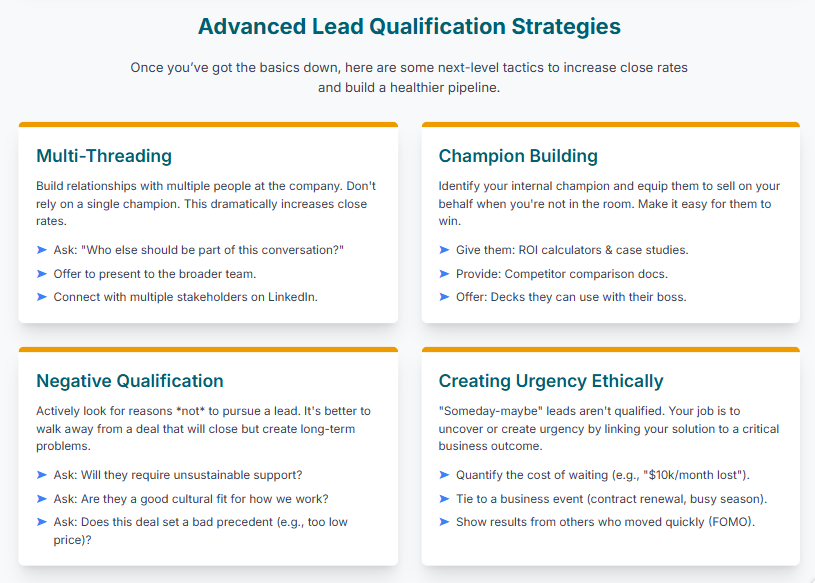
Multi-Threading
This means building relationships with multiple people at the same company, not just your initial contact. It dramatically increases close rates because you’re not dependent on a single champion.
How to do it:
- Ask your contact, “Who else should be part of this conversation?”
- Offer to present to the broader team
- Connect on LinkedIn with multiple stakeholders
- Send valuable content to the wider group, not just your main contact
Champion Building
Identify who your internal champion is (the person who really wants your solution) and actively equip them to sell it internally on your behalf.
Give them:
- ROI calculators showing the business case
- Case studies from similar companies
- Comparison docs addressing competitors
- Presentation decks they can use with their boss
- One-pagers summarizing key benefits
Your champion is doing your selling when you’re not in the room. Make it easy for them to win.
Negative Qualification
This is actively looking for reasons not to pursue a lead. It sounds backwards, but it’s incredibly valuable.
Ask yourself:
- Is this the type of customer who will be successful with our product?
- Will they require an unsustainable amount of support?
- Are they going to be a cultural fit for how we work?
- Is this deal going to set a bad precedent (too much customization, too low price, etc.)?
Sometimes the best decision is to walk away from a deal that will close but create problems down the road.
Creating Urgency Ethically
Qualified leads who sit in your pipeline forever aren’t qualified—they’re just “someday maybes.” Part of qualification is creating or uncovering urgency.
Tactics:
- Understand what business event would create urgency (contract renewal, busy season, new regulation, etc.)
- Quantify the cost of waiting (“If this problem is costing you $10k/month, that’s $60k over six months of evaluation”)
- Offer time-bound incentives (but don’t overdo it—desperation isn’t a good look)
- Create FOMO by mentioning other customers who moved quickly and saw results
The key word is ethically. Don’t manufacture fake urgency or pressure people. But do help them see the real cost of inaction.
Measuring Lead Qualification Success
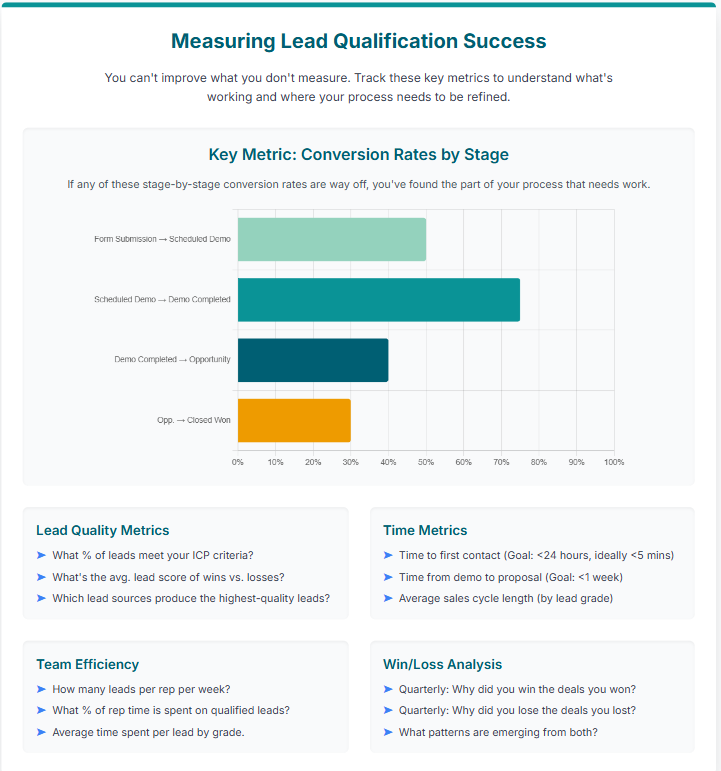
You can’t improve what you don’t measure. Here are the key metrics to track.
Conversion Rates by Stage
- Form submission → Scheduled demo: Should be 40-60% for qualified leads
- Scheduled demo → Demo completed: Should be 70-80% (no-shows are normal)
- Demo completed → Opportunity: Should be 30-50%
- Opportunity → Closed won: Should be 20-40%
If any of these are way off, that’s where your process needs work.
Lead Quality Metrics
- What percentage of leads meet your ICP criteria?
- What’s the average lead score of closed-won deals vs. closed-lost?
- Which lead sources produce the highest-quality leads?
This helps you refine both your ICP and where you’re investing marketing dollars.
Time Metrics
- Time from lead submission to first contact (goal: <24 hours, ideally <5 minutes for hot leads)
- Time from demo to proposal (goal: <1 week)
- Average sales cycle length (track by lead grade)
Faster isn’t always better, but long gaps often mean leads are going cold.
Team Efficiency
- How many leads per rep per week?
- What percentage of rep time is spent on qualified vs. unqualified leads?
- Average time spent per lead by grade
This helps you optimize workload and identify where you’re wasting effort.
Win/Loss Analysis
Every quarter, review:
- Why did you win the deals you won?
- Why did you lose the deals you lost?
- What patterns emerge?
This is gold for refining your qualification criteria and sales approach.
Frequently Asked Questions
What’s the difference between lead qualification and lead scoring?
Lead scoring is a specific tool used within the qualification process. Qualification is the overall practice of determining which leads are worth pursuing; scoring is a numerical system that helps you do that consistently and at scale.
How many qualification questions should I ask on my demo form?
Between 6-10 fields is the sweet spot. Too few and you don’t have enough info to qualify; too many and your form conversion rate tanks. Always include company size, industry, role, and primary pain point at minimum.
Should I disqualify leads who don’t fit my ICP perfectly?
Not automatically. Use your ICP as a guide, not a rigid rule. If someone’s slightly outside your target but has strong budget, need, and urgency, they might still be worth pursuing. The key is being intentional about exceptions.
How do I qualify leads without sounding like I’m interrogating them?
Frame questions conversationally around helping them. “To make sure I show you the most relevant features, can you tell me about your team size?” feels collaborative, not interrogative. People understand you’re trying to provide value.
What should I do with leads I disqualify?
Don’t just delete them. Add them to a long-term nurture campaign with valuable content. Their situation might change. Or send them to a partner or competitor who’s a better fit—that builds goodwill and sometimes they come back later.
How often should I update my lead qualification criteria?
Review quarterly at minimum. Your ICP evolves as your product and market mature. What worked when you were selling to 10-person startups might not work when you’re targeting 100-person scale-ups.
Can lead qualification work for product-led growth companies?
Absolutely. In PLG, you’re qualifying based on product usage signals (PQLs) rather than just demographic data. Track things like feature adoption, invite rates, and usage frequency to identify qualified users to reach out to.
How do I get my team aligned on qualification criteria?
Document your ICP and scoring model clearly. Run regular calibration sessions where you review recent leads together and discuss whether they were qualified correctly. Make it a living document that everyone contributes to refining.
What’s a realistic lead-to-customer conversion rate?
It varies wildly by industry, but for B2B SaaS with good qualification, you should see 15-25% of qualified demos converting to customers. If you’re below 10%, your qualification process needs work.
Should I use AI for lead qualification?
AI can help with lead scoring and pattern recognition, but don’t overcomplicate things early on. Start with simple, rules-based scoring. Once you have enough data (hundreds of leads), AI tools can find patterns you might miss—but they’re not magic.
Wrapping This Up
Here’s what I want you to take away from all of this: lead qualification isn’t about being picky or elitist. It’s about respecting everyone’s time—yours and your prospects’.
When you qualify well, you’re not wasting time on leads who will never buy. But you’re also not wasting their time pretending your solution is a fit when it isn’t. That’s a win-win.
If you’re just starting out with lead qualification, don’t try to implement everything at once. Start here:
This week:
- Define your ICP with 5-7 specific criteria
- Update your demo form to capture qualification info
- Create a simple scoring system (even if it’s just A/B/C grades)
This month:
- Review your last 20 demos and retroactively score them
- Identify patterns in your wins and losses
- Set up basic automation for lead capture and follow-up reminders
This quarter:
- Implement a CRM or lead management tool if you haven’t already
- Build nurture campaigns for different lead grades
- Review and refine your qualification criteria based on results
For solo founders and small teams juggling demos alongside everything else, having the right systems makes all the difference. If you’re struggling with messy demo scheduling, lost follow-ups, or just keeping track of where leads are in your pipeline, that’s exactly what we built Levelup Demo to solve. It’s a lightweight tool that captures, qualifies, schedules, and tracks your entire demo workflow—without the complexity of a full CRM.
Check out how it works or start with our free trial to see if it fits your process.
The bottom line: lead qualification isn’t a nice-to-have. It’s the difference between spending your days on calls that go nowhere and actually closing deals that move your business forward. You’ve got limited time and energy. Spend it on leads who are ready to buy.
Now go forth and qualify ruthlessly. Your future self will thank you.