What Is Demo Qualification in SaaS?
Demo qualification is the process of evaluating whether a prospect is a good fit before scheduling a demo, based on criteria like company fit, use case, intent, and buying readiness.
It’s the single highest-leverage activity in your sales process—and most SaaS teams skip it entirely, then wonder why their pipeline looks full but their revenue stays flat.
Why Most Demo Requests Are Not Worth Your Time
Here’s the conversation I keep having with founders:
“We’re getting demos booked but nothing’s closing.”
My first question is always the same. How are you qualifying those requests?
Silence. Or worse—”We accept all of them.”
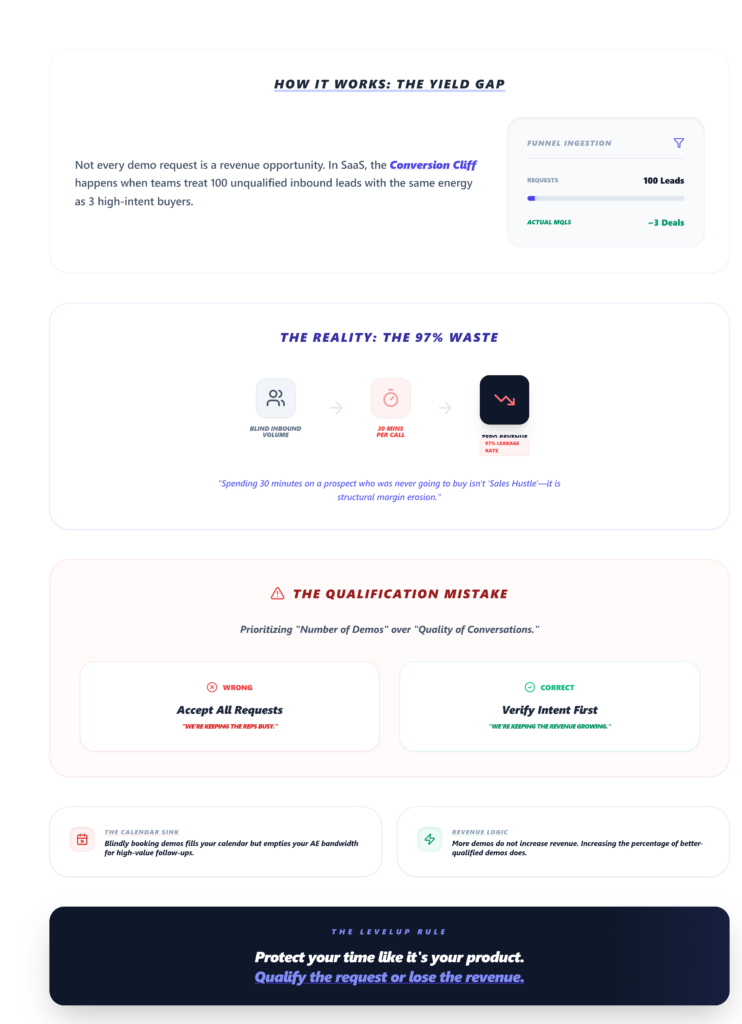
Not every demo request is an opportunity. Many SaaS teams treat all inbound leads equally, and that’s exactly where conversion drops off a cliff.
The average demo request-to-MQL conversion rate hovers around 2–5%. That means for every 100 demo requests, you’re looking at maybe 3 that actually move forward.
And yet teams are spending 30 minutes per call on prospects who were never going to buy.
More demos don’t increase revenue—better qualified demos do.
What Happens When You Don’t Qualify Demo Requests
I’ve watched this pattern play out dozens of times. No qualification process leads to:
- Wasted demo slots. Your top rep spends Tuesday afternoon walking a marketing intern through features they’ll never purchase.
- Low conversion rates. That 2–5% benchmark? It drops further when tire-kickers flood your calendar.
- Longer sales cycles. Unqualified leads don’t say “no” fast. They say “let me think about it” for six weeks.
- Poor pipeline quality. Your CRM shows 40 open opportunities but your forecast is fiction.
The real cost isn’t the demo itself. It’s the follow-up emails, the internal handoffs, the pipeline reviews where everyone squints at a lead that was never real.
Conversion problems almost always start before the demo even begins.
What to Look for When Qualifying Demo Requests
Before you build a system, you need to know what “qualified” actually means for your product.
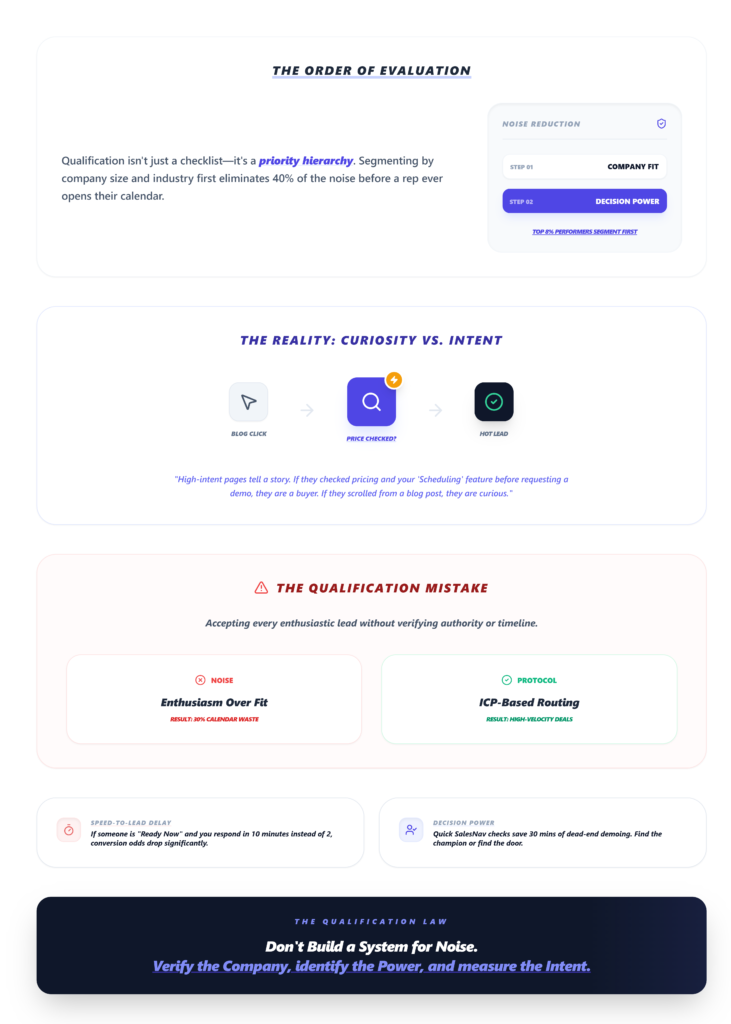
Here’s what I evaluate—and the order matters.
Company Fit
Size and industry are your first filters. A 5-person agency requesting a demo for an enterprise procurement tool isn’t a fit, no matter how enthusiastic they sound.
HubSpot data shows that the top 8–10% of performing SaaS sales teams segment by company size before the demo ever happens.
Don’t overthink this. Two questions: How many employees? What industry? That alone eliminates 30–40% of noise.
Role & Decision Power
Are you talking to someone who can sign a contract, or someone who’s “just exploring”?
Decision-maker verification—even a quick LinkedIn SalesNav check—saves you from the classic trap: a great demo with someone who has zero purchasing authority.
Committee decisions in B2B SaaS are real. But there’s a difference between a champion gathering info and a random employee killing time.
Use Case Clarity
This one’s underrated. When a prospect can articulate what they need your product to do, they’ve already done internal problem-definition work.
That’s buying behavior.
Vague requests like “just want to see what you do” are a red flag.
Not always disqualifying—but definitely a signal to probe deeper before blocking 30 minutes.
Urgency & Timing
“Immediate” versus “maybe next quarter” changes everything about how you prioritize.
A prospect with an immediate timeline and decision-maker authority gets routed to your best rep.
A “just researching” lead gets a different path entirely.
Speed-to-lead data backs this up hard: responses slower than 2 minutes drop acceptance rates significantly.
If someone’s ready now and you respond in 10 minutes, you’ve already lost momentum.
Buying Intent
High-intent pages tell a story. Did they visit pricing before requesting a demo?
Did they check your demo scheduling and management features? Or did they land on a blog post, scroll to the bottom, and click a button out of mild curiosity?
Intent signals are the difference between a hot lead and a warm body.
The SaaS Demo Qualification Framework
This is the system. Five steps. Each one builds on the last.
Step 1: Capture Structured Data
What to do: Replace your generic “Request a Demo” form with one that captures qualification data upfront. Company size, role, use case, timeline—dropdowns, not open text.
What you should see: A CRM dashboard (HubSpot, Salesforce, or lightweight alternatives) showing a “New Lead Scored: High Priority” badge for leads that match your ICP criteria.
The friction warning: Forms with more than 7 fields cause roughly 50% abandonment. Cap it at 5 fields max. Use progressive profiling if you need more data later—don’t front-load the form and wonder why leads don’t convert.
Verification: Every new demo request in your system has company size, role, and timeline filled in. If those fields are blank, your form isn’t doing its job.
Step 2: Enrich Lead Context
What to do: Before anyone touches this lead manually, enrich it. LinkedIn SalesNav for role verification. Company website for size/industry confirmation. Check which pages they visited before requesting the demo.
The pro shortcut: Zapier automation triggers a Slack alert the moment a lead scores above your threshold. Auto-enrichment pulls company data so your rep sees context before they even open the lead.
What you should see: A lead profile with checkmarks next to each BANT criterion—Budget: Confirmed ✓, Timeline: Immediate ✓.
Verification: You can glance at a lead and know within 10 seconds whether they’re worth a call.
Step 3: Score Qualification
What to do: Assign point values. Company fit: +30. Decision-maker role: +25. Immediate timeline: +20. Visited pricing page: +15. Vague use case: -10.
I spent way too long trying to build a “perfect” scoring model before realizing the first version just needs to separate obvious yeses from obvious nos. You refine later.
The friction warning: Small teams forget to actually use the scoring. A score sitting in a CRM field nobody checks is decoration, not qualification. Set up color-coded funnel stages—Red for unqualified, Yellow for maybe, Green for booked—and make them visible on a shared dashboard.
Verification: Every lead in your pipeline has a numerical score, and your team can explain why.
Step 4: Accept or Reject
What to do: This is where most teams flinch. You have to be willing to say no. Low-score leads don’t get a live demo. They get a self-guided demo link, a video walkthrough, or a nurture sequence.
One team I worked with implemented what they called an “application process”—mimicking job applications—to filter demo requests. Tire-kickers self-selected out. Qualified prospects actually appreciated the rigor.
Automation booked 67% more demos when teams stopped manually triaging every request during off-hours. Let the system reject for you.
Verification: You have a clear, documented threshold. Leads below it never hit a rep’s calendar.
Step 5: Route Correctly
What to do: Qualified leads get routed based on score and segment. Enterprise goes to your senior rep. SMB goes to a different workflow. “Maybe” leads—Yellow status—get a 48-hour follow-up sequence, not a calendar invite.
The friction warning: Unassigned leads sitting for 48+ hours is the silent killer in small teams. Round-robin assignment with auto-escalation if no one claims a lead within 2 hours.
What you should see: A “Demo Confirmed: 20–30min slot” calendar event with an attached lead score summary. Your rep walks into the call already knowing the prospect’s use case, timeline, and authority level.
Verification: Zero leads sitting in limbo. Every qualified request is assigned within 2 hours. Check your demo conversion checklist to make sure nothing’s falling through.
Qualified vs. Unqualified: A Real Example
- Lead A: VP of Sales at a 50-person B2B SaaS company.
Filled out the form with “replace our current demo scheduling tool” as the use case. Timeline: immediate. Visited the pricing page before submitting. Score: 90.
→ Routed to senior rep. Demo scheduled within 45 minutes. Closed in 11 days. - Lead B: “Marketing Coordinator” at a 3-person agency. Use case field: “just checking it out.” No timeline selected. Score: 15.
→ Auto-sent a product video and added to nurture. Never responded. Total rep time spent: zero.
That’s the difference. Same form, same product, completely different outcomes—because the system sorted them before a human had to.
Why Most SaaS Teams Get Demo Qualification Wrong
Four patterns I see constantly:
- Qualifying after scheduling. By the time you realize the lead isn’t a fit, you’ve already spent 30 minutes on a call and 20 minutes prepping. Qualification gates belong before the calendar invite.
- Relying only on forms. Forms capture intent. They don’t verify it. Enrichment—checking LinkedIn, reviewing page visits, confirming company data—is where real qualification happens.
- No scoring system. “I’ll know a good lead when I see one” is not a strategy. It’s a guess. And it doesn’t scale past one person.
- No follow-up prioritization. Even after a good demo, if your follow-up treats a high-score and a low-score lead the same way, you’re leaving money on the table. Segment your demo funnel by qualification tier.
(I’ll be honest—I made every one of these mistakes before building a system that actually worked. The scoring model alone cut our wasted demo time by nearly half.)
Why Qualification Is Where Conversion Actually Begins
If a lead is not qualified, the demo doesn’t matter.
You could deliver the most polished, compelling product walkthrough ever built, and it won’t close someone who doesn’t have budget, authority, or a real problem to solve.
The teams I’ve seen hit consistent demo-to-close rates aren’t running better demos. They’re running fewer, better-targeted ones.
One team went from a 2% demo-to-MQL rate to clearing their benchmark after implementing lead scoring—not by changing their pitch, but by changing who heard it.
Qualification is the first step to conversion. Everything downstream depends on it.
Why Demo Qualification Needs a System
Manual qualification breaks the moment your team grows past two people. Spreadsheets get stale. Slack threads get buried.
CRM fields go unfilled because updating them feels like homework.
Scattered tools make it worse—one app for forms, another for scheduling, a third for follow-ups, and nobody has a single view of where a lead actually stands.
This is where purpose-built demo management changes the game. A tool like LevelUp Demo consolidates lead capture, qualification scoring, scheduling, and outcome tracking into one workflow.
No migration from your existing CRM required—it layers on top of what you already use and gives your small team the visibility that usually requires a 10-person ops team to maintain.
If you’re running demos as a core part of your sales motion, request a demo of LevelUp and see what a structured qualification workflow actually looks like in practice.
FAQ
How do you qualify demo requests?
You qualify demo requests by collecting structured data at the point of request—company size, role, use case, timeline—then scoring each lead against your ICP criteria before scheduling. Leads that don’t meet your threshold get routed to self-serve content instead of a live call. The goal is to filter before you invest rep time.
What makes a lead qualified for a demo?
A qualified lead matches your ideal customer profile on company fit, has decision-making authority or direct influence, can articulate a specific use case, and has an active timeline. Buying intent signals—like visiting your pricing page—add confidence to the score.
Should all demo requests be accepted?
No. Accepting every request is the fastest way to burn out your sales team and tank your conversion rate. Low-score leads should receive alternative paths: recorded walkthroughs, self-guided demos, or nurture sequences. Reserve live demos for prospects who’ve cleared your qualification threshold.
What improves demo-to-close conversion rate?
Pre-demo qualification has the single biggest impact. Beyond that: speed-to-lead under 2 minutes, personalized demo prep based on the prospect’s stated use case, and structured follow-up sequences segmented by lead score. Teams that implement scoring see measurable lifts without changing anything about the demo itself.
How do you handle “just exploring” prospects?
Don’t ignore them—redirect them. A self-guided demo or a short product video keeps them in your orbit without consuming rep time. Tag them in your CRM with a “nurture” status and re-engage when they show higher-intent behavior, like returning to your pricing page or re-submitting a request with a clearer use case.
What to Do Next
Stop treating your demo calendar like an open door. Build the gate first. Score before you schedule. Route before you pitch.
The question isn’t whether you’re running enough demos. It’s whether the demos you’re running have any chance of closing.
Fix qualification, and the rest of your funnel gets easier. Skip it, and you’re just performing for an audience that was never going to buy.
Read More: Best Demo Scheduling Tools for SaaS Team