I still remember the first demo I gave that felt perfect. The prospect asked all the right questions, nodded at every feature I showed, and said they’d “definitely be in touch.” I hung up feeling like I’d nailed it.
Three weeks later, they went with a competitor.
That moment taught me something crucial: a great demo experience means nothing if it doesn’t convert. And after analyzing hundreds of demos over the past few years—both my own and those of the small SaaS teams I work with—I’ve learned that most conversion problems don’t happen during the demo. They happen in the messy spaces before and after it.
The good news? Most of these problems are fixable with some straightforward process changes. In this guide, I’ll walk you through the proven strategies that actually move the needle on demo conversion rates in 2025—no fluff, just what works.
What Exactly Are Demo Conversion Rates and Why Should You Care?
Demo conversion rate is the percentage of demos that result in your desired outcome—whether that’s a closed deal, a trial signup, or a qualified next meeting. It’s basically your “did this demo actually matter?” metric.
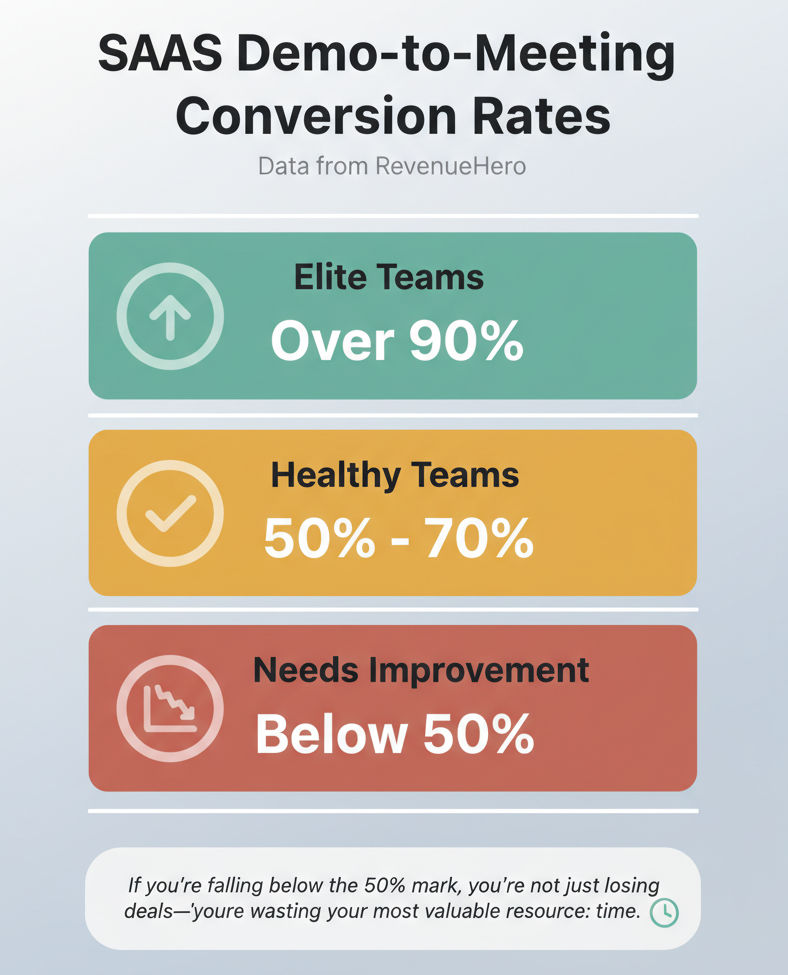
Here’s why this number is so important: according to recent data from RevenueHero, healthy SaaS teams see demo-to-meeting conversion rates between 50-70%, while elite teams hit over 90%. If you’re falling below that 50% mark, you’re not just losing deals—you’re wasting your most valuable resource: time.
Think about it. If you’re doing 20 demos a month and only converting 30% of them, that’s 14 hours of demo time (at 30 minutes each) that went nowhere. For a small team or solo founder juggling product development, marketing, and sales? That’s devastating.
The real kicker is that most teams don’t even track this number properly. They know how many demos they gave, and they know how many deals they closed, but they can’t connect the dots between specific demos and outcomes. That’s like trying to improve your golf swing without knowing where the ball landed.
How Does Demo Conversion Actually Work in Practice?
Let me break down what a high-converting demo funnel actually looks like, because it’s not what most people think.
The journey starts way before the demo itself. Someone fills out your demo request form—and this is your first conversion point. Are you asking the right questions to qualify them? Are you making it easy enough to book?
Then comes scheduling. This is where a ton of leads fall off. They requested a demo on Tuesday, but your calendar link is buried in an email they didn’t see, or the back-and-forth about times takes three days and they lose interest.
Next is the actual demo. But here’s what I’ve learned: the content of your demo matters less than whether you’re showing it to the right person at the right time. I’ve seen mediocre demos convert at 70% because they were laser-focused on qualified leads, and I’ve seen incredible demos convert at 20% because half the audience had no budget or authority.
Finally—and this is where most teams completely drop the ball—comes follow-up. The difference between a 40% conversion rate and a 70% conversion rate often comes down to whether you followed up within 24 hours with something personalized and valuable.
When you map this out, you realize demo conversion isn’t one number—it’s actually several mini-conversions stacked together:
- Demo request → qualified lead (should be 60-70%)
- Qualified lead → attended demo (should be 70-80%)
- Attended demo → next step/close (should be 50-70%)
If any one of these breaks down, your overall conversion rate tanks.
What Are the Main Benefits of Improving Your Demo Conversion Rates?
Okay, this might seem obvious, but stick with me because the benefits go deeper than “more revenue.”
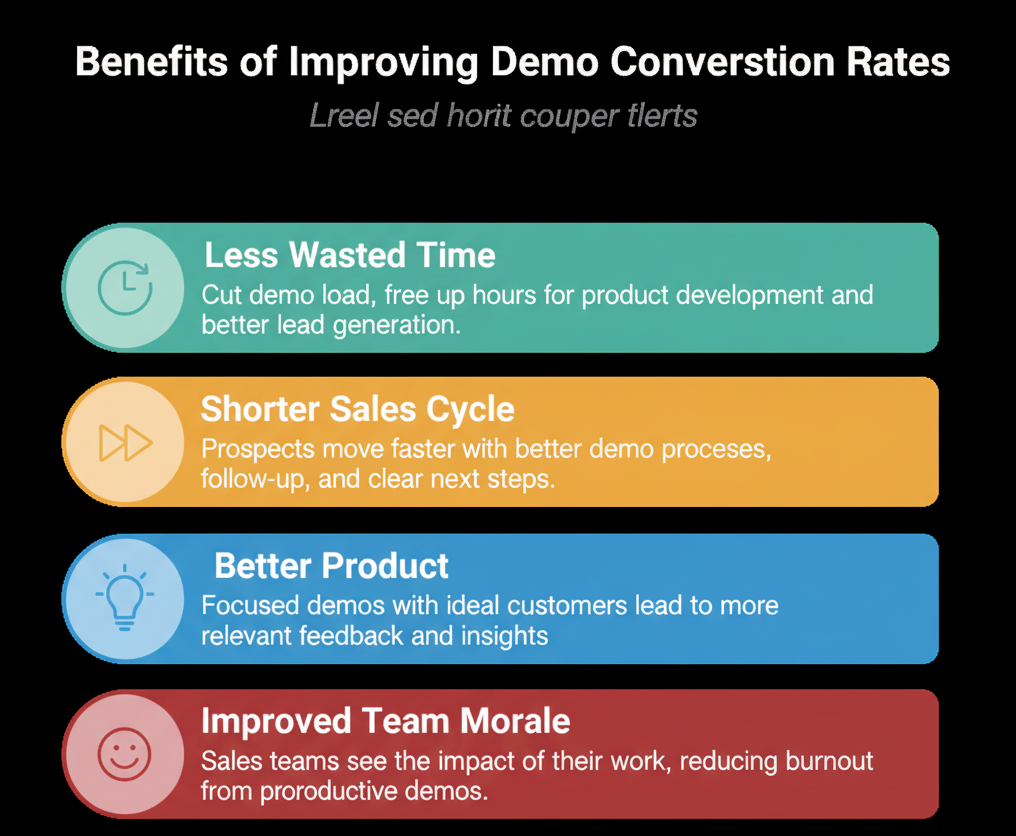
First, you waste less time. This is huge for small teams. When I improved my demo qualification process, I cut my monthly demo load from 25 to 15—and closed more deals. Those 10 extra hours went back into product development and marketing that actually generated better leads.
Second, your sales cycle shortens. When you nail the demo process, prospects move faster. I’ve seen teams cut their average sales cycle from 45 days to 30 just by implementing better follow-up sequences and clearer next steps during demos.
Third—and this surprised me—your product actually gets better. When you’re doing fewer, more focused demos with your ideal customers, you hear more relevant feedback. You’re not wasting time showing features to people who’ll never buy; you’re having deep conversations with people who will.
Fourth, team morale improves. Nothing burns out a small sales team faster than giving demo after demo that goes nowhere. When your conversion rate climbs, people can actually see the impact of their work. That matters more than you might think.
And honestly? There’s a compounding effect. As your conversion rate improves, you can be more selective about who you demo to, which improves your conversion rate further, which gives you better customer insights, which helps you attract better leads. It’s a virtuous cycle.
When Should You Focus on Improving Demo Conversions?
Not every stage of your SaaS journey calls for the same level of demo optimization. Here’s when it matters most:
You should prioritize this when:
- You’re doing more than 5-10 demos per month consistently
- Your demo-to-close rate is below 40%
- You’re losing track of follow-ups or letting leads slip through
- Your team is spending more time on demos than on product or marketing
- You’ve validated product-market fit and are ready to scale
You can probably wait if:
- You’re still in early product validation (under 10 total customers)
- Your product is going through major pivots
- You’re not getting enough inbound interest to justify the process work
I’ve seen too many pre-product-market-fit startups obsess over demo conversion optimization when their real problem is that nobody wants what they’re building. Get to 10-15 happy customers first, then optimize how you get more of them.
That said, even early-stage founders should track basic metrics. You don’t need fancy tools—a simple spreadsheet noting who you demoed to, when, and what happened is enough. Future you will thank you for this data when you’re ready to optimize.
Common Mistakes That Absolutely Kill Demo Conversions
Let me save you some pain by sharing the mistakes I see over and over:
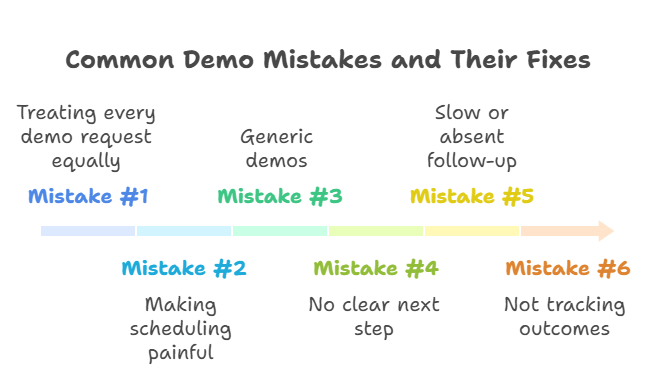
Mistake #1: Treating every demo request equally
I used to block off 30 minutes for anyone who filled out my demo form. Didn’t matter if they were a solo freelancer with no budget or a VP at a 500-person company. This is insane, but it’s what most small teams do.
The fix? Build qualification into your demo request form. Ask about company size, role, budget timeline, and what specific problem they’re trying to solve. Then actually use that information to prioritize. With tools like LevelUp Demo, you can automatically categorize leads as they come in, so you’re not wasting prime time slots on tire-kickers.
Mistake #2: Making scheduling painful
If someone has to email back and forth three times to find a meeting slot, you’ve probably lost them. Use calendar integrations—Calendly, Google Calendar booking, or a dedicated demo scheduling tool—to let people book instantly.
But here’s the nuance: don’t just throw open your entire calendar. Offer specific slots that work for you. I learned this the hard way after accepting a 6 AM demo request and showing up half-asleep.
Mistake #3: Generic demos
“Let me show you all our features” is the kiss of death. I’ve sat through dozens of these as a buyer, and my brain checks out after five minutes.
Instead, use the information from your demo request form to customize what you show. If they said their problem is “we’re losing deals because our follow-up is chaotic,” don’t spend 15 minutes on your analytics dashboard—show them exactly how your tool fixes follow-up chaos.
Mistake #4: No clear next step
The demo ends, everyone says thank you, and then… nothing. Who’s supposed to do what next?
End every demo by explicitly stating the next step and getting commitment: “I’ll send you a trial link and implementation guide by end of day. Can you try it out by Friday, and we’ll reconnect Monday to discuss?” Get a yes. Put it in your calendar. Send the follow-up immediately.
Mistake #5: Slow or absent follow-up
This is the biggest conversion killer, hands down. If you wait three days to follow up after a demo, your prospect has already talked to two competitors and moved on mentally.
I now have a rule: every demo gets a follow-up email within 2 hours. Not tomorrow. Not end of day. Within 2 hours, while it’s fresh in their mind. This alone boosted my conversion rate by about 15 percentage points.
Mistake #6: Not tracking outcomes
If you can’t tell me which demos from last month closed, which are still in progress, and which went cold (and why), you can’t improve. Period.
You need a system—even if it’s just a spreadsheet—to log every demo outcome. What did they buy? What were their objections? What competitor did they mention? This data becomes gold when you’re trying to figure out what’s working and what’s not.
How to Actually Improve Your Demo Conversion Rates: Step-by-Step
Alright, let’s get practical. Here’s the exact process I recommend based on what’s worked for me and the teams I advise:
Step 1: Audit Your Current Funnel
Before you change anything, you need to know where you’re losing people. Pull the data from your last 20-30 demos and answer these questions:
- How many demo requests did you get?
- How many of those were qualified (matched your ICP)?
- How many actually showed up for the scheduled demo?
- How many moved to a next step (trial, proposal, another meeting)?
- How many eventually closed?
Calculate the conversion rate at each stage. This tells you exactly where to focus. If 90% of people are showing up but only 30% are moving forward, your problem isn’t scheduling—it’s demo content or qualification.
Step 2: Fix Your Demo Request Form
Your demo form should do two jobs: capture contact info and qualify the lead.
Here’s what I ask:
- Name and email (obviously)
- Company name and size
- Role/title
- What specific problem are you trying to solve?
- What’s your timeline for making a decision?
That last question is crucial. “Just exploring options” gets a different priority than “need to implement something in the next 30 days.”
Keep it short enough that people will actually fill it out—5-6 fields max. But make those fields count.
Step 3: Automate Scheduling (But Keep It Human)
Use a scheduling tool that integrates with your calendar. I prefer tools that let me set specific availability windows rather than exposing my entire calendar.
Here’s the key: when someone books, send an immediate confirmation email that includes:
- Meeting time and Zoom/Meet link
- What they can expect from the demo
- Any prep they should do (like thinking about their current process)
- A calendar invite
Then send a reminder 24 hours before and 1 hour before. Yes, this seems like overkill. No, it’s not—it cuts no-shows in half.
Step 4: Qualify Before the Demo (Not During)
Once someone books, spend 5 minutes reviewing their demo request form. Are they actually a good fit? If not, consider whether you should:
- Offer a different resource (like a recorded demo or help docs)
- Reschedule for a lower-priority slot
- Politely decline and explain why it’s not a fit
I know it feels wrong to turn down a demo, but trust me—spending 30 minutes with someone who will never buy is 30 minutes you could have spent closing a real deal.
If they are qualified, use their form answers to prep a customized demo. I literally write down 3 things I want to show them based on their stated problem.
Step 5: Structure Your Demo for Conversion
Here’s my demo framework that consistently converts at 60-70%:
Minutes 0-5: Discovery Ask questions about their current process, pain points, and what success looks like. Yes, even though they filled out a form—let them elaborate. This builds rapport and gives you even more customization intel.
Minutes 5-20: Focused Solution Show exactly how your product solves their specific problem. Not every feature. Not the whole platform. Just the stuff that matters to them.
Use their language. If they said “our follow-ups are chaotic,” literally say “Here’s how we eliminate that chaos” as you show the relevant feature.
Minutes 20-25: Handle Objections Ask: “What concerns do you have about this approach?” or “What would stop you from moving forward with something like this?”
Address their concerns directly. If you can’t solve their problem, be honest about it—they’ll appreciate it and might refer you to someone else.
Minutes 25-30: Clear Next Step Don’t end with “any questions?” End with: “Here’s what I recommend we do next…” and get explicit agreement on the next action and timeline.
Step 6: Follow Up Fast and Personalized
Within 2 hours of the demo, send an email that includes:
- Thank you for their time
- Summary of what you discussed
- The specific next step you agreed on
- Any resources you promised
- Timeline/deadline for the next action
Then, if they don’t respond, follow up again after 2 days, then after 5 days, then after 10 days. Use a different angle each time:
- Follow-up 1: “Did you get a chance to try the trial?”
- Follow-up 2: “I found this case study that’s really similar to your situation…”
- Follow-up 3: “Just checking in—is the timing not right, or is there something else I can help clarify?”
Most teams give up after one follow-up. The second and third follow-ups are where a lot of deals actually close.
Step 7: Track Everything and Iterate
After every demo, log:
- Who attended
- What you showed them
- Their main objection or concern
- Next step agreed upon
- Outcome (won, lost, in progress)
Review this data monthly. Look for patterns:
- Are certain types of companies converting better?
- Are specific objections coming up repeatedly?
- Are demos on certain days/times converting better?
- How long is your average sales cycle from demo to close?
Use this to continuously refine your process. Maybe you realize Tuesday morning demos convert 20% better than Friday afternoon ones. Maybe you notice that companies with 10-50 employees close faster than enterprise leads. Adjust accordingly.
Tools That Actually Help (Without Overcomplicating Things)
Look, I’m not going to recommend a dozen tools because that’s not realistic for small teams. But here are the categories that matter:
Demo scheduling and management: This is where something like LevelUp Demo becomes really valuable. Instead of juggling Calendly + a spreadsheet + email + manual follow-ups, you get everything in one place: smart forms that auto-qualify leads, scheduling that syncs with your calendar, outcome tracking, and follow-up reminders.
The ROI is obvious: if you’re doing 15 demos a month and it saves you 15 minutes per demo on admin work, that’s almost 4 hours back. What could you do with 4 extra hours?
Calendar integration: Whether it’s Google Calendar, Outlook, or something else, make sure your scheduling tool syncs automatically. Manual calendar management is where leads slip through the cracks.
Video conferencing: Zoom or Google Meet—doesn’t really matter which, just pick one and stick with it. The key is reliability and screen sharing quality.
CRM or tracking system: If you’re already using a CRM, great—make sure demo outcomes are logged there. If not, even a well-organized spreadsheet works at the beginning. What matters is that you’re actually recording outcomes, not which tool you use.
The mistake I see small teams make is buying a huge CRM before they need it, then spending weeks setting it up instead of selling. Start simple. You can always migrate from spreadsheets to CRM later when you’ve proven the process works.
Advanced Strategies for Teams Already Converting at 50%+
If you’ve implemented the basics and you’re converting at a decent rate, here are some advanced tactics that can push you higher:
Create demo tracks based on persona
Not every prospect needs the same demo. Build 2-3 demo “tracks” for different personas (like founder vs. sales manager vs. operations) and assign people to the right track based on their form answers.
Use async video for initial qualification
For lower-priority leads, send a Loom video walking through the key features and ask them to reply if they want to dive deeper. This filters out tire-kickers and warms up serious prospects before you invest synchronous time.
Implement demo scoring
After each demo, rate the likelihood of close (A/B/C). Focus your follow-up energy on A’s, automate most of the B follow-up, and send C’s to a nurture sequence. Not every lead deserves equal attention.
Build a demo feedback loop with your product team
Share common objections and feature requests from demos with your product team. When you can say “We just shipped that feature you asked about in last week’s demo,” conversion rates skyrocket.
Test everything
Run simple A/B tests on your demo request form (different questions, different order), your follow-up emails (different subject lines, different content), and even your demo structure. Small improvements compound over time.
What to Do When Demos Just Aren’t Converting
Sometimes you’ve optimized everything and conversions still suck. Here’s what to check:
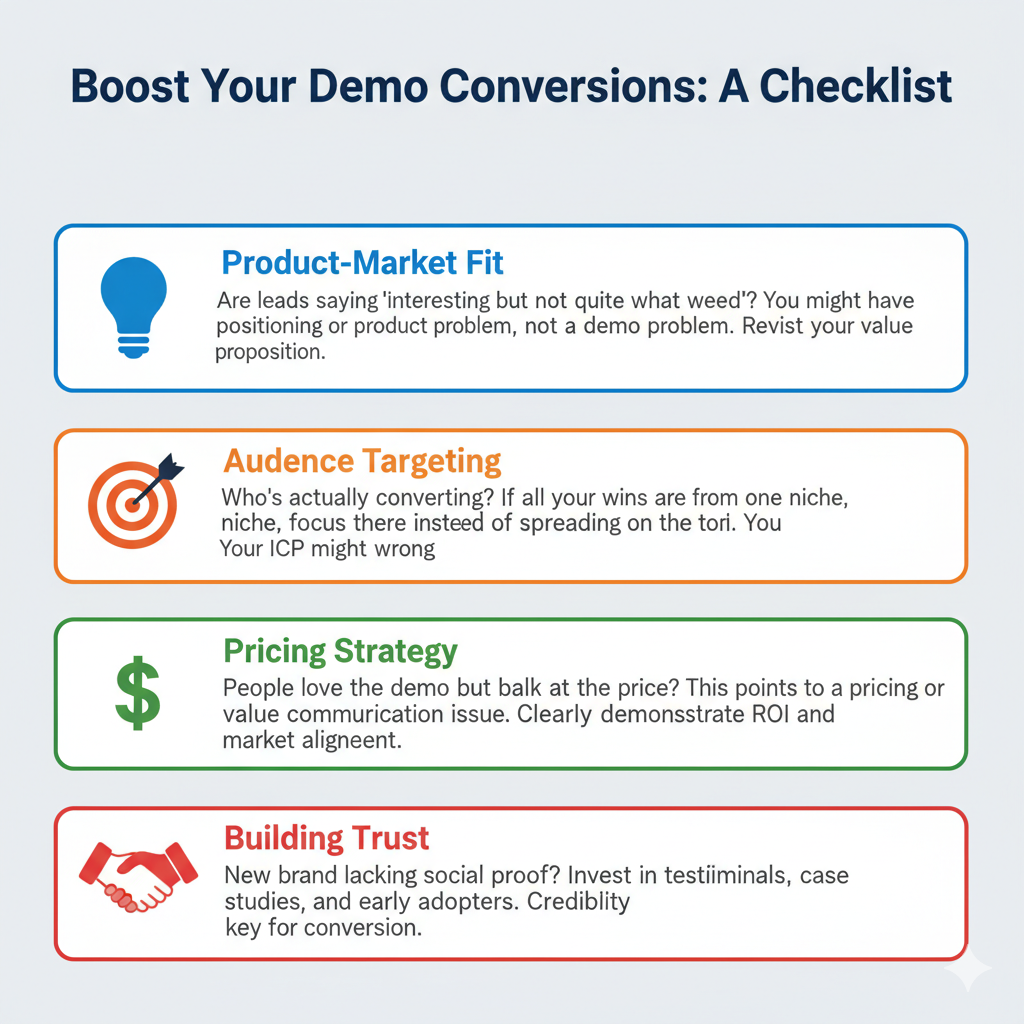
Is it actually a product-market fit problem?
If qualified leads are consistently saying “interesting but not quite what we need,” you might have a positioning problem or a product problem, not a demo problem. Go back and talk to your best customers about why they bought.
Are you targeting the wrong audience?
Maybe your ICP assumptions are wrong. Look at who’s actually converting versus who you’re targeting. If all your wins are coming from one industry or company size, lean into that instead of fighting it.
Is your pricing off?
If people love the demo but balk at the price, that’s not a demo problem—it’s a pricing or value communication problem. Are you clearly showing ROI? Are you priced appropriately for your market?
Do you have a trust problem?
New brand, no social proof, no case studies? That makes demos harder to convert. Invest in getting some testimonials and case studies, even if it means giving away your product to a few ideal customers in exchange for detailed feedback.
Real Talk: This Takes Time to Get Right
I want to set realistic expectations here. You’re not going to implement all of this overnight and see your conversion rate jump from 30% to 70% by next week.
When I first started tracking and improving my demo process, it took about three months to see meaningful improvement. The first month was just getting the tracking in place. The second month was implementing changes and seeing mixed results. The third month was when things started to click.
But here’s what kept me going: every small improvement compounded. Fixing my demo request form saved me 2 hours a week on unqualified demos. Improving my follow-up process recovered 2-3 deals per month that would have gone cold. Better outcome tracking helped me understand what was actually working.
By month six, I’d increased my demo-to-close rate from about 35% to 62%, while actually reducing the number of demos I was doing. That’s the power of process improvement.
Frequently Asked Questions
What’s a realistic demo conversion rate for a new SaaS product?
For early-stage SaaS, 30-40% demo-to-close is common. As you refine your ICP and process, aim for 50-60%. Elite teams with strong product-market fit and excellent qualification hit 70%+ or even 90% in focused segments.
How long should a SaaS demo actually be?
20-30 minutes is the sweet spot. Shorter feels rushed, longer loses attention. If you need more time, break it into two calls—one for discovery/demo, one for deep-dive or technical questions.
Should I let people book demos instantly or qualify them first?
Depends on your volume. Under 10 requests per week? Let them book instantly. Over that? Add qualification questions to your form and manually approve bookings for low-fit leads, or route them to different resources.
How many follow-ups is too many after a demo?
I do 4-5 follow-ups over 2-3 weeks if they’re not responding, with different value-adds each time. If there’s still no response after that, they go into a longer-term nurture sequence. Don’t give up after one email.
What if prospects keep rescheduling or no-showing?
Send reminders 24 hours and 1 hour before. Ask them to confirm attendance. If someone reschedules more than twice, they’re probably not serious—deprioritize them or offer an async option instead.
How do I handle demos when I’m not technical enough to answer deep questions?
Be honest: “That’s a great technical question—let me bring in our product lead to answer that properly.” Then loop in someone technical for a follow-up call. Prospects respect honesty over BS.
Should I record demos?
Yes, if the prospect agrees. Recordings are useful for internal training, for prospects to share with teammates, and for your own review to improve your demo skills. Just ask permission first.
How do I improve demo conversions when I’m competing with bigger companies?
Lean into your advantages: faster implementation, more personalized support, and direct access to founders. Show them exactly what they’d get with you versus being a small fish in a big company’s pond.
What’s the best day/time to schedule demos?
Tuesday-Thursday, 10 AM-3 PM in the prospect’s timezone tends to convert best. Avoid Monday mornings (people are overwhelmed) and Friday afternoons (people are checked out). But test this with your own data.
How can I tell if a low conversion rate is a demo problem or a product problem?
If qualified prospects say “I love it but…” and cite price, timing, or specific missing features, that’s product/positioning. If they say “interesting but I’m not sure it solves my problem,” that’s probably a demo problem—you’re not connecting features to their pain clearly enough.
Wrapping Up: Small Changes, Big Impact
Here’s what I want you to remember: improving demo conversion rates isn’t about being a better presenter or having a flashier slide deck. It’s about building a systematic process that puts the right prospects in front of you at the right time, shows them exactly what they need to see, and follows up relentlessly until they convert or clearly opt out.
Start with the basics:
- Track your current conversion rate at each funnel stage
- Fix your demo request form to qualify better
- Automate scheduling to reduce friction
- Customize each demo to the prospect’s specific needs
- Follow up within 2 hours, then keep following up
- Log every outcome and review monthly
If you’re a solo founder or small team juggling multiple roles, I know this sounds like a lot. But here’s the thing: you’re probably already doing demos. This is just about doing them in a way that actually generates revenue instead of burning time.
The teams I work with who implement this stuff see results within 2-3 months. Not because they’re suddenly better salespeople, but because they’ve eliminated the leaks in their funnel and built a repeatable process.
And look, if you want help with the operational side—the forms, the scheduling, the follow-up tracking, all that admin work that takes time away from actually selling—that’s exactly why we built LevelUp Demo. It’s designed specifically for small SaaS teams who need to improve demo conversions without adding headcount.
You can try it free or book a demo (meta, I know) to see how it works. No pressure either way—the strategies in this guide work regardless of what tools you use.
The most important thing? Start tracking today. Even if it’s just a simple spreadsheet. You can’t improve what you don’t measure, and three months from now, you’ll wish you’d started today.
Now go turn those demos into revenue.