The demo request came in at 2:47 PM on a Tuesday. Company size: 150 employees. Industry: B2B SaaS.
Budget: “Evaluating options.” My sales team was excited—until the demo happened.
Thirty minutes in, it became clear: they weren’t actually evaluating anything. No timeline. No budget holder on the call.
Just a junior marketer “doing research.”
We’d wasted a demo slot on someone who wasn’t ready to buy.
That’s when I realized the problem wasn’t our demo process—it was everything that happened before the demo.
We were optimizing for more leads when we should’ve been filtering for qualified ones. The best SaaS lead generation strategies don’t focus on volume; they focus on intent.
That shift changed our close rate from 12% to 31% in four months.
Here’s what you’ll learn: how to build best SaaS lead generation strategies that prioritize quality over quantity, reduce wasted demos, and create predictable pipeline movement—without needing a massive marketing budget.
What Actually Makes a SaaS Lead “Qualified”?
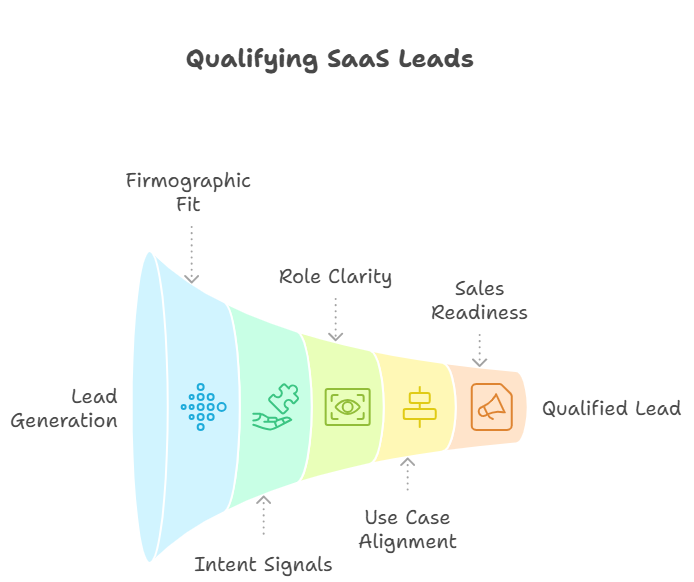
Before we talk strategies, let’s kill the fuzzy definition of “qualified lead.”
A qualified SaaS lead isn’t just someone who downloaded your whitepaper or filled out a contact form.
A truly qualified lead matches at least three of these criteria:
- Firmographic fit: They match your ICP—right company size, industry, and growth stage
- Intent signals: They’re actively evaluating solutions, not casually browsing
- Role clarity: They’re a decision-maker or have direct influence on the buying committee
- Use case alignment: They have a specific problem your product solves
- Sales readiness: They’re willing to take a demo or enter a conversation
When you generate leads using this filter, your demos stop feeling like tire-kicking sessions.
Your sales pipeline becomes cleaner because you’re not clogging it with “maybes.”
The data backs this up: HubSpot reports that qualified leads convert at rates 3x higher than general inquiries.
But most SaaS teams still optimize for volume because it feels productive to see MQL numbers go up.
It’s not.
Why Lead Quality Determines Demo Performance
Here’s the part most lead gen content skips: your lead generation decisions directly affect demo conversion rates.
Bad lead gen creates:
- High no-show rates (30%+ is common when leads aren’t truly interested)
- Low-quality demos where prospects can’t articulate their problem
- Longer sales cycles because you’re educating instead of closing
- Wasted sales capacity on leads that were never going to convert
Good lead gen creates:
- Shorter qualification calls because intent is already established
- Higher demo-to-close rates (our team saw 2.6x improvement)
- Predictable revenue because pipeline quality is consistent
The mistake? Treating lead generation as a top-of-funnel marketing problem when it’s actually a revenue operations issue.
Every lead you capture either helps or hurts your sales team’s efficiency.
🔥 2026 Benchmark Insight
Did you know? The average MQL-to-SQL conversion rate for B2B SaaS is hovering around 13% in 2025/26. If you’re converting below 10%, your qualification filters are too loose. If you’re above 20%, you have a high-efficiency engine.
The Pre-Flight Check: Are You Ready for Qualified Lead Gen?
Before you implement any of these strategies, run this quick audit.
Stop/Go Test: Can you describe your ICP in one sentence that includes company size, industry, and primary pain point?
If you can’t, pause. Organize your existing lead data first so you actually know what “qualified” looks like for your product.
You’ll need:
- A CRM or lead tracking system (HubSpot, Salesforce, or even Airtable)
- Clear ICP documentation (not just “B2B SaaS”—be specific)
- Demo scheduling infrastructure that doesn’t create friction
- A way to track lead source → demo → outcome
Timeline reality check: SEO and content strategies take 6-9 months to compound. Outbound and ABM can generate SQLs in weeks but require clean data.
Pick your strategy based on your actual timeline and resources, not what sounds exciting.
Strategy 1: Intent-Driven Content That Filters as It Attracts
Most SaaS content attracts traffic but doesn’t qualify it. You rank for “project management software” and get 10,000 visits from freelancers when your product is built for enterprise teams.
The qualification mechanism: Create content that only appeals to your ICP by addressing their specific, high-intent problems.
Instead of “10 Benefits of Project Management Software,” write “How to Manage Cross-Functional Product Launches with 8+ Stakeholders.”
The second title repels solo users and attracts exactly who you want.
Why this generates qualified leads: Only people facing that exact problem will engage deeply. When they convert, they’re pre-qualified by topic relevance.
How it affects pipeline: Content-sourced leads that engage with bottom-funnel topics (pricing comparisons, implementation guides, ROI calculators) convert to SQLs at rates 62% higher than generic traffic.
They show up to demos already half-sold.
Common mistake: Writing for search volume instead of search intent. A keyword with 500 monthly searches from your ICP beats 5,000 searches from the wrong audience.
Verification check: Review your last 10 content-sourced demo requests. If more than 3 came from companies outside your ICP, your content is too broad.
Strategy 2: Lead Magnets That Require Qualification to Use
Generic lead magnets (ebooks, checklists) attract email addresses, not buyers. The shift? Build lead magnets that only make sense if you’re a qualified prospect.
The qualification mechanism: Create ROI calculators, workflow templates, or maturity assessments that require users to input company-specific data.
Example: Instead of “SaaS Pricing Guide,” offer “SaaS Pricing Calculator for B2B Products with >$50K ACV.”
To use it, they have to enter their customer count, churn rate, and sales cycle length.
You’re not just capturing an email—you’re capturing zero-party data that tells you if they’re qualified.
Why this works: According to practitioner data, ROI calculators double SQL conversion rates because they filter intent at the gate.
Someone who spends 8 minutes calculating their potential savings is signaling buying readiness.
How it affects demos: When you follow up, you already know their numbers. The demo becomes a “here’s how we get you to that ROI” conversation, not a generic walkthrough.
Common mistake: Asking for too much information upfront. More than 5 form fields cuts conversions in half. Capture intent-qualifying data, not everything.
Don’t Lose the Lead After Qualification
Generating qualified leads is only half the job. Converting them depends on what happens after the demo. Most teams lose deals not because leads weren’t qualified, but because follow-ups fall through the cracks.
Strategy 3: Demo Request Forms That Qualify Before Booking
Your demo request form is either a qualification tool or a pipeline pollutant.
The qualification mechanism: Add 2-3 high-intent fields that filter prospects before they reach your calendar.
Fields like “What’s your evaluation timeline?” or “Who else is involved in this decision?” immediately separate tire-kickers from buyers.
Why this generates qualified leads: You’re making prospects self-select out if they’re not ready.
A lead who answers “No defined timeline” probably shouldn’t be taking up a demo slot yet.
How it affects pipeline: Teams that use intent-based demo forms see 40% fewer no-shows and 2x better demo-to-close rates.
You’re not just booking demos—you’re booking qualified demos.
Common mistake: Killing conversion with friction. There’s a balance between qualification and conversion rate. Test ruthlessly.
Verification check: If your demo request form has a >60% completion rate, it might not be filtering enough. If it’s <20%, you’re adding too much friction.
Strategy 4: Outbound with Tight ICP Targeting and Intent Data
Cold outbound gets a bad reputation because most teams do it wrong—they spray generic emails to outdated lists.
The qualification mechanism: Build a TAL (Target Account List) using firmographic data, then layer on behavioral intent signals (job changes, funding rounds, competitor mentions, tech stack changes).
Why this generates qualified leads: You’re only reaching out to accounts that match your ICP and are showing buying signals.
Response rates jump from <1% to 15-30% when you combine tight targeting with personalized context.
How it affects demos: Outbound leads that come from intent-triggered campaigns show up to demos with urgency. They’re already in-market.
Common mistake: Using stale contact data. If >20% of your emails bounce, your data is dirty. Use intent tools to refresh your TAL before launching campaigns.
The ugly truth: Outbound fails most often because of poor follow-up, not poor targeting. If you don’t have a system to track outreach → response → demo → outcome, you’ll lose deals in the handoff. Qualifying leads properly means knowing where they are in your pipeline at all times.
Strategy 5: PLG Freemium Models That Self-Qualify Users
Product-led growth isn’t just a go-to-market motion—it’s a qualification engine.
The qualification mechanism: Let users try your product with a freemium tier or trial. Track activation behaviors (features used, frequency, team invites) to identify high-intent users ready for sales conversations.
Why this generates qualified leads: Users who activate key features or hit usage limits are signaling product-market fit. They’ve already validated that your solution works for them.
How it affects pipeline: PLG-sourced leads convert 3x faster because they’re not evaluating hypotheticals—they’re upgrading from a working solution. Sales cycles shrink from months to weeks.
Common mistake: 70% of freemium users churn before reaching an upsell conversation. The fix? Embed activation toolkits and behavior-triggered drips to guide users to value quickly.
Verification check: If <50% of trial users complete core activation steps, your onboarding is leaking qualified intent.
Strategy 6: Strategic Partnerships and Referral Ecosystems
Partner-led leads are the highest-converting source most SaaS teams underutilize.
The qualification mechanism: Build co-marketing relationships with complementary tools or agencies that serve your ICP. Their referrals come pre-qualified because they already trust the source.
Why this generates qualified leads: Referred leads convert at rates 4x higher than cold outbound. They enter conversations with established context and lower skepticism.
How it affects demos: Partner referrals rarely no-show. They’ve already been briefed on why your solution fits their problem.
Common mistake: Treating partnerships as one-off campaigns instead of ongoing ecosystems. Co-create webinars, integration guides, or shared case studies to keep the referral pipeline active.
Verification check: If partners aren’t sending at least 3-5 qualified referrals per quarter, the relationship isn’t aligned.
Strategy 7: Retargeting Based on High-Intent Behavior
Not all retargeting is created equal. Retargeting site visitors who bounced after 10 seconds is noise. Retargeting visitors who spent 5+ minutes on your pricing page is signal.
The qualification mechanism: Set up behavioral triggers that only retarget users who engaged with high-intent pages (pricing, case studies, demo pages, integration docs).
Why this generates qualified leads: You’re re-engaging people who already showed buying intent. They’re not strangers—they’re warm prospects who got distracted.
How it affects pipeline: Retargeted high-intent visitors convert to demos at 3-5x the rate of cold traffic. They’re already familiar with your value prop.
Common mistake: Retargeting too broadly and wasting ad spend on low-intent visitors. Segment ruthlessly.
⚡ The “Speed to Lead” Advantage
Companies that respond to qualified leads within 5 minutes are 9x more likely to convert them. However, 55% of companies take 5+ days to respond. Automating your initial “book a demo” sequence isn’t just convenient—it’s a competitive weapon.
The “Ugly Truth” About SaaS Lead Gen
Here’s what the glossy marketing guides won’t tell you:
| Problem | The Weird Fix | Why It Happens |
|---|---|---|
| Leads ghost after demo | Centralized demo outcome tracking | No accountability for follow-ups |
| Cold emails land in spam | Rotate sender domains, use zero-party data | Generic templates trigger filters |
| Freemium users churn pre-upsell | Product-embedded activation guides | Poor onboarding kills intent |
| MQLs never become SQLs | Behavioral scoring over demographics | Relying on outdated qualification models |
| SEO traffic doesn’t book demos | Personalized CTAs with social proof | Generic landing pages repel intent |
The pattern? Most lead gen failures happen after the lead is captured.
You can drive perfect traffic, but if your demo workflow is messy or follow-ups fall through, qualified leads turn into lost pipeline.
Turn Qualified Leads Into Predictable Revenue
Driving qualified leads works only when your demo and follow-up workflow keeps them moving forward.
The strategies above will get the right people into your pipeline.
But if your team is still losing good leads after demos—because follow-ups aren’t tracked, outcomes aren’t logged, or coordination is happening in Slack threads—you’re leaving revenue on the table.
Even when SaaS teams generate qualified leads, deals fall apart if demos and follow-ups aren’t tracked properly.
That’s where demo workflow tools like LevelUp Demo help teams turn qualified interest into real pipeline movement.
Turn Qualified Leads Into Predictable Revenue
Driving qualified leads works only when your demo and follow-up workflow keeps them moving forward. If your team is still losing good leads after demos, it’s time to track outcomes, follow-ups, and next steps in one place.
FAQ: Implementing SaaS Lead Generation Strategies
How do I fix MQLs that never convert to SQLs?
Use behavioral scoring to prioritize engagement signals (feature page visits, pricing checks, repeat visits) over demographic data. Then trigger demo outreach within 24 hours of high-intent actions to capture urgency.
Why do my cold emails land in spam folders?
Generic templates and outdated contact lists trigger spam filters. Rotate sender domains, personalize with zero-party data, and use intent signals to reach prospects when they’re actually in-market.
How do I reduce demo no-shows above 20%?
Integrate calendar scheduling directly into your demo request flow and send behavior-triggered reminders 24 hours before. High no-show rates usually signal low intent at capture.
Why isn’t my SEO traffic booking demos?
You’re likely ranking for informational keywords, not commercial intent. Map content to bottom-funnel searches (pricing, comparisons, implementation) and use personalized CTAs with social proof.
How do I fix freemium churn before upsell conversations?
Embed activation toolkits that guide users to core value within the first session. Use behavior-triggered drips to nurture based on usage patterns, not time-based sequences.
Why do partnerships underperform on lead quality?
Misaligned audiences. Co-create webinars or integration content that serves a shared ICP. One-off referral agreements rarely create consistent pipeline.
How do I build a TAL without intent data tools?
Start with competitor conquesting—target searches for competitor pricing pages, complaints, and “vs” comparisons. Layer in LinkedIn Sales Navigator filters for firmographics.
Why are my lead magnets low-conversion?
You’re asking for too much information upfront. Limit forms to 3-5 fields and tie the magnet directly to a high-intent outcome (ROI calculators beat generic ebooks).
How do I fix team coordination on demo follow-ups?
Centralize demo tracking in a CRM with Slack or email alerts. Without accountability and visibility, follow-ups die in inboxes.
Why is my outbound ROI negative?
You’re not attributing to Net New ARR—just MQL volume. Track lead source → demo → close, and ruthlessly cut non-converting segments.
The bottom line?
Qualified SaaS lead generation isn’t about driving more traffic. It’s about filtering intent early and consistently—so the right people reach your demos, and those demos actually turn into pipeline and revenue.
The strategies in this guide help you attract leads who are ready to buy, not just browse. But lead quality alone isn’t enough. If demos aren’t tracked, follow-ups aren’t clear, and next steps live in spreadsheets or Slack threads, even qualified leads will go cold.
That’s where most SaaS teams still lose deals.
When qualified leads move through a structured demo workflow—where outcomes are logged, follow-ups are visible, and nothing slips through—you stop guessing which leads matter. You start closing more of them.
Stop Burning Your Best Leads
You’ve done the hard work to generate qualified traffic. Don’t let your “High Intent” leads fall into a black hole after the demo because of messy spreadsheets and forgotten follow-ups.
✅ Track Demo Outcomes
✅ Automate Next Steps
✅ Close More Deals
See why SaaS teams switch from spreadsheets to LevelUp.